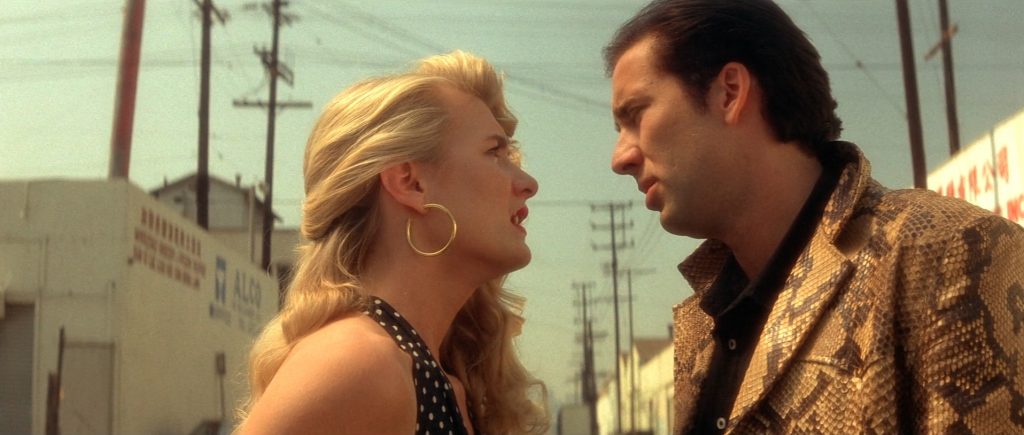
Wild at Heart
1990, directed by David Lynch
One way to get a handle on a difficult film is to wrestle with its eccentric parts until they fit into a consistent whole. Wild at Heart is so loaded, though, with strange people and happenings that this approach can be challenging. David Lynch, in any case, famously discouraged audiences from seeking meaning too consciously in his films: “It’s better not to know so much about what things mean. Because the meaning, it’s a very personal thing, and the meaning for me is different than the meaning for somebody else.” We can respect the director’s wish for meaning to arise intuitively, while also noting that filmmakers who disparage analysis (Lynch, Bresson, Herzog, Tarkovsky, to some extent Kubrick) are the same ones who attract a mystical cult around their work. If our object is to look at films with wonder instead of reverence, then we needn’t fear any investigation that demystifies a film.
The easiest way to find a common thread in Wild at Heart is to approach it as a Lynch movie, with all the benefit of hindsight that his later films provide. That shortcut, however, would feel unsatisfactory if the film didn’t stand on its own. If unravelling its strangenesses is too daunting, then the surest path into Wild at Heart, ironically, may be through its regularities – i.e. by probing its symmetries.
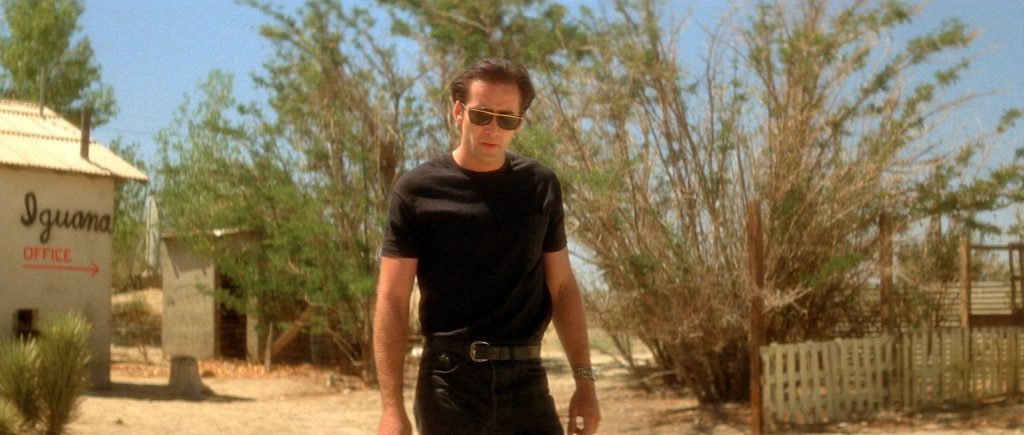
Sailor’s and Lula’s adventure is bracketed, roughly speaking, by two prison terms. At the beginning Sailor does two years for manslaughter after going too far in defending himself from Bob Ray Lemon’s knife attack. Toward the end he does nearly six years for an armed robbery with Bobby Peru. The names Bob and Bobby might look like a trivial coincidence until we notice that the name also figures strongly in the central incident when Sailor and Lula happen on a car accident off a Texas highway. The last survivor is a disoriented young woman searching for a bobby pin and screaming for her companion named Robert. This woman dies precisely in the center of the film, a fact which no casual viewer can be expected to notice, though it’s prefaced by Lula’s offhand remark, “Well, we’re really out in the middle of it now, ain’t we?” as if to call attention to the film nearing its midpoint.
There may be some special significance in the name Robert, but it’s sufficient if we take it as a structural marker helping to stitch the film’s ends and middle together. Such symmetries are usually artifacts of the scripting process, and Lynch would have been right to insist that it’s not meant to reach the viewer’s consciousness. More important than the neatness of any pattern is the contrast that the symmetry offsets. In the first incident Sailor is almost impossibly heroic, vanquishing Bob Ray Lemon decisively with his bare hands, but when the robbery with Bobby Peru goes awry, the messiness of the chain of events is more lifelike.
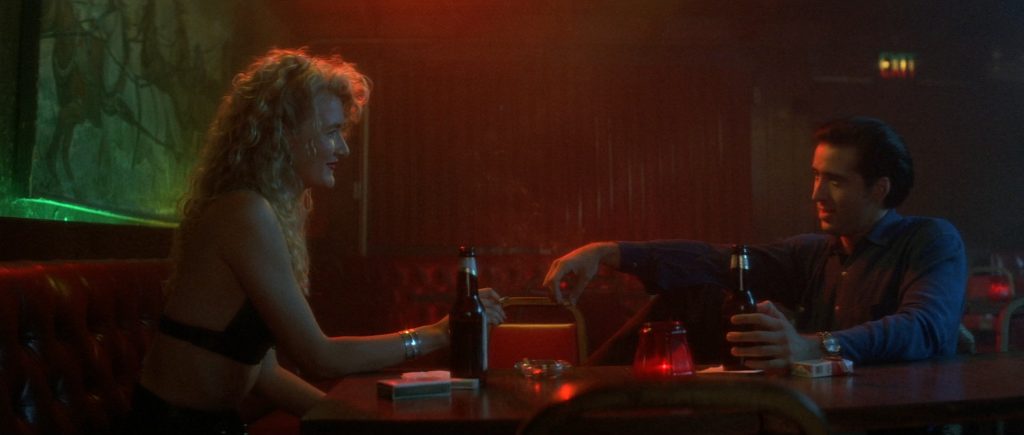
Each prison term is shortly followed by a violent incident that fits the same pattern. In one case Sailor righteously humiliates a boorish young man in a nightclub, gallantly defending Lula from an unwanted advance on the dance floor. In the other, Sailor is beaten up by a street gang. Looking at Wild at Heart from the perspective of Lynch’s whole career, we might say that Sailor’s first crime and the fight in the nightclub represent an idealized “Hollywood” vision of life, whereas the concluding incidents bring Sailor down to earth without the Hollywood heroics.
Hollywood doesn’t appear as directly in Wild at Heart as in many of Lynch’s other films, but the couple is on their way to Los Angeles until things go wrong in Texas. Sailor and Lula never reach their idealized destination, but on close inspection Hollywood sits behind everything, the conscious or unconscious model for a society that constantly reaches for one elusive ideal after another – money, glamor, excitement, heroics, power, attention, eternal youth, easy living.
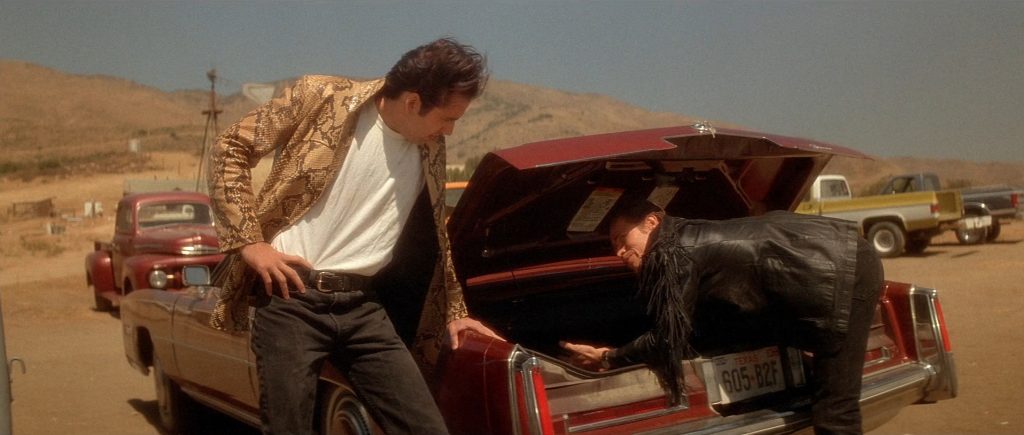
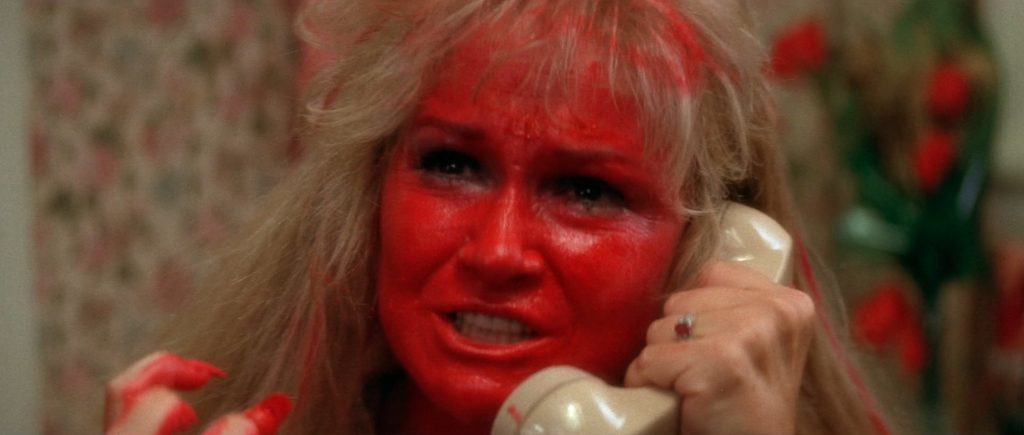
When Bobby Peru opens his trunk to show Sailor the shotgun and pistol they’ll be using the next day, the surface of the red car momentarily reflects palm trees that are nowhere to be seen in the bleak Texas landscape – a seemingly accidental artifact of a second-unit shot filmed in California, but the effect is to link the guns to the place that has taught us to see them, and to see the landscapes of the West for that matter, as heroic. When Marietta smears lipstick all over her wrists and face, we can recognize Hollywood’s demand for glamor going haywire, while simultaneously alluding to horror films or to the witch’s green face in The Wizard of Oz. When Lula flips through the car radio only to catch sensationalistic news reports, she alludes to a movie: “Holy shit! It’s Night of the Living fucking Dead!” Even the background characters in Big Tuna imitate Hollywood in their own way: “Them are making a pornographic movie… Texas style.”
By this token, all the references to Christmas are scarcely different. Like Hollywood, the modern celebration of Christmas exalts life beyond the scale of ordinariness. Lula’s cousin “Jingle Dell” wants it to be Christmas every day of the year. Dell may be mentally ill, but his symptoms, including his thoughts of aliens, are a metaphor for a society so desperate to make everything special that nothing is ever satisfactorily special. We can imagine how tedious life must be for a gangster like “Mr. Reindeer” (another Christmas reference) who entertains himself with naked dancing girls even while he sits on the toilet. The titillation he seeks so obsessively cannot possibly be sustained, and his madam scolds the girls for failing to make Mr. Reindeer happy.
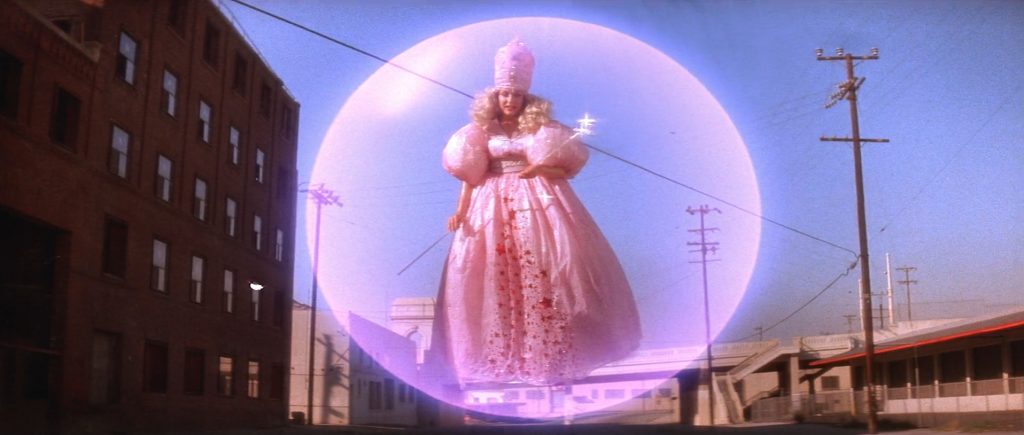
Sailor and Lula seem to be the only characters with much capacity for happiness, but like the travelers on the Yellow Brick Road in Oz, their happiness is thwarted by various obstacles. Lula dreams of a life “over the rainbow”, and in that sense she’s little different from everyone around her, but the couple’s journey represents an active striving, and both of them are open to the lessons that their experience brings. It’s appropriate that Wild at Heart‘s cinematic model, while being a quintessential Hollywood movie, is also a model of Hollywood reflecting on its own flaws and limitations. In the American mindset, Los Angeles has long been a kind of Emerald City, and Lynch’s films consistently expose the cultural and personal effects of that city’s mystique.
One of the great ironies of Wild at Heart is that, although Los Angeles is never reached, the scenes around Sailor’s and Lula’s hometown are in fact filmed in Los Angeles, including the hotel at Cape Fear and the industrial area where the film ends. This irony corresponds to The Wizard of Oz, where Oz itself is a transformation of Dorothy’s home that she finally comes to appreciate. It’s also fitting that the bleak warehouse district in the final scene shows the mundane reality of Los Angeles, in contrast to the ideal vision ingrained in the modern psyche. It’s as arid and unappealing as the sepia-tinted Kansas farm in The Wizard of Oz, but it’s where Sailor and Lula find their happiness at last, not by reaching for some impossible ideal but by appreciating the togetherness of their family.
Wild at Heart recasts The Wizard of Oz for a modern age fifty-one years after the MGM musical. The sexuality that’s expressed so openly here was always implicit in The Wizard of Oz, where Toto substituted for a child born out of wedlock, and where Dorothy’s arc followed the stages of growing up. Just as Lynch’s film brings a sexual subtext into the light, it also clarifies the original film’s subversive commentary on Hollywood. Though Hollywood itself remains implicit, its corrupting effects are shown in all their variety and in all their extremity.
The crystal ball, and the curved mirror in the Texas bar where Sailor sees his face pulled out of shape, remind us that everything tends to get distorted in a society led astray by Hollywood’s deceptions. Wild at Heart is not shy about identifying that society – it’s a portrait of the United States, a journey across the nation’s underbelly. As much as any of the villains, Sailor himself stands for the American mindset, telling Lula twice that his snakeskin jacket is “a symbol of my individuality and my belief in personal freedom.” His symbolism suggests the snake in the Gadsden flag, and the importance he ascribes to “freedom” is echoed in the word “Liberty” inscribed across Mr. Reindeer’s ominous silver dollars. Individualism and liberty have been American values since long before Hollywood existed, but Hollywood has always catered to those ideals while reducing them to heroic abstractions… in Westerns, for example, or in crime films or action movies.
In its dark portrait of America, Wild at Heart describes a country uniquely affected by the influence of Hollywood. As Sailor tells Lula, “All I know for sure is, there’s more than a few bad ideas runnin’ loose out there.” Sailor had once worked for Marcello Santos, a gangster and a Hollywood archetype, but his love for Lula is genuine, and he’s determined to set his life on the right path. Through the examples of Sailor and Lula, the film charts a path through, around, and beyond the “bad ideas” that generations of their fellow Americans have inherited.
CONNECTIONS:
The Wizard of Oz – Crystal ball, wicked witch, red shoes, Glinda, rainbow, Munchkin voice(s), Yellow Brick Road, Emerald City, Toto, Wizard
Vertigo – Boyish older detective named Johnnie Ferguson or Farragut who drives around following his target and who’s smitten with a woman whose name starts with “Ma”