North by Northwest
1959, directed by Alfred Hitchcock
Pretty much everyone gets the innuendo at the end of North by Northwest when the train goes into a tunnel, but that is not the same thing as getting the full joke. The image is a blatant reference to sexual penetration, but the context of the joke goes beyond what Roger Thornhill and Eve Kendall are doing in their sleeper compartment inside.
More than just a naughty afterthought, the train in the tunnel closes an arc that’s been developed from the beginning. To put the plot in a nutshell, Roger Thornhill gets mistaken for the wrong man, and his life is put in imminent danger three times. The first time, on Long Island, he calls his mother. The second time, after the cornfield, he runs to Eve. The third time, at the auction, he relies on his own wits and courage. Finally, at Mount Rushmore, he takes the initiative to save Eve’s life. The real story in North by Northwest is how Thornhill grows up, and the sly hint of sexual intercourse is simply a shorthand for the completion of that arc. At last he has become a man.
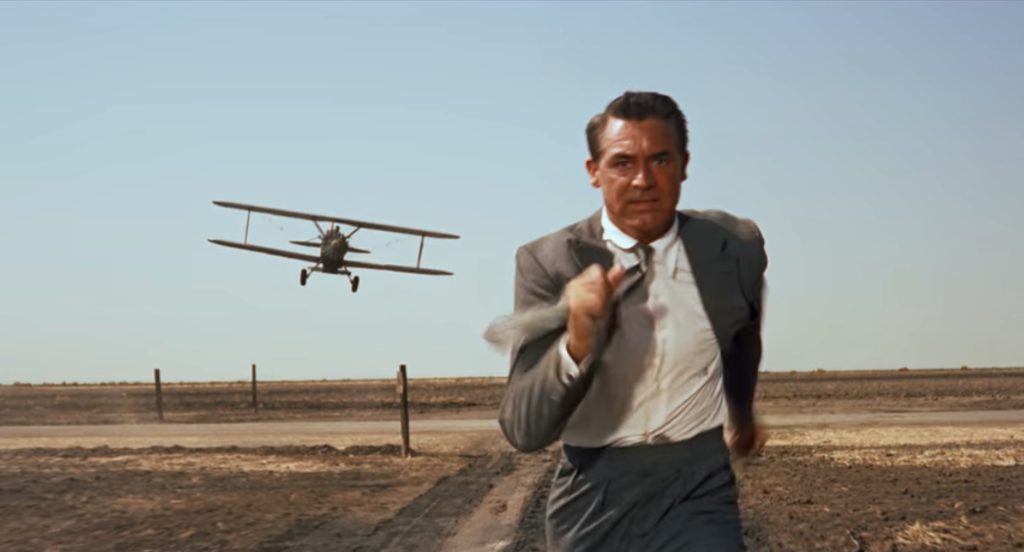
All of this characterizes Thornhill well enough, but it’s a bit oversimplified. Roger’s mother and his lover don’t save his life; he only runs to them after his luck saves him. None of this tells us why a man’s development was so important to Hitchcock, a devoted Freudian who made a career of critiquing the impulses and influence of stunted juvenile men. Despite Roger Thornhill’s flippant manner, it might not occur to most viewers to describe him as juvenile, because Cary Grant brings a kind of dignity to his character’s whimsy. Thornhill is introduced rattling off instructions to his secretary with the confidence of a seasoned executive, but that’s not enough to make him fully adult. Society has taught us to confuse authoritativeness with maturity. When Thornhill bumps a stranger out of a cab door, or when he says, “In the world of advertising there is no such thing as a lie,” he shows flashes of the undeveloped sociability one expects of a small child.
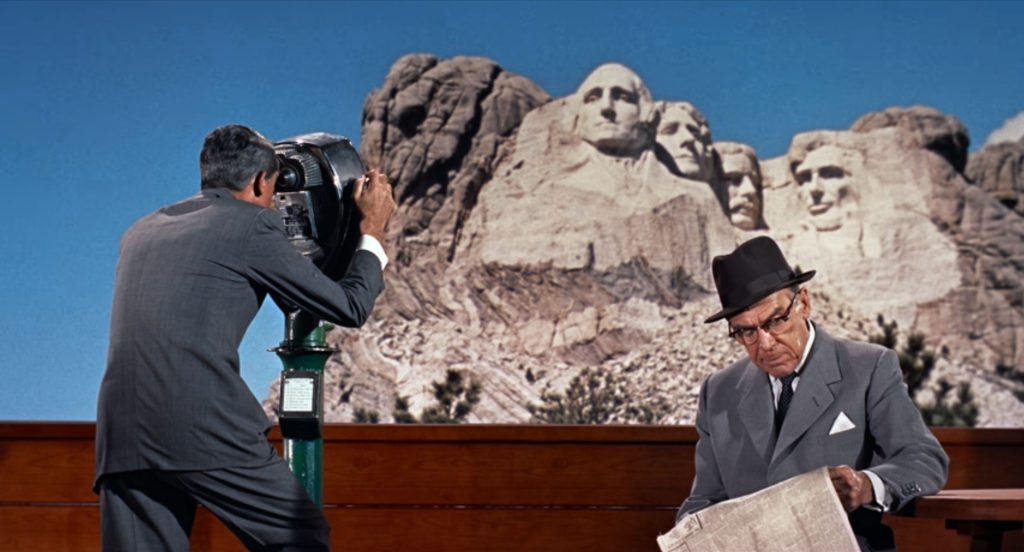
Thornhill’s entire misadventure rests on a single ill-timed word that gets him mistaken for a decoy agent. It’s not insignificant that the word is “Boy”, addressed to a bellhop who’s just called for the non-existent George Kaplan. At that moment we also meet two smug men who introduce themselves as “errand boys”. The insinuation, borne out beyond this scene and into many other Hitchcock films, is that American society is full of grown “boys” thrust into adult roles and making a mess of things. The word “boy” reflects back on Thornhill most of all. As soon as he’s led into the car, he puts particular emphasis on the first syllable of “kidnapped”, and when he gets to the mansion he asks, “By the way, what are we having for dessert?” He may be a middle-aged man, but by this point it shouldn’t be surprising when he calls his mother for help.
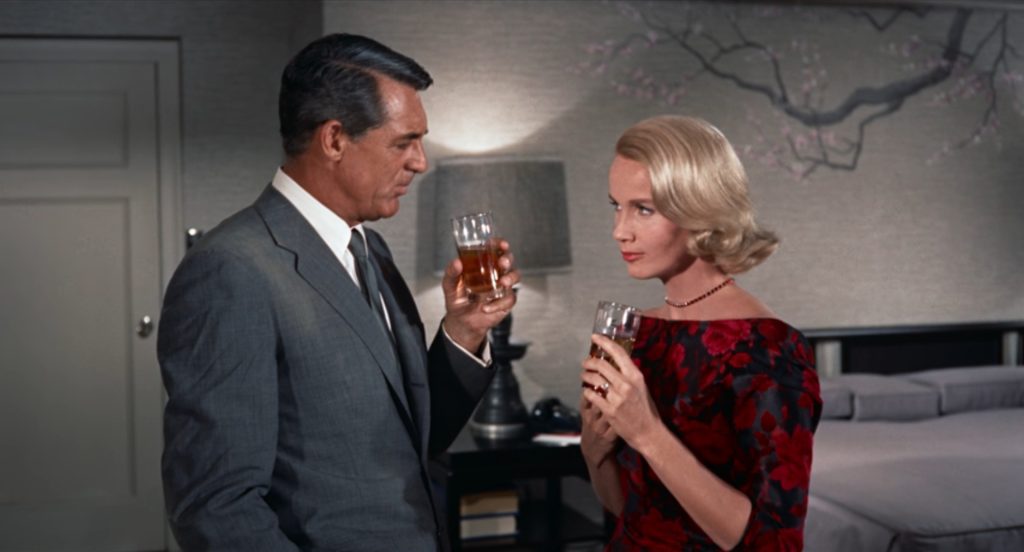
In Hitchcock’s films the foil to the juvenile man is usually a woman. On the train to Chicago, when Roger discourages Eve from getting involved in his pursuits, she tells him, “I’m a big girl,” and he responds, “In all the right places, too.” Later, when they start to get intimate in the hotel, he tells her, “When I was a little boy, I never even let my mother undress me,” and she answers, “You’re a big boy now.” Their reciprocal statements are clearly not equivalent. She’s evidently grown up, whereas he talks about sex like a child does. “You’re a big boy now” is a direct echo of Midge’s line to Scottie early in Vertigo when he gazes wide-eyed at a brassiere as if he hadn’t seen one before. Given the line’s importance in characterizing Scottie Ferguson, it would be hard to believe it doesn’t have a similar importance here.
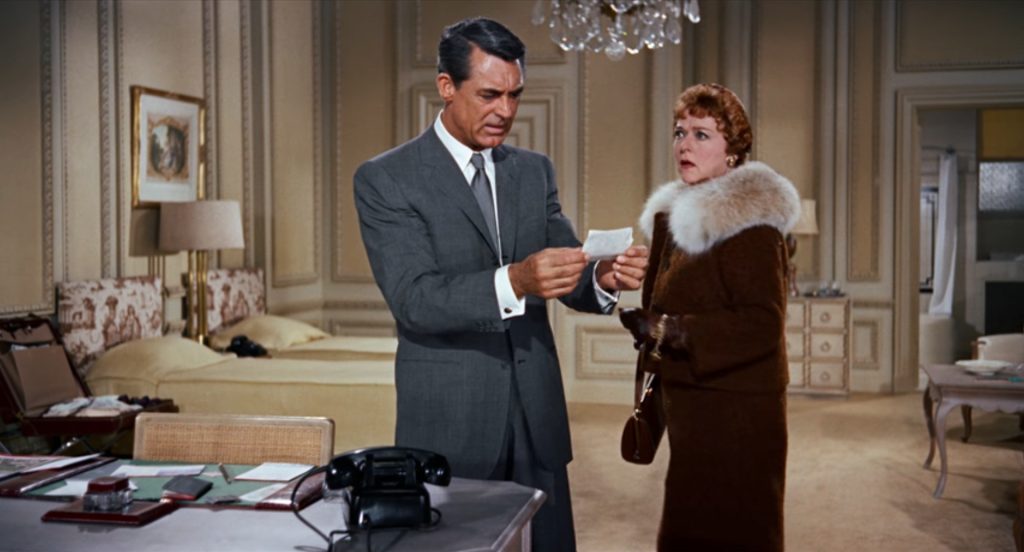
Unlike Scottie, however, Roger Thornhill will grow up over the course of the plot. In the early stage he’s so close to his mother that he’ll pull her into a bedroom for a whole scene, and she’ll remark how big he is for the clothes he tries on. His childlike amazement at a razor, and his subsequent use of it at the station in Chicago, are symbolic milestones in his growth. Eve’s line “You’re a big boy now” is a turning point, as if he takes the words to heart. He’ll then accept Eve’s rejection and go to the auction where he’ll demonstrate his newfound self-sufficiency. For the second time, the word “boy” has an almost magical effect… this time for the better.
As consequential as the word “boy” may be, the key line in North by Northwest comes when Roger lights Eve’s cigarette in the dining car. His matchbook is printed with his initials ROT, and when she asks what the “O” stands for, he shrugs and says, “Nothing.” On its surface his answer is a simple joke, a feigned confusion between a zero and a capital “O”. On an anecdotal level, the joke must also be a dig at Hitchcock’s former nemesis David O. Selznick, the demanding producer who brought him to Hollywood. On a still deeper level, the letter “O” has an outsized significance for Hitchcock, standing for the two poles that his films are built around: “Ordinary” and “Oedipus”.
Coming from a working class family and shunned by the British establishment, Hitchcock was always more interested in ordinary characters than in powerful or elite figures, and in Stage Fright he names the exemplary male “Ordinary Smith”. Sophisticated villains like Charles Tobin in Saboteur, Gavin Elster in Vertigo, or Phillip Vandamm in North by Northwest tend to vanish from the plot once they’ve served their purpose, with scant attention given to their punishment. The director idealized ordinariness, but he also entrusted ordinary people with the world’s outcomes for better or worse. When things go wrong it’s always because of someone ordinary who aspires to be extraordinary, like Mrs. Danvers in Rebecca, the servant who allied herself to the aristocracy.
Those same characters who reach beyond ordinary life are corrupted, not only by pride, but by arrested sexual development, the men often bound too tightly to their mothers like Alexander Sebastian in Notorious, Bruno Antony in Strangers on a Train, or Norman Bates in Psycho. Roger Thornhill fits into a long line of such characters, an oedipal male who evidently fancies himself his mother’s little prince. His filial relationship is hardly a matter of love… the last time we see his mother he ditches her beside the two murderous men chasing him.
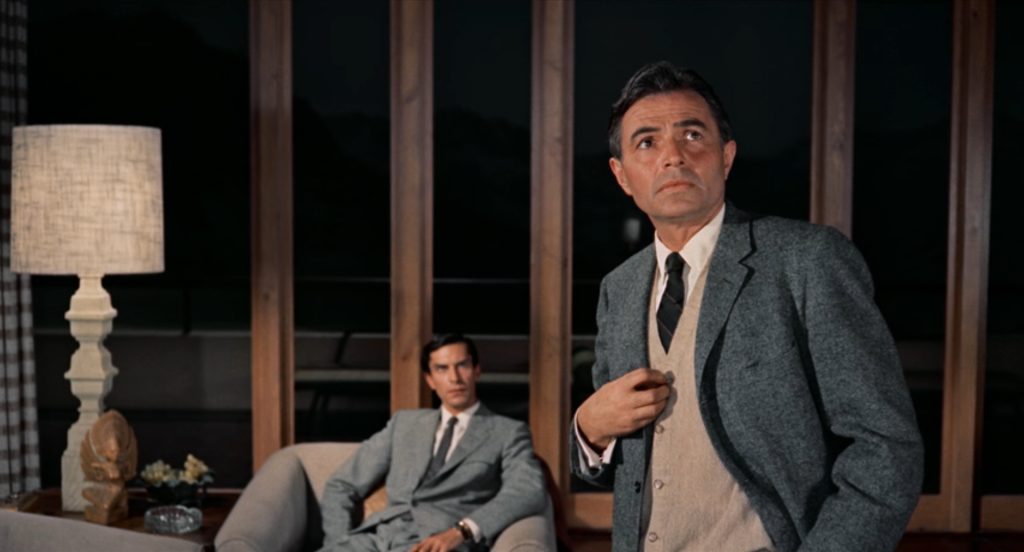
Just as important as the initial “O” is the word “Nothing” that Thornhill equates it with. “Nothing” occurs eighteen times in the dialogue, and like the letter “O” it points in two directions. On one hand Thornhill starts out respected and successful, important in his own world, a “something” who’s gradually brought down to earth until he’s an ordinary “nothing” by the end. By the same token, and in Hitchcock’s preferred view, he starts out a pompous juvenile “nothing” who becomes “something” as he matures. It’s fitting, then, that at the outset he’s easily confused with a real “nothing”, a man who doesn’t even exist. Likewise, when Thornhill says “Think thin” in the cab, or when he misinterprets Eve’s warning not to order dessert, the weight loss jokes correspond to the notion that by becoming less, he’ll also become more – that is, a better person.
Toward the end, Roger tells Eve why he’s been divorced twice: “I think they said I led too dull a life.” Although we’ve had plenty of reason to suspect that he was at fault, this revelation – like so much else – cuts two ways. In one sense, because he was self-absorbed in such a childish way, his wives were right… he was dull. It’s ironic that now that he’s had an undeniably exciting life, he’s ready to live on a more ordinary level, to make of his life a service to others.
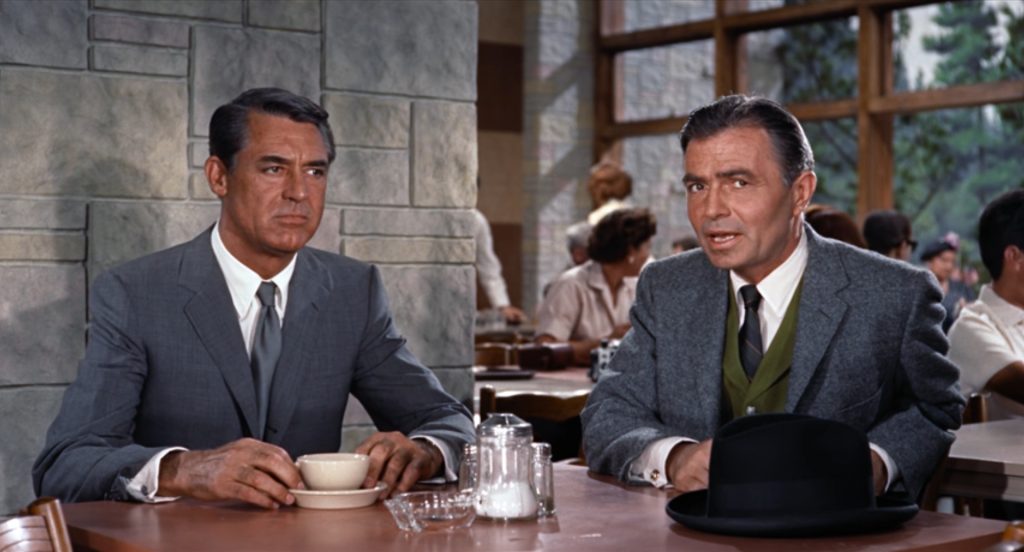
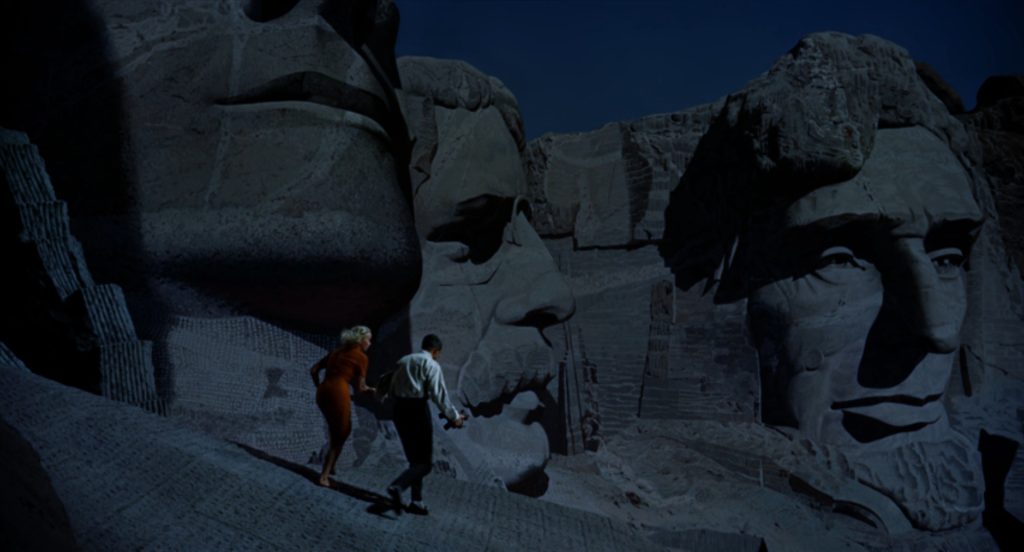
At Vandamm’s hideout in the Black Hills, the film reveals its MacGuffin, an exotic statuette bought at the auction containing microfilmed government secrets. The figure has childlike proportions, and when Eve grabs it and carries it across the faces of Mount Rushmore with Roger, it becomes like an adopted child, a token of the new couple’s maturity, and a foil to the supremely adult (at least by reputation) visages of the revered presidents behind them. When it’s finally smashed on the rocks, the couple does not need to pretend anymore. The last vestiges of Roger’s infancy are gone… he saves Eve, and the film cuts to their train compartment.
North by Northwest is packed with references to Hitchcock’s earlier films: the disrupted assembly in The 39 Steps, the comical impasse in the corridor in Secret Agent, the tall trees in Vertigo, the senator in Strangers on a Train, and the Dracula connections in Shadow of a Doubt. Vandamm is introduced sounding like Bela Lugosi with his “Good evening,” then he draws the curtains like a vampire afraid of sunlight. The connection that stands out though is Saboteur, to such an extent that North by Northwest can be called a loose remake. Against a backdrop of serious international conflict, a common American man is sucked by accident into a transcontinental chase, culminating with climbing, dangling, and falling on the monumental sculpted face(s) of a national landmark, the Statue of Liberty or Mount Rushmore. Both films, somewhat unusual for Hitchcock, were based on his own original story idea.
The chief difference from Saboteur is the direction of the journey, which would be a trivial point if the west-to-east direction weren’t so politically charged in the earlier film. As a newcomer to the United States back then, Hitchcock saw the nation as the defender of the common man against sinister forces in the east that would impose a rigid hierarchy. In 1942, California represented the promise of American ideals, and Saboteur was filled with images of Americana, with society becoming more divided the closer one came to Europe. In the intervening years, however, Hitchcock’s films portray a psychological corruption in American society, particularly in his string of oedipal villains or anti-heroes, and the reversal of Saboteur‘s direction in North by Northwest suggests a souring in his attitude toward his adopted country.
CONNECTIONS:
The 39 Steps – Protagonist escapes from danger by attracting the attention of a large assembly; plot about smuggling government secrets out of a country
Suspicion – Cary Grant plays an excessively boyish man in a story about maturity; film begins or ends in a railroad tunnel; car veers to the edge of a coastal precipice
Saboteur – Journey across the United States in a direction that points to the symbolic seat of corruption; villain’s stooge falls during a climactic struggle on a famous sculpted landmark
Shadow of a Doubt – Letter “O” or its repeated sound points obliquely to the ideal of ordinariness at one end and oedipal corruption at the other; various clues linking villain to Dracula
Strangers on a Train – Arc of maturity in three or four stages; Leo G. Carroll plays a benevolent government figure framed in one shot beside a national symbol
Rear Window – Development of an oedipal male into a mature man; unflattering allusion to David Selznick
Vertigo – Heightened significance in the line “You’re a big boy now”; male and female protagonists draw closer to each other in a forest
Seconds – A New York executive is given a new identity, travels west, and has a love affair; scene in Grand Central Terminal
Frenzy – Joke at the very end sums up a character’s level of maturity
Eyes Wide Shut – Two visits to a dangerous Long Island mansion, first during a party and again to investigate
Enemy – Critique of masculinity that hinges on a scene with a bellhop
LIST OF APPEARANCES OF “NOTHING” IN THE DIALOGUE:
0:06:00 – “The car is waiting outside. You will walk between us saying nothing.”
0:11:26 – “Naturally, I don’t expect to get this for nothing.”
0:13:41 – “Nothing, thank you. I’ll just take a quick ride back to town.”
0:38:06 – “Listen to me. I had nothing to do with this.”
0:39:46 – “We uh… we do nothing.”
0:39:50 – “Nothing?”
0:39:51 – “That’s right. Nothing.”
0:43:19 – “What time is the next train?” “Nothing till ten.”
0:48:26 – “Think how lucky I am to have been seated here.” “Well luck had nothing to do with it.”
0:50:18 – “Roger O. Thornhill. What does the ‘O’ stand for?” “Nothing.”
0:50:49 – “A roomette?” “Nothing, not even a ticket.”
1:17:01 – “What’s that?” “Nothing, nothing.”
1:37:02 – “Well, you can stick this in your alphabet soup: I had nothing to do with that United Nations killing.”
1:43:55 – “The price?” “For doing nothing to stop you.”
1:48:18 – “I guess I had nothing to do that weekend, so I… I decided to fall in love.”
1:58:04 – “There’s nothing to worry about.”
2:00:21 – “The truth? I’ve heard nothing but innuendos.”
ACKNOWLEDGMENT
The analysis of the letter “O” here is inspired by the essay Shadow of a Doubt: “Oh’s” for Oedipus by Gershon Reiter, which analyzes the frequent use of “Oh” in Hitchcock’s 1943 film with admirable thoroughness.