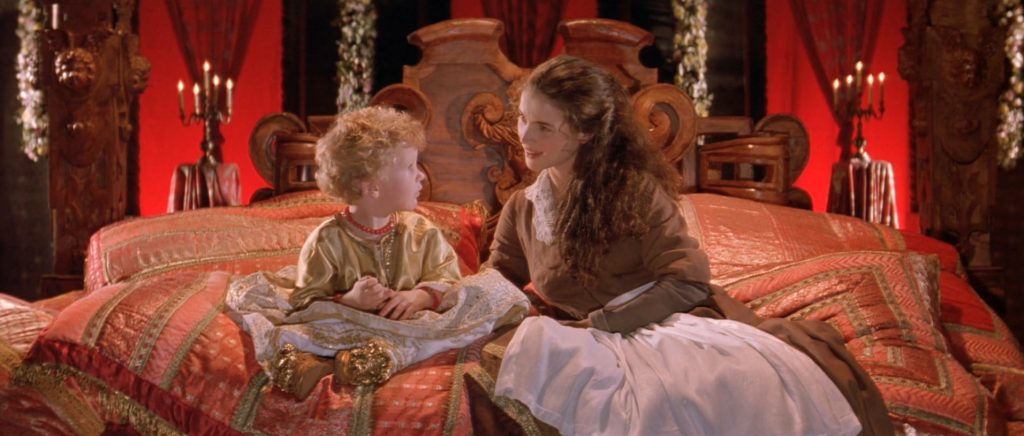
The Baby of Mâcon
1993, directed by Peter Greenaway
The Baby of Mâcon is a story of reversal, told in the form of a palindrome. The birth of a healthy baby boy ends the infertility of crops, animals, and women in Mâcon, but good fortune is soon undone, and the city reverts to famine. This reversal, however, concerns more than just the fate of a Burgundian city in the 17th century, and its warning is relevant to a surprising degree today.
Peter Greenaway’s films often look back to the 17th century to comment on the modern world, which owes so much of its character to that age’s brutal religious wars and colonialism. The Baby of Mâcon brackets the first two thirds of that century. The action is set in a vast theater, presumably in Florence, where Cosimo III de’ Medici and his court interact with the characters of a morality play set around the year 1600 in Mâcon. Cosimo is still referred to as a prince, so the performance must shortly predate his ascension to the Grand Duke’s throne in 1670.
By mixing performers and patrons onstage, the film playfully blurs seven decades of history, and musical anachronisms further blur time to encompass much of the baroque era. The point is not to create confusion, but to ground the film’s insights in the broad historical transition that defines the period. The most provocative anachronism is the title fanfare by Jean-Joseph Mouret, composed in 1729 six years after Cosimo III’s death. The Fanfare-Rondeau is famous as the main theme of the Masterpiece Theatre television series, but viewers expecting a similar sort of refined taste or high culture would likely be shocked at the blasphemy, obscenity, and violence ahead of them.
To the prejudiced eyes of our own age, Greenaway’s unflinching portrait might suggest a century with one foot in a savage historical past and one foot in a highly civilized future. The drama contrasts poverty against wealth, vulgarity against high art, superstition against reason, and cruelty against virtue. The historical moment is summarized in the strange fact that the bishop’s son (Ralph Fiennes) personifies science, but on reflection it’s not so strange that reason should descend from dogmatic religion, just as the Enlightenment grew out of Catholic society. Like the Church since Thomas Aquinas, the Enlightenment sought rational proofs as a condition for belief. Religion had its supernatural miracles, while science sought technological miracles. Both the bishop and his son are skeptical of the declared virgin birth, seeking material evidence of the professed mother’s virginity.
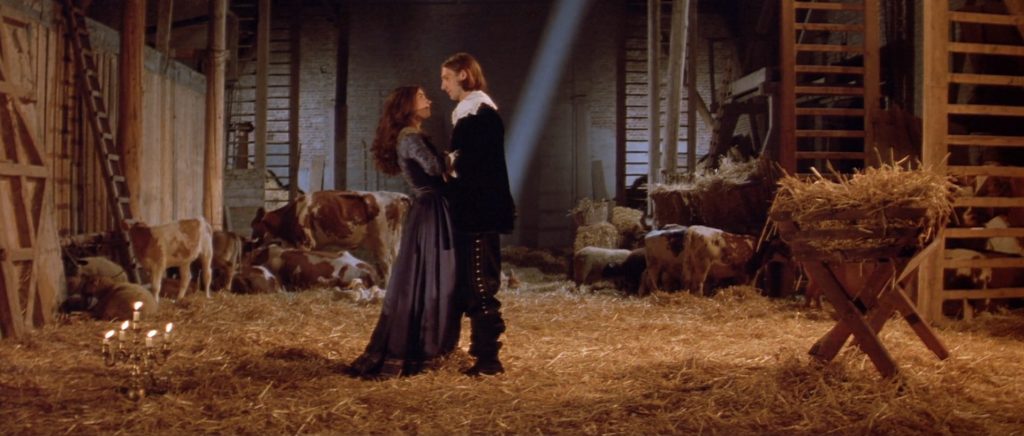
This interface between faith and reason is centered right in the middle of the palindrome, in the repartee between the baby’s sister (Julia Ormond) and the bishop’s son. The palindromic structure singles out this banquet scene as the summit of prosperity before Mâcon descends back into superstition and famine. The palindrome is unmistakable in the following nested pairs of events:
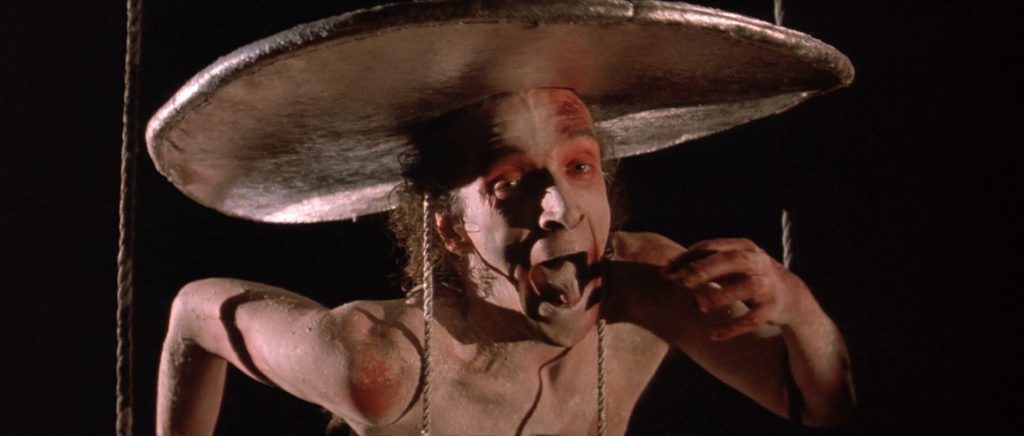
- A grotesque personification of Famine brackets the play at both ends;
- The baby is born in 13 contractions, and the Daughter is raped 13 + 13 + 13 + 13² times;
- The baby is born and dies;
- Women praise the newborn’s body parts, and in the end his parts are distributed as relics
- Cosimo orders a “holy cow” for the child, and a cow is ordained as a cardinal after it’s killed;
- The baby’s blessings are bartered, and his bodily fluids are auctioned;
- The child is dressed in precious raiments, which are later stripped in reverse order;
- The Daughter swears the Mother to secrecy then forces her to divulge the baby’s parentage;
- Right before the banquet the parents are locked in bed, then freed right after the banquet.
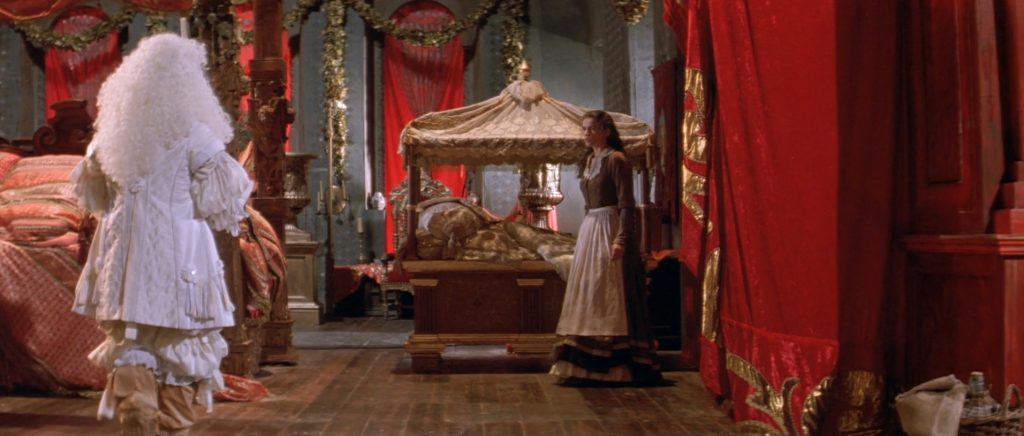
These symmetries are not always precise. For instance, the baby is stripped and dismembered after he dies, and the turning point occurs roughly seven minutes before the film’s midpoint, but this central hinge is doubly underscored with a reversal of camera movement (the long forward tracking shot through the banquet hall) and the midwives’ comic reenactment of the baby’s birth on a makeshift bed at the end of the hall. The bed image therefore ties the structure together, appearing at the beginning, middle, and end of the drama as well as bracketing the central banquet scene.
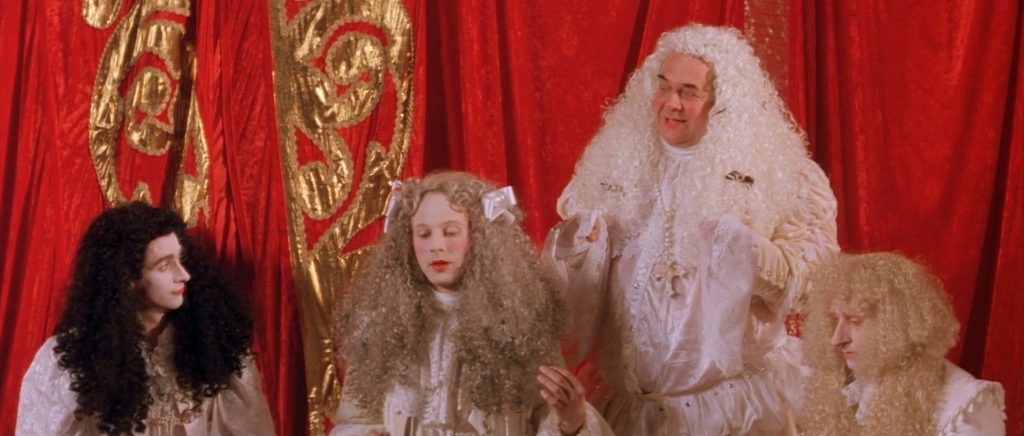
All the irregularities and asymmetries ensure that the palindrome is not some abstract formalist gesture. More important than the form is the effect, which is to shatter the arrogant assumption that history advances in a steadily upward direction. That same arrogance is evident in Europe’s assumed triumph over a “primitive” world; in the Enlightenment’s triumph over superstition; in the baroque excesses of the Medici court or its contemporaries at Versailles (Cosimo III is made to resemble Louis XIV); or throughout later centuries – in the prelude to World War One, for instance, or in the aftermath of the Cold War when The Baby of Mâcon was made. The banquet scene overflows with that arrogance.
The baby is the antithesis to the arrogance in everyone around him. At three key moments he represents a countervailing movement in opposition to the story’s rising and falling arc. When Famine plunges from his swing, setting the story in motion, his wide-brimmed hat remains floating in place, shortly to appear suspended above the spot of the baby’s delivery, so that there’s a vertical continuum between Famine’s fall and the “fall” of the baby from the old woman’s womb. After the banquet, when the Daughter’s seduction of the bishop’s son should complete her triumph, prove her virginity, and unite her to the ruling class, the baby redirects the couple’s fate, causing the man instead of the woman to be penetrated and to bleed. At the end, when the baby is dismembered, his foot is given to the prince, and his head is hoisted over the front of the stage like Famine’s hat before.
If there’s a rule governing all of this, it’s that extremes invite perversity. Famine is the first extreme, and when the baby is born the desperate citizens of Mâcon overreact, turning the baby into a fetish and an object of worship. Religion may teach us that worship is a sign of humility, but in The Baby of Mâcon it’s a projection of arrogance. To worship something is to set it apart from oneself, thus tempting the worshipper to possess, debase, and commodify the revered object. The baby’s blessings are sold, his fluids auctioned, and his body parts sanctified one by one. His clothes are simultaneously linked to virtues (humility, chastity, prudence, piety, strength, perseverance, poverty) and valued in worldly riches (pearls, diamonds, gold, silver, slaves).
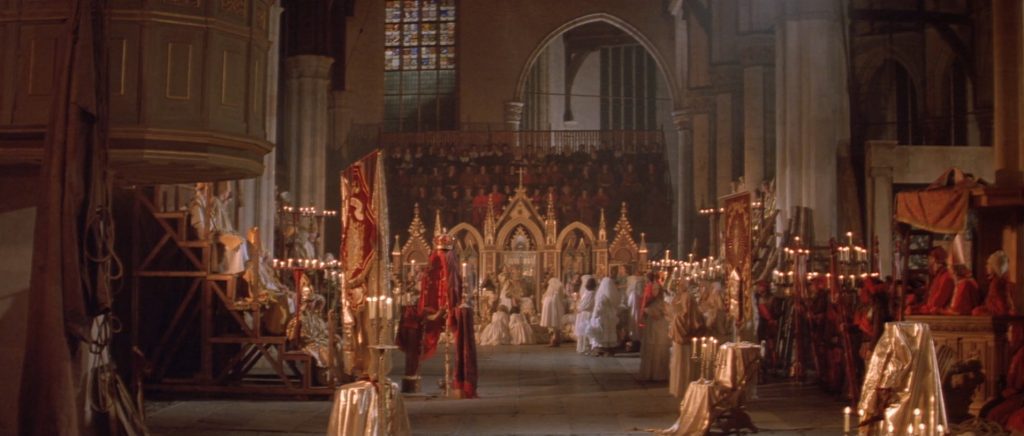
Virtually everyone in The Baby of Mâcon shows some propensity to worship, and it always reflects a wish for control. Religion has its saints, idols, and icons. Science worships knowledge for its own sake, often at the expense of humanity. Commoners and aristocrats worship riches or power, and even art is not exempt, as the elevation of the play onto a grandiose stage continually reminds us. There’s a running joke about a courtier whose eagerness for a part in the play keeps bubbling over, as if he weren’t already intermingling with the actors onstage. He eventually gets his wish through a bribe. Even if actors held a low social rank back then, there’s always been an element of glamor in public performance that might have attracted persons of higher standing. At the end of the film, the play’s audience turns to take a bow, as if they too wish to share in the esteem given to art.
In popular usage, the idea of worship may connote deep respect, but The Baby of Mâcon works to overturn that notion. Elevating an infant to the status of a living saint or a second Christ does no favors to the child, to its family, or to the society that participates in such a spectacle, and by extension, paying that sort of reverence to the saints, to Christ himself, or to any religious figure obscures whatever positive contribution that figure may have made. In this story, the clergy and nobility who promote the baby’s elevation aggrandize themselves in the same manner, in their dress and in their posturing, and we can believe that that’s typical throughout history of persons who facilitate any kind of worship.
To idealize something, or to make it larger than life, is almost always an oversimplification, and the palindromic structure of The Baby of Mâcon implies that the same idealization affects our views of history. The baroque nobility must have seen themselves as sitting at the pinnacle of a grand historical arc, and from today’s perspective their veneer of civilization may be unsurpassed, if not their scientific or social understanding. Each age may have its own claim to superiority, but whether we look back to a past Golden Age, believe in the superiority of our own time, or expect some utopian future, a closer understanding of history will usually deflate that belief.
CONNECTIONS:
Ordet – Counterintuitive alignment between religion and science
Devi – Innocent person elevated to spurious godly or saintly status and placed on display
Contempt – A person’s body parts are praised individually in succession shortly after the opening
Weekend – Reversal of camera direction midway through, signalling a greater reversal; critique of the assumption of progress in history
Diva – The act of worship leads to commodification