Nosferatu: A Symphony of Horror
1922, directed by Friedrich Wilhelm Murnau
If Nosferatu: A Symphony of Horror feels genuinely enchanted, as its enduring popularity attests, it’s because the filmmakers, F.W. Murnau and his team, were operating under the real spell of two extraordinary forces, one creative and one sinister.
The creative influence was the recent release of The Cabinet of Dr. Caligari, which single-handedly launched the outpouring of cinematic imagination known as German Expressionism. The movement is all the more exceptional in being historically out of step, as the heyday of Expressionist painting had already come and gone almost a decade earlier. Every Expressionist film owed its fantastic mood and its twisted visual style not to the paintings of Kirchner or Marc or Beckmann, but to the phenomenon of Caligari, whose sets were more directly influenced by those artists. Although the style persisted in art salons into the 1920s, its late reinvention in the cinema was an anomaly of art history, a sort of resurrection, a bit like a vampire’s existence beyond the grave.
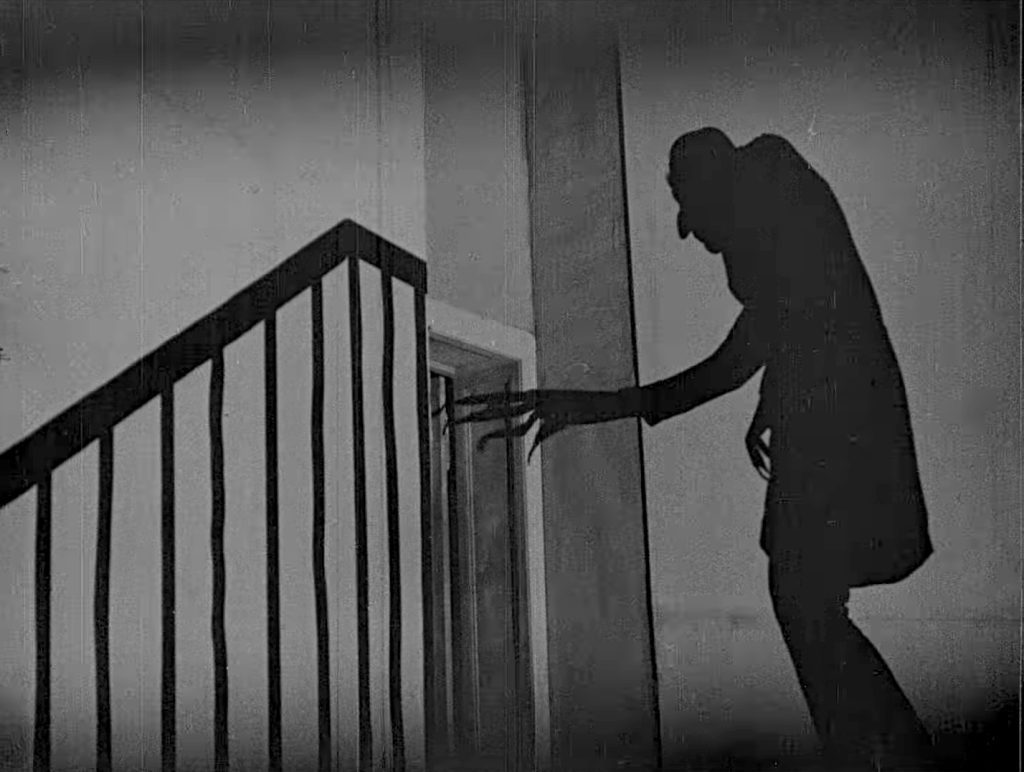
Nosferatu‘s deviations from Caligari extended the range of the cinematic movement. Instead of otherworldly stage sets, the film’s effects relied on real locations and on Murnau’s instinct for kinetics. As much as Max Schreck’s terrifying make-up, audiences tend to remember his intimidating movements: the unnatural speed of the castle coachman, the vampire approaching Hutter’s bedside or prowling the ship, the schooner gliding into Wisborg harbor, the vampire’s slow levitation onto the deck, and his shadow’s creepy approach up Hutter’s stairway.
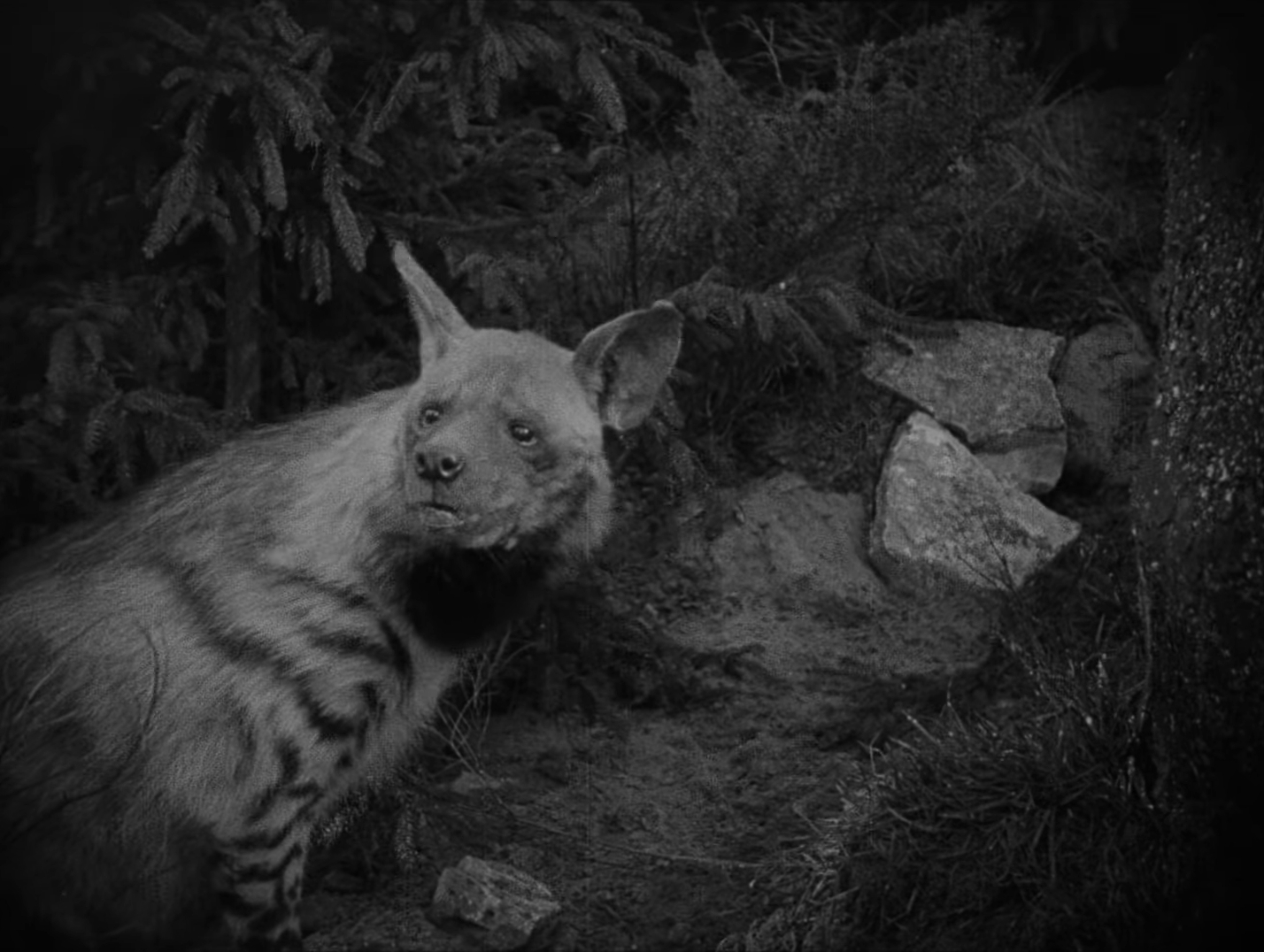
For all of Murnau’s inventiveness, however, the film owes a great debt to Caligari. Like the somnambulist Cesare, the villain lives and travels in a long wooden box, and Ellen herself becomes a somnambulist when the vampire feeds on her husband. Alan and Hutter are both attacked in bed by assailants seen only in shadow. Knock tricks his pursuers with a scarecrow like the doctor’s dummy; he flees over the rooftops like Cesare; he’s confined to a cell like the copycat murderer; and he’s bound up with rope like the doctor or Francis in a straitjacket. Each film features a lamplighter, a graveyard, officials in a city hall, an insane asylum, a book of secrets, a legitimate medical doctor, an exotic animal (a monkey or a hyena), and gothic arches.
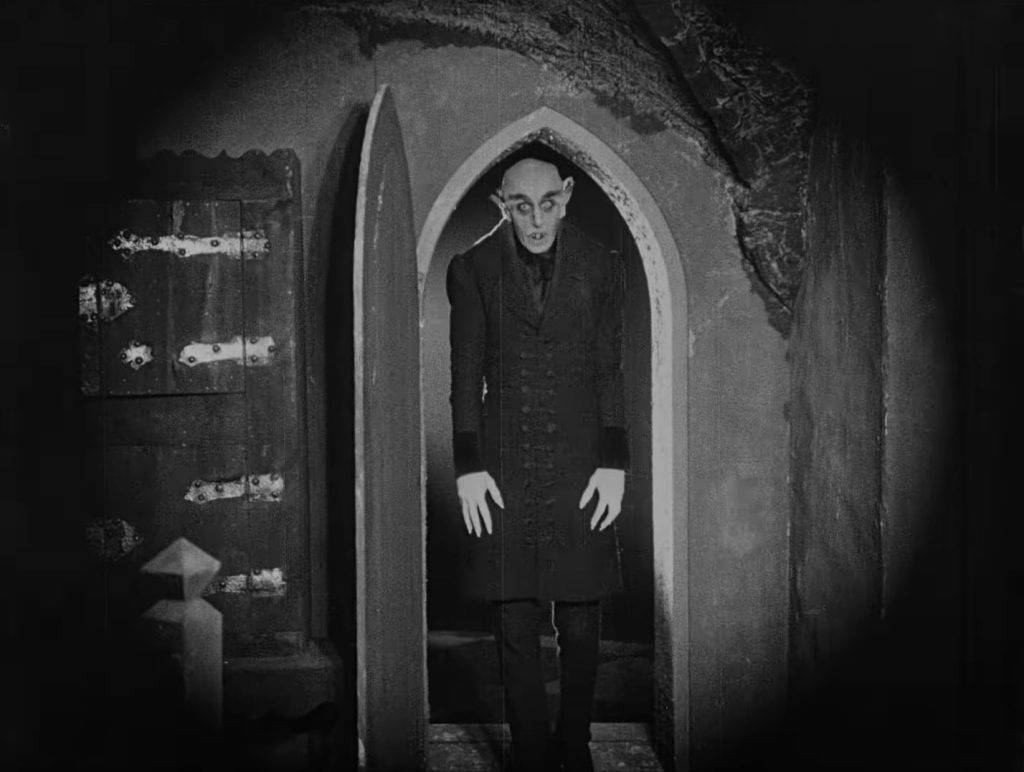
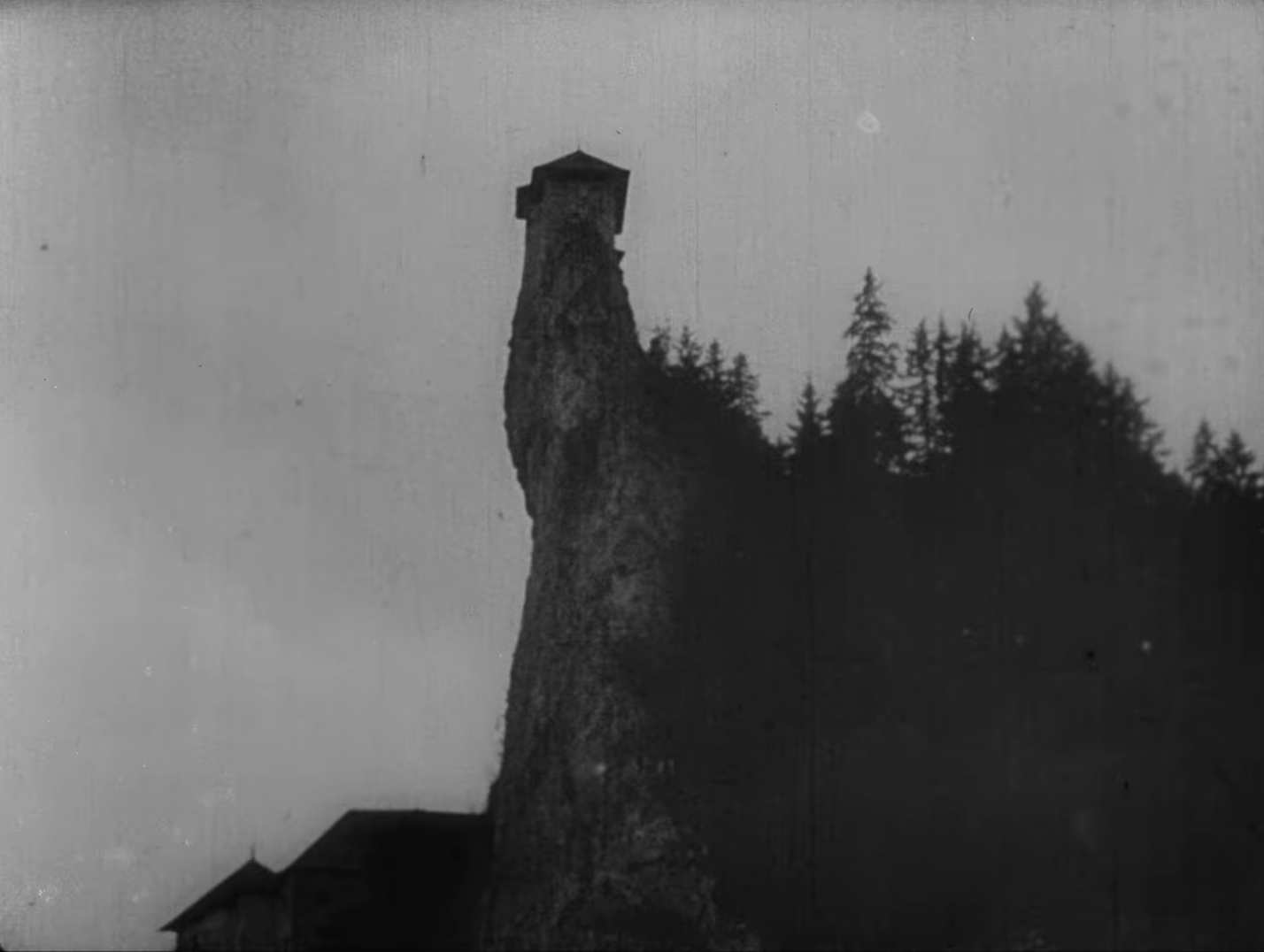
The sinister influence is more telling. Nosferatu was made in the long shadow of the World War when terrible memories of foreign misadventures were still fresh for most Europeans. The whole plot is like an echo of the wartime experience, from Hutter’s high hopes upon setting out, to Ellen’s worrying, the perilous venture abroad, the loss of blood, the husband’s reassuring letter, the convalescence in a hospital, the menacing approach of a ship, the deadly plague (like the Spanish flu pandemic), and the strangely sudden abatement of the crisis (“At that very hour, the Great Death came to an end”), which must have reminded audiences of Armistice Day. Count Orlok’s ruined castle in the final shot might have better evoked the effects of urban bombardment in World War II, but here it corresponds to the earlier war’s destruction of the European aristocracy. The peaceful ending comes at a great price, but the success of Ellen’s sacrifice brings a cinematic sigh of relief.
One might easily credit the magic of Nosferatu to other factors, including the novel Dracula, which the story follows closely enough to have provoked a lawsuit from Bram Stoker’s widow, or the inspirations of producer and art director Albin Grau, a dedicated occultist who claimed to have met the son of a Serbian vampire during the war. There is nothing automatic, however, in bringing a supernatural tale to life as vividly as this film does. By showing Count Orlok as early and as often as it does, it violates a cardinal rule of horror, yet that hardly seems to matter. Certainly the filmmakers’ talents played a role, but Nosferatu resonates so closely with its historical moment that it bears a stamp of authenticity no matter how fantastic its story. A close look at Caligari shows that German Expressionist film sprang from psychological demons unleashed in the Great War, and no Expressionist film captures the collective experience of the war as totally as Nosferatu.
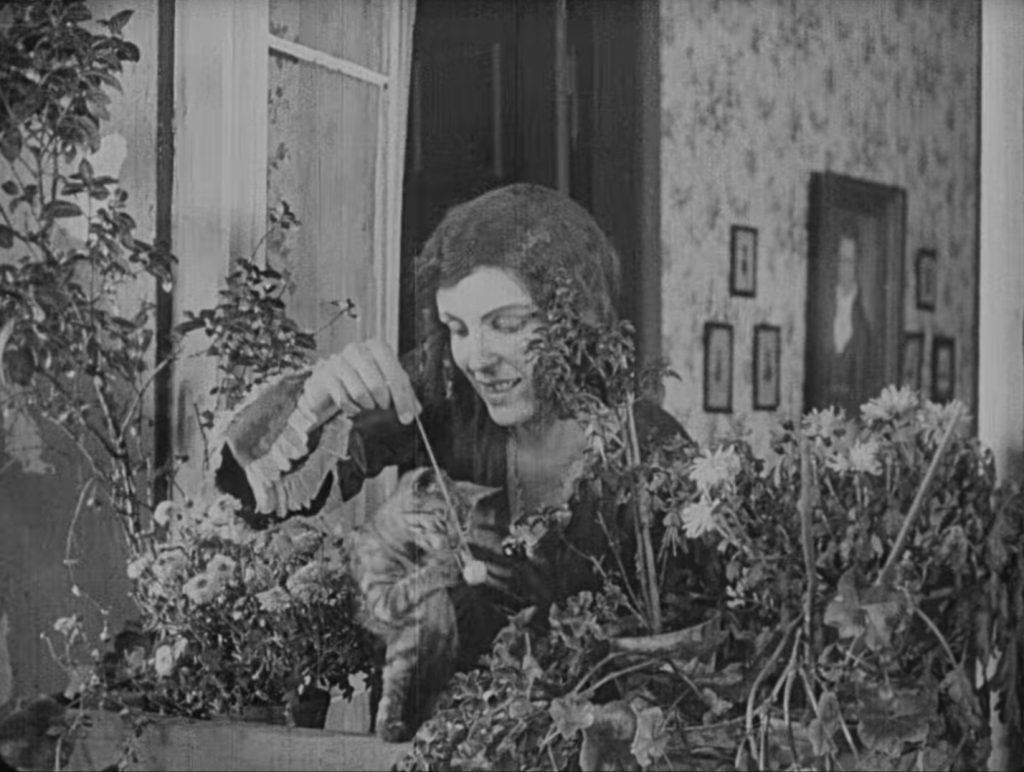
Nosferatu‘s transformative retelling of recent history may have had therapeutic value, like a nightmare that helps a dreamer to process trauma, but the opening shots point to an additional purpose. After a written preface and an overview of Wisborg (from the Marienkirche in Wismar) Hutter and Ellen are contrasted in two introductory vignettes. First Hutter preens himself in front of a mirror, then Ellen plays with a cat by the windowsill. Already we see the man’s vanity and the woman’s skill at handling predators with fangs and sharp claws, and thus the two shots foretell the story all the way to its end. Nosferatu is not just a rehashing of the war – rather it’s a warning against masculinity run amok, and a reminder of femininity’s power to restore order.
While Hutter is introduced at his mirror, he spies his wife in another room, inspiring him to pluck flowers for her in the garden. He gives them enthusiastically, as if expecting appreciation, but she receives them with surprising sadness: “Why did you kill them… the lovely flowers?!” His journey to Transylvania will be a similar mistake, also motivated by a wish to please Ellen. For the promise of a handsome commission, he foolishly brings death into their contented home. After the carnage of a war started and waged almost exclusively by men, no elaborate reasons were needed to link masculinity with a death wish or to describe femininity as a guardian of life.
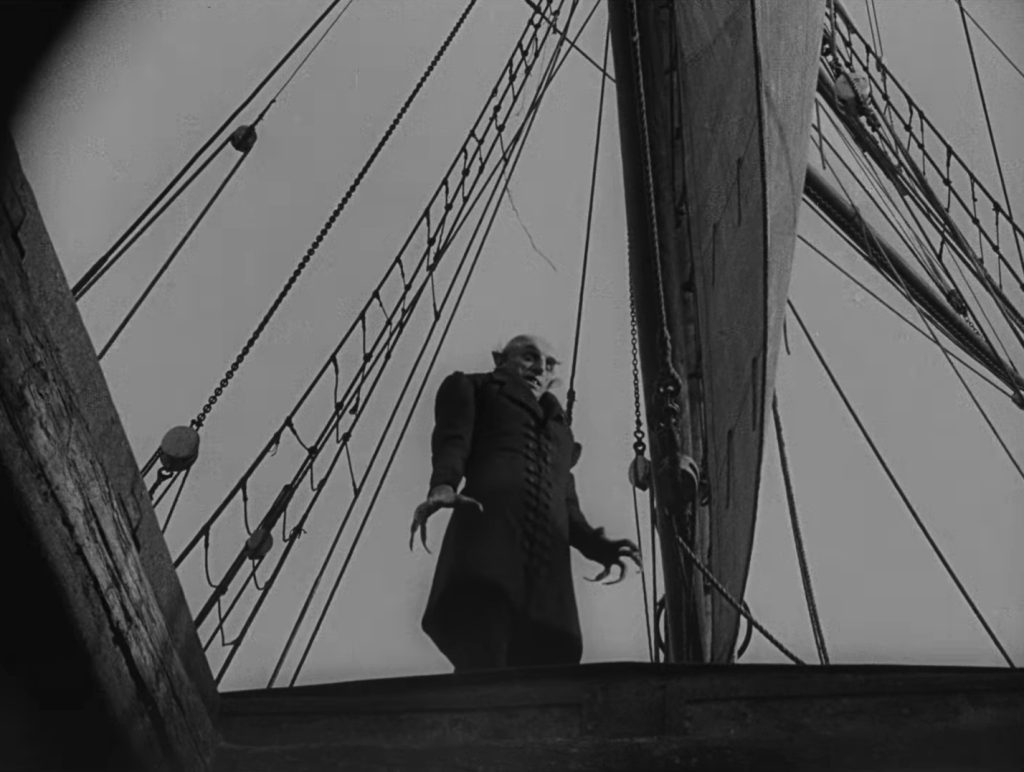
In Bram Stoker’s novel, the vampire relocates from Transylvania to London. For a villain to move to a global seat of power is one thing, but the premise of an undead Romanian aristocrat moving from his castle to a vacant house in a small German seaport demands a reason, and it must be more than a shooting convenience that the vampire’s new home faces Hutter’s directly. The signs, rather, imply that the vampire is Hutter’s double, the true face of his overbearing masculinity – not a vigorous or muscular image, but an old emaciated phantom. All the supernatural effects, like the coachman or the doors opening unaided, serve to draw the two men closer together, either in the castle or again toward Ellen in Wisborg. The same blood runs through both of them; they both desire Ellen; their simultaneous journeys dovetail through intercutting; and they both arrive in Wisborg at the same time. Their great physical intimacy may have appealed to Murnau’s homosexuality, but more importantly it reflects a shared identity.
Hutter is first horrified, not at the villagers’ warnings, at the eerie castle, or at the appearance of Count Orlok, but by the vampire’s physical contact when sucking blood from Hutter’s cut finger. The moment may be read as a man recoiling from intimacy with another man, or better as a man first confronting his own true nature. When the two make contact again in the bedroom, the potential sexual implication is redirected in a cut to Ellen, who begins sleepwalking at the same moment. The abrupt shift to Ellen seems to startle the vampire, but instead of saving Hutter (who’s already been bitten), it establishes the strength of the woman’s love, while alerting the vampire to his next target, who will outmatch him. From here on, the film will cut liberally between the three of them, uniting them in a triad that can be understood as a wife’s relationship to a man with a dual nature. Her task will be to subdue the man’s destructive side, which corresponds to the imbalance that had upset the world’s peace not long ago.
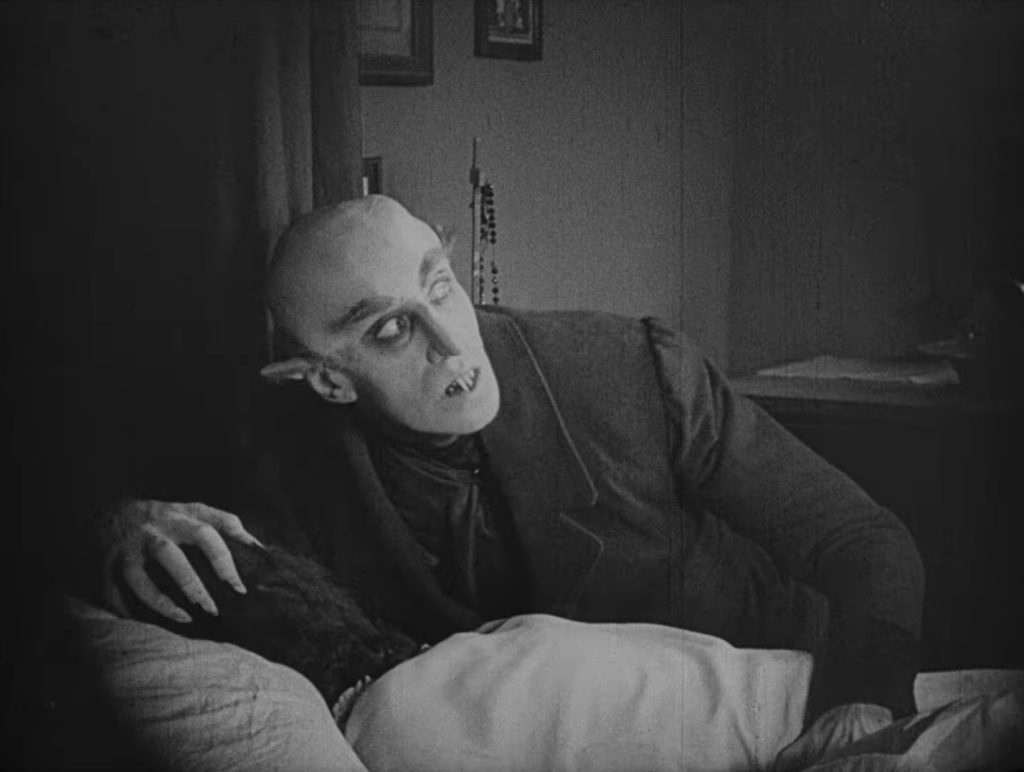
Murnau’s film contributed one popular element to the vampire myth, namely the idea that sunlight can destroy a vampire. Ellen holds the creature until the first crowing of the cock, exposing him to the first rays of the rising sun. Light is a particularly cinematic element, and it connotes the illumination that accompanies superior awareness. The sunlight here is a metaphor, and it’s really Ellen’s wisdom that saves her husband and her city. Likewise, it takes feminine wisdom to bring an end to wars and save the world. It’s not a trivial detail that Ellen learns what she must do because she disobeys her husband, who had made her swear not to read his book of vampires. Our society normally regards the violation of an oath as sinful, but Hutter’s book stipulates that only “a woman wholly without sin” can end the vampire’s curse. The logical conclusion is that Ellen commits no sin in disobeying her husband, and that women must not be bound by the dictates of men.
CONNECTIONS:
The Cabinet of Dr. Caligari – Sinister figure who sleeps in a wooden box; aggressive disembodied shadows; trick dummy; villain’s stooge running over rooftops; sleepwalking; character confined to a cell; uncanny distortions in either artificial or naturalistic settings
Sunrise – Musical allusion in title; story built around a journey; test of marriage; ends with a sunrise; bell chimes at two important early moments
Vampyr – Vampirism as a metaphor for an imbalance in the real world; old book that describes the workings and weaknesses of vampires
The Wizard of Oz – Villain defeated by an innocent woman, not through physical power but with light or water which vaporizes or melts the vampire or witch, leaving a plume of smoke or steam
Alphaville – Use of the name “Nosferatu”; negative film footage; conflict with an inhuman villain