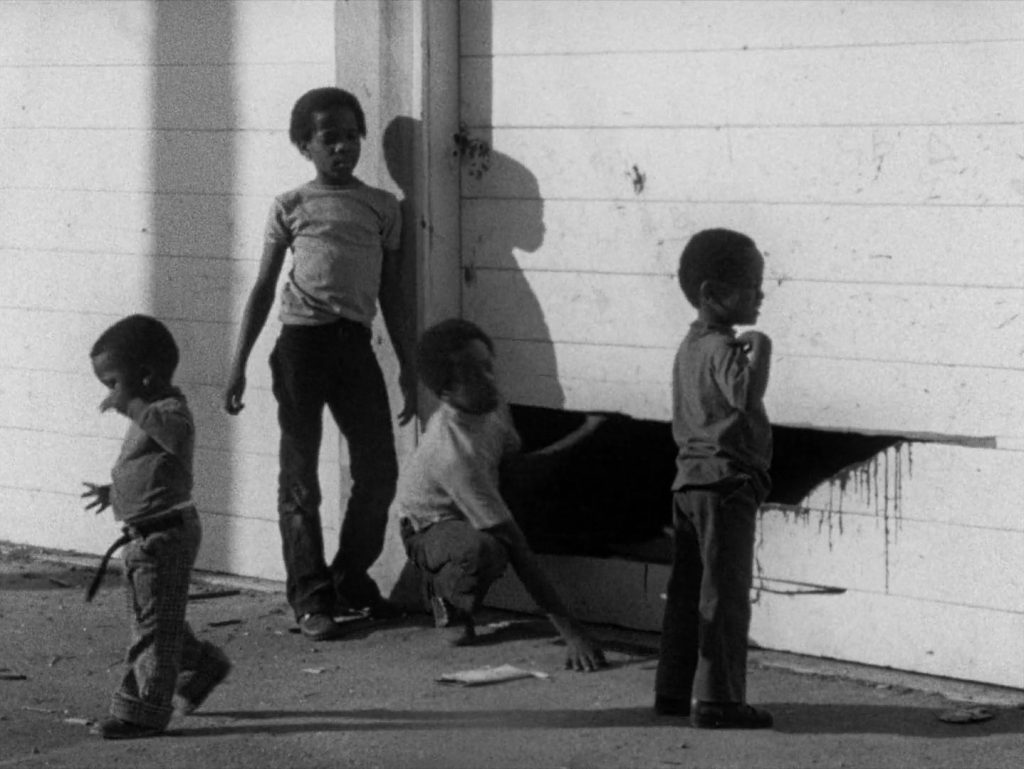
Killer of Sheep
1978, directed by Charles Burnett
The title Killer of Sheep refers ostensibly to the film’s protagonist Stan, an African-American slaughterhouse worker raising his family in the Watts neighborhood of Los Angeles. A casual reading might take his profession as a metaphor for the bleakness or brutality of the man’s joyless life, with the understanding that he represents a broad underclass that’s shut out from America’s prosperity – but that simplistic reading overlooks the poetry and precision of the title’s real metaphor, which the film gives away thirteen minutes in after Bracy says he had seen Stan’s lights on at 3 a.m. Stan asks, “Why didn’t you stop? I’m always awake.” “Yeah,” Bracy replies, “counting sheep.” The film is packed with hidden plays on this idiom.
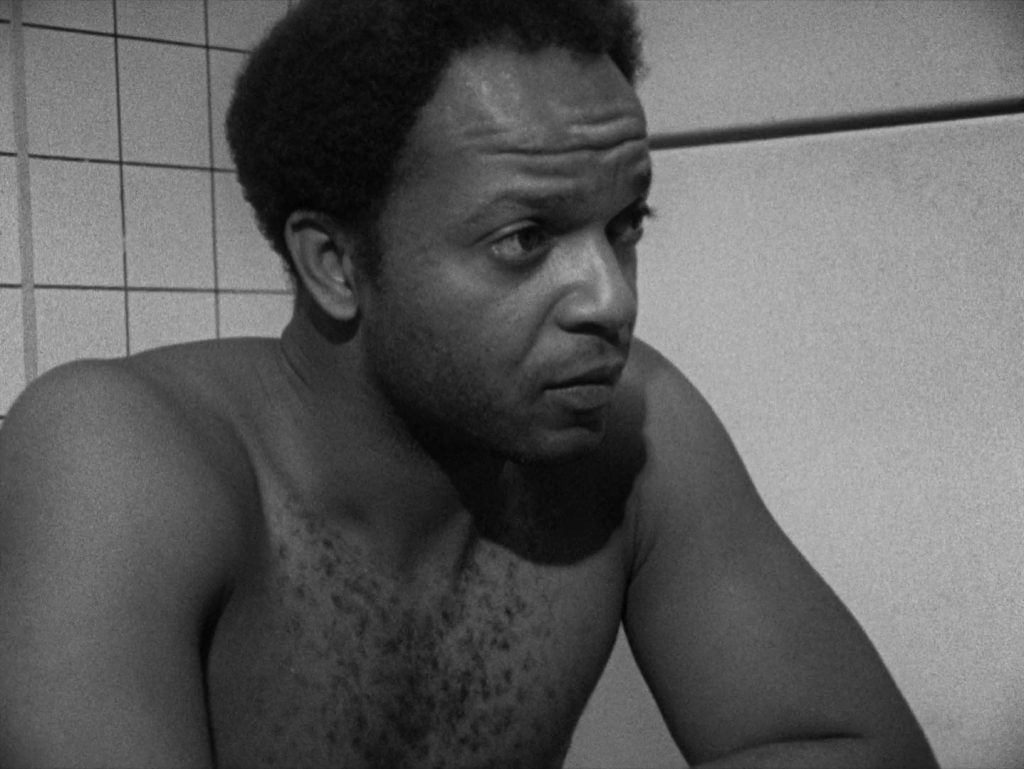
Stan is introduced five minutes earlier, painstakingly cleaning his kitchen cabinet on hands and knees. He pulls his head out to tell Oscar, “Just working myself into my own hell. Can’t close my eyes, can’t get no sleep at night. No peace of mind.” If “counting sheep” is supposed to induce sleep, then the title suggests that something is killing Stan’s opportunity to find this desperately needed peace of mind.
Killer of Sheep opens with a George Gershwin lullaby over the titles:
So lulla-lulla-lulla-lullaby-by
Do you want the stars to play with?
Or the moon to run away with?
They’ll come if you don’t cry
So lulla-lulla-lulla-lullaby-by
In your mother’s arms you’re sleeping
The key line here is “They’ll come if you don’t cry,” which imposes an impossible condition on the stars and the moon, i.e. on the child’s dreams arriving. Killer of Sheep is not a maudlin film, and what little crying there is is understated, but it’s a portrait of a hard life. The lullaby cuts abruptly to the opening scene of a man scolding his boy for letting his brother get beaten up. “You are not a child anymore. You soon will be a goddamn man. Now start learning what life is about now, son.” In other words, on the streets of Watts, children barely get to be children, and life is no treat for grown-ups either. Stan’s wife tells him, “You never smile anymore… I think deep down inside, you worried you ain’t happy,” and another woman says, “You would be a good-looking fella if you didn’t frown so much.”
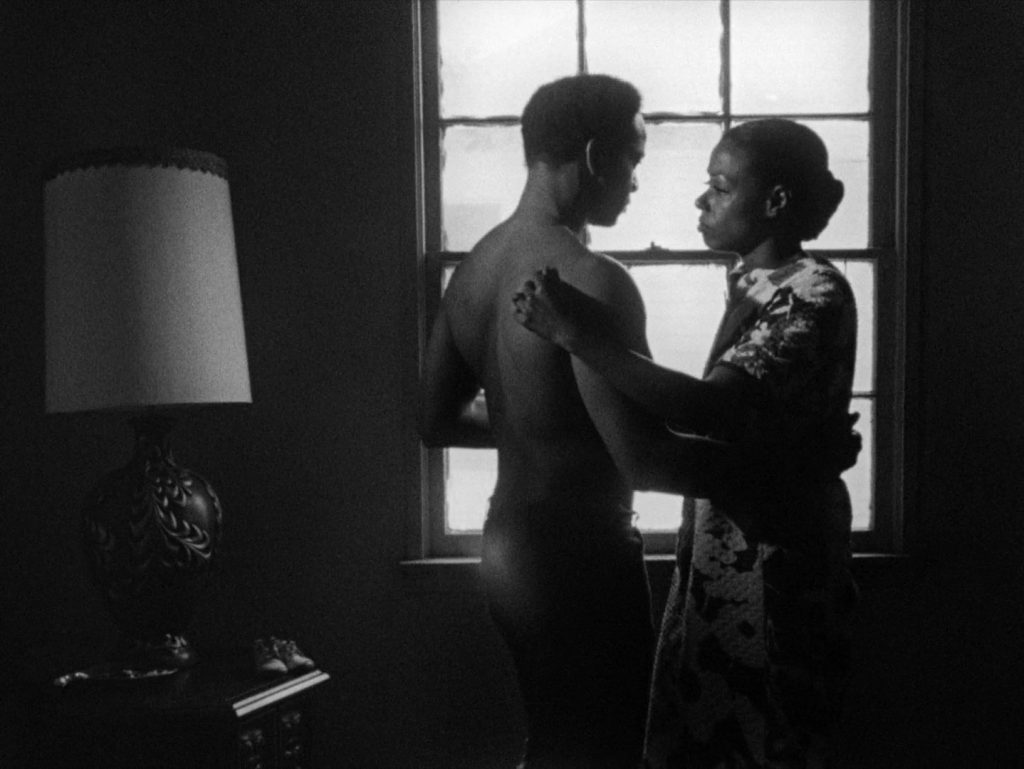
The lack of joy is equated here with the impossibility of dreams or of sleep. We never see Stan in bed or sleeping. Twice at the kitchen table his wife invites him to sleep, but the first time he unfolds a mat and begins scoring it with a knife, and the second time he simply looks away. Despite his loving marriage, even the bed itself seems to be off-limits. When the occasion comes for love-making after a slow dance by the bedroom window, he gently pushes his wife away, leaving her disappointed. It’s not a story of impotence or unwillingness… it’s that the bed represents the peace of mind that’s denied to someone living in the American ghetto.
The film spans at least six days of Stan’s life, but the focus is not always on him. It skips around among the children and adults in his neighborhood, and what goes for Stan goes also for them. Only twice does anyone lie down, and they’re both a long way from resting. A boy lies under a freight car which his playmates attempt to roll over his neck, and Silbo’s nephew lies on the floor after getting beaten up. The only person who gets any sleep is a tiny girl dozing on her brother’s chest while a man downstairs, possibly their estranged father, comes to collect his shades. Their mother guards the door with a pistol, as if protecting this little bit of sleep allotted to her daughter before she grows up.
Without excessive sentiment or drama, we’re constantly reminded how dangerous children’s lives are in this neighborhood. They fight each other with rocks and fists, play on railroad tracks, witness crimes, and in one iconic scene they leap in succession across a gap between two buildings. The latter image recalls the sheep jumping over a fence in the proverbial cure for insomnia. Children are again likened to sheep about an hour in, right after a slaughterhouse scene with sheep hanging head-down, when a couple of boys do handstands on a porch.
While those two boys stand upside-down, a third keeps trying to count through a range of numbers in the 450s, repeatedly going back and skipping numbers. His voice comes on over sheep running and jumping in the slaughterhouse pen, so that his broken series is likened to someone persistently counting sheep without results. A woman calls irritated from off-screen: “Can’t you count?” and he answers, “Count yourself then.” In this light, other instances of counting or numerical sequences also allude to counting sheep. Children sing “knick-knack paddywhack”, a popular counting rhyme. Stan’s daughter Angie counts on her fingers in the kitchen. A man offers Stan a “one-to-five proposition”. A roomful of gamblers utters a jumble of numbers, and Bracy talks about a “5-4 ballroom” and the 10-1 odds on a racehorse, the random or descending series suggesting an improper counting of sheep.
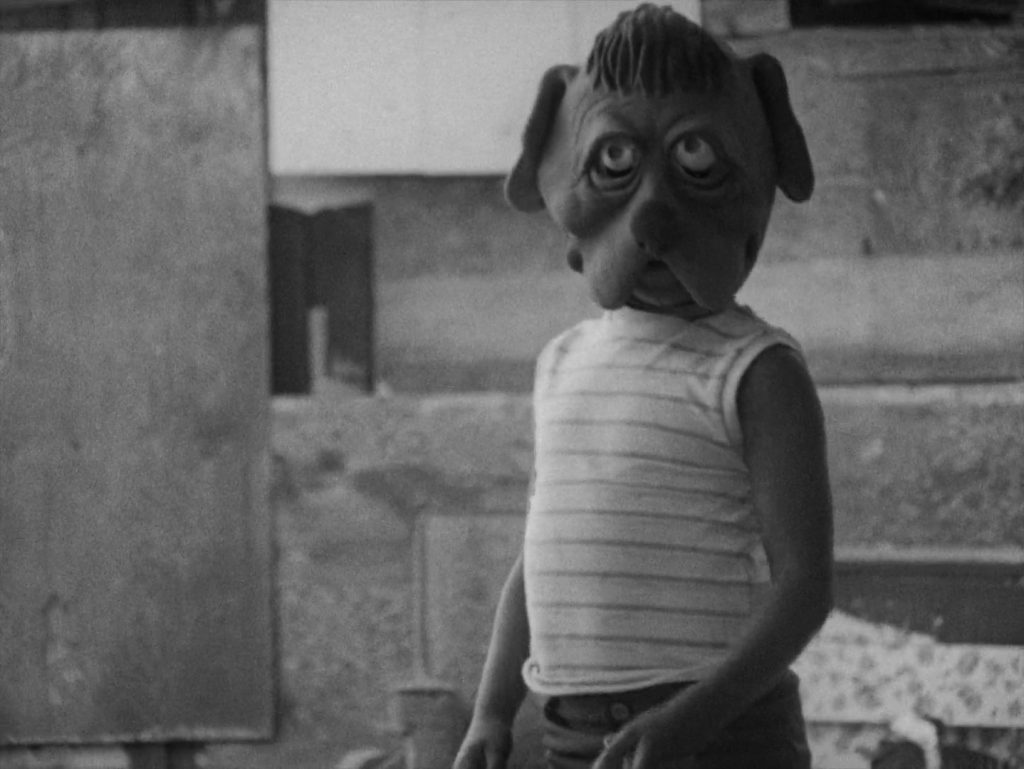
Dogs appear about as often as sheep, and they too have a place in the film’s guiding metaphor. Angie wears a rubber dog mask (which the towel on her mother’s head echoes when seen from behind). Stray dogs chase a trio of boys off a bike. Dogs bark frequently off-screen. The “knick-knack” song repeats the line “Give a dog a bone.” A girl calls a boy “You dog” in an alley, and a woman says “You dirty dog” at Silbo’s house. Dogs are traditionally used for herding sheep… not an immediately antagonistic image, but as the film’s last shot reminds us, herding is not for the sheep’s benefit. A dog is also the domesticated form of a wolf, the sheep’s proverbial enemy. The prevalence of dogs in Killer of Sheep is thus another symbolic obstacle to the peace of mind that should result from counting sheep. For that matter, even the mention of coffee in two scenes is a symbolic sleep-killer.
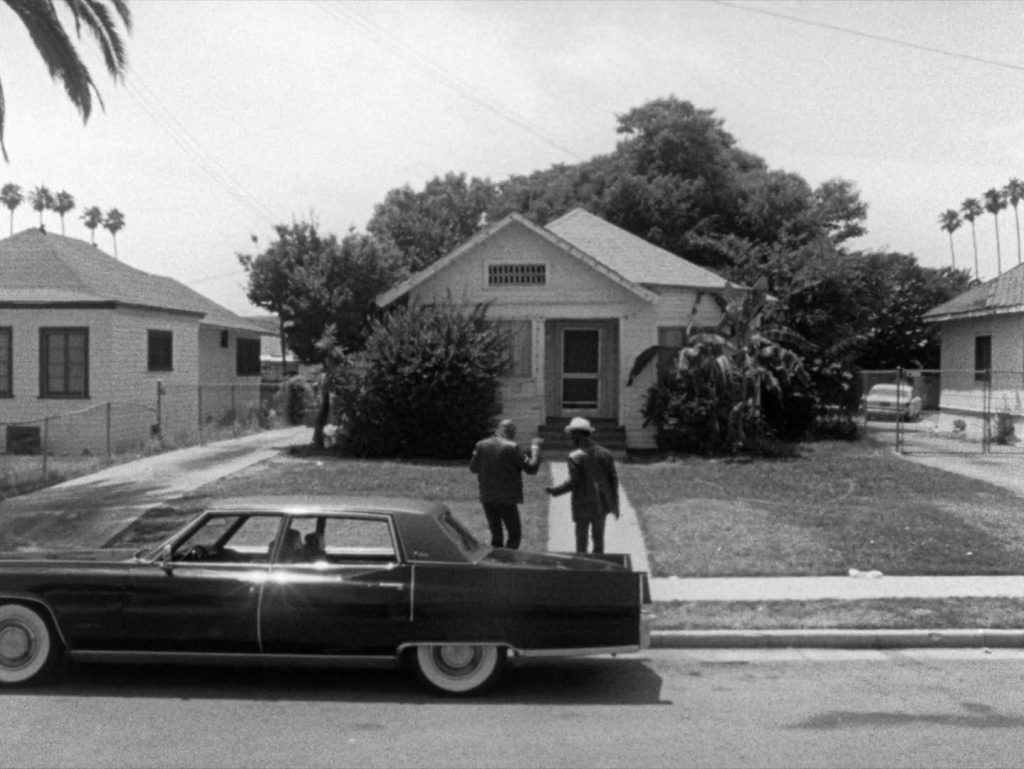
Although Stan is hardly alone in living without peace of mind, the film doesn’t insist that it’s a universal condition in ghettos like Watts. Stan’s friend Oscar tells him, “I don’t have any trouble sleeping. I ain’t ashamed of nothing I can’t help.” We can guess that the two men who ask Stan to help with a murder also have little trouble sleeping… their attitude is totally relaxed, and at least one of them embraces a brutal worldview. Stan resists them though, and his wife tells them off. An ordinary person cannot be resigned so easily to incessant brutality.
Stan is evidently a decent family man, a loving father and husband, and he holds a steady job. He insists that he’s not poor, comparing his lot to a man he knows who forages weeds from a vacant lot. Nevertheless his life is hard compared to the average American, and his job enlists him in a routine of killing. He worries that he might harm someone else, and he shows he’s capable of hardness toward his son, or to men who block his car door or owe him money.
Killer of Sheep analyzes the effects rather than the causes of poverty. In the opening vignette, the father tells his son to “knock the shit out of whoever’s fighting your brother, ’cause if anything was to happen to me or your mother, you ain’t got nobody except your brother.” Here we’re alerted to a counterintuitive law that governs life in the ghetto. Much of the harsh language, feeling, and action stems not from a lack of care, as it may seem to an outsider, but from a protective concern for self, family, and community. Toward the end, Stan comes home from work and says, “I gotta find me a job.” Killing sheep isn’t anything he wants to do… it’s only to provide for his family. All the harshness that we see comes with a steep price, leaving people like Stan spiritually exhausted.
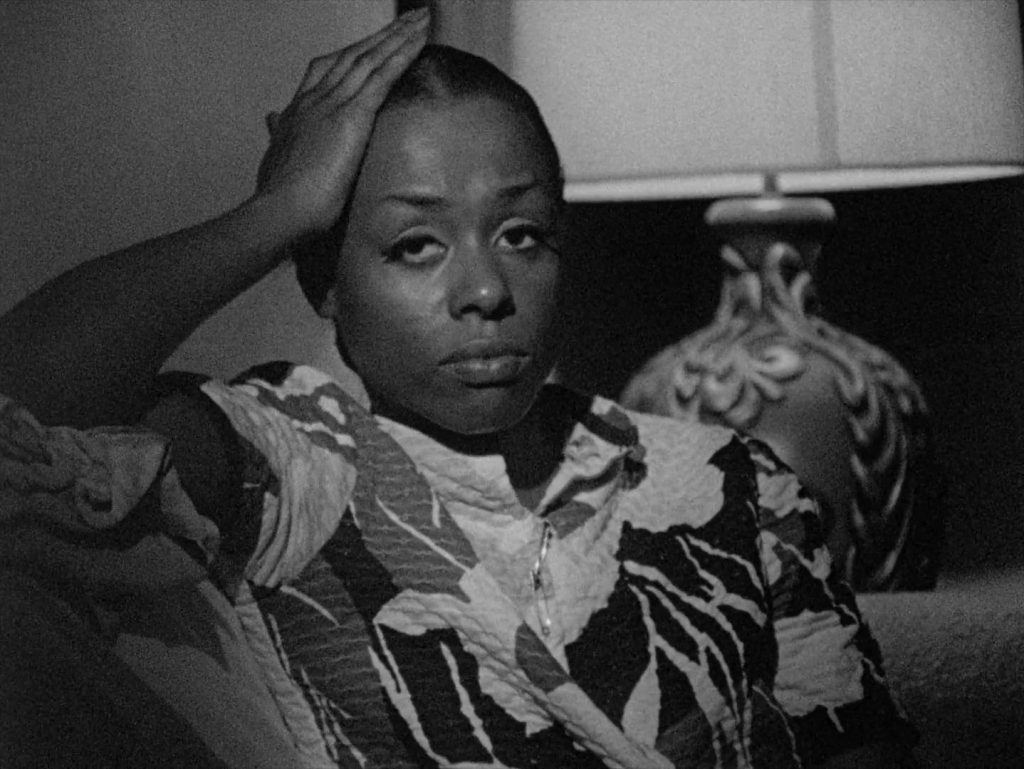
Though it’s only hinted at, it’s important that Watts is a displaced community, many of its residents having migrated from the Deep South. Charles Burnett moved there from Mississippi when he was about three, and there’s mention of a Vicksburg Club in Killer of Sheep. Stan says the last time he attended church was “back home,” presumably in the South. The internal displacement of African Americans mirrors their original displacement across the Atlantic on slave ships, so that there’s long been a sense of living far from home. In the closing credits, Dinah Washington’s “Unforgettable” segues into a couple bars of Paul Robeson singing “Going home” – an aspiration synonymous with the peace of mind that Stan longs for.
CONNECTIONS:
The Wizard of Oz – Final line elevates the value of home
Good Morning – Portrait of an economically struggling neighborhood, with roughly equal attention given to children and adults
The Cloud-Capped Star – Story of a character supporting her/his family in a community displaced by migration
LIST OF DOUBLINGS:
- Two people lying down
- Two mentions of coffee
- Two middle-aged men in flamboyant clothing
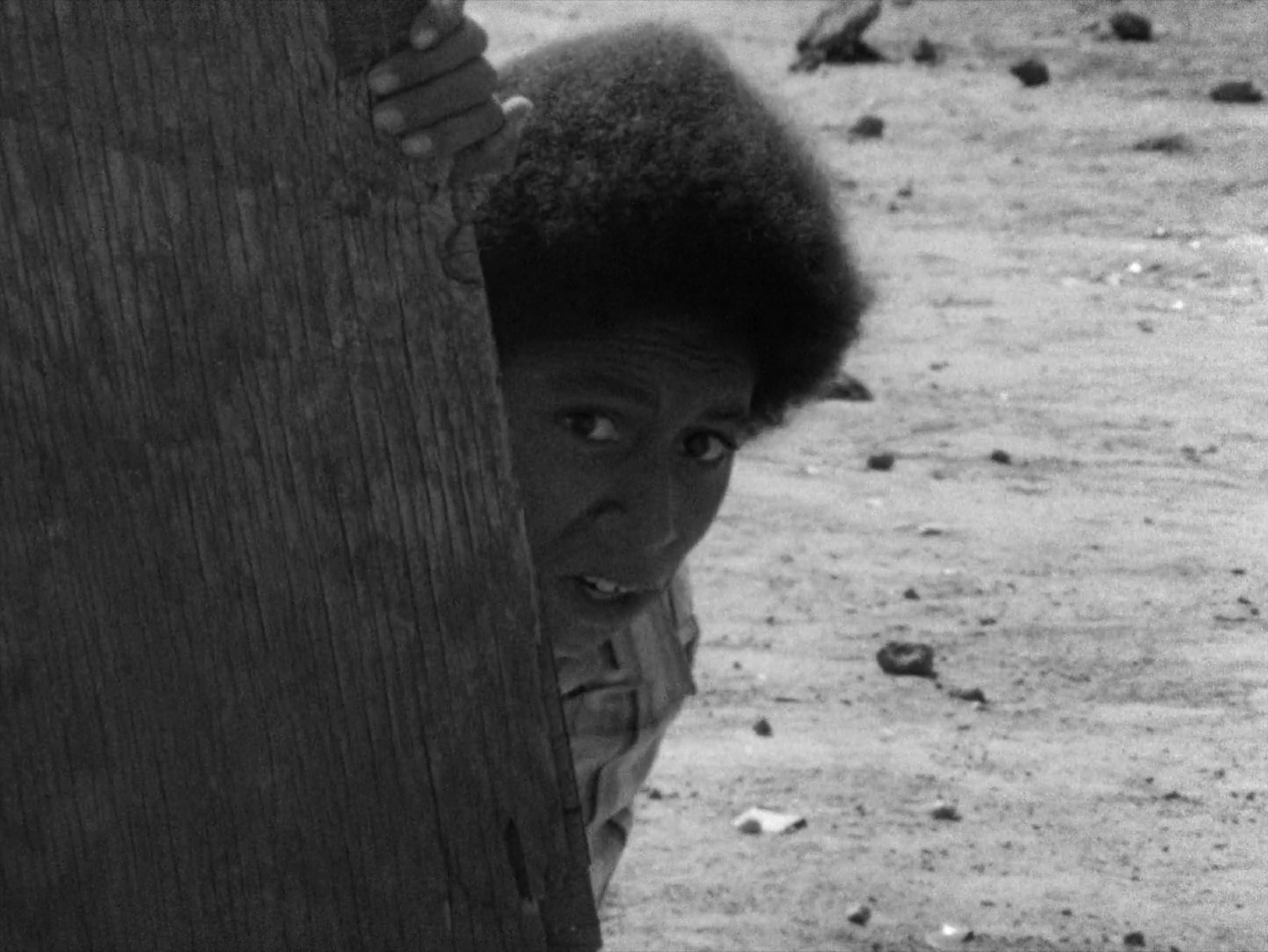
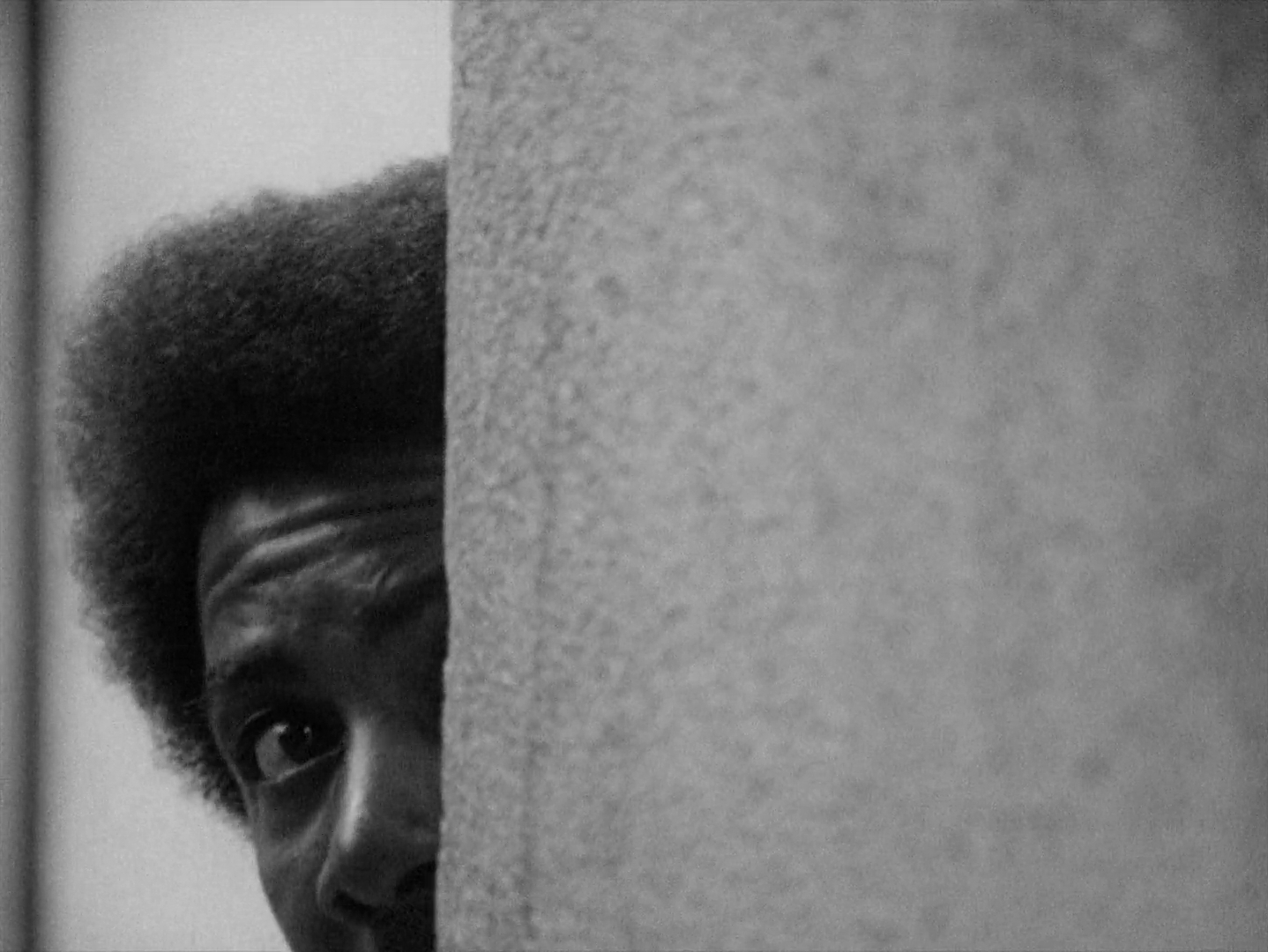
- Two faces hiding behind a board or a wall
- Two pairs of men carrying a heavy apparatus (tv or engine) out of a house
- Two scenes of children on a roof
- Twice at the dinner table Stan’s wife suggests he go to sleep
- Two scenes of kids riding a bicycle into trouble
- Dog mask & towel that looks like a dog
- Visitors suggest suicide & murder to Stan
- Two women remark on Stan’s unhappiness