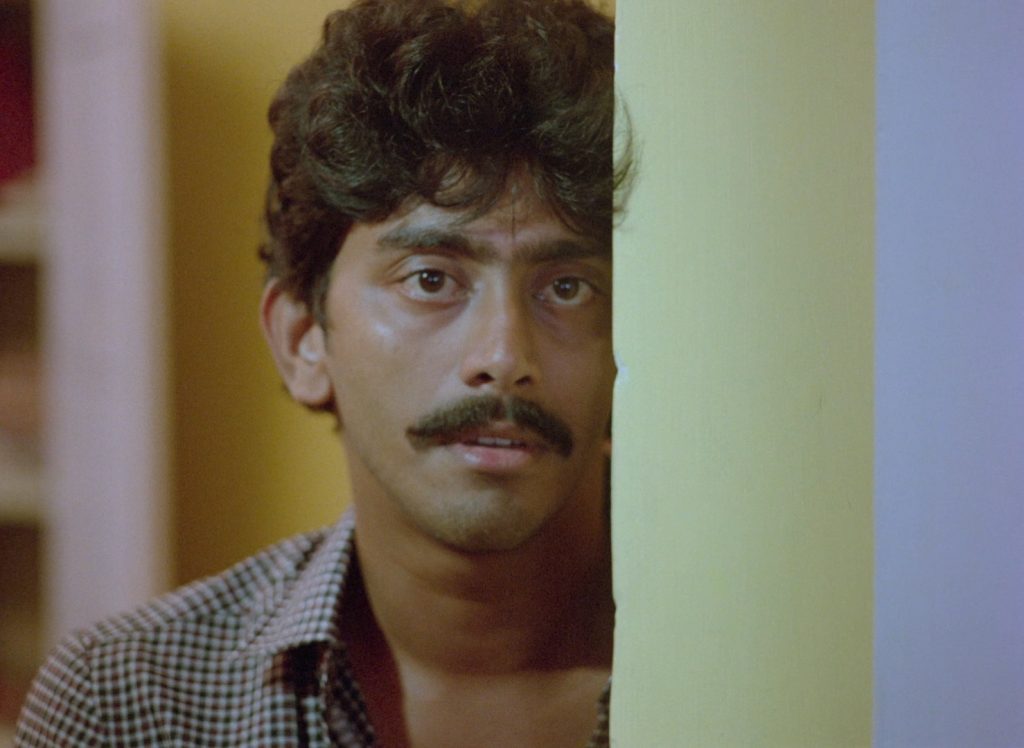
Anantaram
1987, directed by Adoor Gopalakrishnan
Shortly before the intermission of Anantaram, when Ajayan contemplates writing to confess his attraction to his sister-in-law Suma, a slow zoom closes in on the blank letter. Among the books on his desk, one title is recognizable: A General Introduction to Psychoanalysis by Sigmund Freud. The book is typical reading for a college student, but its inclusion is certainly not random in a film that exists in close dialogue with the most Freudian of all films. Anantaram is not merely inspired by Vertigo – it is a vital addendum to Hitchcock’s film.
Anantaram and Vertigo are both stories of obsessive romantic longing told in two parts. Each portrays an outwardly gentle man who’s revealed in stages to be self-absorbed, twisted, and possessive. In each film’s first half, his romantic ideal is married to his friend or to his brother, but in the second half he has free rein to pursue her under a new identity. When Ajayan mistakes a woman on the beach for Nalini, it recalls Scottie misrecognizing Madeleine in other women. These plot parallels, however, are superficial compared to the psychological parallels.
In Vertigo, all signs point to Scottie Ferguson being a case of oedipal incest unleashed after the death of a father figure. Madeleine is dangerously idealized in Scottie’s mind, and the first two letters of her name are one of many hints that she triggers a childhood memory of his mother. Despite a thorough alignment of evidence characterizing Scottie as a man trapped in his psychological past, and despite a general consensus that his behavior is perverse, the notion of incest is a bridge too far for critics and audiences who prefer vague discussions of “obsession”. Freud himself provokes a similar resistance in readers who find only salaciousness in the Oedipus complex. The trick of Anantaram is to recast Hitchcock’s story with an orphan at its center, so that any question of oedipal attraction must circumvent the literal role of a mother and a father in the protagonist’s mind.

The absence of real biological parents does not change everything for Ajayan. Although he evidently loves his adoptive father, his “Doctor-Uncle” interferes at least symbolically in his libido. As soon as Ajayan discovers a note from his first crush, an older girl named Lata, Doctor-Uncle sends the boy to bed before he can write a reply. Nalini enters his life (in the second half) almost at the very moment we find him living away from home, and Suma appears (in the first half) immediately after Doctor-Uncle’s funeral, so that each romance is equated with a liberation from his primary father figure. In the second half Ajayan believes he’s responsible for the man’s heart attack, horrified like Oedipus to think he’s committed parricide.
It’s significant though that the adoptive father is called “Uncle”, because there are many surrogate fathers in Ajayan’s life. Most of them are strict and elderly, particularly his teacher, the headmaster, and the three servants who run the household with “unbridled authority” during the master’s frequent absences. Ajayan’s happy relationship with Nalini comes undone after the entrance of another father figure, a man claiming to be her father, although the reality of that whole incident is ambiguous.
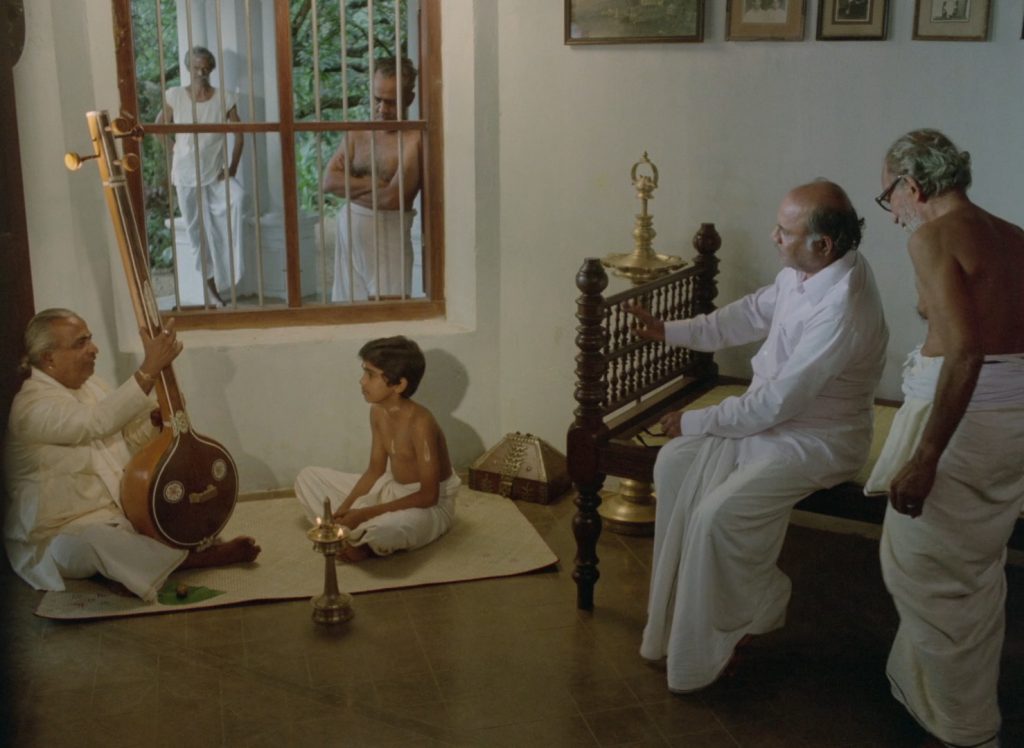
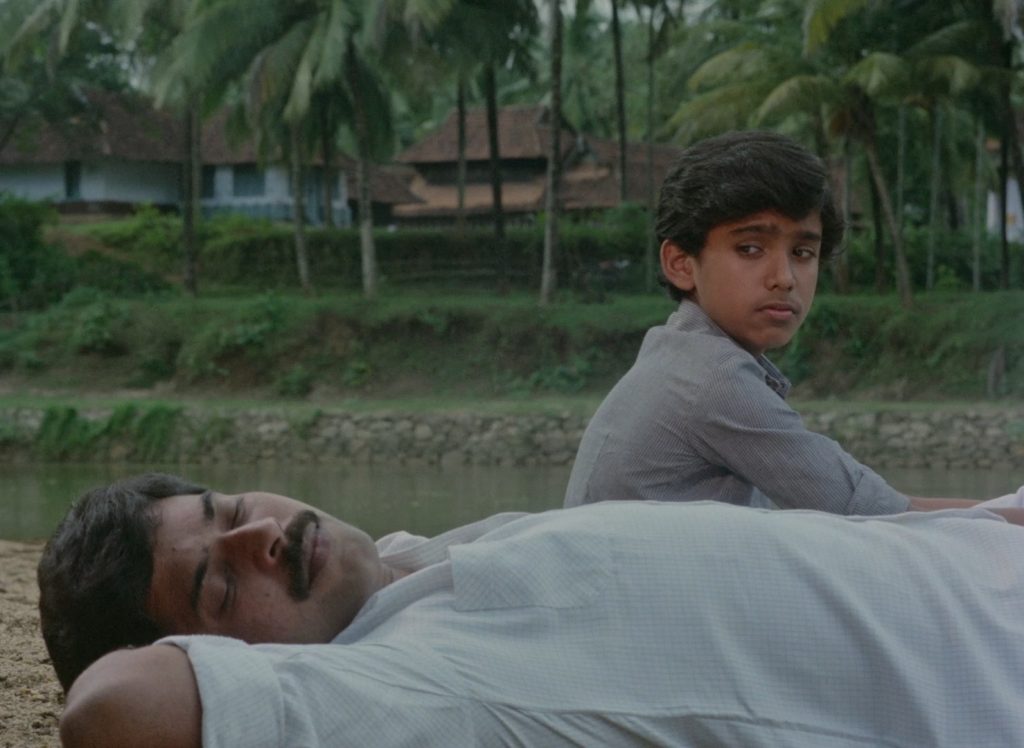
Before proceeding to analyze Ajayan, we must attend to the film’s structure. Anantaram is narrated in the first person in two halves, each half ending with Ajayan’s comment that something more remains to be said. A one-minute coda follows the second half, a single shot of Ajayan as a boy counting steps on the ghat near his home. First he counts by odd numbers, then he climbs up and counts by evens going down again. The insinuation is that the two tellings we’ve just witnessed represent interwoven accounts of the same time span, a point which begins to clarify the story after a number of disorienting contradictions, not least of which is the same actress playing Nalini and Suma – a device whose point is that both women embody the same ideal for Ajayan, much like Madeleine in Vertigo. Once we understand that the two tellings dovetail, we can see that each is unreliable in a different way. The first half is self-flattering… Ajayan is the smartest in his class; he’s an avid reader; he excels at running, holding his breath underwater, darts, and singing; and Suma returns all his loving glances. This first account ends in his dorm room, his roommate and other students pounding on the door and peering through the transom window as if to suggest some dire end like madness or death.
The second half begins with a clock set to 12:00. Ajayan appears as a boy spinning before the clock then walking backward as if regressing in time. His second telling appears to be a more honest revision, showing the less flattering parts of his life. At the hour mark Balu gives him a book of fairy tales, then an eight-and-a-half minute sequence details the various tricks the old servants play on the boy, filling his mind with fantastic stories that mask their own vices while laying a foundation for later self-deceptions, particularly around the story of Nalini.
In Ajayan’s order of telling, Nalini’s first appearance is doubly juxtaposed, coinciding with his independence from Doctor-Uncle while also following from the death of the local ashram “mother” who had shown kindness at Ajayan’s bedside when he had typhoid fever. Ajayan was still a boy when that woman died, but his narrative sequence links the idealized maternal figure with an idealized romantic figure. When Nalini first steps off the bus and speaks of love, she gets back on and rides away, but the second time when she stays with Ajayan, he tells himself “I must be dreaming.” His attachment is not to Nalini herself but to an unreal image, the sort that a boy forms when picturing his ideal mother. Confronted with the presence of a real woman, he keeps looking away, but she continues: “No, Ajayan. I won’t leave by this bus. You say where we are to go now.” The next shots, however, show him alone again at the bus stop, still waiting for her, as if he had failed to act on her invitation. He tells us, “Nalini did not appear again. She became a cherished memory.”
She does appear again though, knocking at his room in the next shot. He acts scandalized, again uncomfortable with the reality of the situation. Their happiest moment together is at the beach, but when she appears there all other bystanders are suddenly gone, as if the moment is only a fantasy. After her purported father comes to end the relationship, Ajayan puts up little resistance, almost as if he feels relieved. He turns away from Nalini at the bus stop, and when she assures him that her father died seven years prior, she gives him an ultimatum to believe “either that impostor or me.”
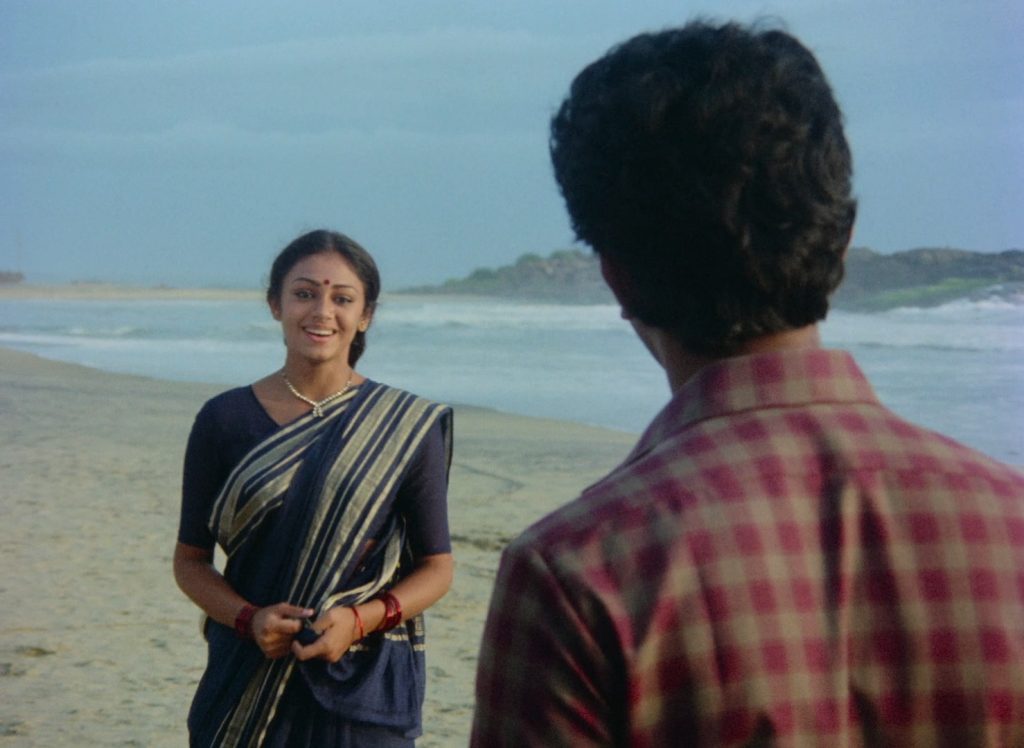
Strangest of all, when Ajayan subsequently seeks his lover out at her home, possibly regretting his wrong response to her ultimatum, he’s directed to a different attractive young woman named Malini. She and her mother seem receptive to him, but he walks off disappointed. If we take this as an allusion to Vertigo, we may suppose that Malini and Nalini are the same person. The “Ma” in her real name confronts him with the incestuous source of his fantasy, driving him off until he can relocate his ideal object in his sister-in-law – still incestuous in a fashion, but not too directly maternal. He refuses to recognize Nalini in Malini, but he clings to Nalini’s image, and her blue sari becomes a fetish for him like Madeleine’s blonde hair for Scottie. The real Malini is like Midge (whose full name also began with “Ma”), too consciously maternal for the man’s comfort.
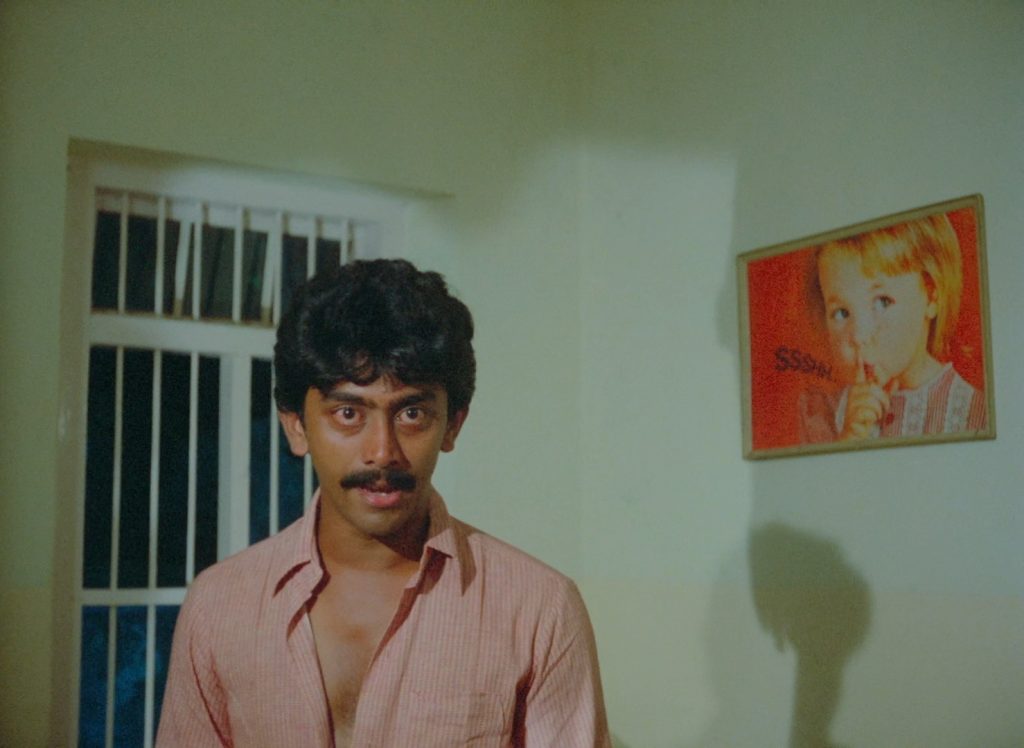
Anantaram is not a corrective to Vertigo; rather it has the advantage of showing that the point of the Oedipus complex is not the literal attraction to one’s own mother, but rather the infantile idealization of a woman. The oedipal male lives in the past, clinging to an impression that no real woman can live up to. Ajayan first speaks to Nalini right after a professor speaks of living in the present, but the lesson fades quickly, and Ajayan prefers the “historical fiction” that his first schoolteacher had likened to a sunken ship. The film’s first image is a crying toddler, and we’re meant to understand that Ajayan will remain like a crying toddler into his adulthood. Right after the intermission he says “My childhood still lives with me,” and when he lashes out at Suma at the end, calling her Nalini and shouting that she will not deceive him again, he stands beside a painting of a small child, just as Scottie Ferguson had stood before a painting of a child at a key moment in Vertigo.
Ajayan’s second narration, like his first, ends with a hint of things left unsaid, and his story is left open, but the coda on the ghat steps drops a few clues beyond simply clarifying the narrative structure. First of all, it ends with the boy standing by the water. Ten minutes earlier, a cryptic insert of a chemistry class had ended with the professor writing “H₂O” on the blackboard, hinting at water as a final element. During Ajayan’s flirtation with Suma he had witnessed a dead body floating by the same steps, and as a child he had told Balu of a female water spirit who tried to pull boys into the water there, just as Ajayan’s own story ends with him figuratively pulled under by the imaginary spirit of a woman. Secondly, the ending is not the first time we’ve heard counting in that spot. When the teenage Ajayan had demonstrated his superior lungpower in the river, a friend had counted to seventy on the steps. In that scene Ajayan was the center of attention, but at the film’s end he’s barely recognizable, and the focus is on the place itself. Any cure for his unhealthy obsession would need to be a figurative death of his ego, removing himself from the central position in his internal autobiography.
CONNECTIONS:
The Cabinet of Dr. Caligari – Unreliable narrator who tells a self-flattering account of his past; protagonist turns mad at the end, misidentifying and accusing someone
Modern Times – Clock set to 12:00 at the central inflection point
Vertigo – Tale of obsessive longing in two parts; gentleman who turns out to be demanding and possessive; romance forbidden in first half and permitted but tainted in second half; allusions to Oedipus; romance follows loss of a father figure; name or identity of romantic ideal shifts; significance of “Ma-” in a woman’s name; protagonist juxtaposed with a painting of a child
Psycho – Stuffed birds mounted on a wall; grown man with a juvenile wish to possess women
The Moon in the Gutter – Incest equated with an attraction to the impossible or unreal