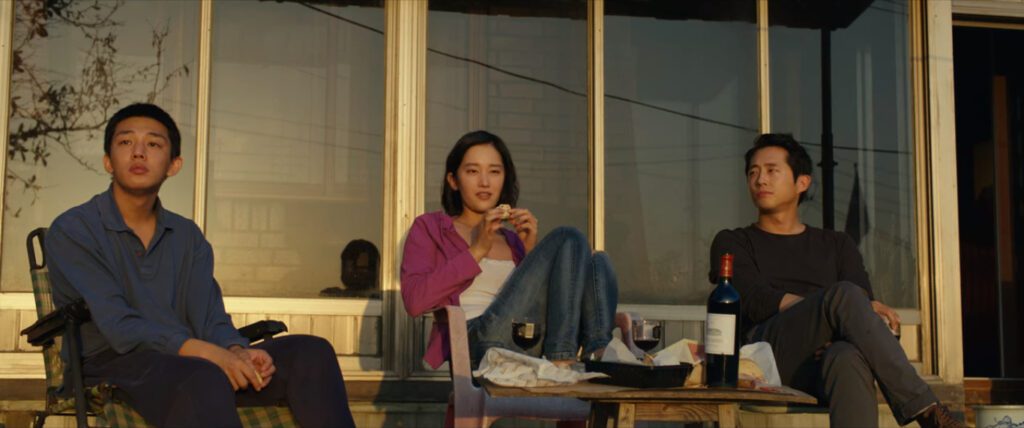
Burning
2018, directed by Lee Chang-dong
Early in Burning when Jong-su first visits Hae-mi’s apartment, she tells him how a fleeting daily reflection from Seoul Tower provides the room’s only sunlight. She says you have to be lucky to catch it, but while they have sex Jong-su happens to witness the brief flash, and just then the film’s recurring musical theme makes its first appearance. It wouldn’t be unreasonable to take the sun’s rays as a figurative source of illumination, a key to the movie, because the view of Seoul Tower from Hae-mi’s window will mark two further turning points: first when Jong-su fantasizes about Hae-mi during her trip to Africa, and again toward the end when he begins writing his novel.
The enigmas of Burning start to clear up if we think ourselves into Jong-su’s character at the moment Hae-mi calls him from Nairobi. At that very point he had been masturbating to her photo while facing Seoul Tower, and now he hears she will be back the next day and wants to see him. Their sex earlier was too sudden – he had not yet formed his desire – but now he is totally drawn to her, and halfway through the movie he will say he’s in love. At the time of this phone call, therefore, we have an unsuccessful loner who for once is ready to see his fantasy come true. When we think of a fantasy, however, we tend to think mainly of the object and neglect the subject. If a man fantasizes about a woman, for example, at the same time he fantasizes about himself as he would wish to be.

When Jong-su meets Hae-mi at the airport, the second half of his fantasy materializes in Ben, who is everything Jong-su wants to be: rich, confident, respected, playful, good looking, cool, successful with women, a good cook, and free from sadness or fear. Ben boasts of his superior DNA, and Jong-su doubtless admires the condescending way he speaks to his mother on the phone. Instead of sulking or protesting when Hae-mi favors Ben, Jong-su lets Ben drive her home, even as she seems to wait for him to change his mind. Does Jong-su lack the confidence to take her home? Or does he identify with Ben and give Hae-mi willingly to his ideal self? Ben speaks of being in two places at once, which fits with his being a projection of Jong-su.
Once we see what Ben represents to Jong-su, we can also see that everything in Burning revolves around the problems of fantasy. The fact that Hae-mi, a girl he called ugly in middle school, has had plastic surgery to look pretty, makes her a fitting object of fantasy in his eyes. Like a fantasy she gives herself easily, falling into his life out of the blue. Her pantomime with the imaginary tangerine opens new channels of fantasy: “Look. I can eat tangerines whenever I want.” After this he’s so primed to see the working of imagination that when Hae-mi’s cat Boil doesn’t show himself, Jong-su questions the cat’s existence, supposing that he’s being drawn into some grand pantomime. Once he’s handed Hae-mi off to his ideal self, his fantasy turns from object (Hae-mi) to subject (himself). The recurring question as to whether the well by her house ever existed is so important to Jong-su because, if her story is true, then he’s a hero in her eyes for having saved her.
Burning leaves almost everything open to question, and one may argue endlessly about what is real or imagined. Does Boil or the well or Ben or Hae-mi actually exist? Does Ben murder Hae-mi, clean up her apartment, and steal her cat? It’s natural to wonder about these mysteries, but interpretation should not be limited to sorting out what actually happened. Defining the story’s dynamic, logic, and purpose is more important than ironing out its ambiguities.

In the second half, after Ben confesses his illegal hobby of burning greenhouses, the fantasy takes a dark turn. Everything points to an unspoken idea, at least in Jong-su’s mind, that Ben murders Hae-mi, “burning” a “greenhouse” that’s closer to Jong-su than he thinks. Beside one particularly desolate greenhouse Jong-su gets a wordless call from Hae-mi: a light set of footsteps runs away, and heavier steps approach calmly to hang up Hae-mi’s phone. Hae-mi disappears, her apartment is tidied up, her suitcase remains, and no further calls come from her phone. Her pink watch appears in Ben’s drawer among other feminine souvenirs, and Ben has newly adopted a cute cat who answers to the name Boil.
If we view Ben as an extension of Jong-su, as his fantasy-self made real, then Ben’s crimes expose to Jong-su the dark side of his own fantasy life. In addition to all the positive qualities he envies in Ben, Jong-su secretly wishes to use women and destroy them. This revelation horrifies him, and killing Ben equates to killing off this destructive side of his own personality. Right before finding Hae-mi’s watch in Ben’s drawer, Jong-su takes a hard look in the mirror as if to see himself more clearly. When he delivers the fatal thrust into Ben’s chest, Ben embraces him. Is this the gesture of a man asserting his moral superiority by showing kindness to his killer, or is it the natural reaction of a long-embedded character trait resisting its ejection? After killing Ben and burning his Porsche, Jong-su drives off stark naked, newly unencumbered by his old faults. The film rises to a new level if we take it as a story of Jong-su growing up.
Jong-su hates his father and wishes to play savior to his mother. Both are signs of an oedipal personality, a man stuck in a juvenile sexuality, nurturing a rivalry with his father and a possessive bond with his mother. If we’ve learned anything from Vertigo or Psycho we should understand that such men are dangerous to women because they’ve never outgrown the self-centeredness of a five-year-old boy. When Jong-su berates Hae-mi for undressing in front of men, we see the possessiveness of a boy who wants his mommy to himself. This might be normal in a child, but in a grown man it’s perverse. Ironically such men tend to mirror the faults they find in their hated fathers. If Jong-su can break the law without getting caught like his dad, he’ll feel his filial contempt is justified.
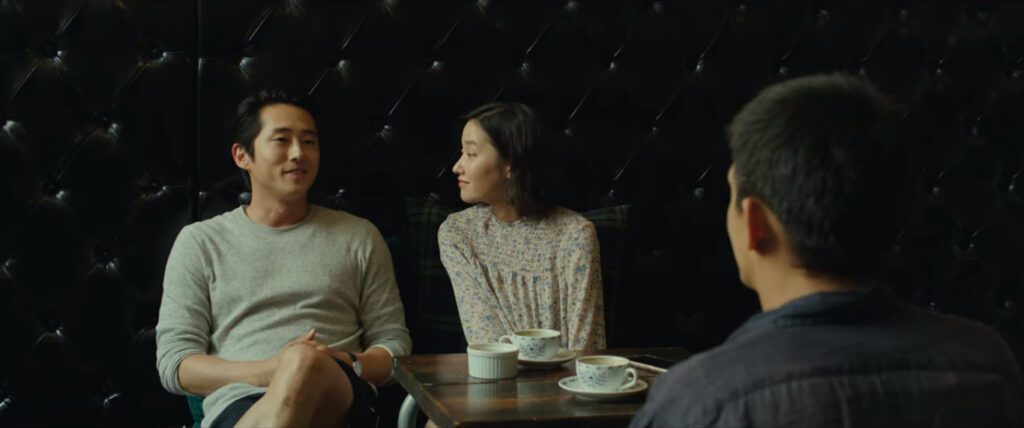
Insofar as Ben is Jong-su’s invention, or at least the object of his projection, his name is hardly neutral. The Western name marks him as cosmopolitan, but more importantly “Ben” means “son” in Hebrew. Like Scottie Ferguson in Vertigo (whose name also includes the word “son”), an oedipal character is acutely conscious of being a son to his parents, imagining himself still a child, old enough to make demands but not yet ready to comprehend responsibilities or to see others as equals. Right before the final scene Ben applies make-up to a young woman, re-making her like Scottie makes Judy over in Vertigo before driving her to her death. It’s the first scene without Jong-su in it – he’s finally ready to see Ben separate from himself.
Unlike Scottie Ferguson and Norman Bates, however, Jong-su comes to realize what he’s been. The movie gives him plausible motives to break free from his immaturity. He may be touched to hear he’s the only person Hae-mi trusted, or he feels ready to survive without his dark side after projecting it onto another person for so long. After stalking Ben for a long time (i.e. getting to know his own dark side), the pink watch in Ben’s drawer shocks him into self-awareness, and he’s ready to guess that the cat is Boil. Hae-mi shows up in a final moment of fantasy, giving Jong-su a hand job in her bed, but her image vanishes, leaving him alone. It’s precisely at this point that he first begins to write.
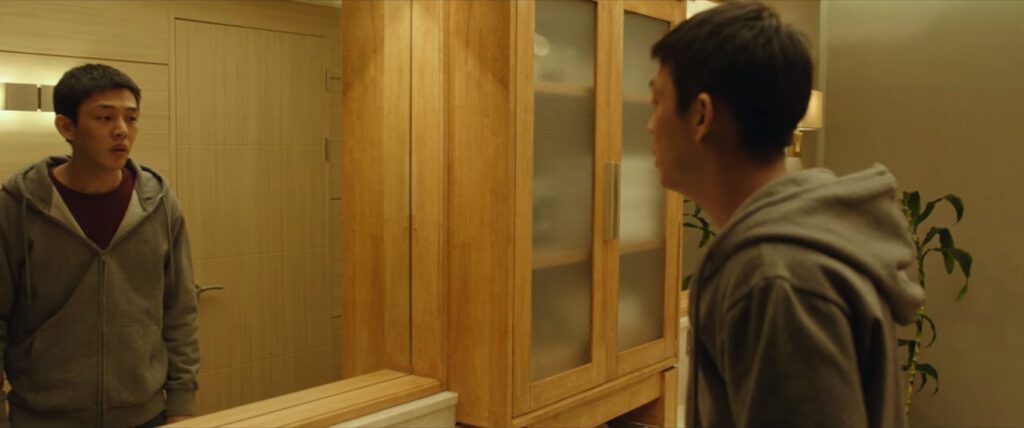
It’s no accident that Jong-su starts to write as soon as his fantasy dissolves. This is the chief insight of Burning – the definition of growing up is to channel fantasy into creative work. Each time Jong-su uses Ben’s bathroom he’s running away from a question about writing, either how to define a metaphor or what kind of novel he’s working on. Until he sees the reality behind his fantasy he’s not ready to be creative. If reading Faulkner only makes him think of himself, as he tells Ben, then Jong-su still has a child’s point of view.
To define creativity as a product of maturity is stricter than the prevailing definition. Most people are willing to call the imaginative products of fantasies “creative”, but according to the logic of Burning, the real productive creativity that Jong-su aims for comes from a mature impulse that puts the self aside. This insight should interest any critic who’s willing to separate the wish fantasies of immature artists from mature works driven by a constructive purpose. The distinction between fantasy and genuine creativity mirrors the difference between “Little Hunger” and “Great Hunger” that Hae-mi witnesses in the Kalahari. “Little Hunger” is a self-focused craving for satisfaction that corresponds to childlike fantasy. “Great Hunger” is a desire to understand the meaning of life, a wish that transcends the self and corresponds to true creativity.

Many reviews of Burning focus on the disparity between economic classes, often grouping the film with Parasite, which was released the following year and which foregrounds the topic of inequality. The contrast between rich and poor is prominent in Burning, and the clips on Jong-su’s television add real-world social and political context, but the chief concern here is to understand the dangers of fantasy, which naturally extend into economics and politics. The concentration of wealth into a few hands, which, assuming a finite-sum game, deprives countless people of needed resources, happens because so many of us (of whom some succeed) reach for a fantasy life that fulfills every desire.
When Ben asks Jong-su what kind of story he’s writing, Jong-su answers that he hasn’t started yet because “To me, the world is a mystery.” It’s an honest answer, yet we can see that Jong-su’s difficulty comprehending the world stems from his childish self-centeredness. Precisely one minute later, after approaching Ben’s bathroom with visible fear, Jong-su will be jolted into the real world when he discovers the pink watch. Now the world is less of a mystery to him, and he’ll soon be able to start writing about it.
CONNECTIONS:
5 Fingers – Character motivated by an image of what he’d like to be
Rear Window – Oedipal male who grows up when he moves beyond a fantasy world
Vertigo – Oedipal character with “son” in name; oedipal complex resulting in danger to women
Psycho – Oedipal character who fantasizes being a hero to his mother
Last Year at Marienbad – Hazards of fantasy
The Man Who Left His Will on Film – Young man with artistic ambitions pursues his double without seeming to realize it, while treating a young woman as an object
The Hypothesis of the Stolen Painting – Rays of sunlight reflected into a room are a key to interpretation
Diva – Protagonist projects his ideal self onto a fantasy figure; growing up defined as an evolution from fantasy to creative appreciation
Enemy – Man meets his double who embodies his darkest impulses; analysis of men’s mistreatment of women
There Is No Evil – Man retrieves a cat hiding in an apartment building’s garage