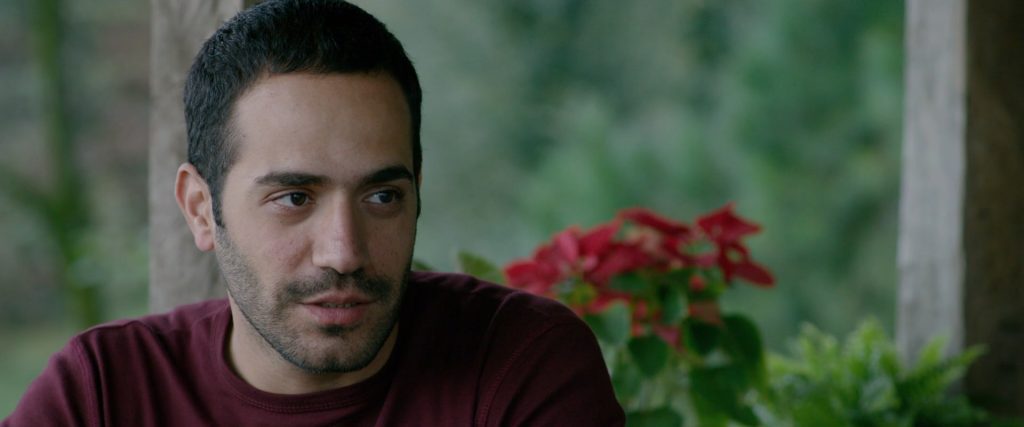
There Is No Evil
2020, directed by Mohammad Rasoulof
The first of the four episodes in There Is No Evil is an unmistakable portrait of what the philosopher Hannah Arendt famously called “the banality of evil” – the great harm done without malice, relish, or passion by persons acting unthinkingly, often following orders or a routine. A middle-aged man, Heshmat, leaves work and spends a fairly ordinary day with his family. Only in the episode’s last minute do we find out that he’s an executioner. It’s appropriate that the film begins with his story, because as powerful as it is, the remaining episodes show that Arendt’s analysis doesn’t say enough. To describe evil as “banal” is only one step on the way to the more radical denial of evil in the title.
By taking Arendt’s position as its starting point, the film dispenses with the usual characterizations of evil. No one in the four episodes is a psychopath, a sadist, or a fanatic. When people apply the word “evil” to those types, they’re typically expressing shock. Under the cover of moral judgment, the label is actually a cry of helplessness. The word is therefore counterproductive, because this same helplessness encourages the persons doing harm. If we’re honest about the extreme behavior of such persons, we must recognize that the psychopath is constitutionally incapable of empathy, that the sadist is psychologically warped, and that the fanatic is deceived. None of these necessitates a moral judgment, and there are means more practical than condemnations and punishments to minimize their harm.
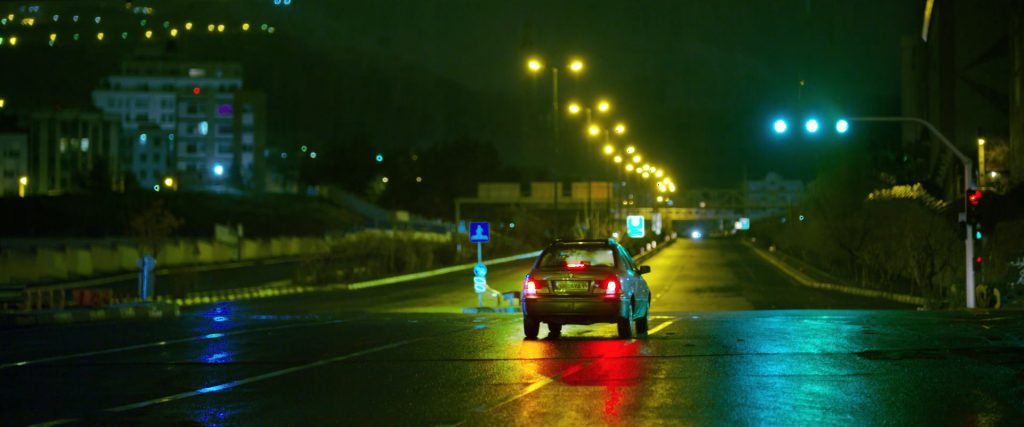
Heshmat’s tale opens with flickering fluorescent lights in the garage of what we’ll later learn is a prison. These lights are the first of many foreshadowings of the red and green lights that blink in Heshmat’s office when a hanging is being prepared in the adjacent room. On Heshmat’s drive home a pair of traffic lights changes from red to green, each color accompanied by a digital countdown, an ominous sign in retrospect. Red and green crosses blink in a pharmacy’s windows, one of them reflected over Heshmat’s face in the car window as if haunting him. His alarm clock bathes his bed in green light, and when the time changes to 3:00 it beeps like the panel in his office. Green, white, and red LED lights decorate lampposts at night, pointing simultaneously at Heshmat’s panel and the Iranian flag, obliquely commenting on a government that ranks second worldwide in the application of capital punishment.
Finally, nearing the prison, Heshmat remains stopped at an intersection as the light goes from red to green and red again, as if the lights trigger something in his conscience, holding him back from his job. Earlier it came out that he regularly sends his wife into the bank to deposit his salary, despite her protests and the bank’s rules. Although doing so saves the inconvenience of parking, the real reason is likely that his conscience rebels against depositing the dirty money himself. There’s evidently enough decency in him that killing is against his nature. The segment is modeled after Jeanne Dielman, spending nearly all its time on quotidian activity until a final twist, which in this case highlights the ironic discrepancy between Heshmat’s nature and his actions.
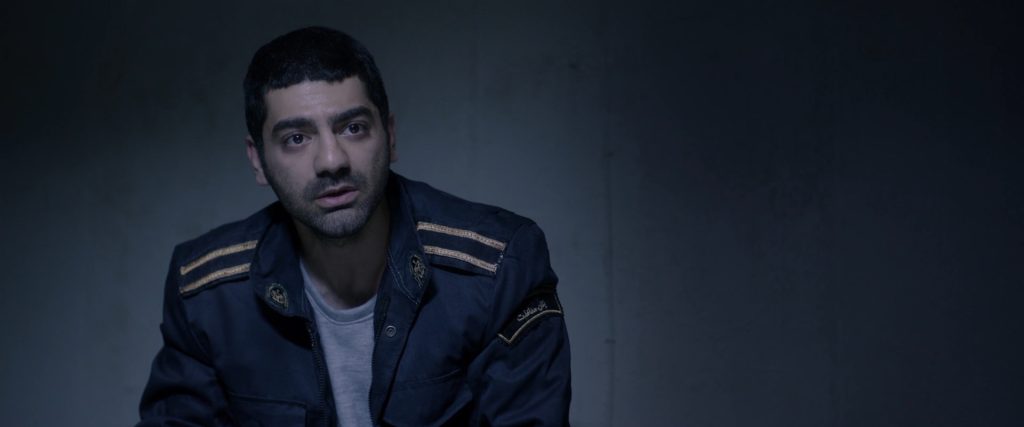
The second episode is also modeled on a classic film. Like Robert Bresson’s A Man Escaped, it’s about breaking out of a prison, only with the irony that it’s an executioner who escapes. Like Fontaine in Bresson’s film, Pouya is given instructions to facilitate his exit. Like Fontaine he must descend and ascend before reaching the perimeter, and at the moment of liberation (when his girlfriend picks him up) a train passes. The glory of Mozart’s Sanctus is replaced here by a jubilant rendition of the anti-fascist anthem Bella ciao.
Though each episode is an independent narrative, they are strongly linked as each puts the subsequent episodes in greater context, minimizing the need for exposition. The third and fourth are clearly built on the second, and the second follows logically from the first. It’s not only that wrongs are committed unthinkingly, but that anyone can appreciate how difficult it can be to avoid wrongdoing. Despite Pouya’s triumphant ending, it’s clear that even a conscience as strong as his might have failed if things hadn’t gone so favorably.
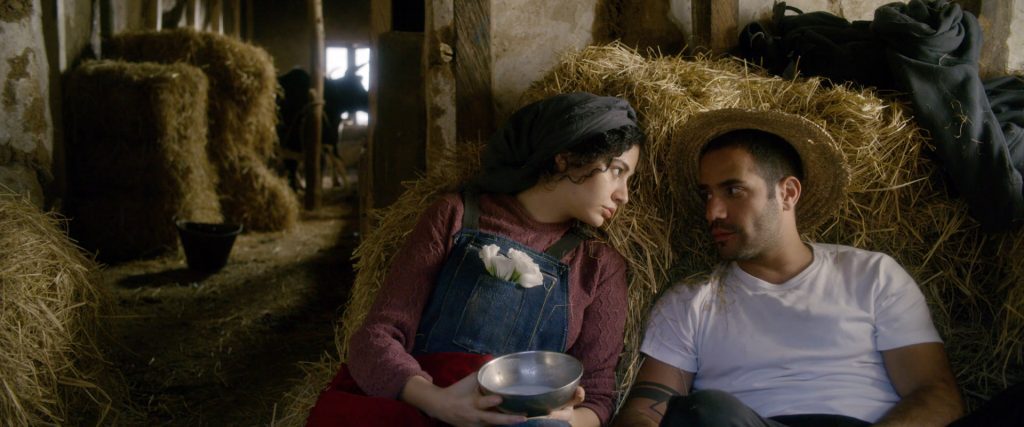
The third episode asks what might happen to a soldier in Pouya’s position who failed to resist his assignment. Javad is weaker than Pouya, and like Heshmat the act of killing weighs on him, but he can bear it until it costs him personally. The actions of Javad’s girlfriend Nana, though, are more revealing. Upon hearing that Javad had executed her family’s dear friend Keyvan, she’s momentarily tempted to execute her boyfriend in turn, but when he says “I’m cold” she loosens her grip on the rock she was clutching. Still, despite her persistent love, she cannot marry Javad, and sending him away is a symbolic execution – she’s draped his uniform on a branch like a hanged man, and as he watches her go he’s framed beside the empty uniform as if suspended against the sloping riverbank. The image looks like a double hanging.
There may or may not be some cinematic antecedent to this episode, but in any case it shows echoes of Tarkovsky, most obviously in the recurring call of a cuckoo around Nana’s house. In Ivan’s Childhood a pair of soldiers is left hung beside a river, and in Stalker the cowardly character puts on a crown of thorns, as Javad wears a crown of flowers from Nana. The ironic contrast is between the room in Stalker where wishes are granted, and Nana’s living room where the dreadful news hits Javad. As the double hanging suggests, every crime creates two victims, one being the perpetrator. The notion of evil is further eroded when we understand, as Nana does, that a wrongdoer should be pitied.
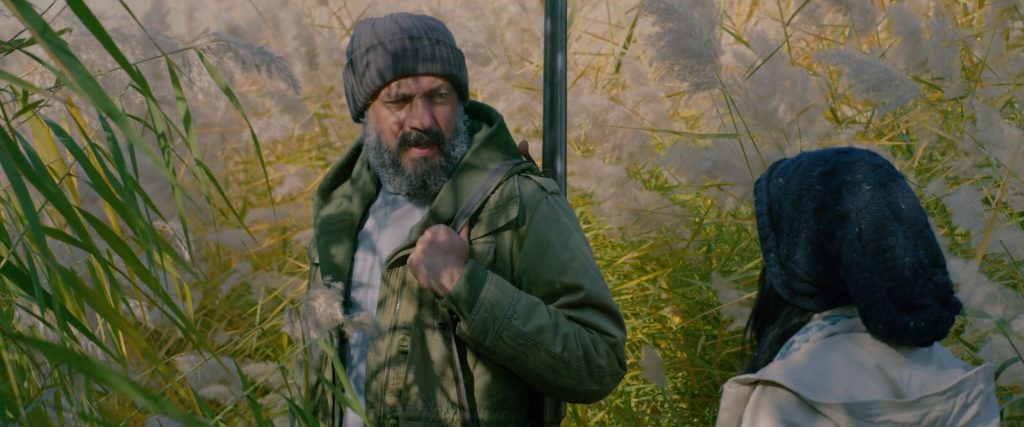
Again in the fourth episode the cinematic model may be less definite, but it would be natural for Rasoulof to end with an homage to a master of Iranian cinema. Both the premise and the visuals show parallels to Abbas Kiarostami’s The Wind Will Carry Us. In each film a visitor travels from Tehran to a semi-arid mountain village to see someone who’s dying. The beehives on the hill recall the graveyard, and Darya is framed against the sky using her cell phone on a hilltop. The warm tone of Kiarostami’s portrait of village life contrasts with the melancholy tone here. The episode dampens the victorious tone of the second, bringing Pouya’s story down to reality. The melody of Bella ciao is reprised, but this time it’s played mournfully. The ending is ambiguous, with room for hope as Darya smiles at the fox she saved, and we can hope her compassion reaches to her newly revealed father Bahram.
Though Bahram recognizes the symmetry between Darya’s mercy for the fox and his mercy for the condemned prisoner long ago, the crux of the story is a mutual misunderstanding, as neither one accepts the other’s action. The point here is the capstone to the argument in the title – everyone’s compassion is selective. There is probably no soul alive who would extend equal care to animals, strangers, enemies, friends, and family, or to all sides of a pressing conflict, yet this disproportion of empathy gives rise to most of what we call “evil”. In that case the word makes little sense.
For lack of a better vocabulary, many viewers might describe There Is No Evil as a set of moral tales, but in disavowing the existence of evil, the film implicitly suggests that we look outside the abstract frame of morality, basing our choices instead on the broadest understanding of metaphysical reality that we’re capable of. Compassion, in this sense, represents a broader view than selfish interest because it accounts for multiple points of view. When Pouya refuses to kill the prisoner, it’s no abstract law that guides him but rather an instinctive appreciation of the other man’s position in the universe as well as his own, including his own limits. He doesn’t want to play God.
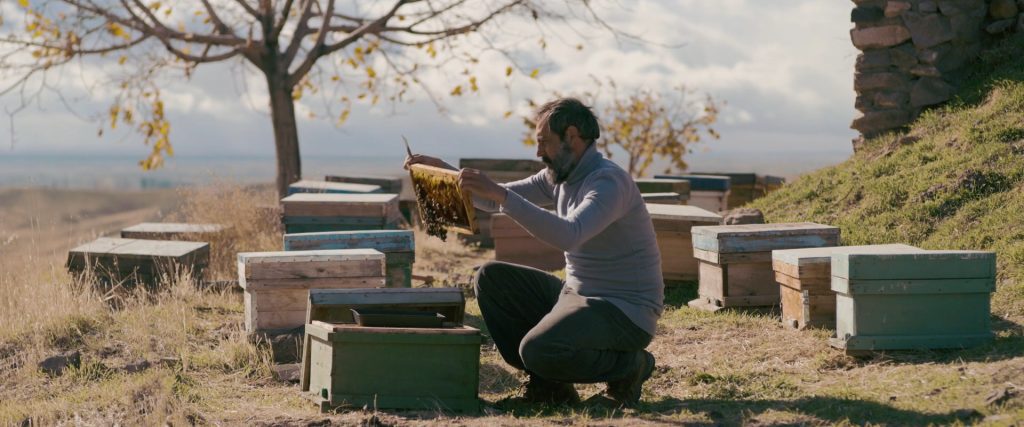
Another of the film’s ironies is the extent of wisdom to be learned from animals. The fourth episode introduces three types of animal life: a snake, a fox, and honeybees. Some humans, the pathological cases, are like the snake who’s bitten the little girl. Those people are harmful by nature and need to be sidestepped, treated with caution, their poison arrested as promptly as possible. Most humans are like the fox, causing unwitting damage but also vulnerable and capable of affection. The most admirable are the bees, a highly social creature capable of stinging on rare occasions but primarily occupied with making honey.
CONNECTIONS:
A Man Escaped – Escape from a prison; comrade gives instructions for exit; descent and ascent; train passes at the climax; joyous music at end
Knife in the Water – Ends with a car stopped on a highway, leaving the viewer to guess what happens inside
Alphaville – Institutional corridors and flickering lights portray a system guided by abstraction
Jeanne Dielman, 23 quai du Commerce, 1080 Bruxelles – Methodical account of everyday life with a violent twist at the end
The Wind Will Carry Us – Visitor travels from Tehran to a mountain village to see a dying person; cell phone calls from a hilltop; high ground marked with tombstones or beehives
Dancer in the Dark – Argument about capital punishment that goes deeper than morality
Dry Season – Character takes pity on someone who killed a loved one, but cannot enter a close relationship with the killer
Wild Tales – Anthology of tales presenting an ethical question from different angles
Burning – Man retrieves a cat hiding in an apartment building’s garage
No Bears – Subversive Iranian film that ends ambiguously with a car stopped on a road; possible allusions to The Wind Will Carry Us