The Return
2003, directed by Andrey Zvyagintsev
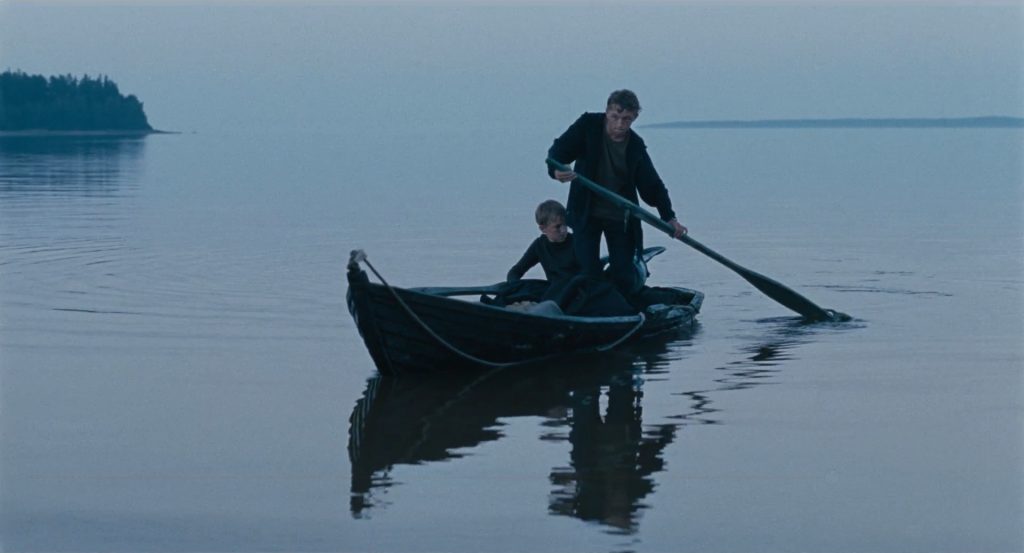
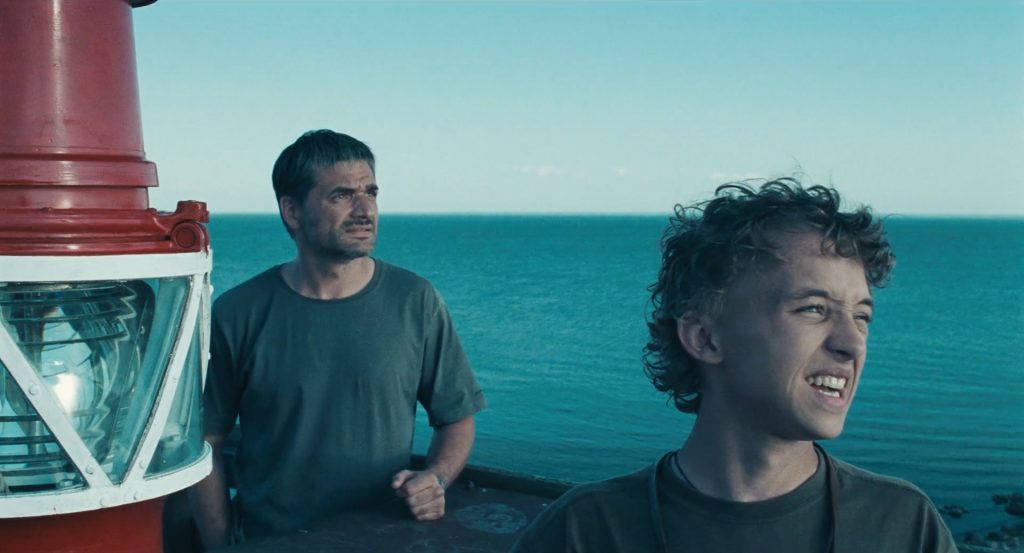
Until the Friday near the end of The Return, it’s an open question whether the father loves his sons or is driven by some sinister motive. Ivan and Andrey have plenty of cause for suspicion. Their father has been away from the family for twelve years; he takes the boys on a road trip with a secret agenda; he pretends to abandon them on a bus; he leaves Ivan alone on a bridge for hours; he gives Andrey a bloody nose when the car gets stuck; he makes them row to the island through heavy rain while he sits in the bow; and he slaps Andrey to the ground for returning late after fishing. Whatever anyone may think of his methods, though, there’s little sign that he means to abuse his sons for his own benefit. Each act of discipline carries a plausible intention of imparting some of the father’s strength to the boys, who will ultimately demonstrate this strength when he’s gone.
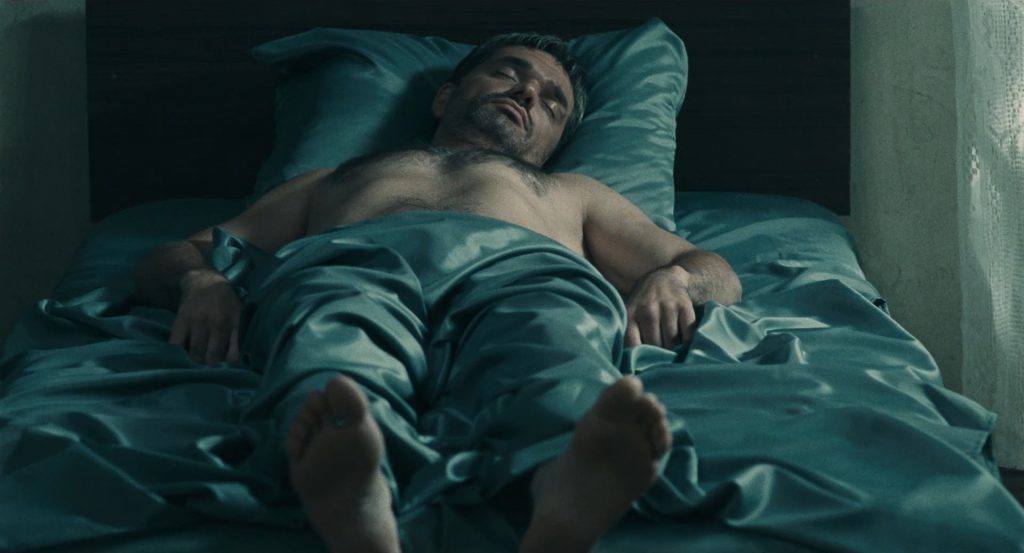
If this reading doesn’t sit well, it’s likely because experience teaches us that so-called “hard love” is rarely altruistic. Physical and psychological punishments tend to harm the recipient, and their motivation is usually selfish or impulsive. Nevertheless, to read The Return as an advertisement for tyranny would repeat Ivan’s fatal misunderstanding when he runs up the tower. The film is not a manual for parenting or for the exercise of power – rather it lets us know from the moment the father is introduced, in a fairly precise likeness of Andrea Mantegna’s Lamentation of Christ, that it will be a parable.
The subject of the parable is laid out in the opening scene when Ivan is too scared to jump from the earlier, smaller tower into the lake. The story will be about courage, but its translation into religious terms changes it into a parable of faith, which is simply the religious equivalent to courage.
The reference to Mantegna’s painting is not the first religious image. When the boys’ mother climbs the tower to comfort Ivan, she cradles him like the Mary in a Pietà, a gesture of unconditional love equivalent to the father’s later act of love on the higher tower, restaging Christ’s sacrifice on a Friday on an upright wooden structure. Though each parent loves Ivan, it will be up to the father to summon the boy’s courage.
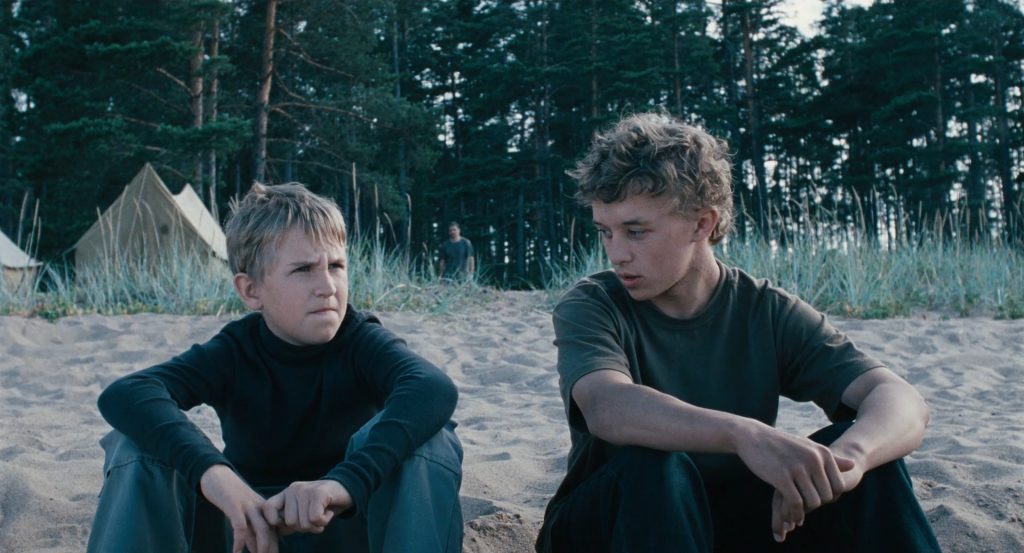
Other details cement the divine nature of the father’s role. At his first appearance he’s “anointed” with a white feather in a direct allusion to Tarkovsky’s Nostalghia (the word “Christ” meaning “the anointed one”). The boys believe he’s a pilot, working in the sky, and Ivan makes a big deal of his father’s silence when asked where it was so “far away” that he “ate too much fish”, the oblique allusion being to Christ’s miraculous multiplication of fishes. More telling though are the boys’ respective attitudes toward their father. Andrey, like a dutiful Christian, believes the man is his father because his mother told him so, while Ivan continually questions his father’s identity and is reluctant to call him “papa”. The night before the trip, Andrey packs a diary while Ivan wants to bring a camera. The same difference distinguishes the faithful, content with a written record, from those who need proof to believe. As it happens, the father is missing from the montage of recent photos in the coda. We only see him in photos from the boys’ childhood, just as we’re so often told to accept the word of distant generations that God ever showed himself on earth.
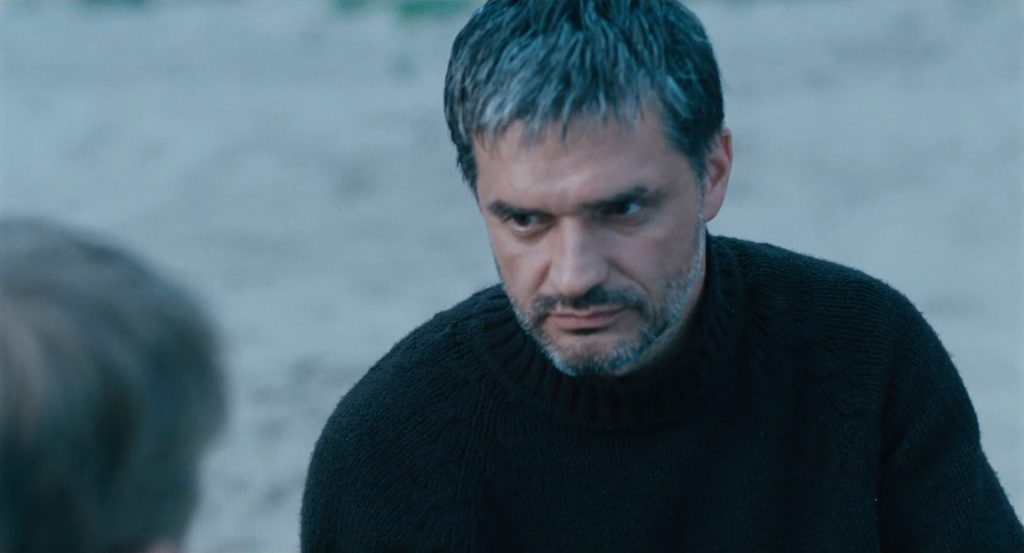
However, the question of faith here is not a matter of adherence to religious authority, but rather of the courage to accept a gift. Ivan mistakes his father’s attitude for hostility, but the man shows a few signs of love even before proving it on the tower, and before the photo in the car confirms it at the end. On the Wednesday, as Ivan sits fishing from a fallen tree trunk, the father casts a loving smile at his son from far away. The most surprising sign of love comes right after the father digs up his box on the island and stows it in the boat. The brothers then come with their can of worms, gathered from the same pit as the box, and decide to row out and put their bait to use. The father must be keenly aware of the boat’s hidden cargo, which is evidently valuable enough to require a remote hiding place and a week-long excursion to fetch it, yet without hesitation he trusts the boys to take it beyond his control. We can only suppose that he calculates, in an instant, that his sons are more valuable to him than the treasure, and that if he’ll trust them with their own lives on a rowboat then he must also trust them with the box.
This MacGuffin in the treasure chest, which the camera passes over right after the film’s title, and whose identity we never learn, must therefore represent the boys’ inheritance, the valuable reward that’s denied to them not by the father’s will but by their own lack of faith. If only Ivan had believed in his father’s love instead of imagining the worst, the treasure would have belonged to them in the end. Likewise, if only Andrey’s belief in his father were deeply felt, not merely the passive acceptance of his mother’s word, he would have respected his father’s command to return in an hour, and the fatal incident wouldn’t have occurred. It’s not a total loss… the father’s watch is a symbolic gift of time, i.e. of life itself, and Andrey is still wearing it at the end. Both boys have apparently learned from their father what they need to survive, but the lost box is a surplus happiness that they’ve deprived themselves of.
When their father shows up, the boys verify his face from an old photo in the attic, tucked beside a page with an engraving of Abraham at the point of sacrificing Isaac. The biblical scene will be restaged in the climactic showdown when the father holds an axe to Andrei’s neck. In its scriptural context, the anticipated sacrifice of Isaac is not an act of abuse; it’s a sacrifice precisely because Abraham loves Isaac and doesn’t wish to lose him. We’re meant to understand here that the father loves Andrey and Ivan, and like Christ he will give his life for them.
From a religious point of view there must be great emotional power in this. Whatever hardships one faces, one may believe that some unknown treasure awaits, and that one’s trials are preparation to receive that treasure. The story also reconciles the two faces of God in Abrahamic scripture, the stern lord and the loving father. Even without the religious context, it still works as an invocation of courage and an affirmation of faith in life.
Another reading suggests itself when Ivan reminds his father that they’ve been apart for twelve years. The Return was made in 2003, twelve years after the dissolution of the Soviet Union, so that the Russian nation had been on its own for the same span of time. The film may therefore be understood as an affectionate exhortation of courage directed at a young nation that, unlike its neighbors, had not yet “taken the plunge” in joining the family of modern nations.
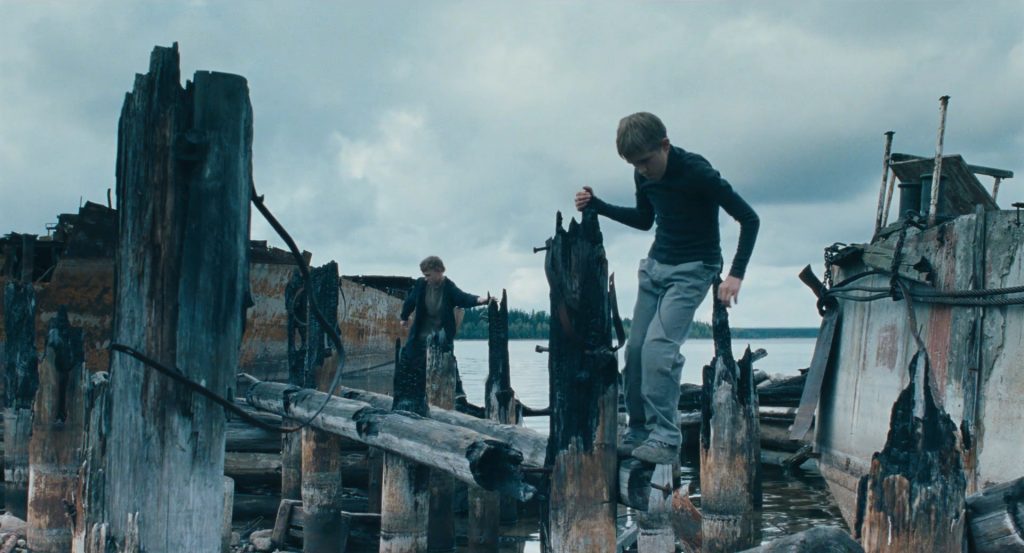
The Return is filled with allusions to Tarkovsky: the seven-part structure of Andrei Rublev, the sudden changes of weather in The Mirror, the feather from Nostalghia; and the sacrificial artwork from The Sacrifice. The strongest connection though is to Stalker, especially in the journey of three men into an isolated zone, in the middle of which is the answer to some deep wish. Like the men in Stalker, the father and his two boys fit the template of Dorothy’s companions in The Wizard of Oz: the father seems to lack heart; Ivan lacks courage; and Andrey, with his blind faith and his bad decisions, lacks brains. More than in Stalker, however, the characters follow their models from Oz in transcending their apparent handicaps. The father turns out to love his sons deeply; Andrey finds his brains when he must figure out how to get back home; and Ivan gradually shows signs of courage. Though it was Andrey who wanted to bring the diary (which represents faith in contrast to the camera as an instrument of proof), it’s Ivan who insists on writing in the diary every night. He stands up to his father in defense of Andrey, he overcomes his fear of heights to climb the tower, and he shows fortitude in helping to bring his father’s body back to shore.
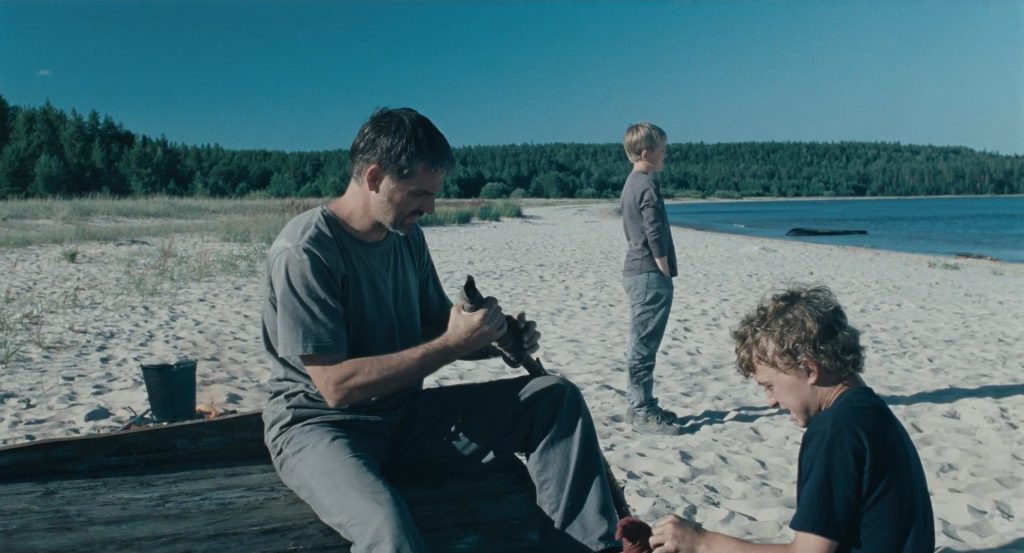
Everything the brothers do to get home depends on the experience they recently shared with their father: rowing the boat, driving the car, and using their “little hands” (as their father had told them, and Andrey echoes) to cut conifer branches and put them under the body (as they had done with the tires). The film’s last line, “Take your shoes off,” repeats the father’s instructions when the car got stuck. The father may be dead, but he lives now in his sons. If the seven days point to the Holy Week before Easter, then the film suggests that the boys will return home on Sunday carrying their father’s living spirit, so that the title points also to a second more wondrous return.
CONNECTIONS:
I Was Born, But… – Reconciliation between a father and his two sons; wheel spinning in the mud
The Wizard of Oz – Three men on a journey to uncover their latent intellect, heart, and courage
Monsieur Hulot’s Holiday – Seven-part structure alluding to a particular week from scripture; personification of God in a way that reconciles viewers to the world’s imperfection
Tokyo Story – Gift of a wristwatch represents a gift of time
Wild Strawberries – Parent(s) looking at a son with love from across a stretch of lake shore
Knife in the Water – Intergenerational tension on a boating trip; prominent MacGuffin
Stalker – Journey to an isolated zone with a room, framed by an open portal, containing the answer to a wish; character knocked down multiple times in succession; fish swimming in shallow water
Nostalghia – White feather landing by a man in a symbolic anointing
The Sacrifice – Act of sacrifice framed as a gift and represented symbolically in a reproduced painting or engraving
Loveless – Prediction of a recurring disappointment after a second 12-year interval