Le bonheur
1965, directed by Agnès Varda
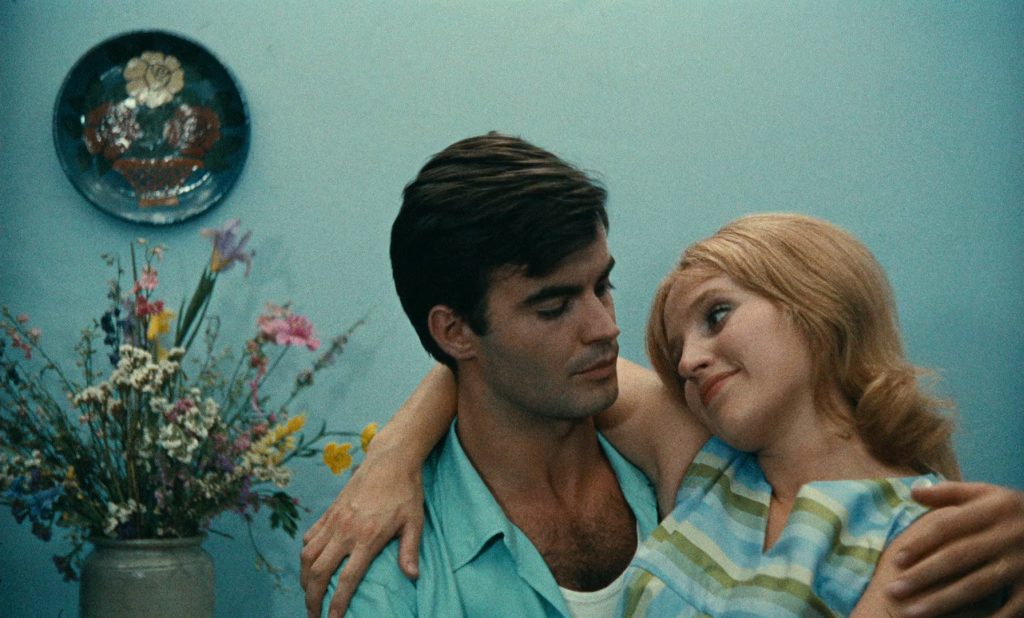
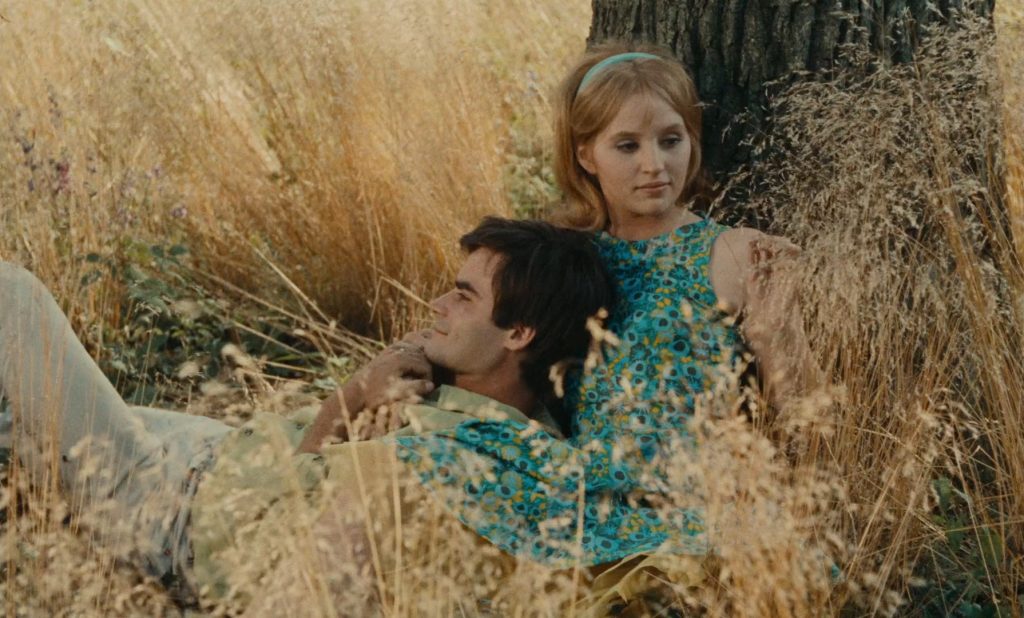
The first disturbance in Le bonheur occurs three and a half minutes in, during the Father’s Day outing while François sleeps under a tree. The children stir in their makeshift tent, and some youths pass by in a convertible, singing and playing guitar. The slight commotion wakes François, but his wife Thérèse keeps the peace, kissing her husband and letting the kids sleep longer. What’s extraordinary is that the passing revelers are dressed in the same colors as the family: reddish-orange, dark green, yellow, and khaki. The yellow dress is flecked with green and red just like Thérèse’s. Most viewers will sense some level of color coordination in Le bonheur, where even the clothing of the extras often matches the surroundings, but quick cutting hides the extent of this artifice. The colors, moreover, are only one facet of a deep symmetry.
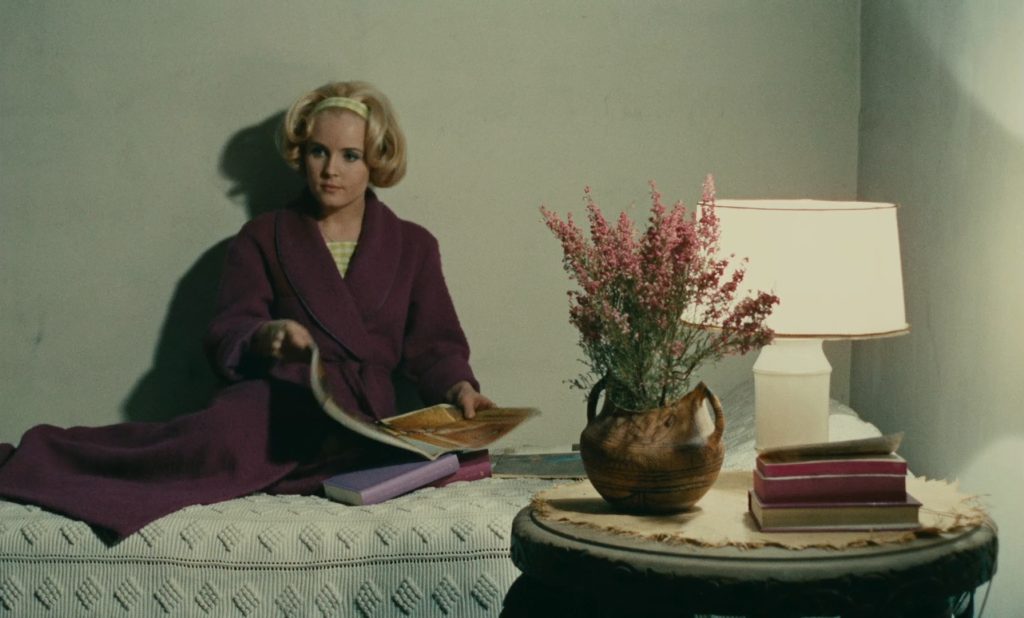
While the family picnics, François’ aunt and uncle play Jean Renoir’s Picnic on the Grass on television. Thérèse builds a tent for her children out of fabric, and François builds a cabin for his nephews out of wood. François meets two attractive blondes: the bride who’s moving out of Fontenay, and Émilie, who’s moving to Fontenay. Pinups of Brigitte Bardot cover a cabinet in the workshop, and a portrait of Bardot hangs on Émilie’s wall. Gisou feeds a sugarcube to a pretend horse, and Jean and Émilie eat sugarcubes. François builds a tricolor toy garage for Pierrot, and he installs a bookshelf the same colors for Émilie. In separate conversations François negotiates with Jean and with Émilie whether to go inside or outside, losing each time. Outside the Fontenay post office is a cinema schedule; inside is a television promotion. The cafés in Vincennes are named for a castle and a château.
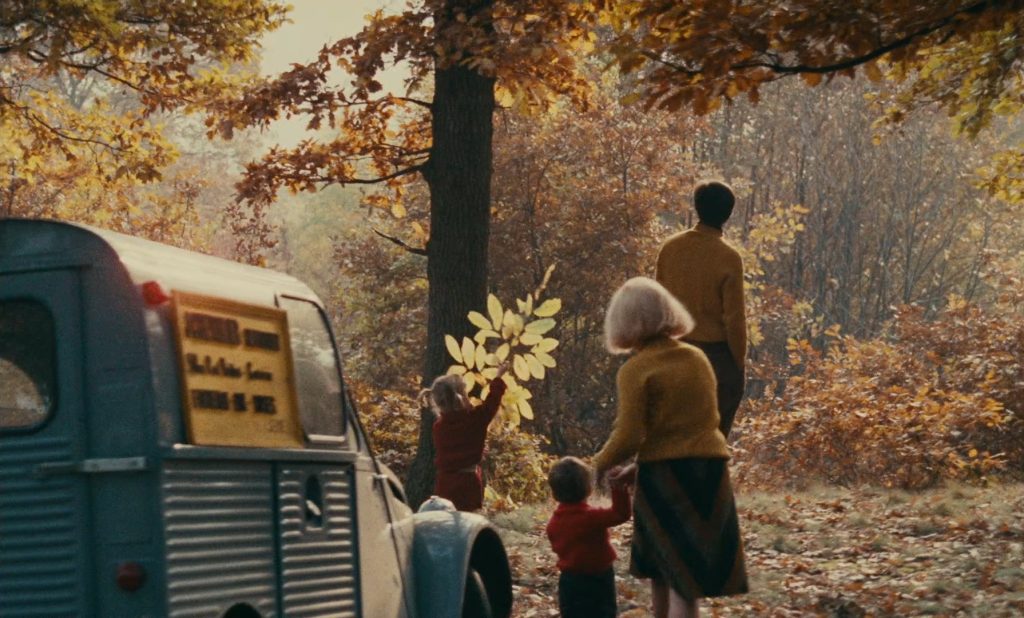
Le bonheur starts and ends by fading in from orange and out to orange. The family walks toward a bed of sunflowers in the titles and walks away through fall foliage at the end. There are two picnic outings by the same pond, two dances in the street, two scenes of lovemaking (a single unbroken shot with Thérèse, a montage of body parts with Émilie), and two shots that include both Thérèse and Émilie (the street market and the first dance). François writes a love note on a blank form, and Émilie draws a heart on a greeting card. The love note is an homage to Jean-Luc Godard’s title sequences, and the fragmented sex scene with Émilie is an homage to Godard’s A Married Woman.
The common denominator in all these symmetries and doublings is a contrast of opposites: soft fabric and hard wood, moving out and moving in, Bardot as an object or as a woman, inside and outside, words and images, a wedding and a funeral, etc. Émilie points out that her job deals with wires (lines) while her brother works with tires (circles). Twelve seconds after Émilie says forty centimes is “cheap for a family” a man asks whether a call to Tel Aviv is expensive. A portrait of the wedding party puts all the men in shadow and all the women in sunlight. François compares his mistress to a wild animal and his wife to a plant. The eight flash cuts between François and Émilie at her doorway underscore the opposition between man & woman, not to mention their nearly opposite hair colors. At various points the dialogue highlights oppositions between night & day, happy & unhappy, sister & brother, boys & girls, right & left, country & urban living, work & home, surprise & habit, young & old, summer & winter, turning the radio off or on.
It might seem backwards, or even robotically obtuse, to prioritize the formal aspects of a movie so strongly rooted in emotion. Apart from the sensuality of the colors, nobody coming out of Le bonheur is thinking of its nuts and bolts. They’re probably filled with sympathy for Thérèse, outrage toward François, or some related emotion. Many, apparently, are outraged at the film itself for letting François get away so lightly, while others detect a feminist comment on the social structures that let men off the hook so consistently. Examining the film’s structural cues, however, reveals something greater than a moralistic lesson. More than exposing the bad behavior of men toward women, Le bonheur inquires into the roots of that behavior.
It’s important that the film is called “Happiness” and not “Fidelity”. Cheating on spouses is not the real subject. Instead of belaboring the wrongs of infidelity, which viewers would file away alongside other familiar warnings, Le bonheur dares to attack the concept of Happiness itself. Once we learn to see happiness as a false ideal, we can begin to understand not only how it motivates selfish behavior, but also how it excuses that behavior in everyone else’s eyes, even its victim’s. The most shocking moment in Le bonheur is not when François cheats on his wife, or when he replaces her at the end, but rather when Thérèse outwardly celebrates his happiness amid her own heartbreak.
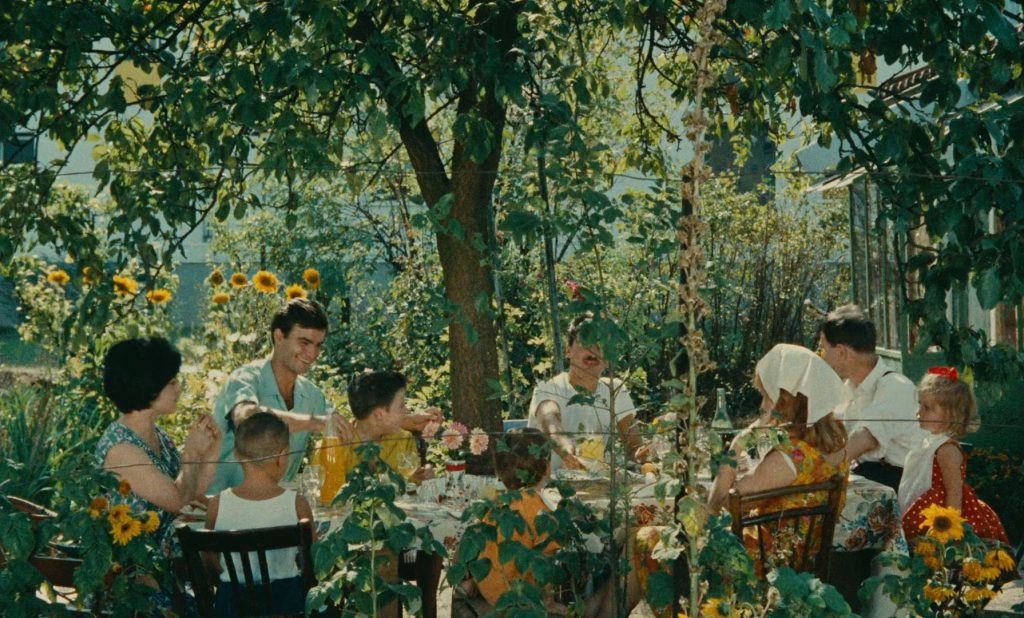
From this point of view, the false allure of happiness is akin to the falsity of opposites. Both are imaginary abstractions, things we believe in because words for them exist. The real common denominator in Le bonheur, if we look more closely, is idealism. All the matching colors, symmetries, and opposites come under the umbrella of ideals, as does the Pollyanna perfection of the characters’ daily life, which we know the film will soon puncture. The first half spans a series of holidays – Father’s Day, the feast of Saint John, baby Isabelle’s birthday, a wedding day, and Bastille Day (announced by successive screens of blue, white, & red) – as if everyone were always celebrating. The protagonists’ surname Chevalier conjures the medieval ideal of knighthood. Flowers are omnipresent, even in the name of Fontenay-aux-Roses. It may be hard to see today, but people in the mid-’60s would have viewed the modern housing blocks in Fontenay as a form of ideal living – clean, convenient, and futuristic. Gisou wears a feathered headdress to play cowboys and Indians with her cousins, alluding to Hollywood’s simplified and idealized view of the Old West.
The first idealized image is in the titles. The image of the Chevalier family approaching a patch of sunflowers may fit the broader pattern of flowers and bright colors, but the discordant element is the lone sunflower that cuts in at intervals. That one flower stands brighter and more upright than the others, and it’s unbothered by bees. Compared to the drooping sunflowers in the other shot it makes an ideal image, but it’s also alone, as François is alone despite his professed happiness and despite having two lovers. He’s alone not because he’s insensitive to others, but because his own happiness comes first. There’s an implicit horror in those shots of the lone sunflower, just as there’s horror lurking underneath all the film’s bright, colorful, and idealized moments. If the film teaches us to be wary of the promises of happiness, then it has achieved its aims.

One might object that this warning against happiness is founded on a limited definition, that real happiness lies in generosity, but in that case we’re not talking about the idealized state of bliss that the word “happiness” connotes. To give selflessly is surely a necessary condition for a good life, but it comes with difficulties, and it would be a mistake to expect unceasing joy as a reward for living generously.
It’s ironic that after a film about happiness, the prevailing emotion would be sadness, but in its way that sums up the point. It’s not that happiness and sadness are true opposites, but that the idealized state that we call “happiness” contains within itself the germ of its own undoing. Describing her conception of Le bonheur, Agnès Varda said, “I imagined a summer peach with its perfect colors, and inside there is a worm.” Watching the exaggerated smoothness of the Chevalier family’s daily life, seemingly free of problems, we probably sense that it’s ripe for disaster, for the same reason that we may recoil from the overwhelming positivity of advertisements, greeting cards, business prospectuses, or modern religions. The promise of happiness, at least as portrayed in this film, is a peculiarly modern phenomenon that prior centuries probably would have distrusted.
It’s also ironic that the two least problematic references to happiness in Le bonheur appear on a greeting card. Unlike a typical greeting card, however, the text does not call attention to itself. It’s inscribed in fine print inside the card where Émilie signs her drawing of a heart: “The Red Cross is happy to be associated with your joy.” In this case neither “happy” (heureuse) nor “joy” (joie) is presented as an ideal. The one is an altruistic happiness, the other a tangible spirit or feeling. Neither promises the impossible, and consequently, neither invites the kind of misfortune that François’ desired happiness invites.
CONNECTIONS:
Holiday Inn – Action spans a series of holidays or other days of celebration
L’avventura – Open question as to how people can move on so easily from the loss of someone close
Alphaville – Pattern of opposites that undermines the idealism or absolutism of polarities
The War Is Over – Homage to the fragmented lovemaking scene in A Married Woman
Topaz – Excess of flowers signals an overly idealized way of life
Parasite – Child who plays in a feathered headdress, alluding to Hollywood westerns while pointing to a broader observation