Il sorpasso
1962, directed by Dino Risi
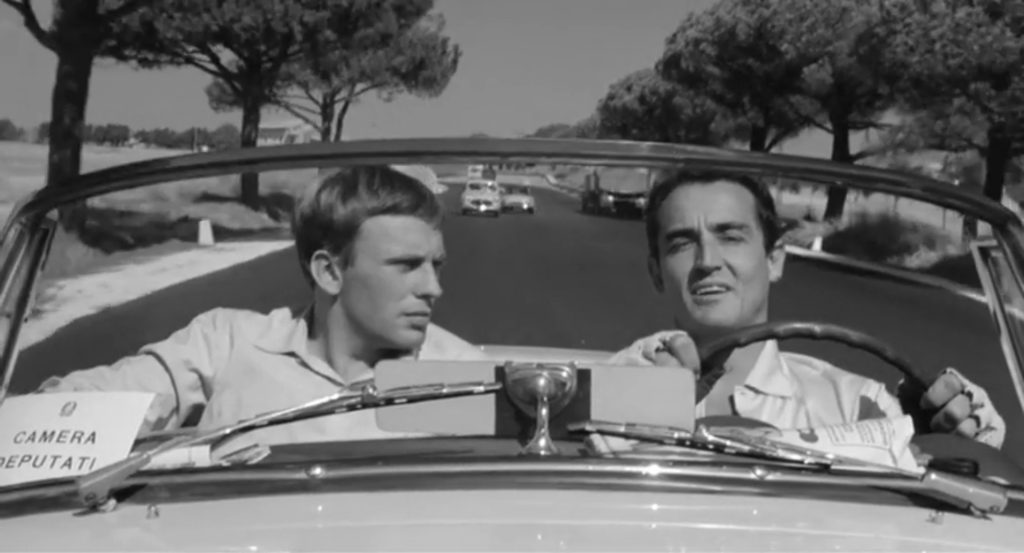
The action in Il sorpasso spans the accidental friendship of two seemingly opposite men, the shy law student Roberto and the free-spirited Bruno. Apart from the plot, however, there’s nothing accidental about their pairing. First of all, their names derive from another movie about an asymmetric male friendship, Alfred Hitchcock’s Strangers on a Train, though both names come from one half of the pair, the villain Bruno and the actor who plays him, Robert Walker. Their meeting echoes another Hitchcock film as Roberto finds trouble outside his rear window. Bruno catches him backing off and challenges his courage: “You hiding?” The significant point here is that Roberto usually spends his idle moments looking out his front window at the ground-floor unit of Valeria, a pretty girl he’s spoken to only twice. Valeria is presently at a beach resort for the Ferragosto holiday, so the infatuated young student happens to look in the opposite direction.
If the object of Roberto’s fantasy is located to one side of his building, the subject of his fantasy is on the other. Bruno, in other words, is his fantasy double, the masculine person Roberto would like to be – bold, seductive, funny, strong, able to get his way with women, cops, strangers, even Roberto’s own relatives. The way he constantly overtakes other drivers is a metaphor for getting ahead in life, as Roberto wishes he could. Their difference is summed up on the beach at night: “Just leap, like I do.” “It’s not that easy. I’m always looking before I leap, so I never leap.”
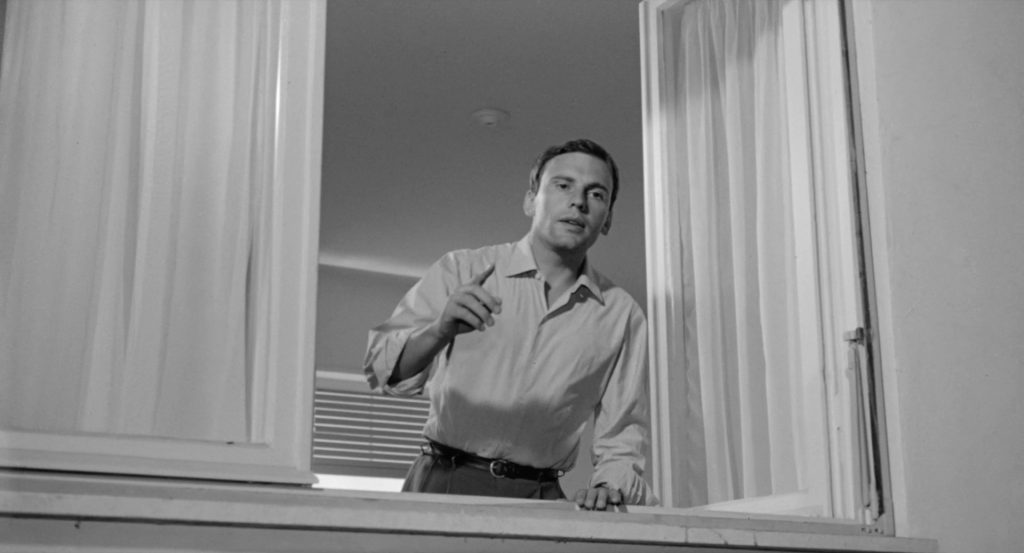
Despite this defining difference, Roberto and Bruno fit together because they share so much in common, starting with the matching shades of their shirts and pants. Roberto follows Bruno willingly because their innermost wishes coincide, especially their boyish views of women. Bruno may mock his new friend’s wish for commitment, but Roberto’s timidness with Valeria could just as well signal a fear of commitment. Bruno’s charm is an imperfect mask for his creepy behavior, but Roberto is equally creepy, taking a furtive photo of Valeria from his window. It’s fitting that both names stem from Robert Walker’s mommy’s-boy villain, because they’re both locked in the mindset of a young boy. Roberto keeps a photo of his mother on his desk, while Bruno anticipates “spending the holiday with Mamma” before conveying his mother’s advice to Roberto: “Mamma says working on a holiday never pays.” The two men take turns wearing a toy mask with glasses and moustache, signalling their shared pretense of adulthood.
Their similarity goes so deep that we might regard them as a single person at two different ages. Bruno says “I was shy too when I was a kid.” He knows his way around Roberto’s apartment without any foreknowledge, and he claims to know the exact contents of his friend’s refrigerator (“two eggs and a lemon”) even though we never see him look there. He intuits family secrets that Roberto never suspected, a gay housekeeper and Aunt Enrica’s infidelity, and he all but seduces Aunt Lidia, the target of Roberto’s prepubescent crush.
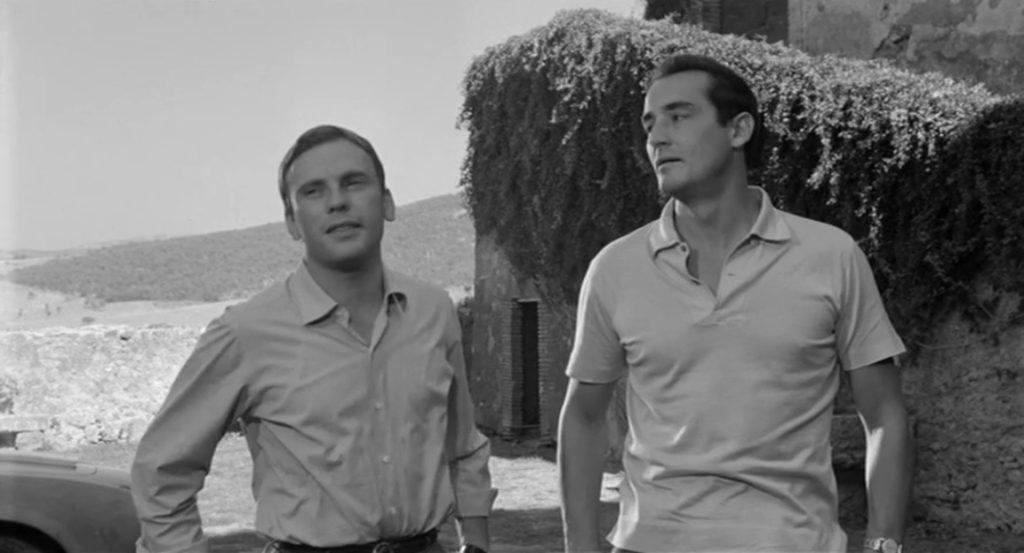
Across the story’s two days, however, the friends gradually trade places. Roberto becomes more and more like Bruno, to the point where he approaches women confidently and goads Bruno to drive more aggressively. Meanwhile Bruno is slowly revealed to be the loser Roberto sees in himself. He bums cigarettes and small change off of everyone, he eats other people’s leftovers at a restaurant, he admits feeling “alone as a stray dog”, and his wife Gianna has lost interest in him. “I’d die before I’d get back together with Bruno. I feel for him what a mother feels for a child who’s always down on his luck.” At the end, when Roberto plummets to his death leaving Bruno standing on the cliff, it’s as if they’ve simply resolved back into one person. Roberto has become the man he wanted to be, only now he understands it’s not worth it. His shy youthful self is gone, and he’s still a loser after all.
If this interpretation sounds fanciful, that’s a credit to a film that weaves it into a lifelike story. To say that Roberto and Bruno are the same person is not to assert some dramatic revelation, nor does the film have any need to announce it. Rather the idea should help us to see what’s essential in the omnipresent contrast between the two men. Most viewers will probably see Bruno as the superior character, which is understandable because Roberto himself holds that view, constantly deferring to his older companion – but by the end, if Roberto has effectively become Bruno, we should appreciate what he has lost in the process.
Roberto may be a weaker version of Bruno with many of the same faults, but he’s also a young man at a point of transition. He could turn into another Bruno, but he still shows signs of innate decency. He objects to Bruno’s treatment of an old man walking on the roadside, and he tries to help a woman who’s lost her baggage at the bus station. When he points to the Etruscan tombs or to Mount Fumaiolo, he shows a sense of wonder that Bruno can only mock. His view of women may be childish, but his interest in Valeria seems to be mixed with some of that same wonder, so that he may yet turn into a respectful husband. Bruno tempts him in the wrong direction, to the point where he cheers Bruno for making off with Gianna’s annulment money, but at least he has the sense to recoil at the path taken by his fascist elder cousin Alfredo whose wife always says “Yes, dear.”
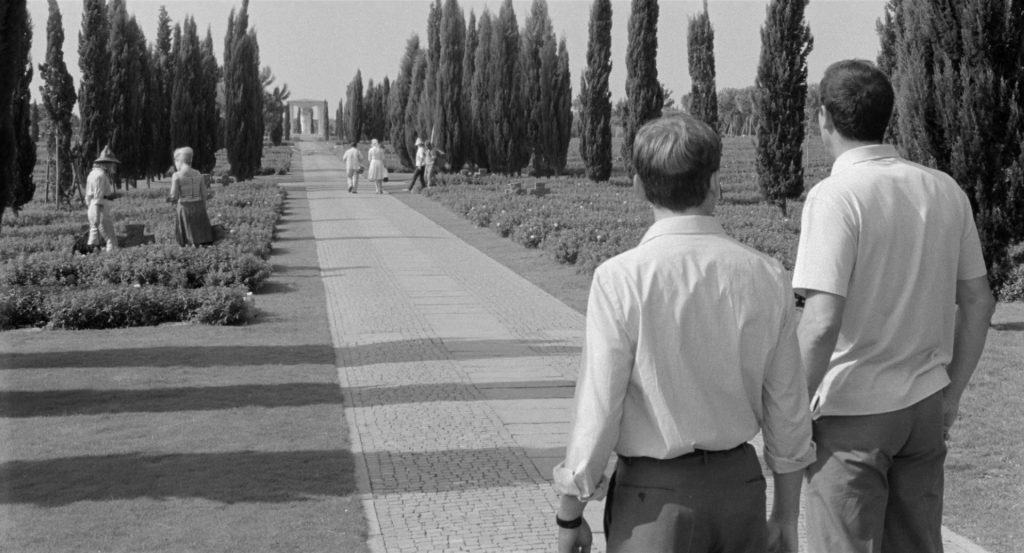
Early in their journey, Roberto gets the better of Bruno in one brief, enigmatic, but revealing scene. Just when the young man starts to catch some of his friend’s energy, they find a pair of German blondes on the road. For once Bruno lets them overtake his car, but with the intent of pursuing them, and Roberto encourages the pursuit, choosing the women over a meal. Bruno will help by sniffing them down, almost as if they were a prospective meal, but only after being stopped by a group of priests changing a tire. Religion, as always, is a nuisance impediment to fantasy. As soon as they follow the Germans into a formal garden, however, the scene turns into an allusion to Last Year at Marienbad, a film about the hazards of fantasy. The garden turns out to be a cemetery, and seeing a name on a grave, the women ask themselves whether they had met a certain man the previous year at Bad Gastein. Roberto gets a bad vibe and suggests they back off, to which Bruno agrees. The scene presages Roberto’s death, which, even if only symbolic, is the result of pursuing a fantasy too far.
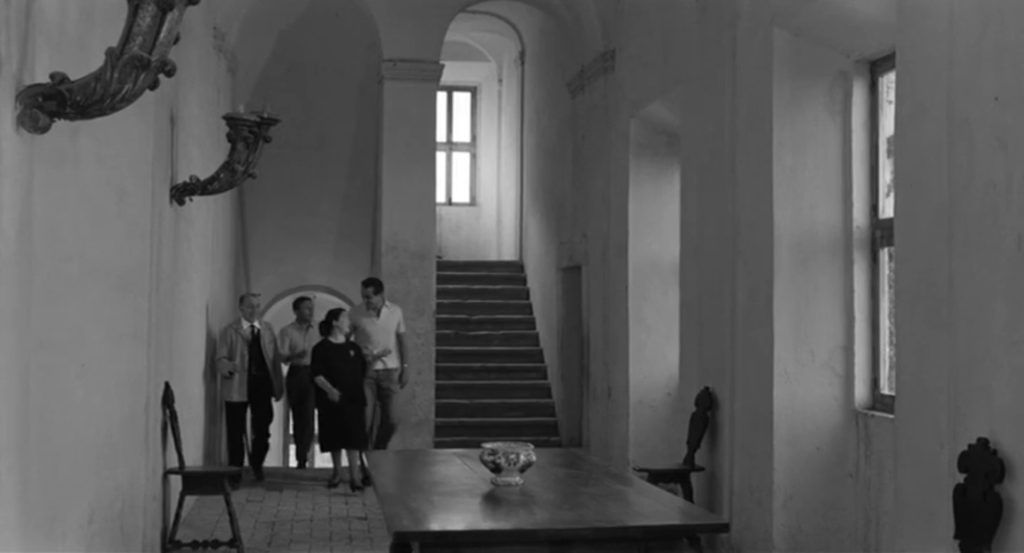
Midway through the film, after Roberto fails to separate from Bruno, the travelers stop at the Tuscan estate of Roberto’s aunt and uncle. The detour begins as a journey into the past, as Roberto reflects on his childhood and wanders alone through the sites of his memories. He speaks of his fond visits there, recalling how he had loved his uncle more than his father while feeling attracted to his then 20-year-old Aunt Lidia, symbolic echoes of an oedipal triangle. Bruno’s salacious observations bring Roberto to reframe his past through adult (though not exactly mature) eyes, and by the end of the episode he’s thinking about his future. On the way out, Bruno speaks of living in the present: “You know what the best age is? I’ll tell you. The age you are, day by day. Until you croak, of course.”
After another attempted separation and a fight with two offended motorists at a restaurant, it’s Bruno’s turn to revisit his past. This time though, instead of mothballs, archways, and feudal lords, it’s a modern home with gigantic plate glass windows that might have inspired Tati’s Playtime, plus a modern wife and an even more modern daughter. If Bruno is a fantasy projection of Roberto’s idealized self, this detour represents an imagined future recollection. The daughter Lilli is also a sort of fantasy, a young woman attracted to older men while still loyal to her father in the ping-pong contest. On the beach Bruno sees Lilli inverted during a handstand, and he has to be reminded that she’s his daughter as she pulls off a black wig to become blonde again.
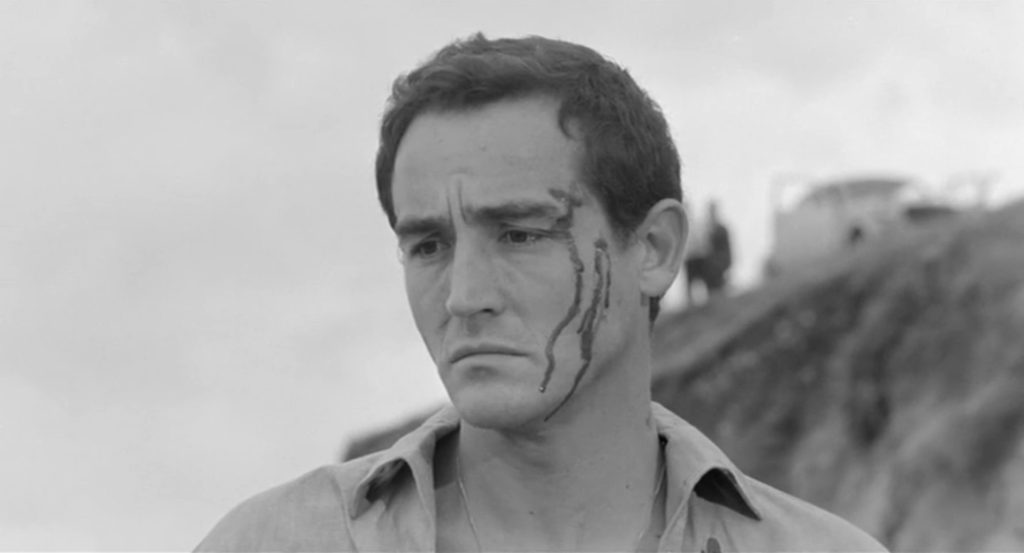
Just as Roberto had recently seen his childhood and family through adult eyes, here at Gianna’s house and the beach, Bruno begins to see his own irresponsibility through adult eyes. He calls his handstand “child’s play” as if realizing what an overgrown boy he still is, and the episode brings him down to earth, humbling him and preparing for the epiphany at the end when he realizes that in holding onto his youth, he’s lost his youthfulness. Right before the road accident that kills off his more innocent side, a small boy waves to him from the back of a pick-up truck, the last in a series of cutaways to small boys that points to the story’s real subject. When the car tumbles down the precipice and Bruno looks down with a mix of horror and resignation, the exchange is complete. The young man has finally overtaken his older projection of himself – the real “surpassing” in the title.
CONNECTIONS:
Strangers on a Train – A man gets into trouble when he meets an uninhibited man named Bruno; plot concerns an exchange of roles; recurring reference to a lighter or cigarettes
Phone Call from a Stranger – Man startles his friend(s) with a pair of fake eyeballs (plus nose & moustache in Il sorpasso); one protagonist is the sole survivor of a crash
Rear Window – Trouble begins for an immature male when he looks out his back window
Vertigo – An impromptu drive becomes a symbolic journey into the psychological past
La notte – Two characters roughly a generation apart who may be viewed as the same person at different ages
Last Year at Marienbad – Formal garden where a woman questions whether she met a certain man the previous year at a certain spa
I Knew Her Well – Portrait of modern Italy with pop music, shock cuts, and scenes at a road accident, beach, fight, train station, country house, & dance floor
Enemy – Man meets his more masculine double, and one of them dies in a car accident
Burning – Young man meets his ideal self at the moment he fantasizes about a woman