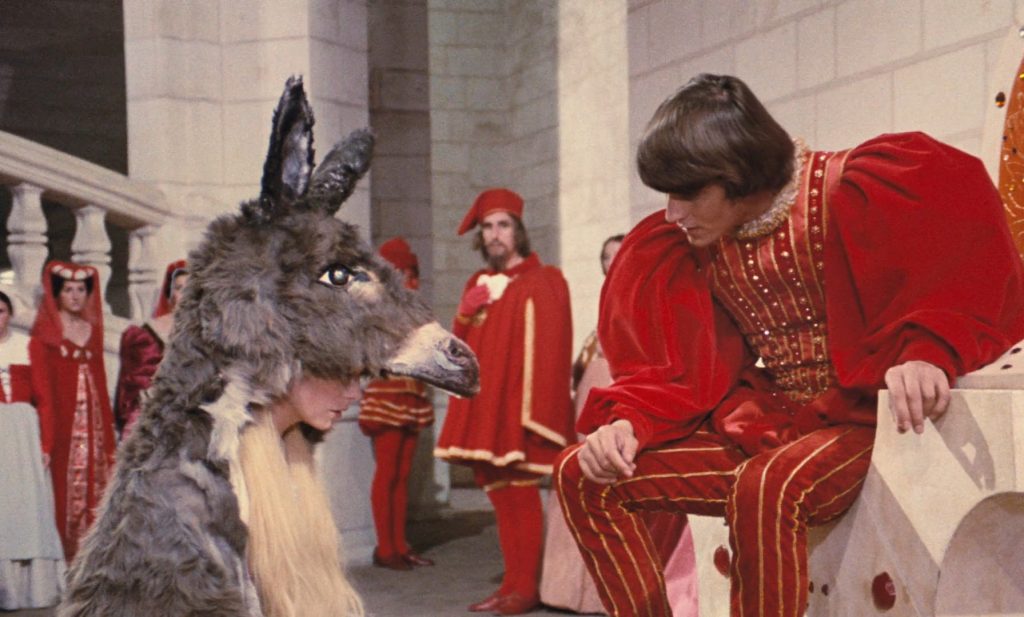
Donkey Skin
1970, directed by Jacques Demy
The easiest thing one could say about Donkey Skin is that it’s a throwback to the classic age of French cinema, rekindling the spirit not only of fairy tales like Les visiteurs du soir and Beauty and the Beast but also a whole tradition of fantasy and surrealism. There’s certainly truth in that, but it would be a mistake to suppose that the film means to swing the pendulum backward after a decade of the Nouvelle vague‘s realism and formal experimentation. The real aim of Donkey Skin is altogether different, and the biggest clue to its purpose is the missing piece in its casting.
There’s a manifold symmetry to the characters of Donkey Skin. They belong to two kingdoms, one blue and one red, though the princess will cross over, and her godmother is the Lilac Fairy (whom we see changing once from yellow). There are also two generations, although Catherine Deneuve plays both the princess and her mother the Blue Queen. Moreover there are two sexes, so that the four principal characters will come to form two couples of different generations, though the Blue King spends much effort pursuing an incestuous match with his own daughter. The most revealing axis of symmetry, though, is the least obvious one – the actors are split in their origin between classic and modern French cinema.
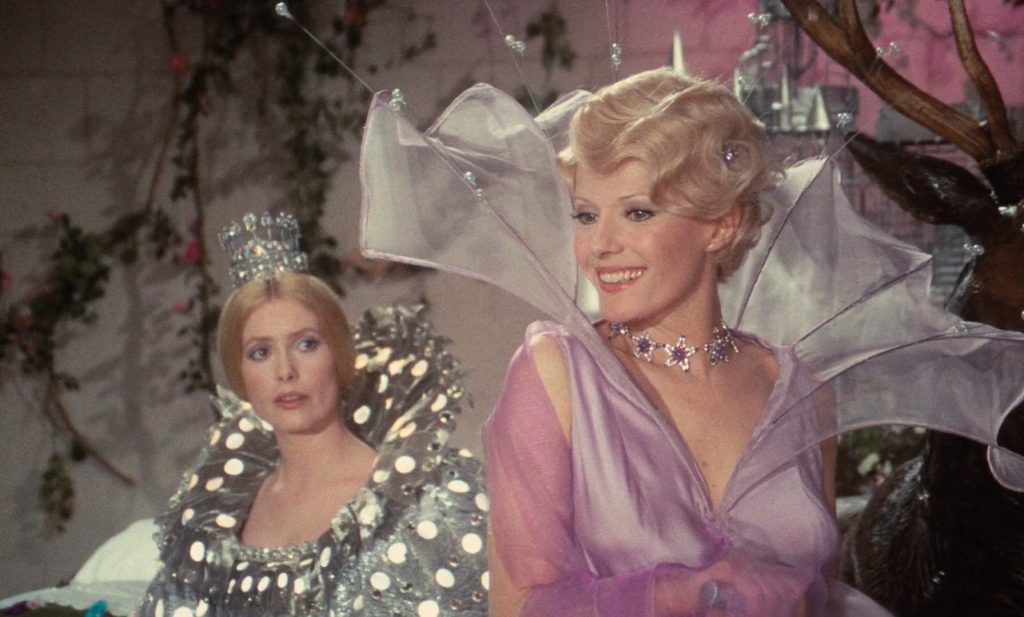
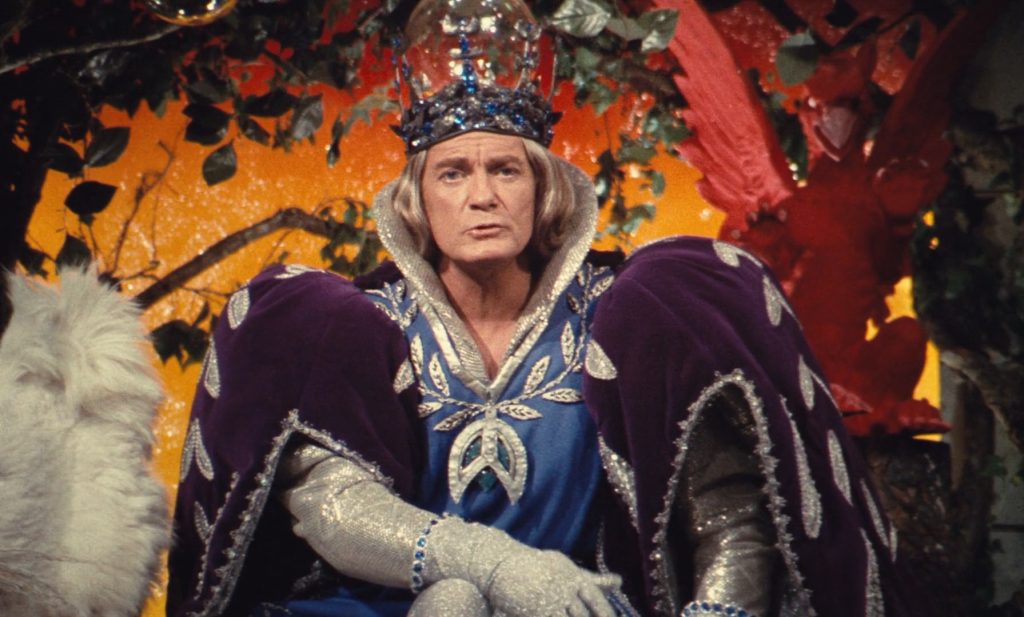
Of the four principals, Jean Marais is a luminary of 1940s and 1950s French film, and he’s joined among the supporting cast by Micheline Presle and Fernand Ledoux (the Red Queen and King) as well as Henri Crémieux and voice narrator Jean Servais. In the other column, Catherine Deneuve and Delphine Seyrig are icons of newer French cinema, and the latter would become a staple of cutting edge 1970s European film. Prime and Second Ministers Sascha Pitoëff and Michel Delahaye are both associated with the New Wave, the former having played Seyrig’s husband in Last Year at Marienbad, and composer Michel Legrand is a major contributor to that movement.
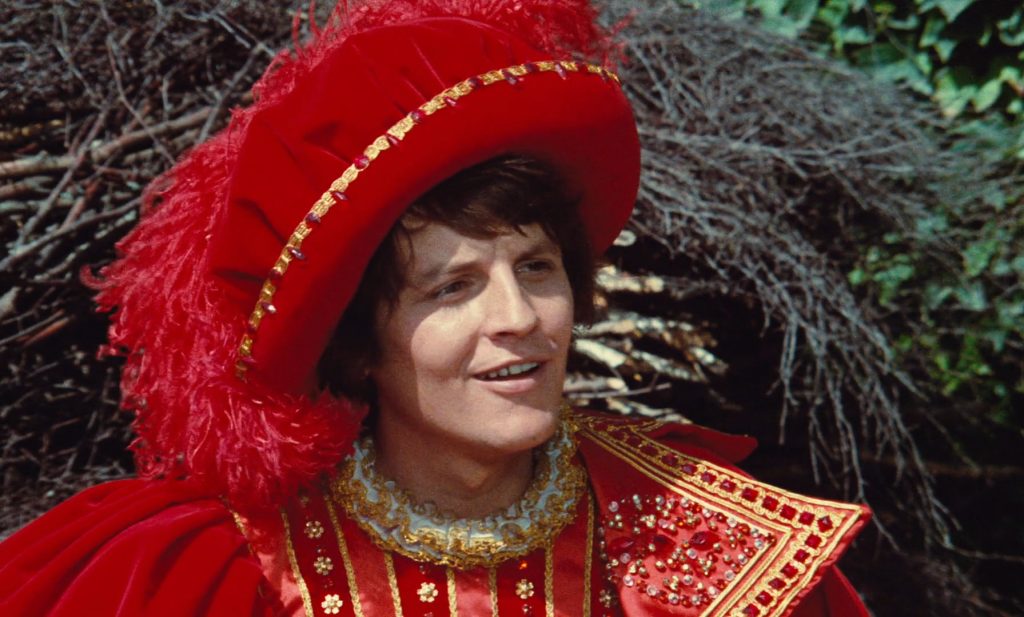
The missing piece is the Red Prince. Jacques Perrin is a relative unknown, about 29 years old at the time of filming, so it would seem impossible to imagine that he could balance out the four leads as a representative of the classic period, except that he so closely resembles star actor Gérard Philipe, in both looks and bearing. Philipe had died young in 1959, though he would have been 48 if cast in Donkey Skin, too old for the youthful prince. To use Perrin as a stand-in for Philipe may feel like a compromise, but as we’ve noted the web of symmetries is broken with anomalies on every level. The optimal thing is not to balance everything neatly, but to erect a framework that the audience can sense intuitively, while remaining true to the complications of real life.
One thing is surprising about the two marriages at the end. If Donkey Skin is in any way a comment on the relationship between classic and modern French cinema, the obvious thing would be to split the representative characters along the generational axis, between old and young. Instead, the two men represent the classical era while the two women, Seyrig and Deneuve, represent modern film. This rearrangement is a refutation of François Truffaut, for whom the French New Wave was a generational rebellion against la qualité française. Rather, Demy’s film posits a romance between the two schools of filmmaking, a happy joining of differences that fit together like the ring on the princess’s finger. Both types of cinema are needed to complete the richness of the French tradition.
It’s fitting, then, that in its journey toward synthesis, the fairy tale is also a story of growing up. The thankfully unconsummated courtship between the Blue King and his daughter, in which the princess alternates between reluctance and willingness, describes the state of immaturity in Freudian theory, just as there’s something akin to oedipal rebellion in Truffaut’s rage against the established cinema of the older generation. The attraction to one parent brings an equal and opposite reaction against the other, hence the derogatory term cinéma de papa. Donkey Skin aims to put that childish attitude of rebellion to rest.
Each couple at the end, therefore, represents a union of traditional and modern cinema. The younger couple forms the main story, as the present state of cinema is the more immediate concern, but the wedding of the Blue King and Lilac Fairy, whose relationship underwent some unspecified turbulence in the past, implies that both kinds of cinema have long coexisted and belonged together. The personification itself is another homage to tradition, as allegory was so important to the cinema of the Nazi Occupation. Allegory has historically been a voice for the oppressed, as well as a medium for unpopular ideas such as Donkey Skin‘s reconciliation of modern and traditional cinema.
The donkey is the film’s most allegorically suggestive image. When the princess, after demanding and trying on three glamorous dresses, smears her face with dirt and puts on the donkey hide, she debases herself as French cinema itself was “debased” in the transition from fancy studio productions to the gritty realism of the French New Wave. Second, one of the most revered modernist/realist French films (which came from outside the Nouvelle vague) was Robert Bresson’s Au hasard Balthazar, with a donkey at its center. Demy had contemplated filming Donkey Skin since before Bresson’s film, but he still could have made use of the connection. Third, despite the New Wave’s modest production methods, its international popularity doubtless made it a cash cow for French culture, like the donkey that shits coins and precious gems.
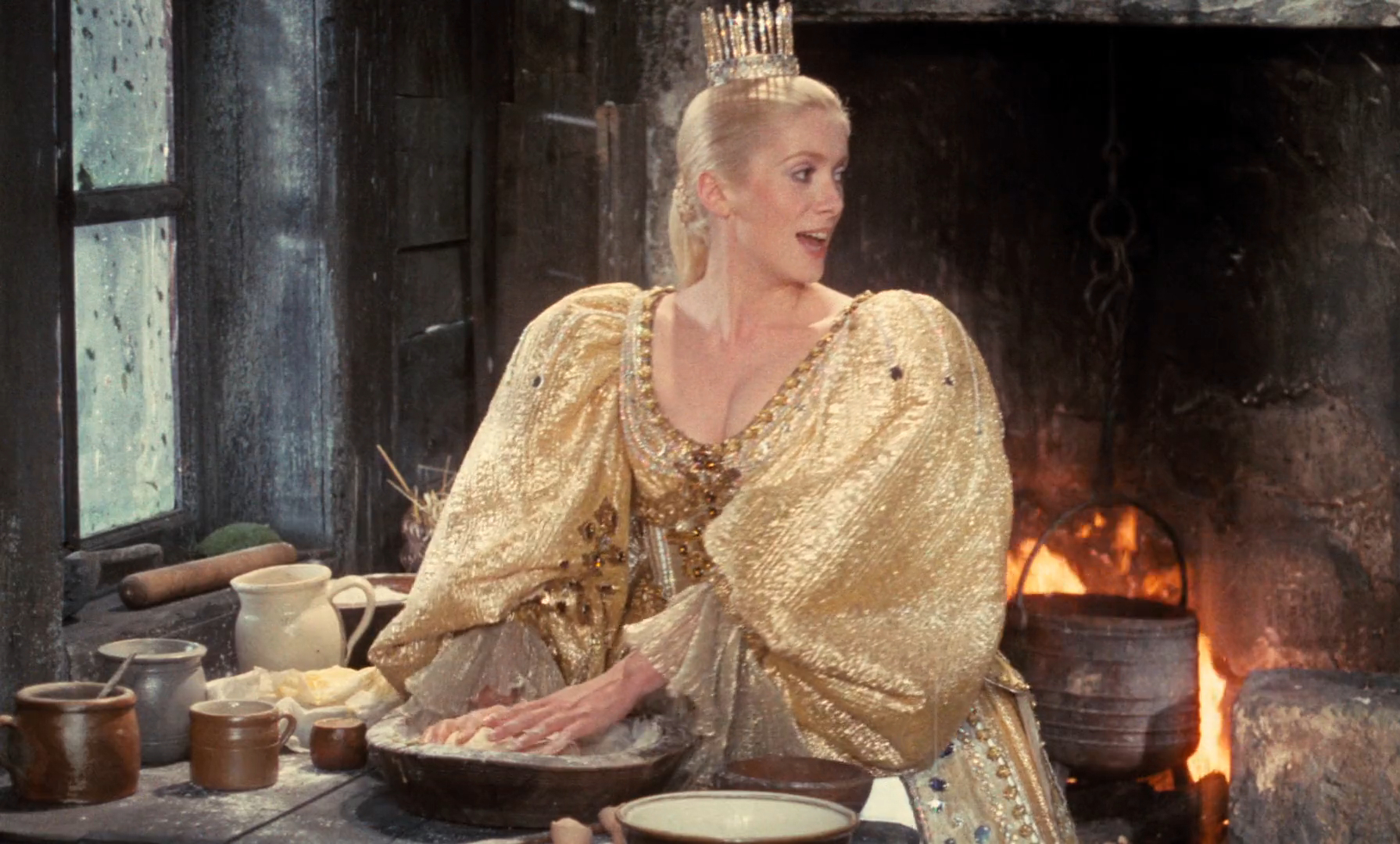
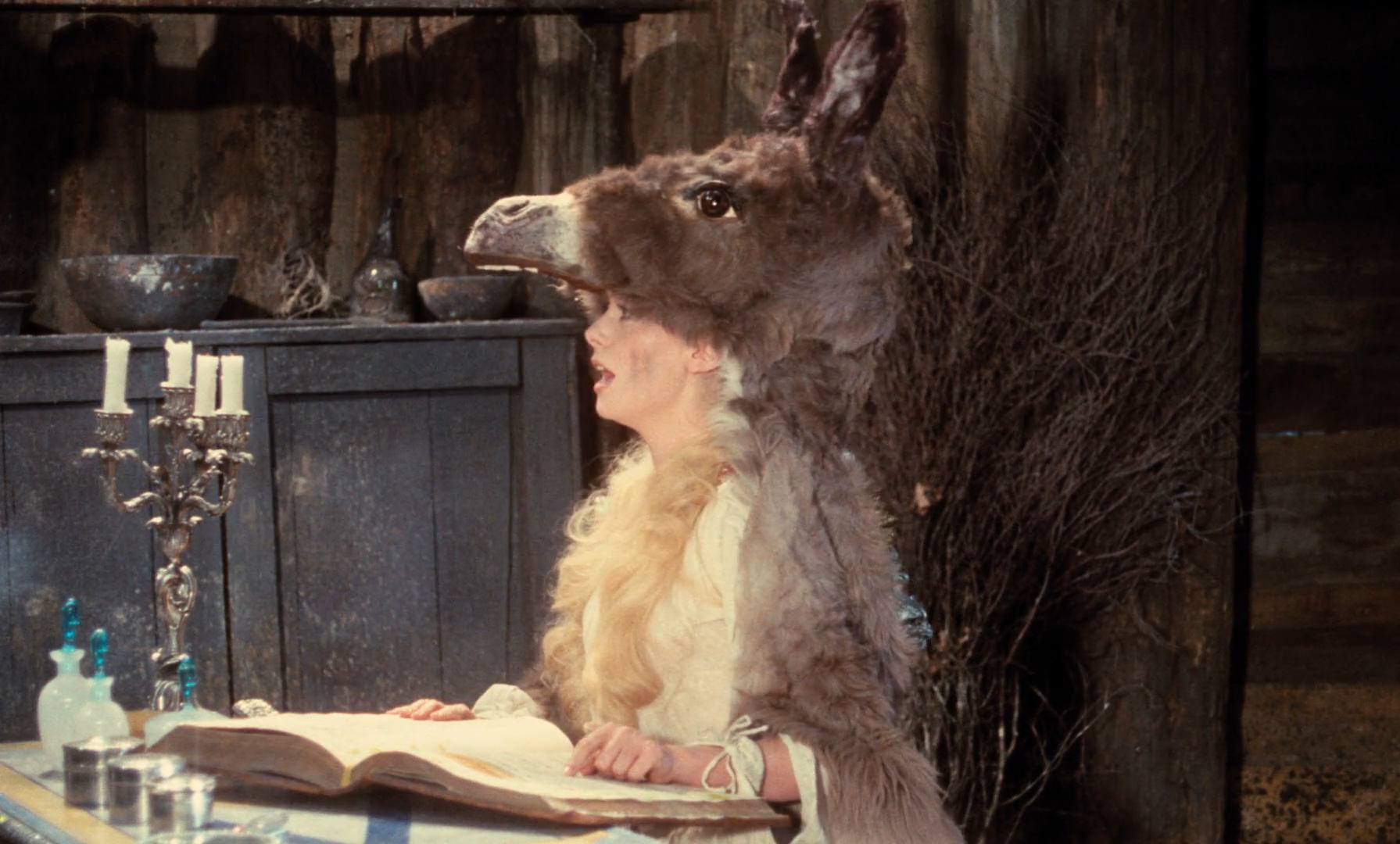
As the princess turns into a scullery maid while retaining her magic wand and wardrobe, she comes to straddle the dualities of fantasy and realism, of high and low-brow culture, of tradition and modernism. Fleeing her father’s castle, her elegant carriage turns into a peasant’s cart, and soon she’s the subject of popular scorn, much like how the masses may sneer at experimental cinema. In the cake baking song she splits physically so that her two identities can show off their harmony, working together and completing each other’s sentences. On top of the difference between established tradition and scrappy avant-garde, there’s an implied class disparity between the princess in her gown and the same person dressed as a donkey, but here they reverse roles, the scullery maid giving directions while her royal persona does the manual work of cooking. Demy goes further than most modernist directors would dare in respecting tradition, but he also suggests that modernity should take the lead. Accordingly, the female characters in Donkey Skin are unmistakably stronger than the males.
Jacques Demy was not a typical French New Wave director, but he is usually grouped with the movement’s “Left Bank” wing, and his wife Agnès Varda was a stylistic and social bridge between the Right and Left Bank factions. The New Wave elements in Donkey Skin are less conspicuous than its retro qualities, but they’re not entirely absent. Demy pays homage to his wife’s Cléo from 5 to 7 in a few details, like the witch spitting frogs from her mouth. Like most New Wave productions, the film was shot on real locations instead of studio sets, at some detriment to its fairy tale effect. However imperfectly the film seeks to imitate the studio style of the 1940s, the helicopter at the end unravels the effort with the playfulness one expects of the 1960s.
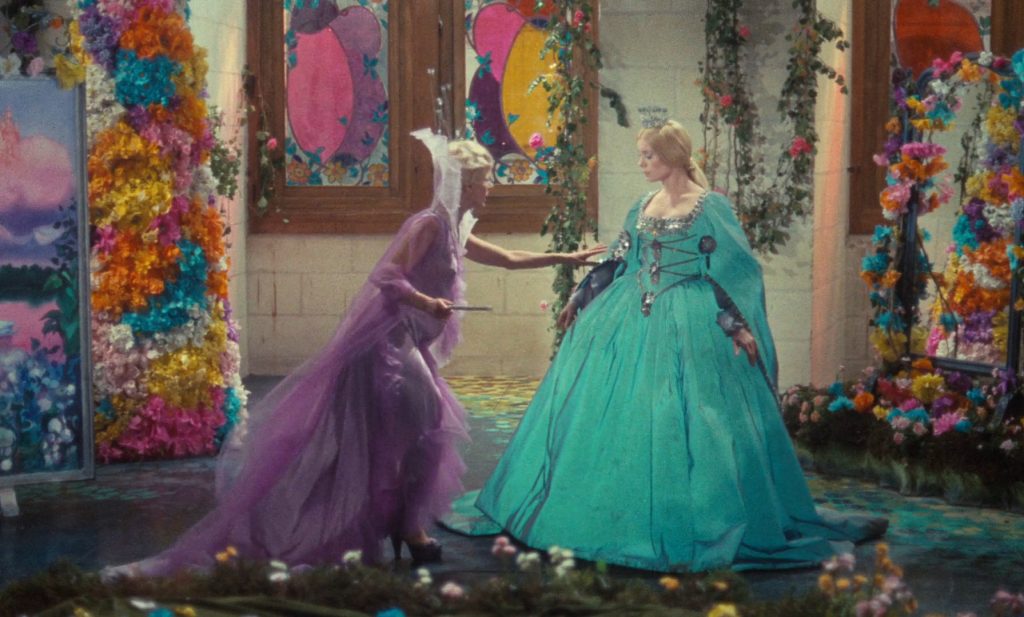
The helicopter confirms that the film’s sympathies are as much with the new as with the old, but it’s neither the first nor the most telling anachronism. Earlier, when the king first began to court his daughter, he had read to her from the poems of Guillaume Apollinaire and Jean Cocteau. “I have some poems from the future. The ancients wrote well, but the poets of tomorrow may delight you more.” Here the film simultaneously acknowledges its respect for the past and its faith in the future’s creativity. By 1970, though, both those poets were dead, and Cocteau had already taken his place in the classical canon of French cinema, so that Jean Marais’s line should remind us how arbitrary and impermanent the labels of “old”, “new”, “traditional”, and “avant-garde” really are.
CONNECTIONS:
The Wizard of Oz – Musical fairy tale with witches, a wizard, dwarves, one or two castles, and a young woman fleeing her home; female characters stronger than the male characters
Lumière d’été – Elaborate birdcage in the archetypal form of the building it’s inside of
Beauty and the Beast – Living statues inside a castle; deer sculptures; magical rose; slow motion for magical effect
Such a Pretty Little Beach – Melding of French traditions of fantasy and realism
Late Spring – Reminder that tradition and modernism are not opposites but rather shifting parts of a long continuum
Cléo from 5 to 7 – Person spitting frogs from the mouth; broken mirror; glass incubator or coffin
Band of Outsiders – Allegory about the dual strains of traditionial and modernist cinema in France
Au hasard Balthazar – Donkey as a central image, with a connotation of humility