A Trip to the Moon
1902, directed by Georges Méliès
It’s strangely auspicious that the motion picture camera was invented by two brothers whose surname, Lumière, means “light”. At its best, over the next century and more, their creation would become an invaluable aid to vision, both to the eye itself and to the “inner eye” that beholds the world more completely, and with greater wonder, through cinema. Inasmuch as A Trip to the Moon represents a second beginning of cinema – the effective origin of narrative film as we usually think of it – it’s equally auspicious that it begins with a symbolic picture of vision being extended. The astronomers’ hall is centered on a high window through which two aligned telescopes, one short and one long, are aimed at the full moon, which just happens to appear right there through a crack in the clouds. In the first incident, six astronomers walk in, and each is presented with his own telescope.
These six telescopes do not last long. The astronomers hold them with the wide ends down, each one like a monumental tower, an object of ego instead of an instrument of vision open to greater things above. As soon as the six men turn their gifts over into their intended positions, the telescopes turn magically into stools, and the men sit on them as if desecrating the gift of vision. This act will set the pattern for the whole story.
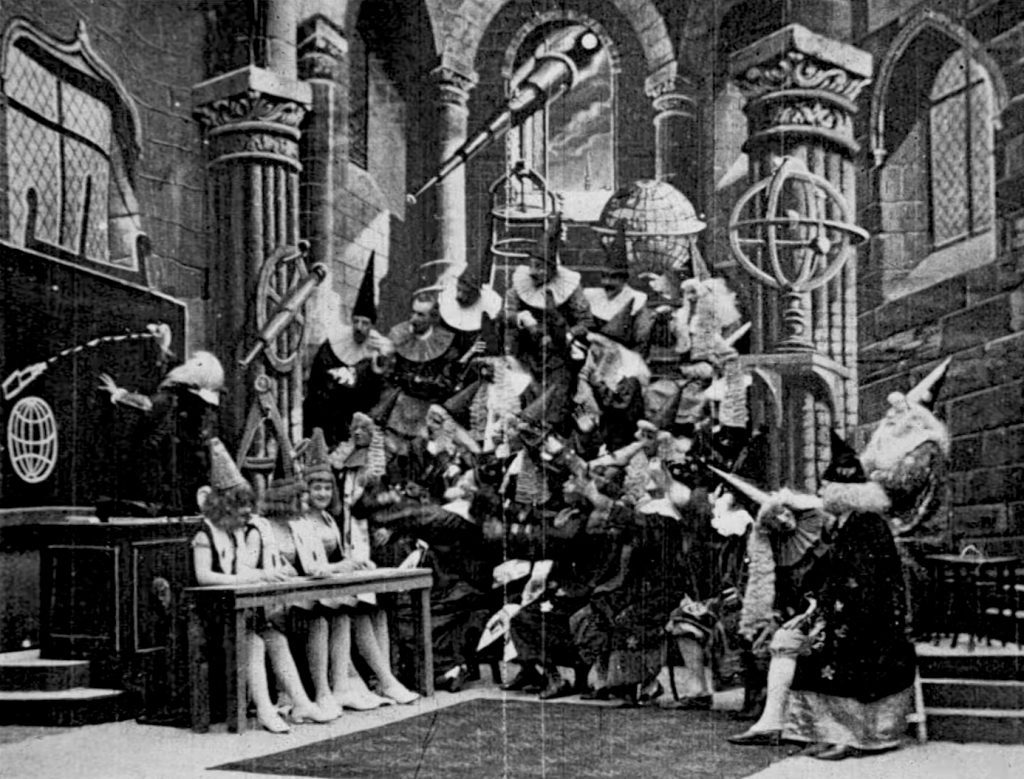
After the men are seated, the chief astronomer, Professor Barbenfouillis, proposes a voyage to the moon. The professor stands in the position of knowledge at the eyepiece of the first telescope, but he has no need to look through the instrument. Instead, on the blackboard behind him, where Earth and its moon are aligned on the same axis as the telescopes, he charts the upcoming expedition. He first draws a launch tube that precisely mirrors the upturned telescopes with its narrow end pointed at the moon. A dashed line traces the rocket’s path, and the rocket itself completes the picture, again pointing its narrow end into the moon’s surface. The tube and the rocket thus reverse the directions of the two telescopes they’re aligned with. Like the astronomers’ earlier desecration of vision, the two machines of exploration overturn the spirit of discovery. Instead of opening out toward the moon, they puncture it like a weapon.
With its strongly triangular composition, the opening scene prepares us to notice the recurring motif of pointed objects. The side walls slant toward the central window, and the human figures fill a triangular space emphasized by the diagonal table on the left. The telescopes define one edge of the dominant triangle, balanced by an astrolabe on the right. Most of the characters wear conical hats, and even the stools are almost like cones. All these cones and triangles reflect the two opposing images around which the film’s argument is built: the telescope and the rocket, which stand for discovery and exploration in a larger sense.
In modern astronomy, we tend to think of discovery and exploration going hand-in-hand, but Méliès’s film suggests a polarity between the openness of one, which leads to vision and wonder, versus the aggression of the other, which leads to conquest and destruction. For all of its forward-looking science, A Trip to the Moon tells a familiar tale of imperialism. Here too the opening sets the stage. Two heavy columns flank a barrel vault and the rounded arch of the central window, reminders of the Roman empire, while a Tudor arch on the left and a Gothic arch on the right represent the rival modern empires of Britain and France.
Professor Barbenfouillis’s lecture provokes a brawl among the skeptical astronomers. He pelts his resistant listeners with loose pages from his desk, the comic melee mirroring the equally fanciful combat later on when the astronauts use umbrellas to vaporize the moon creatures (Selenites). As in the real world, internal disputes within the empire are resolved peacefully, whereas colonial conflicts are deadly to indigenous peoples. This is not to say, however, that internal differences are smoothed over. An empire is built on a hierarchy, and the next scene illustrates the class differences within the empire. While a team of laborers maintains serious focus on the hard work of building the rocket, the privileged astronomers tumble over themselves as they try out the unfinished spacecraft, playing around while others work.
The astronomers then ascend to the factory roof, where they look over the city for a launch site. As usual, vision and discovery are reduced to seeking advantage. Where the film might have offered a wondrous panorama, the men instead survey a landscape of smokestacks. Like the upturned telescopes, the narrowing towers are images of pride and aggression, their rapid streams of smoke foreshadowing the puffs of gas left by the slaughtered Selenites. Already the film has drawn a picture linking imperialism, capitalism, inequality, and environmental ruin that has proved more prophetic than its picture of spaceflight.
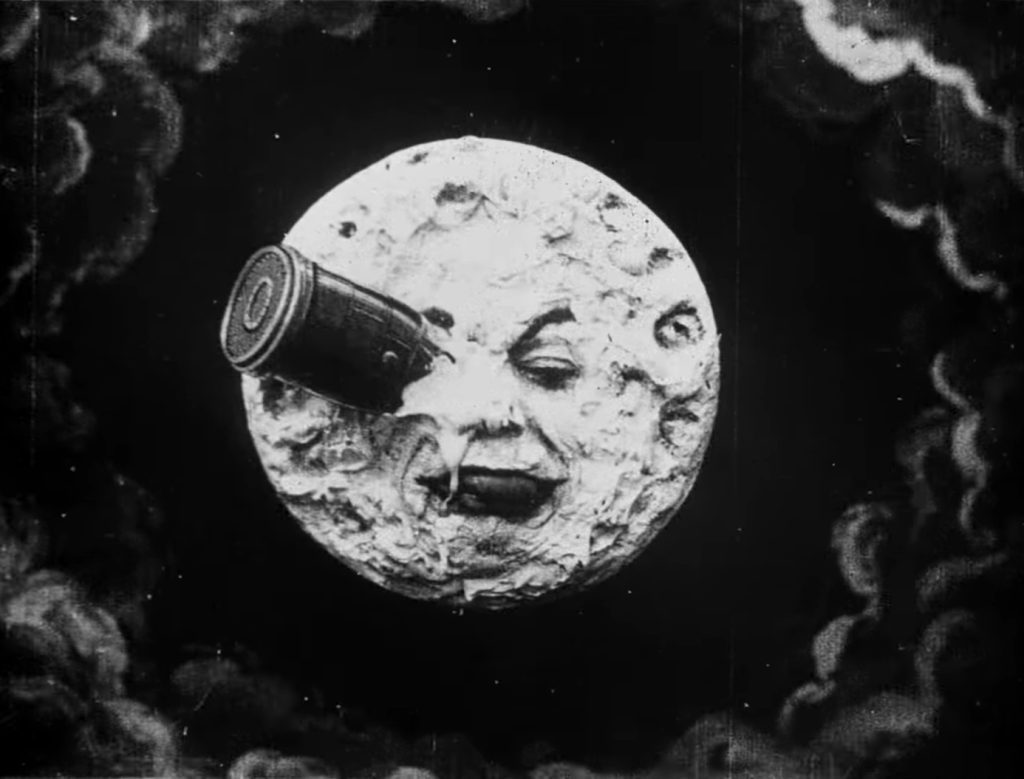
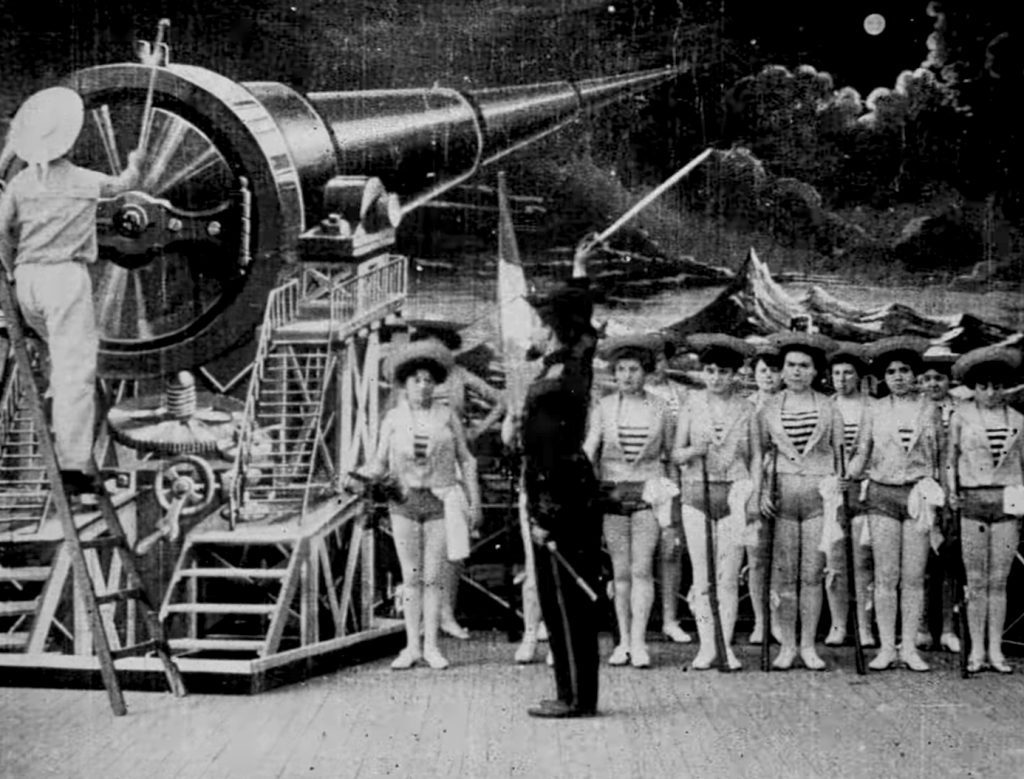
The rocket launch proceeds as planned, only in greater detail than on the blackboard. The launch tube has become even more like a telescope, and the contraption rests on the rooftops of several half-timbered houses which echo the triangles of the opening shot. Another explosion of smoke marks the launch, and when the rocket plows into the right eye of the Man in the Moon (the signature shot, within seconds of the film’s midpoint), the corruption of vision that underlies imperialism reaches its most direct and visceral expression.
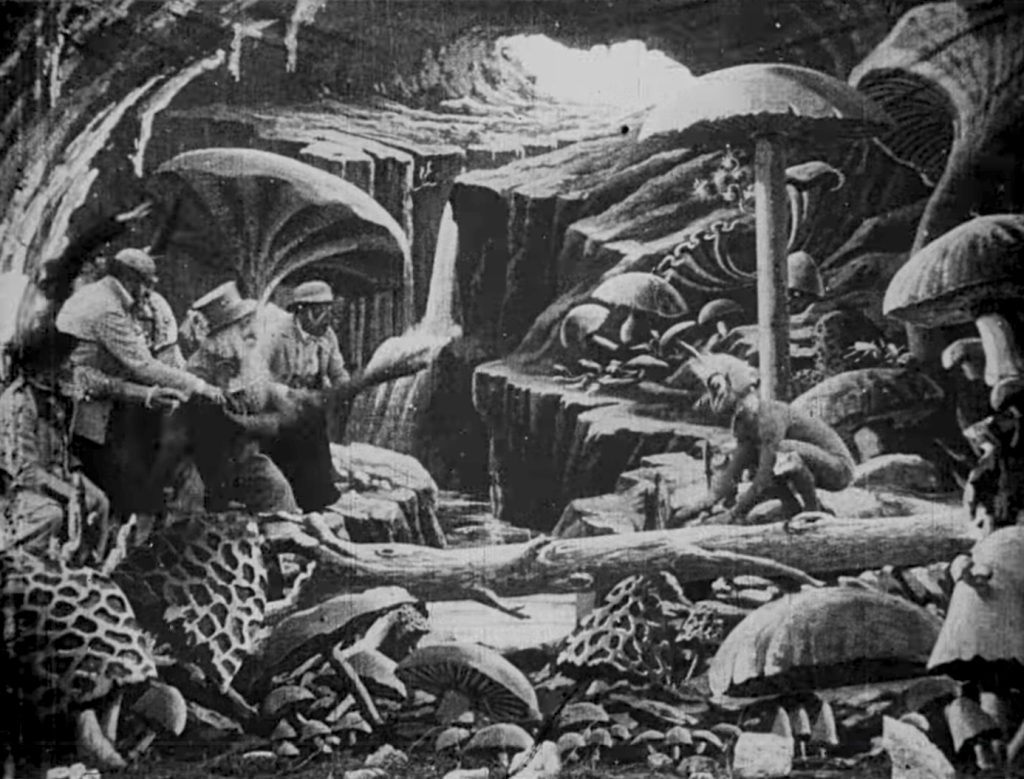
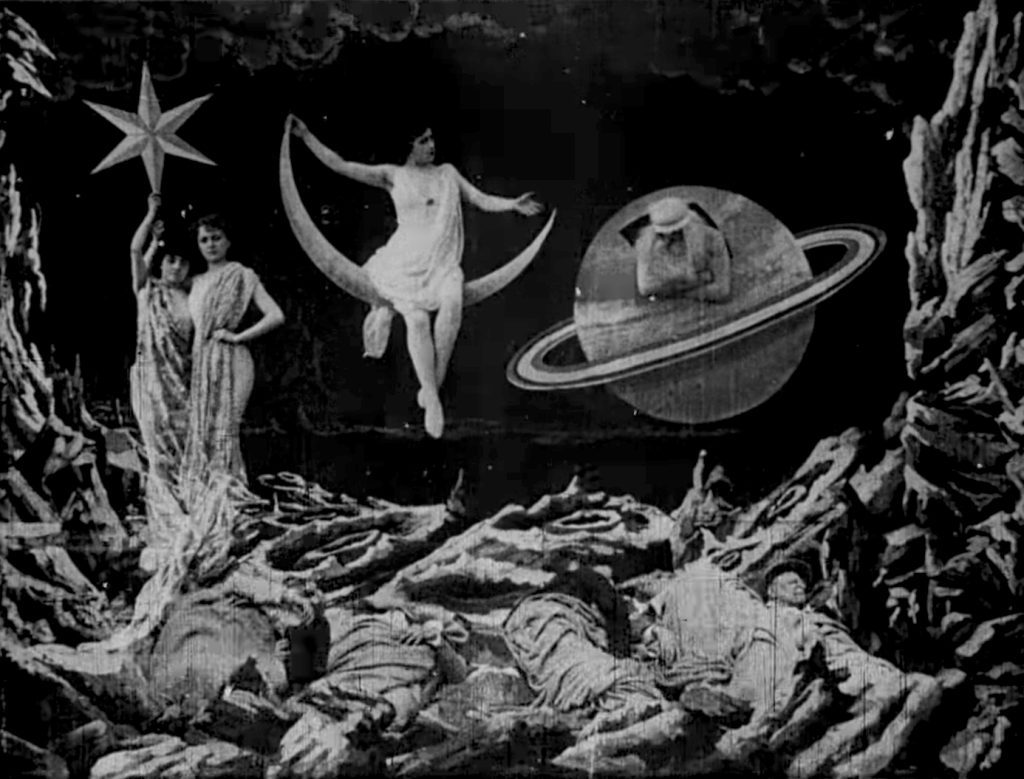
In a film with so much to say about vision, it’s fitting to find at this point an editing innovation that prefigures the avant-garde devices of future classics like The Exterminating Angel and Persona. The moon landing is shown twice, from two different angles – a twice-told tale in miniature form. One is a superior perspective, a hypothetical view from Earth, distorted in scale and mythologized. The second is more naturalistic, its point of view representing a disembodied narrator. The blinded eye in the left half of one shot is balanced by the rocket door opening in the right half of the other, a closing and opening of vision respectively. Here, until the astronauts meet the Selenites, wonders mount and vision achieves its potential. Over the next three minutes (the film’s third quarter), the explorers will marvel at the lunar surface, witness an earthrise, go to sleep under a comet, and dream of living constellations. Awakened by a snowfall, they seek shelter in a vast cavern where a planted umbrella grows into a huge mushroom.
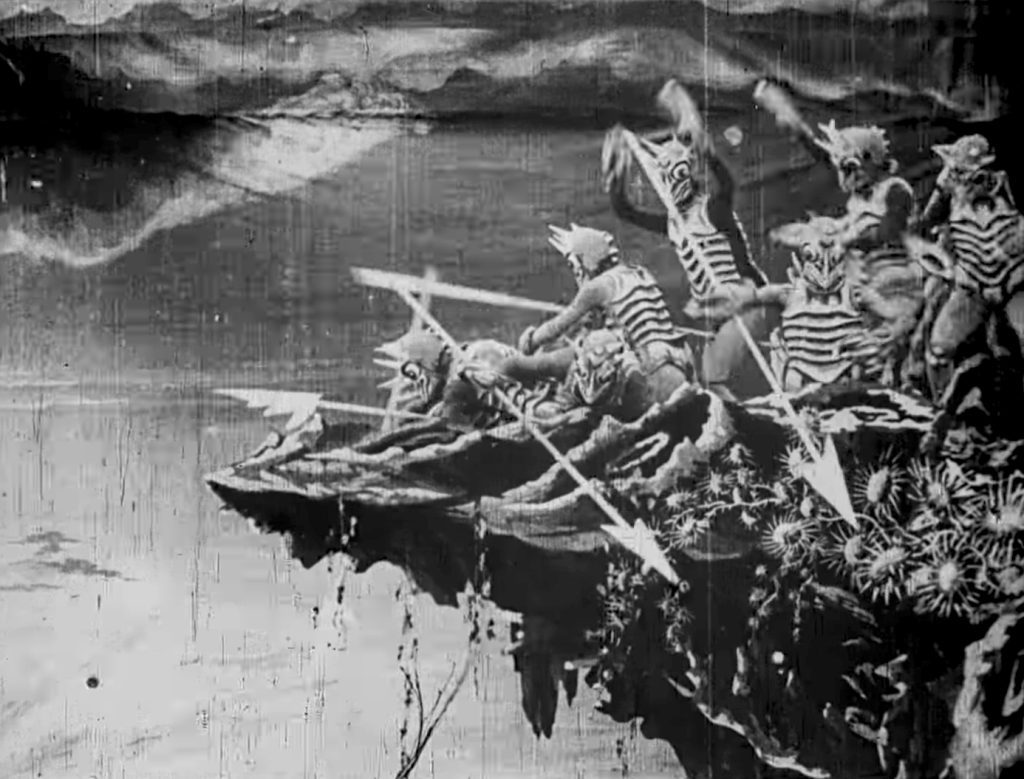
The astronauts’ umbrellas are another form of cone, descended from the telescopes they held in the first shot. The umbrella taking root in the mushroom forest is the culmination of the film’s wonders. Soon, like the telescopes before, the umbrellas (which are meant for protection) will be perverted into weapons. The remaining story repeats familiar pieces of the history of colonialism. The explorers start with a military advantage; they’re momentarily outnumbered, but they overpower the indigenous chieftan and (unintentionally) bring a native home as an exotic specimen. In the Selenites’ royal hall, a Moorish arch and crescent moon motifs evoke the North African cultures that were currently under French colonial occupation.
On returning to Earth, the astronauts are celebrated with a parade, much like the exploits of colonial adventurers. A dignitary lays crowns or wreaths on their heads, recalling the new hats given them in the first scene. The captive Selenite is paraded like a bounty and made to dance for everyone’s amusement. In the final shot, dancing women encircle a statue of Professor Barbenfouillis on a plinth inscribed “Labor omnia vincit” (Work conquers all) and a pedestal inscribed “Science”. The monument echoes the downturned telescopes from the opening moments, an object of misplaced pride and self-congratulation. Like everything else in A Trip to the Moon, the silly statue has the lightness of satire, but there’s a serious purpose. If we’ve followed the logic of all the imagery – the telescopes pointed away from their objects, the rocket in the moon’s eye, and all the pointed instruments of exploration – then the film should help us to see how much the project of imperialism is a betrayal of the gift of vision.
CONNECTIONS:
Last Year at Marienbad – Iconic shot at the film’s midpoint
2001: A Space Odyssey – Space exploration linked to hubris despite the implied potential for wonder; scene located below the surface of Earth’s moon
Chinatown – Prominent image(s) of half-blindness