Daisies
1966, directed by Věra Chytilová
The title sequence of Daisies cuts back and forth between a spinning flywheel and newsreel footage of aerial warfare. Those two intercutting elements open several avenues of interpretation, but the titles themselves form a third element which counts just as much. The letters are printed in the style of a typewriter, and at the film’s middle and end the clacking sounds of typing will reinforce this point. Taken together, the documentary footage and typed letters situate Daisies in the arena of journalism, not unlike the openings of movies such as His Girl Friday or Citizen Kane that are set in actual newsrooms. At the end, the two protagonists will be wrapped in newspapers as if to identify them as embodiments of our times.
These signs cast Daisies in the format of a reportage, commenting in its imaginative way on the contemporary state of the world. Our challenge is to pin this comment down as specifically as the film will allow, yet there’s very little material in Daisies that might make this task easy. In the first conversation, the brunette Marie says that “Everything’s going bad in this world,” but the target of her complaint is as vague as the intention behind the bombing footage, which comes from World War II but could just as well suggest a flare-up of the Cold War. We’re left with a broad claim that things have gone “bad” overall. Instead of looking for some precise social or geopolitical critique, we can find greater meaning in the two Maries’ response to the world they’ve inherited.
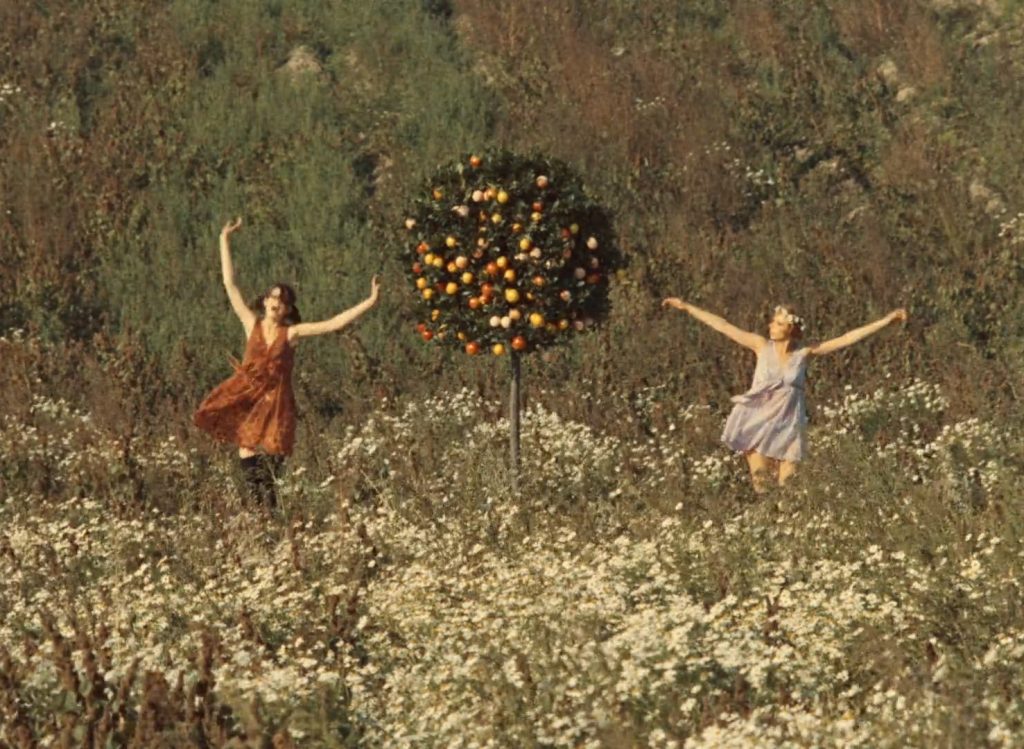
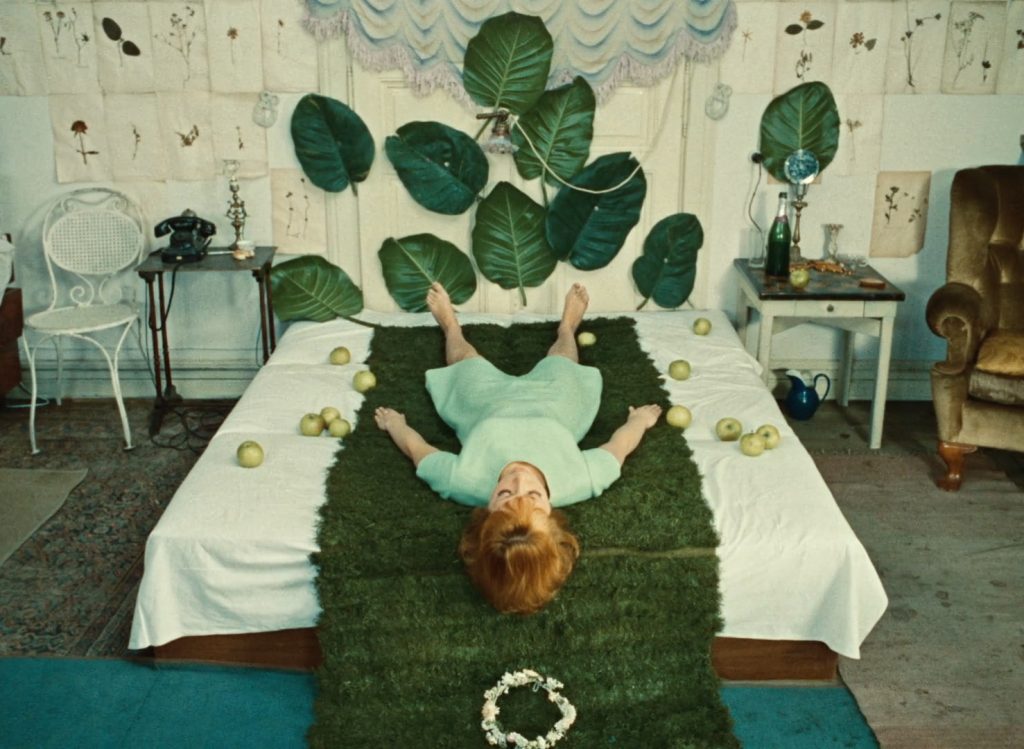
If the printed titles and war footage suggest a journalistic point of view, the flywheel remains enigmatic. It could be a physical correlative to a narrative put into motion (as the rhythmic music suggests), or a generic token of modernity, but the image also has a cinematic antecedent in the iconic gear box of Charlie Chaplin’s Modern Times. Chytilová’s film owes a lot to silent comedy, from the sped-up routines at the train station to the collapsing façade that recalls Steamboat Bill, Jr., but the spirit of Daisies is closest to Chaplin. Like the Tramp and Gamin in Modern Times, Marie and Marie rebel comically against an adverse world. They’re introduced moving like puppets just as the Tramp was reduced to robotic movement in the factory, and they’re reborn in a Garden of Eden just as the Tramp was reborn in the gearbox. Food and circles predominate in both films, and characters in each film enjoy illicit feasts.
In Modern Times, however, the Tramp and the Gamin are unambiguously sympathetic, even when they run afoul of the law. The Maries in Daisies are charismatic, and they’re generally more sympathetic than the targets of their mischief, but the film frames their actions as an adventure of transgression. At the outset they announce that they’ll act spoiled, and they reaffirm that intention midway through. The “Garden of Eden” scene and the recurrence of apples suggest sin, though that can be read with any degree of irony. They’re punished after the climax in the banquet hall, and in the coda (set in the conditional mood) they make imperfect reparations, reassembling broken plates and mashing pieces of cake from the floor back together on a tray.
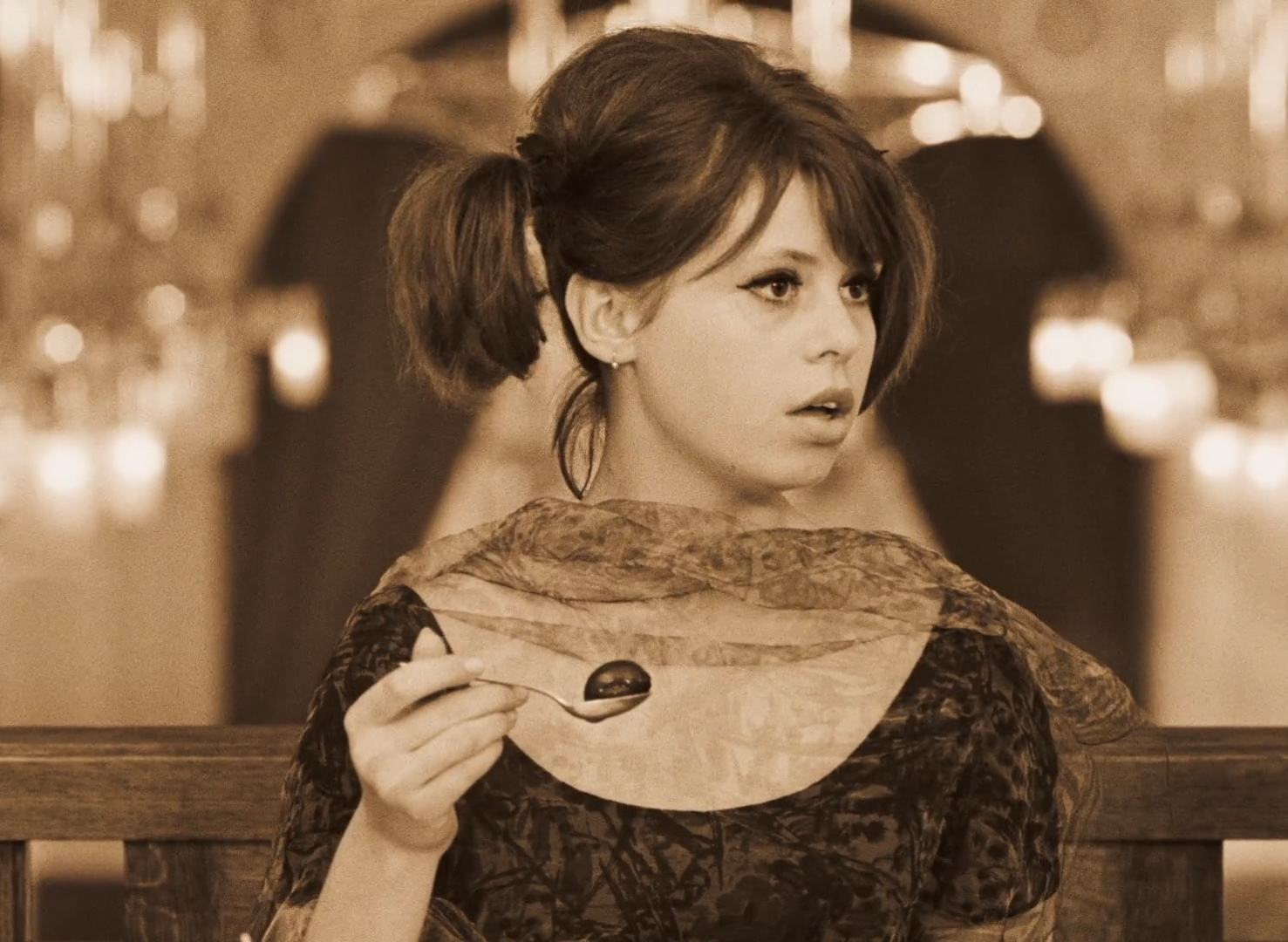
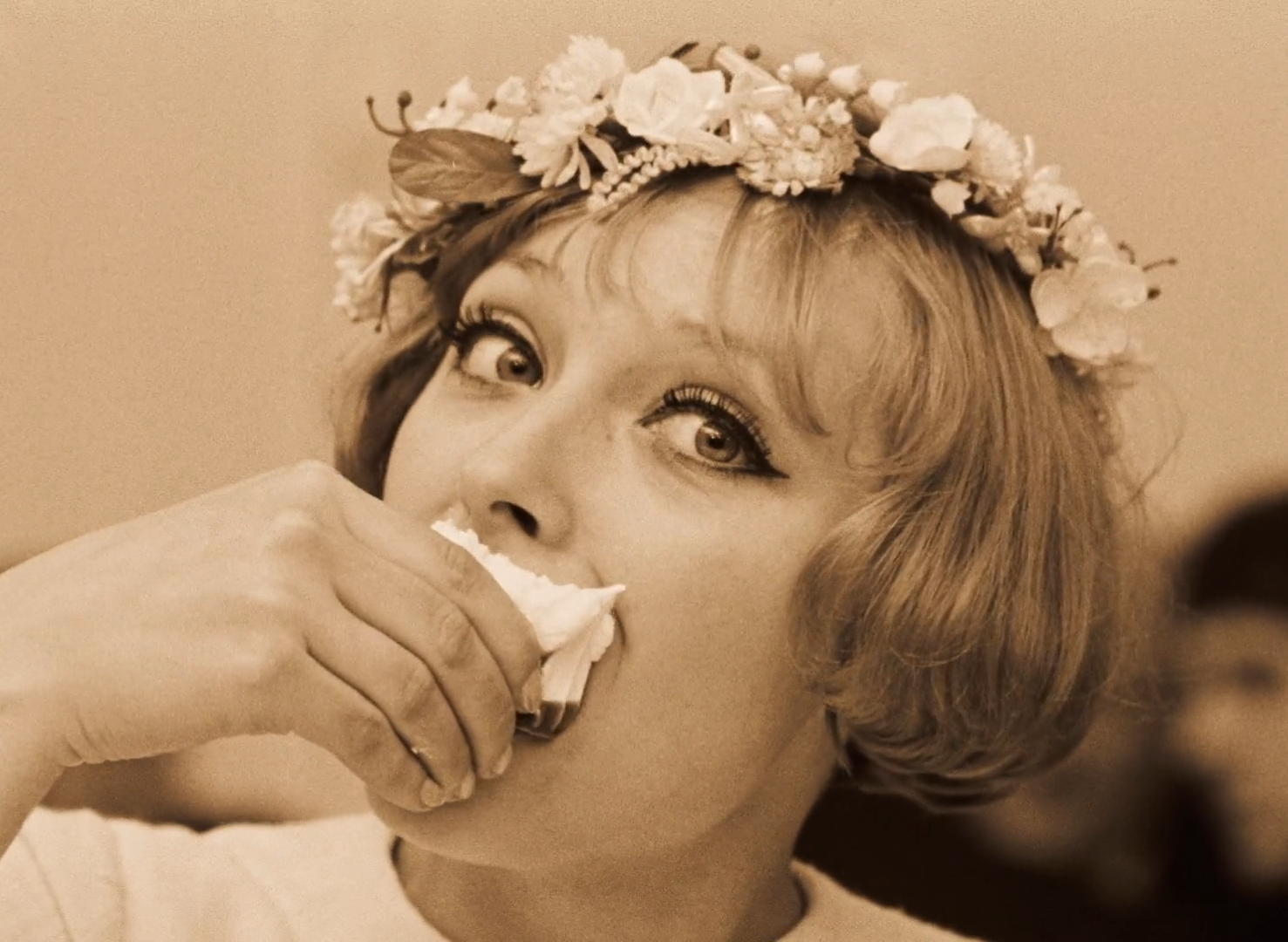
Any judgment of the characters is complicated by the comedy, absurdity, ambiguity, and political context of Daisies, not to mention the women’s position as underdogs in a patriarchal society. Once they make the decision to become “spoiled” they become exemplars of consumerism in a communist country. No matter how critical Chytilová was of state ideology, and no matter how likable the Maries may be to a liberated audience, it would be hard to call them models of ideal behavior. In any case, to judge them is beside the point.
After the brunette Marie notes that their world has gone spoiled, the two Maries resolve together to be spoiled in turn. There’s no contradiction between disapproving of their choice and taking their side… in fact the logic of their decision is at the heart of the whole argument. Not only do those two in particular act spoiled in a spoiled world, but virtually every citizen of a spoiled society will react the same way to some degree, and moreover, it is exceedingly hard for an individual to avoid doing so. In that sense, despite its likeness to Modern Times, Daisies is closer to Chaplin’s 1947 film Monsieur Verdoux, which portrays a serial killer with the maximum possible sympathy as a logical outgrowth of a corrupt society, without endorsing his crimes in any way.

In short, both Monsieur Verdoux and Daisies argue that meaningful change must target the broader structure of society, not individual actions. It’s commendable when individuals resist mirroring a corrupt system, but we cannot expect that to happen en masse. This argument must have been equally relevant on both sides of the Iron Curtain, as it still is today all over the world, so it’s no great matter if Daisies is vague about its economic or national placement. Both capitalism and communism make idealistic demands on the individual (the work ethic, or Marx’s “from each according to his ability…”) that prove unrealistic in an imperfect society. As a whole, Daisies is a plea for tolerance of individual shortcomings, hence its dedication at the end “…to those who only get indignant over trampled salad.” This might be read as a sarcastic barb at people who are easily offended and quick to judge, although the word “only” (pouze) implies a sort of charitable allowance for people’s pet peeves – as if to say that everyone is allowed some small indignation as long as they’re tolerant for the most part.
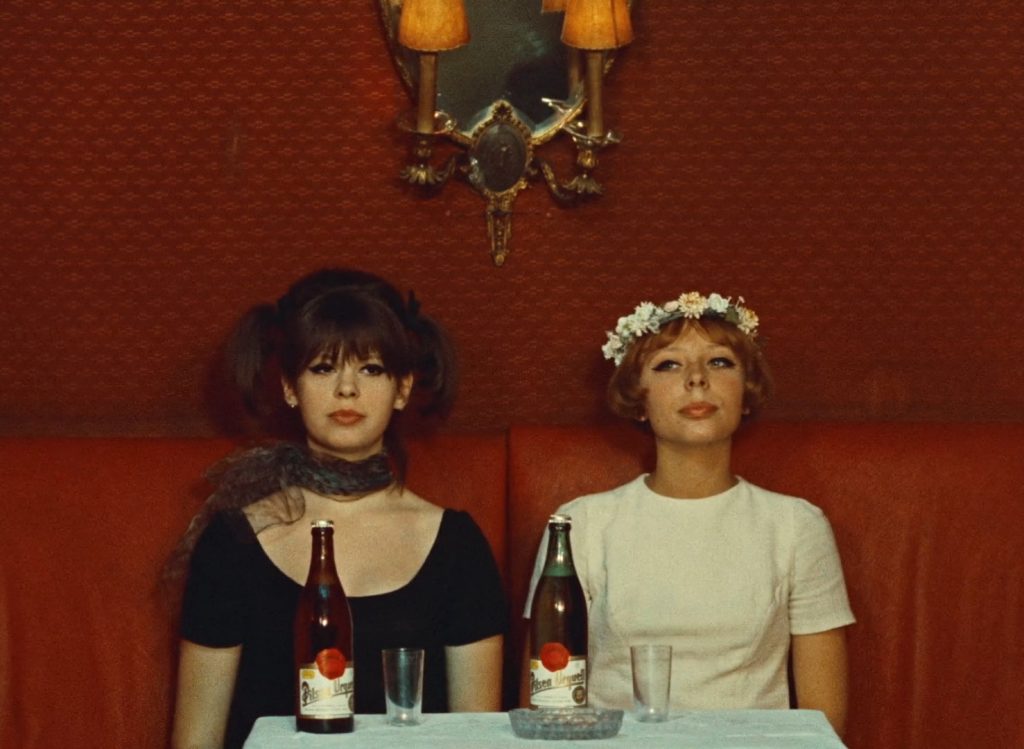
Daisies begins with a realization that the world has gone wrong, and it proceeds to trace a common though ineffective response to that realization. The two Maries are revolutionaries, and like most revolutionaries they become like the system they oppose and wind up co-opted by it. Their story takes a dialectical course, always returning to the same places with some reversal. The first man who pays for their dinner is stuck up; the second plays along; and the third is obtuse to their game. At the cabaret they steal the show, their seats framed by a more stately proscenium than the floor show opposite to them, and after the professional dancers duck out, the band continues playing for the Maries for almost a full minute until they’re booted by security. At home the Maries always play with scissors or knives until finally cutting themselves into small pieces. Twice they resolve to do everything differently. Toward the end they venture out and are stunned to find themselves ignored by a gardener and by workers on bicycles, like so many revolutionaries confronted with the ordinary reality that they’re powerless to change.
If the point of Daisies is to shift the onus of change away from the individual, then it’s fitting that it would satirize Christianity, which has long preached about individual sin and virtue. The two Maries reflect the two Maries in the gospels, a virgin and a prostitute. Accordingly, the strawberry blonde wears a flowery halo and declares herself a panna (both “doll” and “virgin” in Czech), while accusing the brunette of “running around” with men. The arc of Daisies loosely reflects the arc of redemption in Christian scripture, from Eden to the Last Supper and the Resurrection (the “second chance” in the coda). The banquet scene ends with the Maries falling from the chandelier after it swings first side-to-side then in a perpendicular direction, forming a cross.
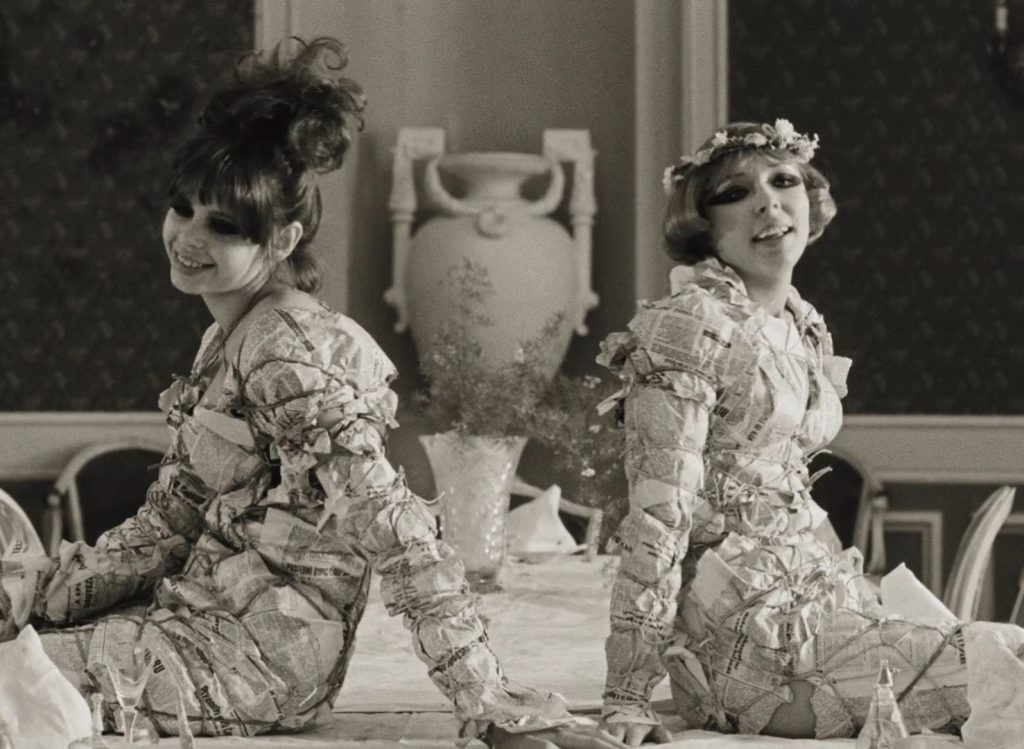
At the end, when the chandelier falls on the Maries, Daisies returns to the wartime found footage of the titles, replacing the chandelier’s impact with the upthrust of debris from an exploding sea mine, connecting the story back to the real world. In their last words, one Marie says “We’re really happy” and the other “But who cares?” echoing the nihilism they’ve both maintained since the opening, but when the chandelier falls, their panicked expressions show that they do care. All along they’ve been detached from the world’s problems, and the newspapers tied around them foreshadow their reckoning. Until now, instead of reading papers, they’ve only thrust a disrespectful armload of newspapers at the man who paid for their first dinner. Now they’ve had their comeuppance, but neither their punishment nor their redemption will suffice to heal a broken world. If we see Daisies in a broader context, we should appreciate the futility of preaching individual betterment. Until social and material conditions are conducive to goodness everywhere, wars and needless destruction will persist.
CONNECTIONS:
Earth – Christian imagery used as a template for a non-religious point
Modern Times – Prominent image of a gear mechanism; food as an economic metaphor; individuals pitted against a social system; profusion of circles
Monsieur Verdoux – Argument that unjust social structures preclude optimal behavior of individuals
Viridiana – Desecration of a formal meal that alludes to the Last Supper in the climax
La chinoise – Revolutionary action exposed as a childish game
Weekend – Series of dialectical reversals that leads nowhere
Céline and Julie Go Boating – Dominated by a whimsical and uruly pair of young women, a brunette and a redhead, who visit a theatrical setting, play tricks on men, trespass in a seemingly uninhabited building, and ride a boat
The Devil Probably – Argument that nihilism tends to be a self-deceptive pose; documentary footage of destruction
Mulholland Drive – Relevance of the typeface in the opening titles to the film’s method or subject