Days and Nights in the Forest
1970, directed by Satyajit Ray
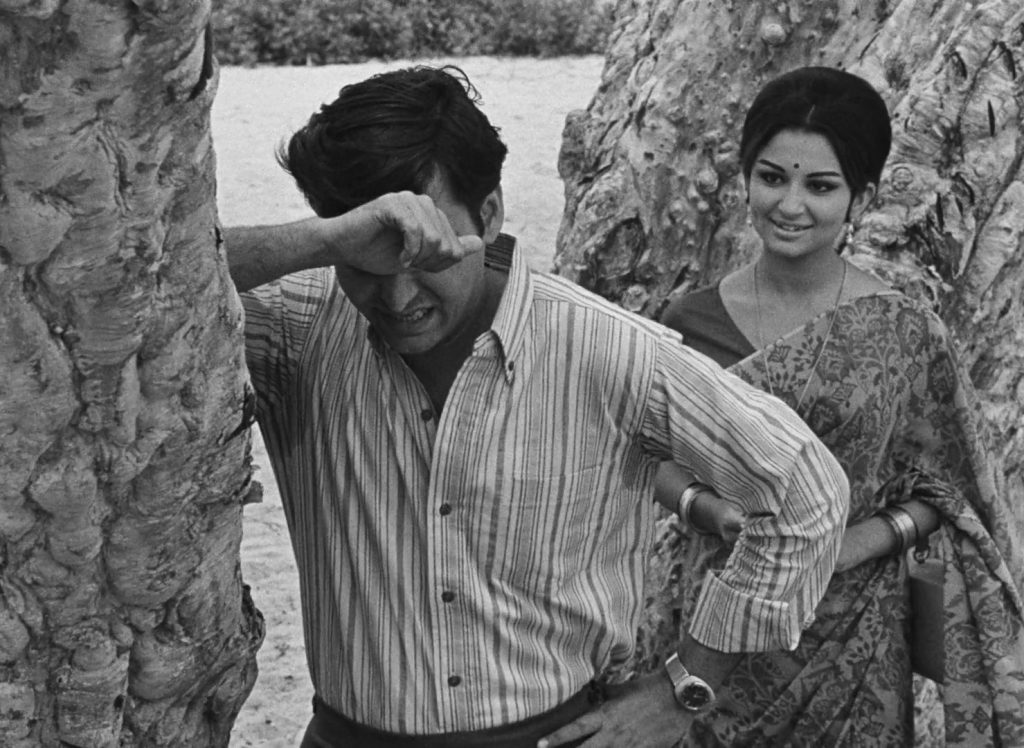
Occasionally the essential spirit of a film will be represented in one unassailable character. In Days and Nights in the Forest, Sharmila Tagore’s character Rini fills that exemplary role. To criticize Rini would be out of the question, even after she rubs her defeat of Ashim in his face with a gentle smile. Her triumph over him is multi-pronged. First, in the room by her balcony, she expertly deflects his advances. She catches him bathing by the road; she saves him and his friends from the conservator’s ultimatum; then she lets him win the memory game. Ashim notices this last bit of generosity, and it irks him, prompting her gleeful admission that she and Jaya had caught the four men dancing drunk on the dark road the night before.
Finally, Rini pounds two last stakes into Ashim’s mortified heart. She confronts him with his callous treatment of the bungalow caretaker, who would lose his job without her intervention, going so far as to show Ashim the man’s sick wife. Before parting, she writes her phone number on a five-rupee note, the only paper at hand, giving him no choice but to accept the symbolic token of charity. Without giving the slightest cause for ill will, she has thoroughly humbled this proud man.
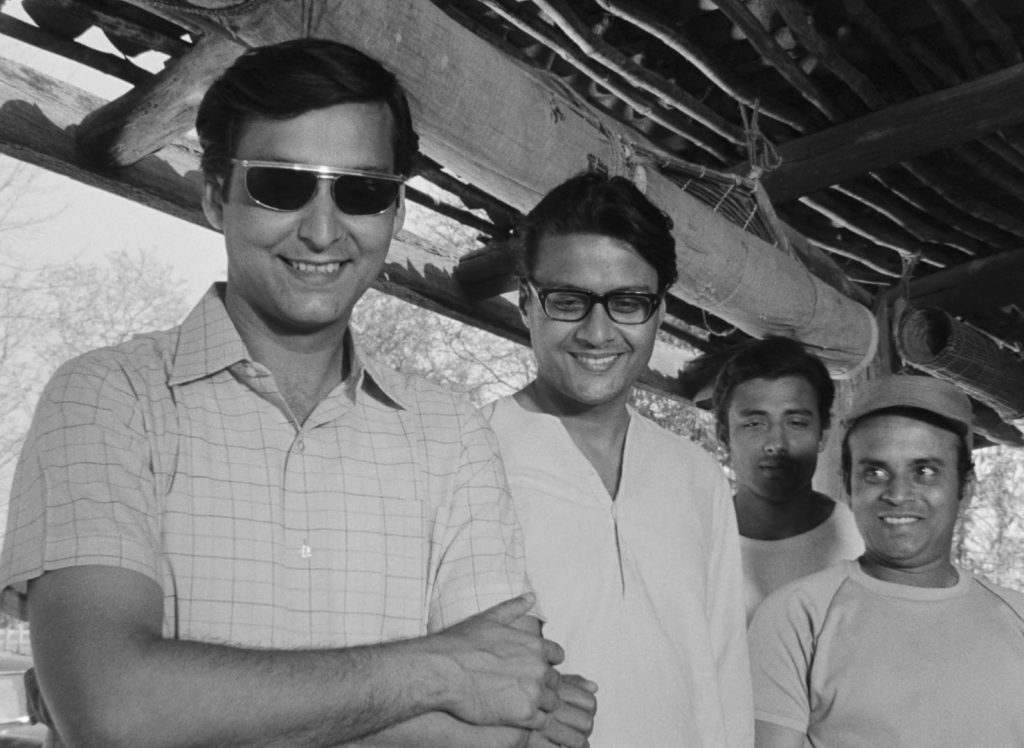
Ashim and his friends arrive in the forest in the opening minutes, each inflated with self-regard. The four young bachelors are cosmopolitan tourists from Kolkata vacationing in a hilly district of what was then part of Bihar, now the northwest corner of Jharkhand. Their displays of entitlement are akin to today’s bro culture, a combination of youthful bluster, male chauvinism, economic privilege, and in their case a kind of internal colonialism, an assumed superiority over the “tribal” Santhal natives that correlates to various forms of racism. Each man will be humbled in his way by the end. The athlete Hari will be knocked out and bloodied by a man he bullied. Shekhar, the clown of the group, who always looks down on the locals, will lose at gambling. Sanjoy, who’s been pining after his boss’s unattainable daughter, and who preens himself while fetching pillows for Jaya, will find himself unable to avail an opportunity for love.
Inasmuch as the film deflates the superior attitudes of the four men, it might seem unjust that it respects Rini’s supremacy, but her superiority is neither assumed nor cheaply earned. It’s forged through hardship, and when she guesses that Ashim has never faced tragedy, the point is not that tragedy is needed to form a complete person, but rather that growing up requires some process of loss. Each of Satyajit Ray’s films is about some particular social flaw that stems from inherited ideas: competition, romanticism, idolatry, resistance to change, etc. Here the flaw is that particular sort of arrogance that treats others as inferior, but in his customary style Ray frames the men’s behavior not as a sin, but as a received bad idea that needs gentle correction. Rini is the agent of that correction in Ashim’s case.
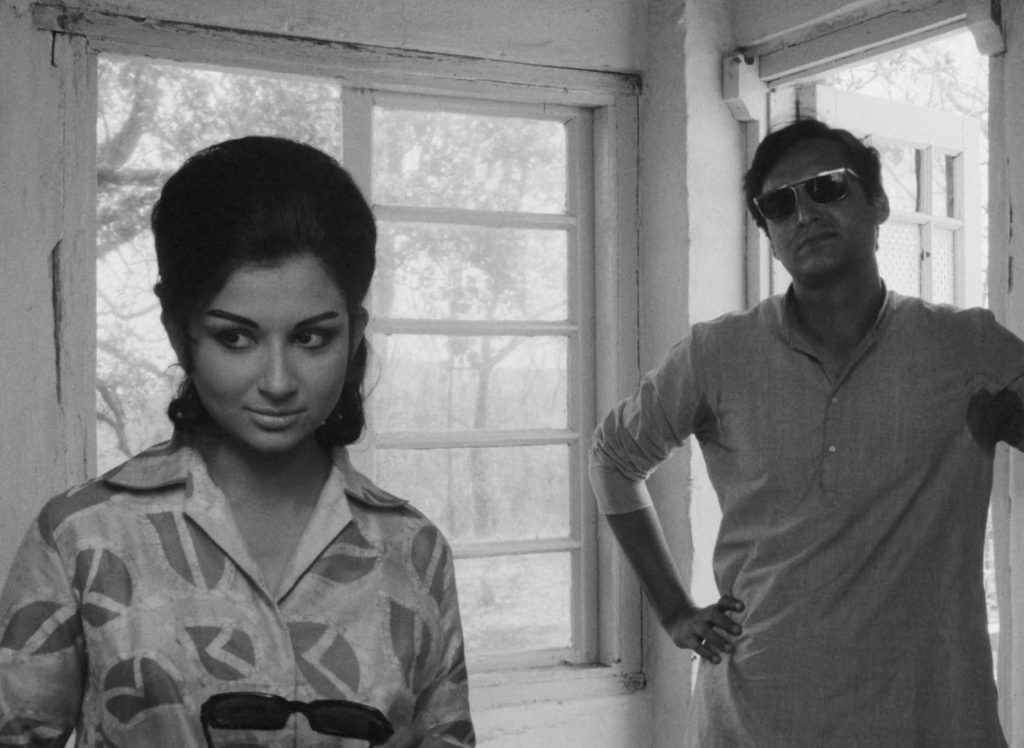
To put it differently, the four men are not unsympathetic, but they’re unfinished. In the car at the beginning, Ashim says, “People behave like kids when they leave the city behind,” but the predilection to behave that way is already a sign of childishness. In a flashback, Hari’s ex-lover tells him to “Stop being so childish.” Later the conservator asks Ashim, “Why behave like a child? You’re being rather silly,” and Rini likewise upbraids him: “The way you took the bungalow, wasn’t that childish?”
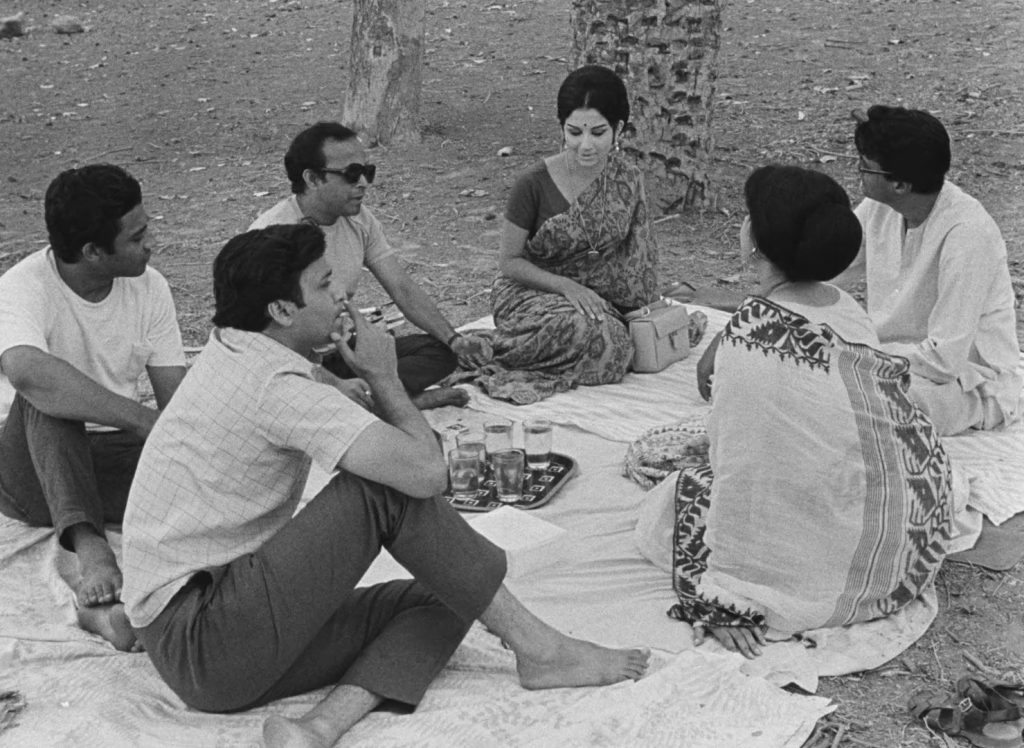
One might simply say that the four visiting men are immature, while Rini in particular is mature, and leave it at that… but Days and Nights in the Forest aims for a higher standard of precision. Rini is not the opposite of Ashim or his friends. Her defining trait is her unusual capacity for memory, which her father remarks on and which she partly reveals in the picnic game. Memory is usually regarded more as a gift or a skill than a virtue, but if we understand Rini we can see that her ability to retain a diverse sequence is a manifestation of her empathy. Memory and compassion are both forms of attentiveness, and it’s essential that she absorbs and retains everything that comes to her. Her broad-mindedness is revealed early when Ashim flips through her books and record albums, each collection displaying a variety that’s analogous to the names in the memory contest. Her reading spans American plays, an Agatha Christie mystery, philosophy, and poetry, while her listening includes classical Indian music, American folk songs, the Beatles, Mozart, Indo jazz, and classical Spanish guitar. The diversity of Rini’s attention is sufficiently far-ranging that she’s able to update Hari on the latest international cricket scores.
If Rini’s range of attentiveness is the film’s ideal, that’s because it applies not only to music and sports and trivia, but to living creatures as well. Her balcony is situated to observe the wild animals that used to pass in greater numbers through the forest, and she delights in pointing out a pair of deer to Ashim. She’s compassionate to poor and privileged alike, advocating for the caretaker while looking charitably on the misbehaving male visitors.
A lesser film might simply hold Rini up as an example, but from its opening scene Days and Nights in the Forest actively elicits the same charitable attentiveness from the viewer. In the close quarters of Ashim’s car, the four men are characterized so rapidly that the viewer must make careful note of their differences. The film’s incidents are tied together in ways that reward attention; for example, we’re told three times that the caretaker’s wife is sick before it becomes an important plot point. When Hari recalls Atashi slapping him at the end of his flashback, his head jerks accordingly in his car seat, and the following cut introduces Lakha, whom he will later slap in turn. In the carnival sequence, Hari suggests that Duli is “getting greedy” and the scene cuts to a roulette wheel. Later it cuts from the roulette game to sand spilling from Rini’s hand, like the money Shekhar is losing.
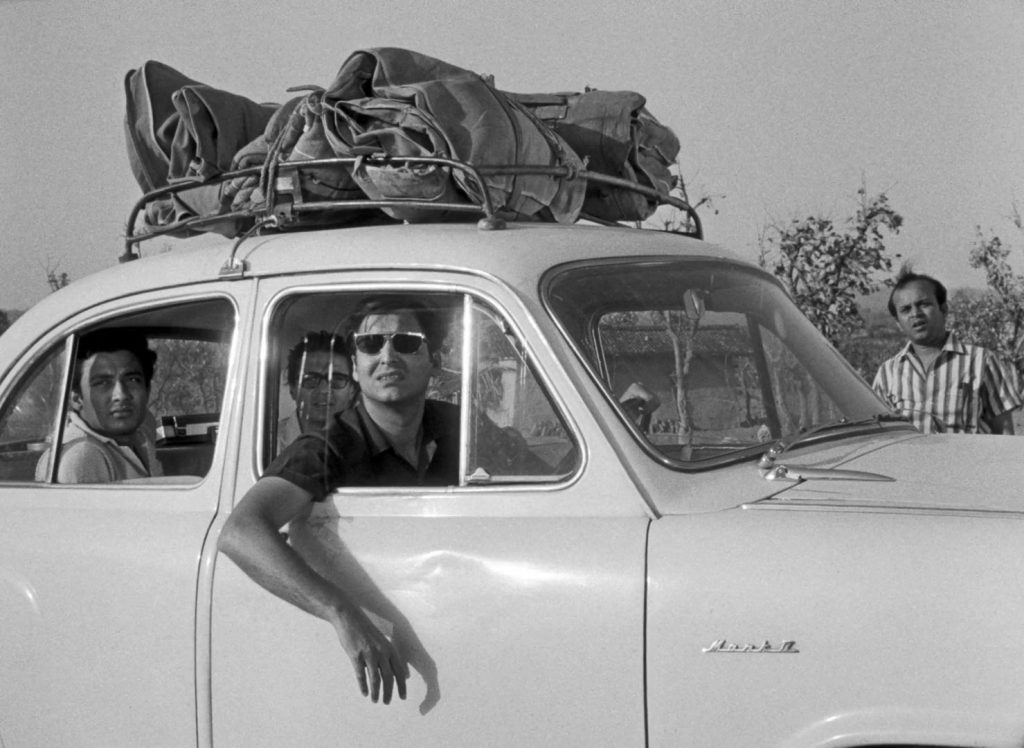
Hari is the furthest from Rini’s ideal, but not merely because he’s abusive. When he transfers Atashi’s slap to Lakha, or when he avoids Rini’s company because she reminds him of Atashi, he conflates different individuals for superficial reasons – exactly what Rini does not do when she holds disparate individuals in her memory, respecting the individuality of each. Even Jaya slips in this regard, mistaking Ashim for Sanjoy as the picnic starts.
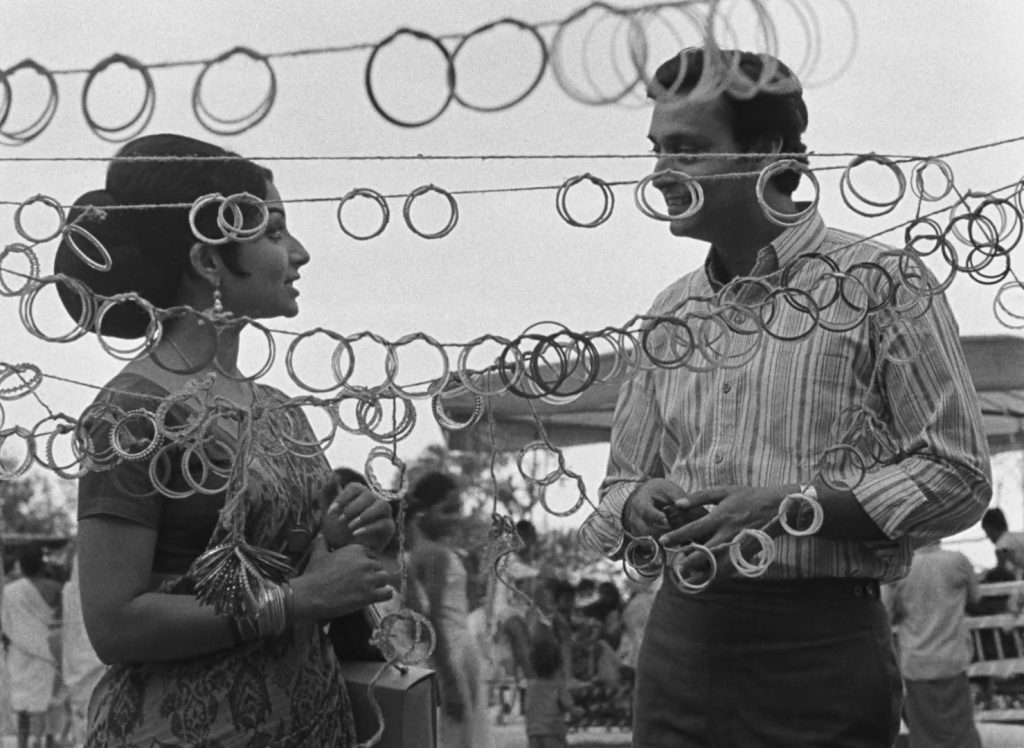
There’s a key difference between the opening in the car, where we’re challenged to memorize the four men, and the picnic where the characters’ memory is challenged. In the first, the men are arranged in a square, while the six picnickers sit in a circle. At the village bar, the natives sit in circles while the visiting men sit in a line. It’s no absolute rule, but in general what’s brought from the city is rectangular (the car, wallet, rupee notes, blankets, pillows) while what belongs to the local landscape, particularly at the carnival, is round (bangles, roulette wheel, ferris wheel, carousel). From the beginning of their stay until the end, the men intermittently ask for or receive eggs, once in a round tiffin carrier, but eggs are never shown until the last line of dialogue when Shekhar holds one up from the Tripathis’ gift box. The round egg represents a new beginning, but it also represents the influence of the forest district, which ultimately rounds the rough corners off of the four men.
The essential change in this “rounding-off” process is a loss of arrogance, and it can be summed up in the transgression that sets everything in motion. The film calls attention to it through the unusual prominence given to the sign which warns bungalow guests that they must be pre-registered. When Ashim bribes the caretaker, effectively steamrolling the poor man to circumvent this rule, Sanjoy’s voice is heard off-screen saying “Thank God for corruption.” Although it fits the circumstances, it’s a jarring thing to say, yet it goes to the heart of the men’s error. In saying it, they convince themselves that the caretaker is corrupt, conveniently ignoring their own greater corruption. Rini later reminds Ashim, “You didn’t take bribes. You did the bribing.” Her compassionate pressure seems to work on Ashim, so that before leaving the bungalow he tips the caretaker with a respect that was missing before. It’s not clear how much he gives, but we can believe that by paying it, he’s repaid his debt to Rini.
CONNECTIONS:
Ornamental Hairpin – Unfinished love match at a vacation spot in the mountains or hills, with the prospect of a reunion in the big city where both reside
Black Narcissus – Power of the rural Indian landscape to influence its visitors
Nazarín – Edifying token of charity given to a proud man at the end
Charulata – Key transition begins abruptly with a rug laid on the ground, followed by a semi-magical ride on a swing or a ferris wheel
MEMORY GAME SEQUENCE:
- Jaya – Rabindranath Tagore
- Sanjoy – Karl Marx
- Rini – Cleopatra
- Shekhar – Atulya Ghosh
- Hari – Helen of Troy
- Ashim – William Shakespeare
- Jaya – [out]
- Sanjoy – Mao Zedong
- Rini – Don Bradman
- Shekhar – [out]
- Hari – [out]
- Ashim – Rani Rashmoni
- Sanjoy – [out]
- Rini – Bobby Kennedy
- Ashim – Tek Chand Thakur
- Rini – Napoleon
- Ashim – Mumtaz Mahal
- Rini – [out]
Notes:
- Jaya’s sole pick is the great-great-uncle of the actress playing her sister-in-law Rini.
- Shekhar’s sole pick shares the last name Ghosh of the actor playing him.
- Sanjoy’s two picks are two of the most famous communists, probably related to his position as a labor welfare officer.
- Ashim’s first pick, Shakespeare, points back to his reference to Romeo and Juliet on Rini’s balcony.
- Hari’s sole pick is consistent with his overt interest in female beauty.
LIST OF DOUBLES:
- Hari’s emotional wound (0:02:50); Hari’s physical wound (1:54:36)
- Hari’s flashback (0:07:50); Ashim’s flashback (0:25:41)
- Hari’s lover tells him to let go of her (0:08:20); Rini tells Ashim to let go of her hand (1:52:24)
- Atashi slaps Hari (0:10:09); Hari slaps Lakha (0:56:07)
- Shekhar tells the caretaker his friends are VIPs (0:13:40); Ashim says “We’re VIPs” (1:04:41)
- Shekhar tells Hari not to stare at Duli (0:25:33); Jaya tells Sanjoy “Stop staring at me.” (1:49:05)
- Irises on bungalow sign (0:32:02) & Shekhar’s watch (1:05:20)
- Shekhar suggests tea with buffalo milk (0:34:39); tells Hari to blame wounds on wild buffalo (1:54:46)
- Ashim says Rini doesn’t seem naive (0:43:17); Rini calls Ashim naive (1:34:46)
- Rini mentions deer (0:45:03); Rini spots deer (1:46:50)
- Ashim refers to Romeo and Juliet (0:45:12); Ashim names Shakespeare in the game (1:22:02)
- Sisters-in-law catch the men bathing (0:58:18) & drunk (1:04:19) on their ways to & from Ranchi
- Hari lies prone over Duli (1:36:50); Hari lies prone when knocked out (1:42:09)
- Duli says her husband died three years ago (1:37:15); Jaya says the same about her husband (1:39:39)