The Big Clock
1948, directed by John Farrow
The Big Clock opens with a pan across the Midtown Manhattan skyline at night, settling on the Janoth Publications building. The brightly lit minimalist tower stands out among its pre-war neighbors, an unmistakable herald of a new age rushing into modernity… rushing maybe too fast in the eyes of magazine editor George Stroud, who’s introduced hiding in the lobby’s enormous clock mechanism, thinking back thirty-six hours to when he anticipated his first vacation in seven years. The arc of the story will clear the way at last for his repeatedly thwarted honeymoon, but this light-hearted premise disguises a more serious intent.
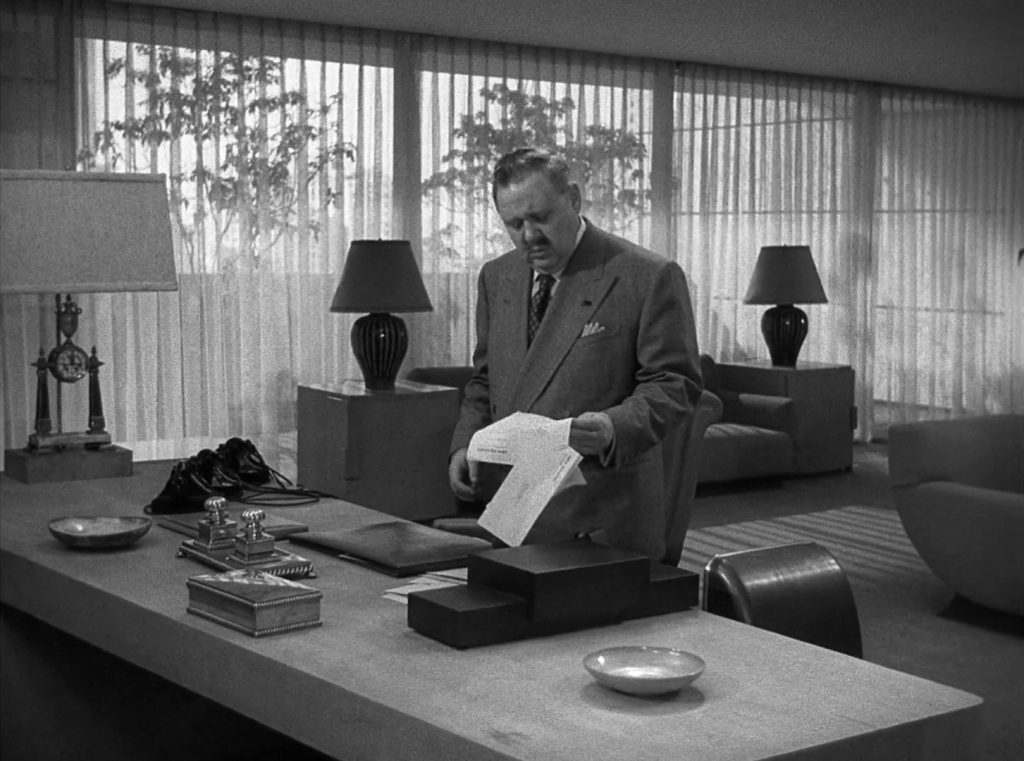
It’s not just that the modern worker can’t get enough time off in a surging postwar economy. When Janoth’s mistress calls his office a “tycoon’s lair, the Berchtesgaden of the publishing world,” she links him to the forces of tyranny that the world had supposedly vanquished three years earlier. Janoth’s office happens to be on the twelfth floor, with a large clock over the private elevator where the floor indicator dials of that era would typically be, reminding us that twelve is also the top of the clock. Janoth positions himself as the master of time itself. When the long flashback begins, a tourist in the lobby asks, “What happens if the clock stops?” and Stroud, passing through on his way to work, answers, “Oh, Mr. Janoth would never permit that.”
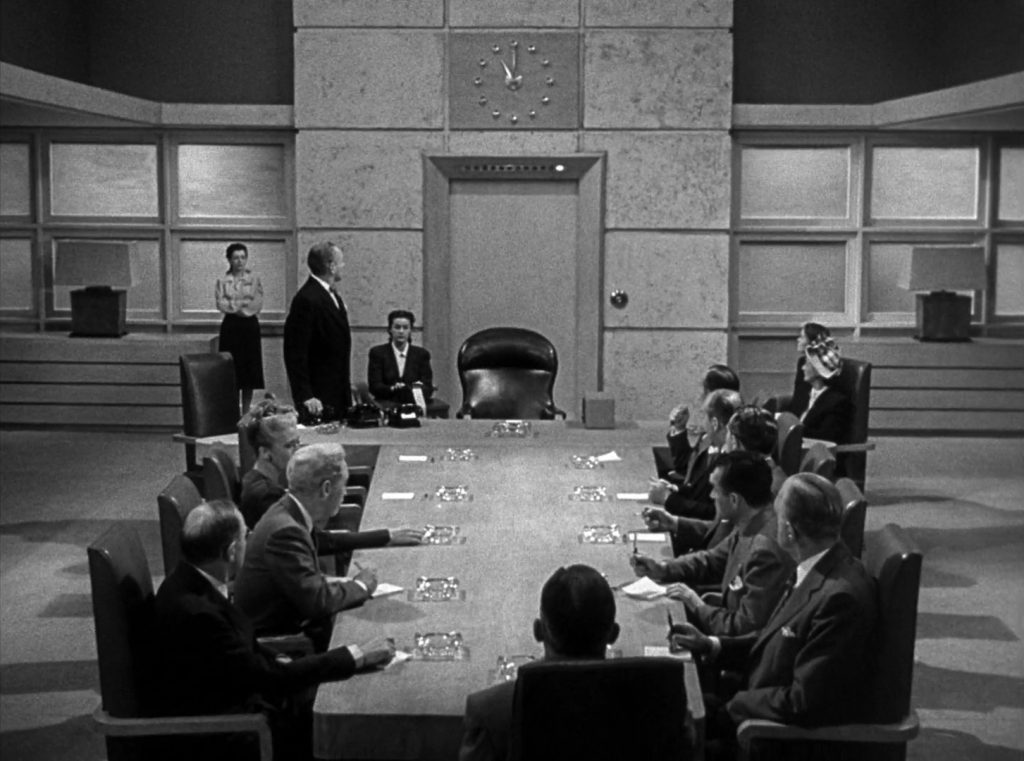
Janoth’s name and English accent are distinctly Old World, and his first name Earl points to the aristocracy that Americans had rejected at their founding. In contrast, George Stroud has a New York accent, while he, his wife Georgette, and their son George Jr. share their names with the father of American democracy, George Washington. Stroud’s secretary is named Adams, after the second president, and his friend from Burt’s bar takes in turn the names of presidents Jefferson, McKinley, and Theodore Roosevelt. Janoth’s lieutenant Hagen has a German name, and Pauline York, with her transatlantic accent and name of ambivalent associations, occupies a gray zone between the two sides. Like the proverbial Yankee Doodle, George Stroud wears a feather in his hat, and his vacation home is a modest, quintessentially American log cabin on Indian Lake in West Virginia. When he rejects Janoth’s promise of a South American vacation, he favors the home front over the preferred retreat of unrepentant Nazis.
From this point of view, The Big Clock is a cautionary tale, warning its American audience against a seemingly unthinkable rebirth of fascism on their own soil, led by corporate titans like Earl Janoth. Like any fascist ruler, Janoth surrounds himself with loyal officers like Hagen and hate-filled thugs like Bill, his henchman who never utters a word of dialogue. Like a Nazi, he calls modern avant-garde art “decadent”. It’s not extraordinary that the film’s warning came to pass seven decades later, as fascism usually allies itself with oligarchs of commerce, and fascist tendencies have been present in the United States for a long time. All the same, the movie feels prescient today in a country where vacation allowances have stagnated compared to other developed countries.
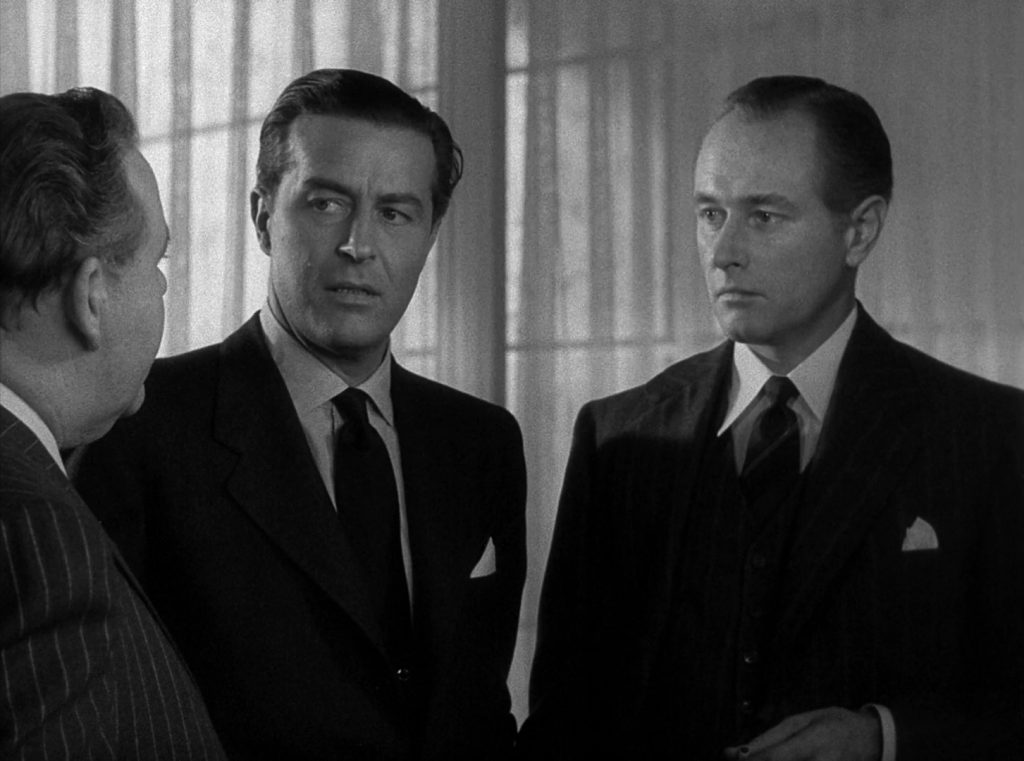
George Stroud has been working seven years for Janoth, “shoulder to shoulder, comrades in arms” as his chief says with feigned warmth, waiting the whole time for his chance to bond properly with his family. Inasmuch as he stands for the American worker pushed to the limit of endurance, that time span should have resonated with audiences in 1948. Seven years earlier the United States had entered a war that would demand four years of devotion and sacrifice, but to find oneself driven with similar urgency in peacetime, with the fruits of labor flowing disproportionately upward, must have been maddening. Stroud’s experience may not have been universal, or even the norm in 1948, but it must have been recognizable, and it reflects the stresses that corporate employers are usually willing to inflict in the absence of regulation.
Still, the point of The Big Clock is expressed more in its title than in George Stroud’s particular dramatic situation. The central conflict is not purely political or socio-economic, but fundamentally between two concepts of time. For Janoth, time is relentlessly linear and forward-moving, “each tick of the clock the beat of a heart.” His obsession with clocks reveals a wish to master time by measuring it, synchronizing it, and predicting it: “We are, in effect, clairvoyants.” The sundial may be the most convenient weapon at hand in Pauline’s apartment, but symbolically it’s the logical outcome of his thinking. A clock ultimately becomes a deadly weapon, just as he’s been using time as a whip against his subordinates for years. He’ll shoot Hagen when he feels his own time running out, and he’ll take aim at Stroud from the elevator door under a clock.
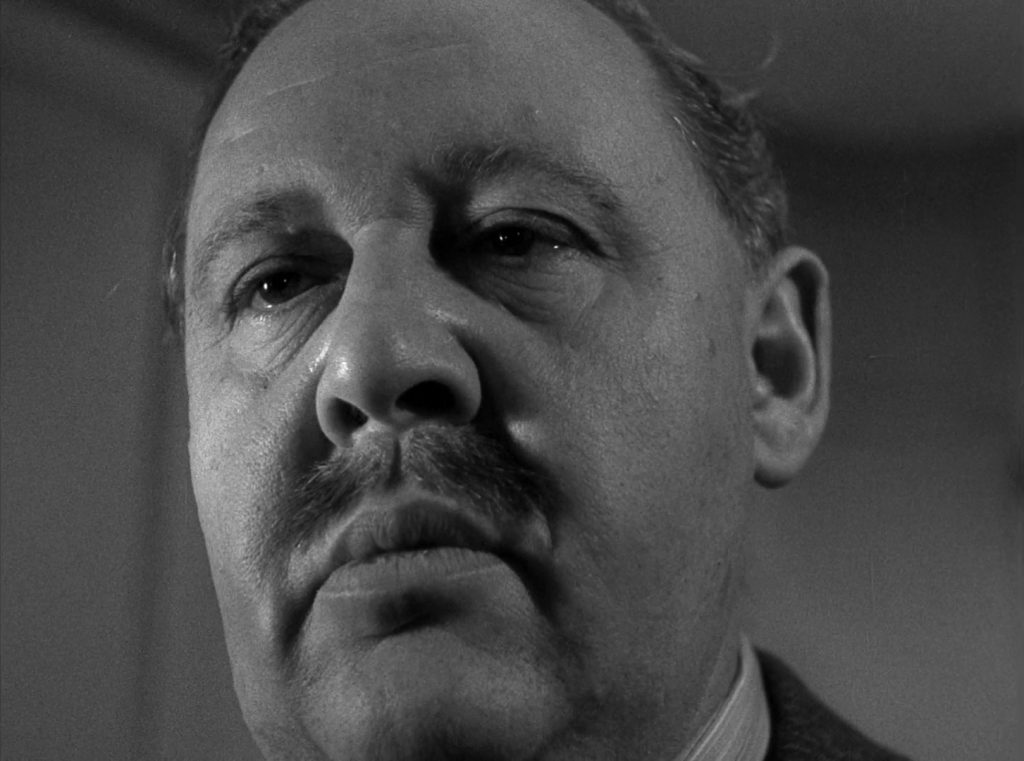
Pauline York is an imperfect reflection of the man she depends on, a self-interested schemer who lacks his absolute control. He demands clairvoyance, while she merely pretends to be psychic. She too uses a clock as a weapon, but her throw misses, and it wouldn’t have been lethal. Unable to master time, her habit is to kill time. She distracts George from his scheduled train and leads him on a bar crawl.
George and Georgette, on the other hand, regard time as the substance of life. Both of them are ready to escape the measured flow of time, but doing so ironically requires one last obeisance to the all-powerful clock. They’re supposed to meet on a train leaving Penn Station at 7:22 p.m., but George misses the appointment, leading to his implication in the murder case. Janoth too contemplates a vacation, but the thought is merely an occasion to assert his superiority to an underling. “I should take an ocean voyage. Have you ever been abroad, Bill? It’s stimulating.”
When George looks out of the clock in the opening passage and thinks back a day and a half, he has symbolically violated the clock’s authority by reversing time, even if only mentally. When his flashback comes full circle 80 minutes later, he’ll accidentally stop the big clock, doing exactly what he said Janoth would “never permit”. To think of time as anything other than a regular, unceasing, almost militaristic forward march is to challenge the authority of figures like Janoth who use time as a means of control. Stroud wonders to himself, “I’m no criminal, what happened? …Thirty-six hours ago I was a decent, respectable, law-abiding citizen.” His real crime has been against Janoth’s law of forward time, and he’s placed in the strange position of leading an investigation into his own activity, turning his role into an analog for introspection. At the end of the process he’ll know his own values better.
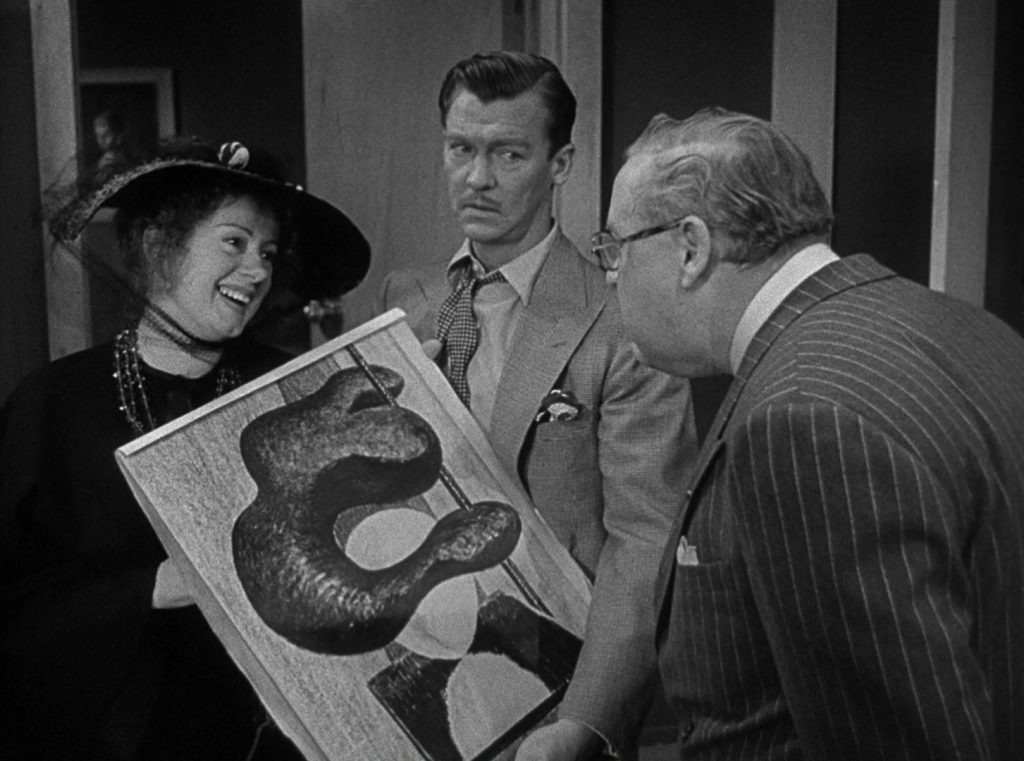
Janoth, ironically, places himself above the law. “Wouldn’t you steal something if you wanted it badly enough?” “I might.” When George rides the elevator to his office the first day, the successive floor stops reveal something of the priorities at Janoth Publications: Sportways, Airways, Artways, Styleways, Newsways, Crimeways. George edits the latter magazine, which occupies the eleventh floor right under Janoth’s lair. Typical of an oligarch, Janoth promotes a message of law and order while excepting himself from society’s rules.
In the end, each wrongdoer gets a sort of poetic comeuppance. For prioritizing work over life, George is temporarily stuck in his workplace, forced to work against himself at great risk to his life. For killing time, Pauline loses her own life (her punishment exceeds the severity of her wrong, but it drives the plot). After being “clocked” inside of a clock, Bill is trapped in the elevator, just as he’s trapped in his own hatred. For blind loyalty to an unscrupulous man, Hagen is betrayed. Janoth plunges down the elevator shaft, falling from his lofty perch.
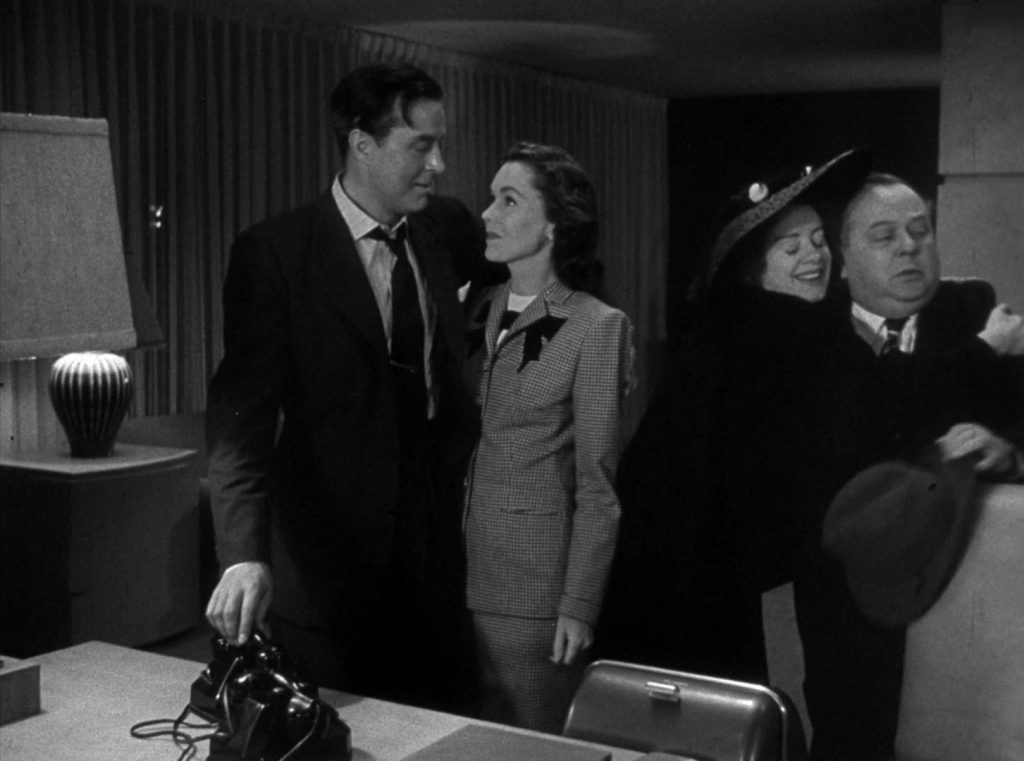
All of this would fall flat if it concluded with the sentimental finale that it seems to aim toward. George and Georgette are finally free to take their honeymoon, and a lesser film would have made a fuss over that foregone conclusion, but The Big Clock sidesteps the obligatory happy ending with a clever substitution. George Stroud has been a “missing husband” for seven years, but the film ends with a comic twist when the artist Louise Patterson shrieks and pounces joyfully on her own missing fourth husband. For a few seconds the two reunited couples stand side by side, the audience’s attention directed at the surprise reunion of two supporting characters whose drama suffices for the happiness we awaited for the main couple.
CONNECTIONS:
Citizen Kane – Strong-willed publishing tycoon who sponsors the career of a woman singer; flashback structure introduced by an allusion to advancing time
Saboteur – Analog to fascism located in New York but linked symbolically to the Old World; American values represented in a log house to the west; villain’s plunge at the climax
Holiday Inn – Protagonist complains at the beginning about working a full calendar including holidays; ideal life represented by a rustic country house; elaborate montage of glossy images bridging a gap in time
The Third Man – Warning against resurgent tyranny rising from commercial activity in a recovering postwar world
David and Lisa – Madman obsessed with synchronized time, who comes to use or view clocks as a weapon
An Autumn Afternoon – Critique of post-war modernity as being too relentlessly forward-driven; explicit or implicit wish to stop the clock
Pan’s Labyrinth – Fascistic tyrant obsessed with clocks; setting inside a large clock or clock-like room; significance in a stopped clock