An Actor’s Revenge
1963, directed by Kon Ichikawa
An Actor’s Revenge does not fit either of the usual molds for a revenge tale. If it aimed for catharsis, then the injustice against Yukinojo’s parents should have been given more weight than a quick expository flashback. If the film were an edifying lesson, then Yukinojo should have more cause for regret than Namiji’s death, which is only a side effect of his vengeance. In other words, we’re left to witness the mechanics of a revenge plot without being invited to share in the intensity of emotions or in the moral reckoning. The real story must therefore lie elsewhere, and it’s indicated in the opening scene.
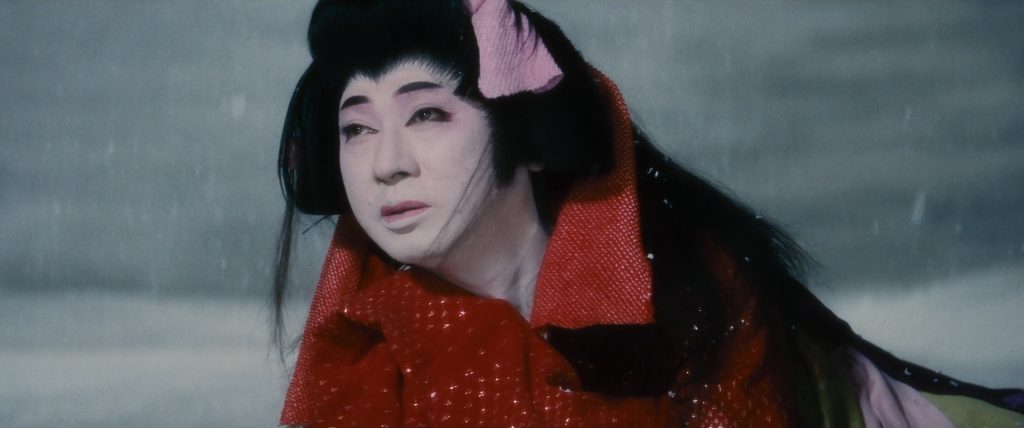
The film opens onto the stage of a kabuki theater in the 1830s, where male actor Yukinojo is playing a princess from the Heian period. We’re only given brief excerpts from the play at the beginning and end, with only the vaguest clues to what’s going on, but some basic parallels to the film are visible – the feminine protagonist (Yukinojo is effeminate even when out of character), the tragedy and unmasking, the winter setting. If the play is a pale reflection of the film that contains it, then the film plot, which is also reduced to its theatrical elements, may also be a pale reflection of some greater drama.
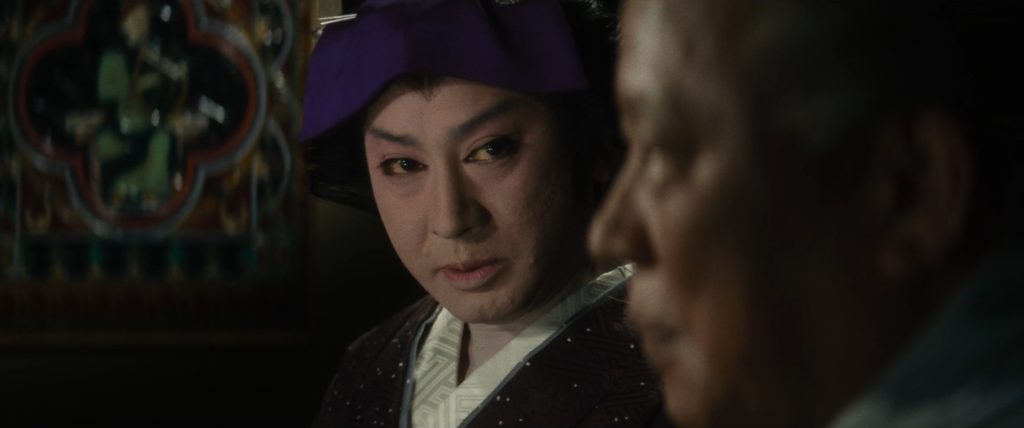
At the kabuki play’s Edo premiere, Yukinojo addresses his long-dead father as he spies two of his three enemies in the audience, with Namiji, the young daughter of his oldest enemy, between them. The three figures in the box seat are framed in a series of irises against the snowy stage set, highlighting the fact that Yukinojo is looking at them. For once, an actor is watching his audience with greater intensity than they watch him, reversing the most basic assumption of the theater. If we choose to see Ichikawa’s film as a fundamental commentary on the performing arts, then this reversal of the gaze suggests a similar reversal across the greater story – the actor will get revenge for being watched.
What would such a thing mean, though? Actors want to be watched, so why seek revenge? The answer is not so literal. Revenge is a settling of scores, and the point here is that the actor will extract a certain price for being watched that the viewer does not anticipate.
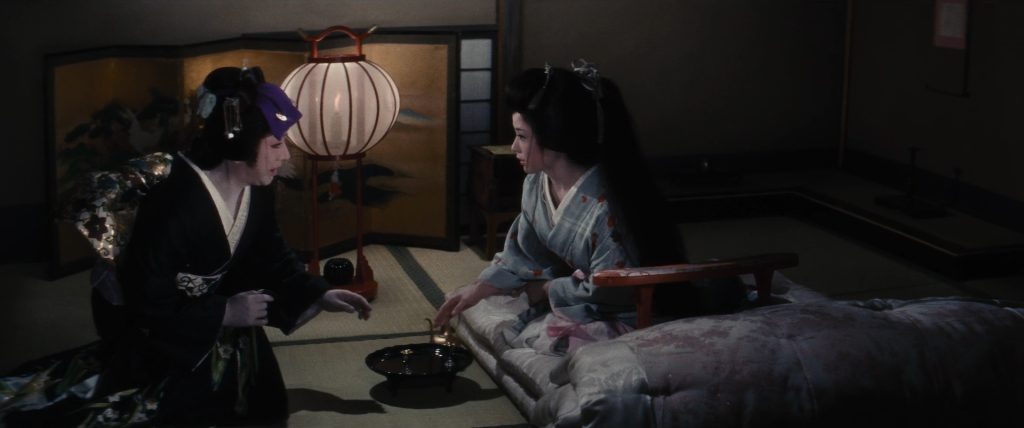
The emotional heart of An Actor’s Revenge is Yukinojo’s relationship with Namiji. He tells his mentor Kikunojo, “Every time I drink sake with Namiji, it feels like molten lead going down,” but at the moment she dies, he’s overcome with emotion: “You were completely innocent. It’s as if you were born only to be deceived. You’ve passed on from this world, never having been truly loved.” Namiji thus stands in for a passionate audience, so absorbed that it imagines itself the target of the actor’s emotions, which never in fact connect with the living recipient. The actor conspires to deceive his target and will never requite her love, yet in the end he’s moved by her affection. Yukinojo tells the dead Namiji he hopes they’ll be wed “on the other shore” where he’ll serve her always.
The romance with Namiji, however, is not the whole story. Yukinojo will also avenge himself on his more casual and distracted viewers, but the substance of An Actor’s Revenge is not as trivial as how he evens the score with a checklist of enemies. Revenge is an act of leveling, but it’s also a turning of tables, and if nothing else the film is a tale of reversals. The onnagata Yukinojo dresses, speaks, and acts like a woman, yet he’s more manly than anyone around him. Likewise among the thieves it’s a woman, Ohatsu, who dominates. The story is set amid the rice riots of the 1830s when the poor turned on the rich, and Yamitaro is a Robin Hood character, stealing and redistributing wealth.
The film itself is a historical costume drama, a remake of a 1935 film also starring Kazuo Hasegawa, yet its style is modernist almost to the point of being avant-garde. The score mixes traditional Japanese theater music, romantic music in the Western classical idiom, and passages of jazz that sound incongruously modern. The chiaroscuro settings are minimalist and theatrical, yet the effect is cinematic and never feels stagey except in the bracketing kabuki scenes. The story is a reversal of Yasujiro Ozu’s 1959 film Floating Weeds, each spanning the run of a kabuki play in one location. In Floating Weeds the troupe plays to a village in western Japan, and it’s an utter failure. In An Actor’s Revenge they’re a rousing success in the capital city. Ganjiro Nakamura plays the head of the troupe in one and the chief antagonist in the other, and Ayako Wakao also stars in reversed roles, from the deceiver in Ozu’s film to the deceived lover in Ichikawa’s.
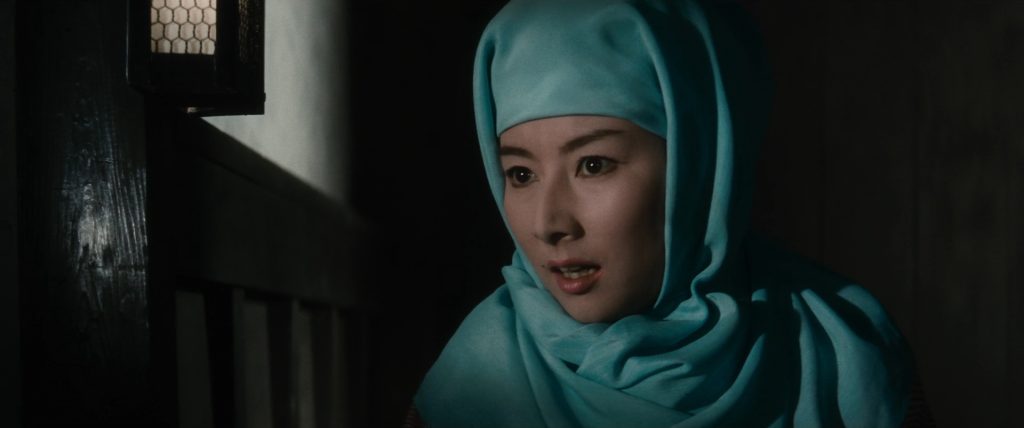
When Yukinojo rejects Ohatsu’s affection, she warns him, “I can swing between snake and Buddha like an acrobat.” To swing between such extremes sums up the pattern of reversals that governs the characters, drama, setting, and dialogue:
- Yukinojo delivers internal monologues on occasion, whereas Yamitaro, a masculine figure played by the same actor, delivers external monologues;
- Yamitaro’s nickname is the “Nighttime Kid”, and his would-be rival is the “Daytime Kid”;
- Sansai Dobe’s first lines are about a precious ruby from Holland, and his last lines are about a deadly poison from Holland;
- Kawaguchiya takes Sansai Dobe’s advice and buys large quantities of rice; Hiromiya takes Yukinojo’s advice and sells large quantities of rice;
- Ohatsu’s partner Mukuzu comments that “People spend more when times are hard”;
- A gift that looks like a fan turns out to be a knife;
- Yukinojo declines his enemies’ invitations in order to get closer to them;
- The wisdom of Isshosai’s martial arts school is written on a blank scroll;
- After fighting him off twice, Yukinojo finally vanquishes his stalker Heima with non-resistance.
The pattern extends into the changing seasons, reversals of east and west, friends becoming enemies, a priest living as an outlaw, and so on. Some of these reversals might be unremarkable on their own, as any dramatic plot will subvert expectations, but other turnabouts are as sharp as switching “between snake and Buddha”, and taken together they leave little doubt that the idea of reversal is baked deeply into An Actor’s Revenge.
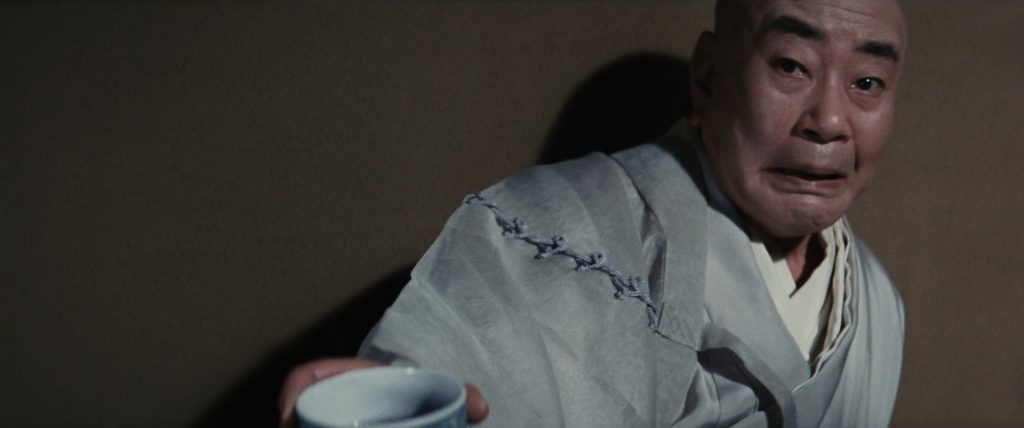
In this context, and given the highly abstract cinematography and settings, it’s easier to look at all the acts of revenge with emotional detachment. Instead of seeing the dramatics of Yukinojo’s vengeance, we can appreciate its metaphorical value. He’s doing the work of an actor. In that sense he’s dangerous, in unexpected ways, to everyone who watches him, just as any skilled actor may change the life of anyone in the audience. It’s important that Yukinojo never kills or harms his targets directly. Anyone watching a play or a movie may feel safe, knowing the actors will never come close enough to cause harm, but the effects of a performance are furtive, and we are not as safe as we think. It’s immaterial that their influence may be positive – it still operates with the stealth of a thief, which explains why Yukinojo outmatches all the thieves in his story.
Immediately after the Daiei logo and the producer’s credit at the start of the film, an inscription celebrates the legendary actor Kazuo Hasegawa’s 300th appearance on the screen. Here he plays two largely opposite starring roles, thus showcasing his range, and his return to a role he had played 28 years earlier showcases his longevity… but more than that, the film’s subject is a tribute to the power of great acting in general.
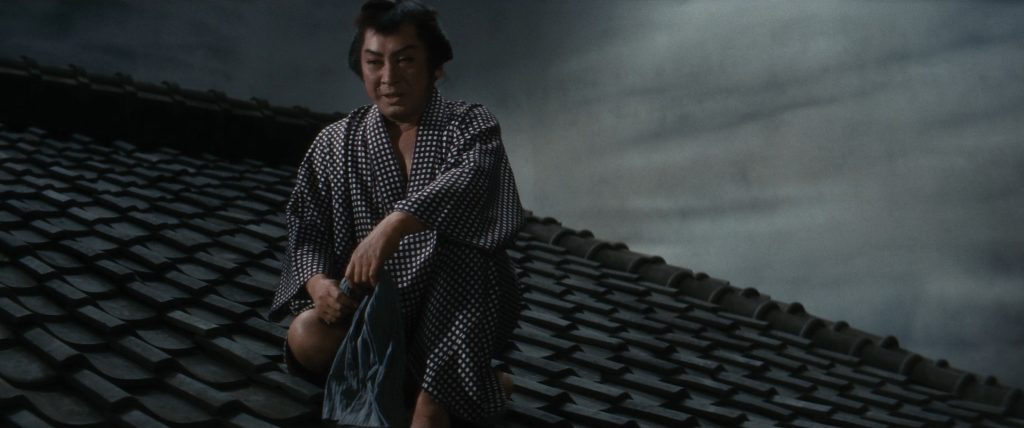
Yukinojo completes his revenge on his three targets, but at the end we’re told of another three persons he makes a lasting impression on:
“But the image of Yukinojo disappearing over the windswept plain remained enshrined in one person’s heart. Was it Yamitaro? Or Kikunojo? Or was it Ohatsu?”
Each of those three – the two thieves and the old actor – had been a sort of audience to Yukinojo, following the course of his revenge plot, and all three had fallen in love with him in some fashion, as Namiji had. Each of them, at one point, expresses a willingness to aid in Yukinojo’s dire task, but none of them is able to – just as any audience member may vicariously participate in an actor’s efforts without truly being able to help. Now, having witnessed the arc of his actions, it’s more than plausible that one of them would carry Yukinojo’s image with great feeling for the rest of his or her life.
CONNECTIONS:
The Cabinet of Dr. Caligari – Villain lashes out then comes undone when men bring in the corpse of a person he used as a pawn
Floating Weeds – Action spans the duration of an acting troupe’s stay in a village or city; Ganjiro Nakamura II & Ayako Wakao in reversed roles
Diva – Begins with a stage performance that affects one audience member in particular; subtext about the gulf between performer and audience