Signs of Life
1968, directed by Werner Herzog
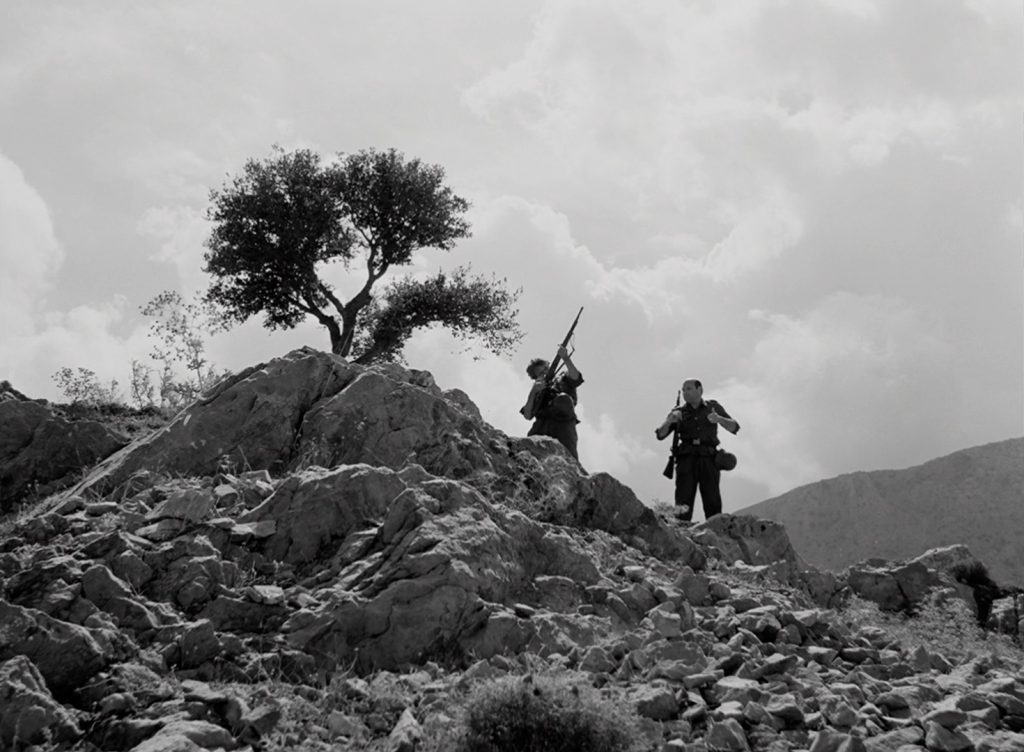
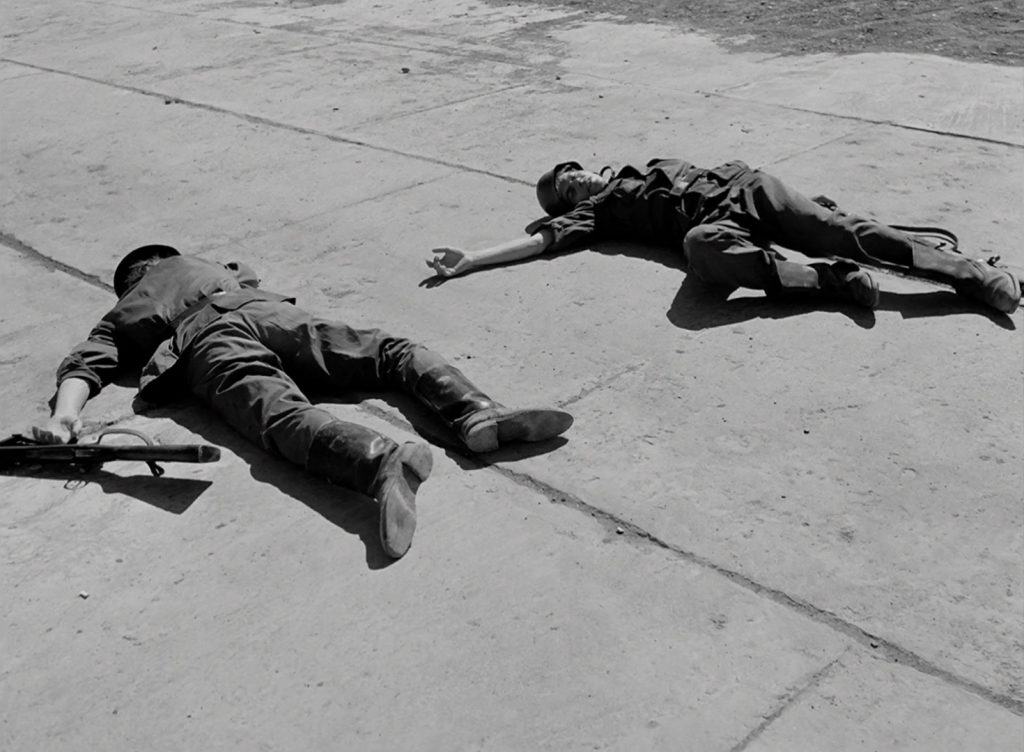
At five minutes in, Signs of Life flashes back to the moment right after Stroszek and his comrade were shot in a Cretan village. Viewers can be excused if they don’t remember the scene, as it barely calls attention to itself. There’s no close-up to identify Stroszek, and the arm movement that identifies him as the sole survivor is barely perceptible. A long hand-held shot leads to the two soldiers’ bodies, zig-zagging up some old alleys to the seafront where it finds them on the pavement to the left. The camera, however, shows greater interest in a pair of goats stepping off a bus to the right. The latter image will prove typical of Werner Herzog, who throughout his career likes to redirect attention away from the facts of a plot toward the strange “signs of life” that intersect with the story.
The goats getting off the bus are not gratuitously strange, nor are they especially surreal. Rather, they’re the sort of lifelike strangeness that’s magnified in proportion to the attention given to it. In short, the film prioritizes wonder over drama. All the same, the hand-held tour through the labyrinth of alleys reveals more about Herzog’s technique than do the goats on the bus. The zig-zagging movement echoes the film’s opening shot of a truck winding through mountainous terrain. Taken as a whole, the film celebrates the strange and circuitous route that real life usually takes, in contrast to the linear path of a more goal-oriented movie plot.
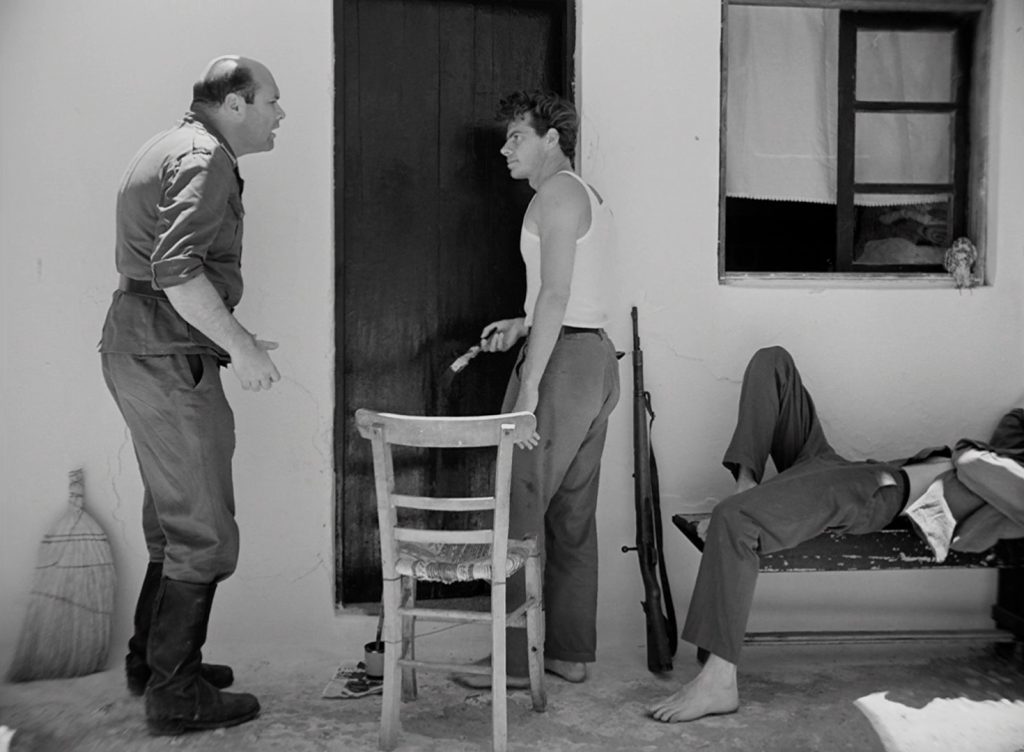
A traveling vehicle is a conventional way to open a film. It establishes a sense of narrative before any narrative is recognizable, and it typically draws the audience into a linear, forward-moving conception of time. Here, the truck’s meandering path, which the high perspective accentuates, helps to break the usual linearity, but still it’s remarkable how closely the reputedly eccentric Herzog adheres to the formulae of classical film narrative. Not just the moving truck, but also the plot and characterization follow standard rules until the vicissitudes of life impose their wondrous deviations on everything. The ammunition depot in the middle of the fortress, ready to blow up at any time, is a classical MacGuffin sustaining the plot – except that instead of leading to drama, its energy will be discharged in a display of fireworks that feels incongruously joyful in a tale of madness and war. Likewise, the three soldiers stationed at the fortress in Kos are initially distinguished along the classical triad of mind, heart, and courage. Becker is the intellectual, preoccupied with ancient inscriptions; the newlywed Stroszek shares many tender scenes with his wife; and Meinhard is the bold and imposing former bar manager – but these distinctions do little to determine the film’s outcome.
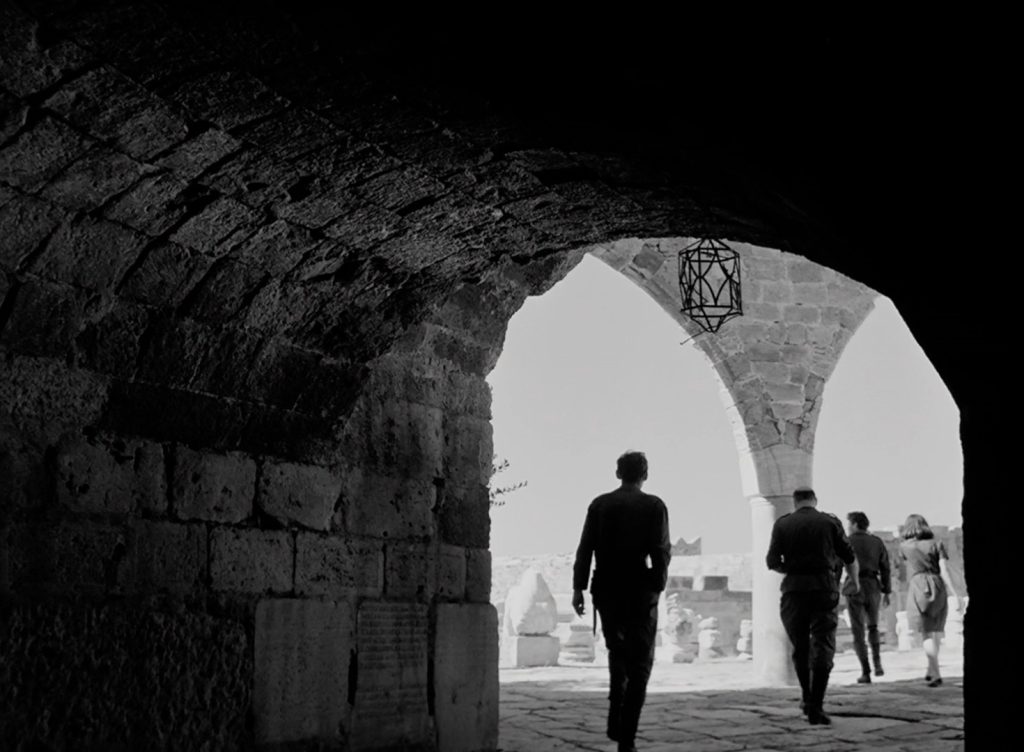
If we can describe Signs of Life as being rooted in the classical mold of filmmaking, it also appears that Herzog was attracted to a setting that evokes the ancient classical world, as if to return to the source of Western culture and start over from there. The fortress on Kos is embedded with artifacts of ancient Greece, and the setting evokes the world of Homer. Like The Iliad it’s set in a war, but more to the point, its meandering storyline is like Odysseus’s circuitous path around the Mediterranean with its variety of colorful incidents.
Herzog’s narrative ideal finds its metaphor in the case of the nomadic Romani king who comes to the fortress gate. The king had been separated from his tribe early in life and spent the rest of his years searching for them all over Europe. Crossing paths again later at a street café, Meinhard suggests that the king and his family were both going in circles searching for the other, but the king answers, “No, I don’t run in circles, others do. Our people always change directions.” Meinhard scoffs, as if unaware that his own life follows a similar course. The fact that this king lives happily in his poverty is a sign of wisdom, giving credence to the wisdom of his travel habits. Toward the end we’ll see him a third time, performing an elaborate dance that constantly shifts direction like the tribe he comes from.
A circuitous, ever-changing route is thus presented as a literal and a metaphorical ideal, a guiding spirit for cinema, for storytelling, for travel, and for life itself. In contrast, Signs of Life introduces two alternatives – the straight line and the circular path – which are always less than ideal.
Meinhard observes that the cockroaches that disgust him so much follow straight paths along the edges of walls, so he devises a ramp, again a straight line, to trap them. Once caught in his flask, they can only run in circles. The most direct expression of a straight path occurs precisely half an hour in when Meinhard hypnotizes a chicken by pressing it to the floor and drawing a line in chalk straight out from its beak. The unspoken idea is that there’s something mindless about moving in a relentlessly straight direction. We don’t need to see marching soldiers to get the wartime connection, but the main characters run in a straight line at their moment of greatest disunity, and the crowd below the fortress flees in straight lines from Stroszek’s bullets. A straight course is thus linked to aggression and fear.
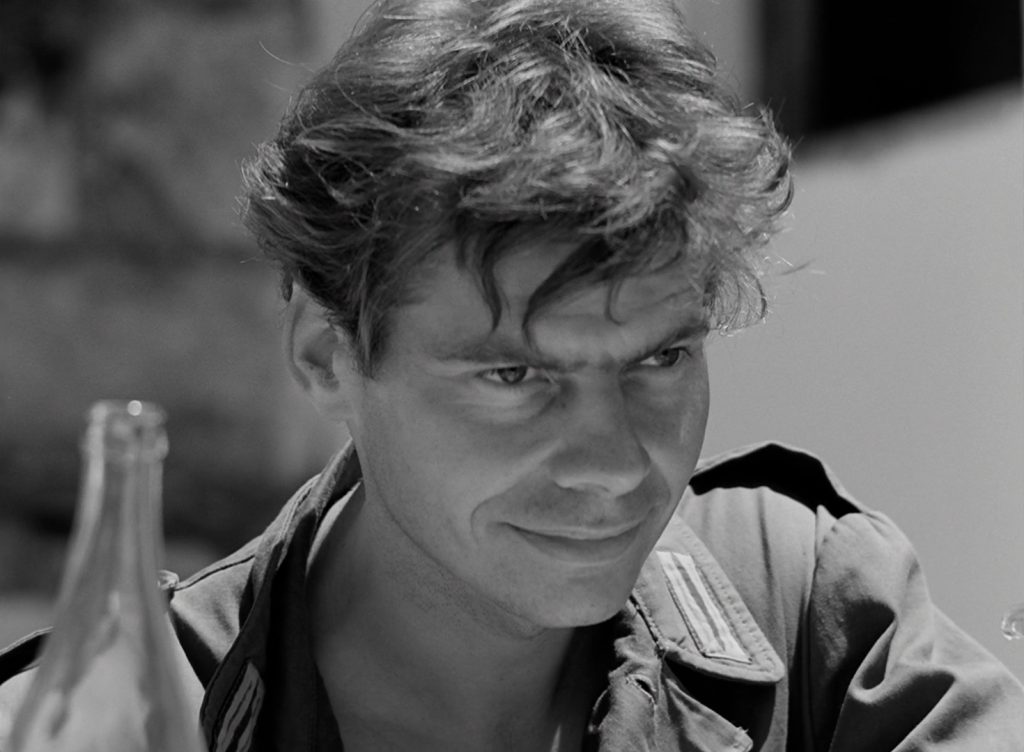
A circular path is no better here than a straight one. Meinhard says that “one could also draw a circle” instead of hypnotizing a hen with a straight line “…then the hen would run in a circle until it became exhausted.” He describes a similar trick on caterpillars, changing the direction of one until they all creep in a big circle. At the quay, Stroszek observes swarms of tiny fish encircling floating objects, prompting a flashback to the physical discomfort of his wedding day. On the way out to the valley of windmills, a little girl recites a poem warning shepherds to heed the vultures circling over their flocks. Stroszek’s breakdown is prompted by the sight of hundreds of windmills spinning their blades in endless circles.
Stroszek doesn’t fully snap until he feels betrayed, but his attack on the windmills (reminiscent of the hero’s misplaced aggression in Don Quixote) follows complaints of feeling confined in the walls of the fortress. He evidently feels stuck in a kind of loop, unappreciative of the variety that we can witness throughout his time in the fortress. Each of the three soldiers, in fact, has his own blindness: Becker is apathetic, Meinhard feels superior to his present station, and Stroszek cracks. Any outside observer should be able to take delight in all the small incidents that punctuate their lives and which they fail to appreciate – the wall-sitting contest, the children’s game with the chicken, the king’s visit, the boys on the quay, the pianist’s strange interpretation of Chopin, and so on. Any one of these may be seen as a forerunner to the trademark images of Herzog’s later films: an airplane husk lost in the desert, a coin-activated dancing chicken, or a steamboat being hauled over a mountain ridge.
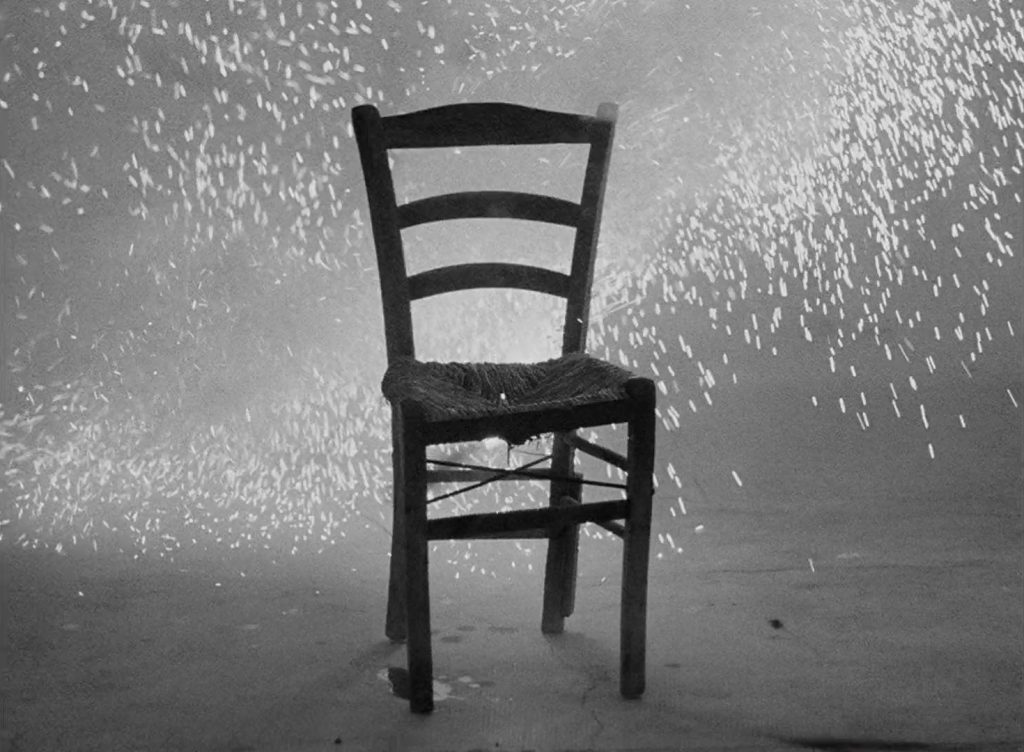
As much as the twists and turns of a winding road, or the quasi-surreal moments of everyday life, the film is also built on a web of ironies. It’s set during history’s bloodiest war, yet in total it’s a picture of peace. The commanding officers in Kos, though belonging to a murderous army, show humanity both to the Greeks and to the convalescent soldiers. Despite the violence of Stroszek’s rebellion, he “only” harms a donkey and a wooden chair. The explosives that threaten so much destruction end up producing fireworks. Meinhard despises cockroaches, yet he feels pity for a fly trapped in a toy owl. The German soldiers receive the Romani king warmly, though their regime was currently in the process of exterminating his people. There’s a bitter irony in the understanding that that’s probably why he cannot find his family. Ironically, although his circuitous wanderings don’t reunite him with his tribe, they do reunite him with Stroszek and Meinhard.
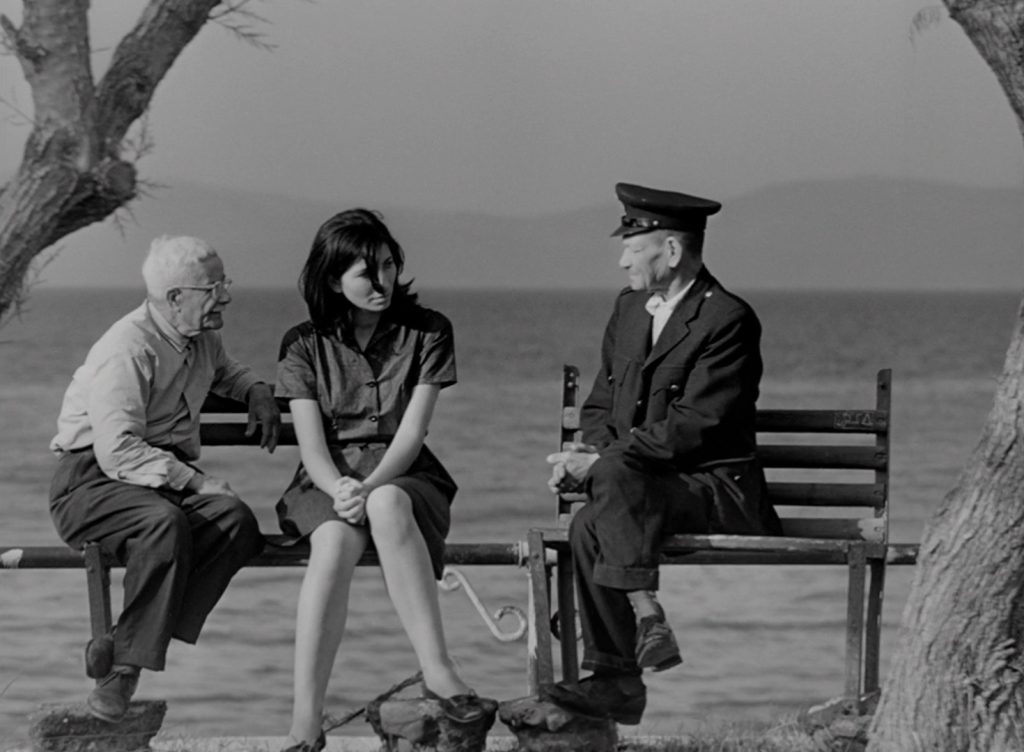
It’s ironic also that a film that begins with a truck winding in every direction, and which puts so much value in the bending of life’s path, ends with a truck driving down a straight road. The camera, significantly, faces backward, and the voice-over casts Stroszek’s experience as a story of failure:
“During the night when Stroszek again started another firework display, he was overpowered by his own men. He didn’t make it to the depot, for he was already surrounded. In his rebellion he had undertaken something titanic, for the enemy was far superior. Thus he had failed as miserably as all others of his kind.”
Although Stroszek’s “enemy” had in fact treated him more charitably than most would expect, anyone watching Signs of Life must be aware that the people and events around this relatively peaceful Greek island were far crueller than anything shown here. In all the twists and turns and ironies we’ve seen, there may be something of a law governing everyday life, but we also know that Stroszek’s episode would have been an anomaly in World War II. Life by its nature may strive for the wondrous diversity that organizes this film, but we also live in a civilization that pushes life simultaneously into straighter and more numbingly cyclical directions. In that sense Stroszek represents the part within every human that rebels quixotically against civilization’s unnatural and constraining forces.
CONNECTIONS:
Nosferatu: A Symphony of Horror – Character who goes mad near the end and hops around on roofs or battlements
The Wizard of Oz – Triad of mind, heart, and courage as a classical basis of characterization
Monsieur Hulot’s Holiday – Series of seemingly random incidents as characters relax on a European coast; protagonist sets off fireworks at the climax
The Burmese Harp – Anomalously peaceful episode from the Axis side of World War II
L’avventura – Evocation of ancient Mediterranean culture as the ground for a new beginning of cinema; valuation of wonder over the dramatic; story hinges on an unexplained incident
Persona – Small number of characters put on an island for recuperation; person who goes berserk when a secret is betrayed; brief chase parallel to the sea coast
Katzelmacher – First successful film of a major New German Cinema director; Germans in Greece or a Greek in Germany; recurring scenes of the main cast passing time idly in front of a minimalist section of ground-floor doors and windows