
Carnival of Souls
1962, directed by Herk Harvey
The surprise at the end of Carnival of Souls comes with no explanation. When the car is dredged up from the river in Kansas with three drowned women inside, including protagonist Mary Henry, no words are needed to make sense of the preceding ghost story. Mary’s whole trip to Utah – her job as a church organist, the salt palace, the rooming house, the phantoms chasing her, and the various characters intruding on her solitude – had simply flashed through her mind like a dream while she was drowning.
In retrospect, it’s as if we’ve been let in on the secret from the beginning. All sorts of details simulate or allude to the experience of drowning, especially the organ music, the bathhouse, the landlady’s odd generosity with baths, and Mary’s two episodes of silent detachment, which evoke the feeling of being pulled underwater. There’s a sense of ebb and flow in the editing, the moods, the lighting, the conversations, and the horror. A bubbler in the park, Mr. Linden’s constant drinking, the hydraulic lift, and other details suggest the liquid surrounding Mary, and the dappled light coming through a tree or a wooden lattice suggests the specks of sunlight that a drowning person might reach for.
The ending puts a stamp of truth on all the ghoulish fantasy. The pale-faced man and his ghostly companions who’ve been haunting Mary are simply the destiny that awaits her. Like a vampire in a coffin, the strange man sleeps during the day in a watery grave, submerged like she is. In two of his first appearances he replaces Mary’s reflection in a window, as if reminding her of her present reality.
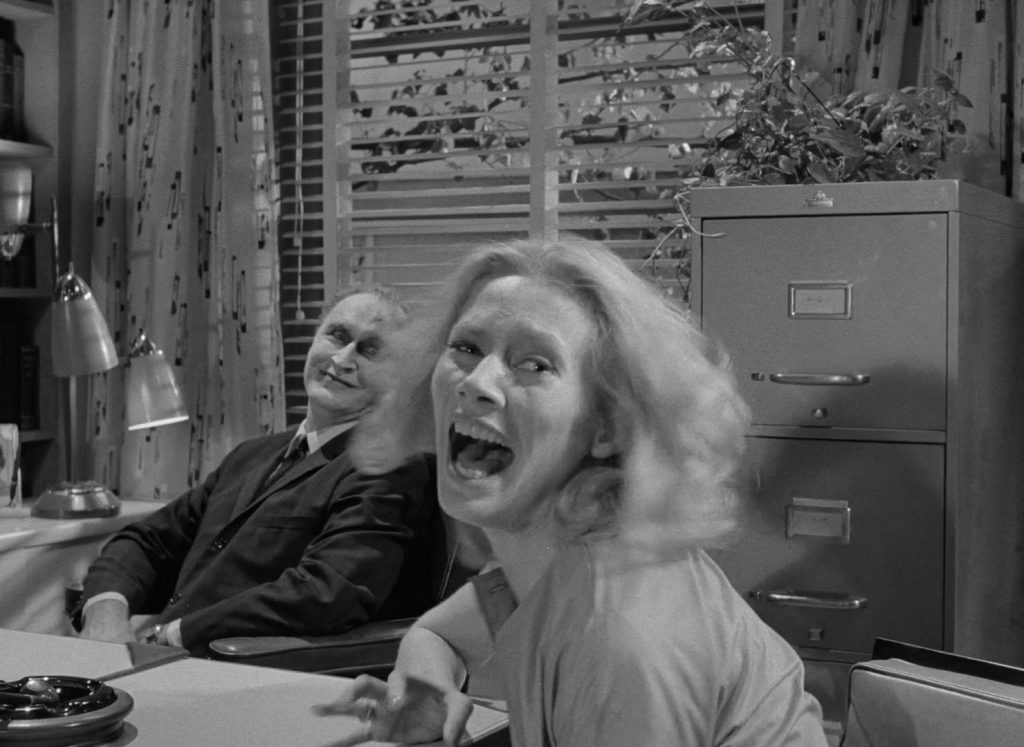
It’s important, though, that in his subsequent appearances this spectre of death becomes an external force. He shows up at the bottom of her stairwell, below the organ loft, in the salt palace, and then in place of three familiar men. When the minister comes to put an angry halt to Mary’s unreligious organ music, she sees the pale man approaching her with hands outstretched. When John Linden snuggles up to her at the mirror, she sees the strange man reflected there instead. On her second visit to the doctor, the chair swivels around to reveal the grinning spirit.
Those three men who trade places with the ghost share something in common beyond being merely obnoxious, and we can define it if we pursue the comparison that the story’s premise invites. Mary is a young woman from Kansas seeking a better life far away, yet her adventure turns out to be a sort of dream. If we compare her story to The Wizard of Oz, it’s easy to connect the pale ghost to the Wizard and the salt palace to the Emerald City, or maybe to the witch’s castle, but the trio of men noted above don’t quite seem to fit the pattern of the Scarecrow, Tin Man, and Lion. Mr. Linden is insecure about his lack of education (“I’m just as smart as the next guy!”), but the characters don’t match up neatly until we realize what they’re doing to Mary. Mr. Linden tries to fix her heart; the doctor tries to fix her mind; and the minister tries to fix her faith, which is equivalent to courage.
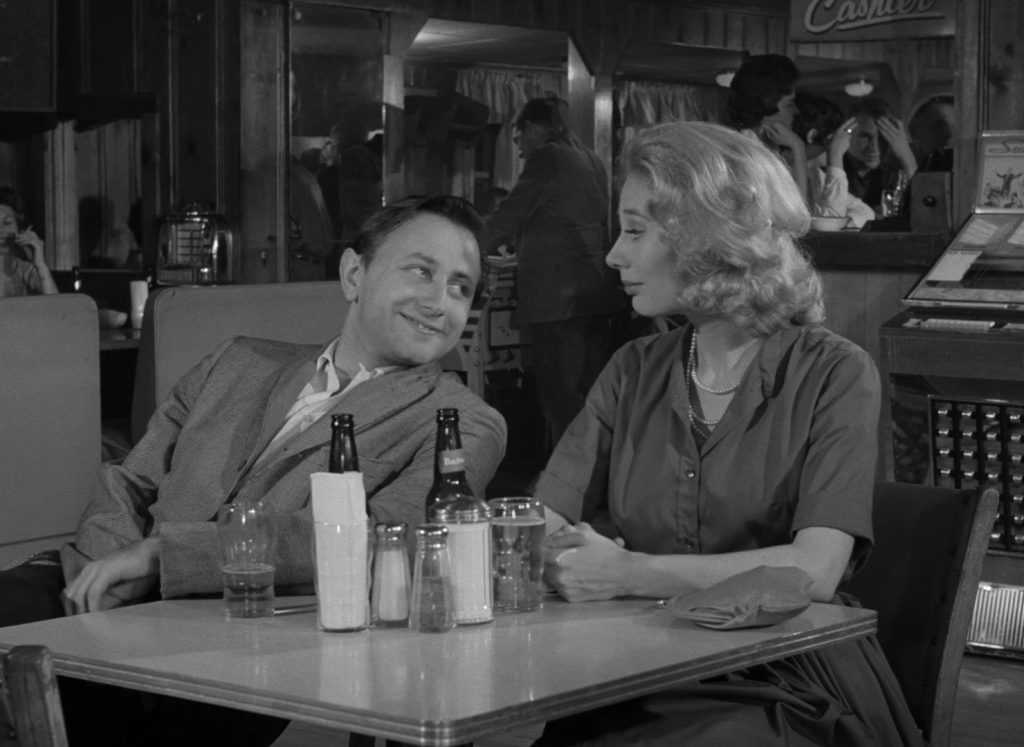
In each case the unpleasant insinuation is that something is wrong with Mary, and that the man is entitled to have his way because it’s for her own good. Mr. Linden finds her uptight and unsociable, and he’s determined to loosen her up. Dr. Samuels catches her in a moment of hysteria, which he thinks justifies holding her forcefully and luring her to his office. The minister dismisses her cruelly for nothing more serious than playing carnival music during a solo practice in an empty church, leaving her stranded without employment, yet he claims the act stems from his conscience, and he still pretends to be benevolent: “There is help here, and I urge you to accept it.”
If this pattern is so clearly defined, then the male behavior in Carnival of Souls is not just an artifact of a sexist era, nor merely an aid to the horror, helping to construct a picture of Mary’s helplessness. It seems, rather, that the film is a considered commentary on men’s treatment of women. From this perspective, the opening scene is more than a plot device. A car with three young men in the front seat pulls up to a red light beside a car with three young women in front. “Look what we got here,” one of the boys says, and his friend proposes a drag race. The women are clearly faster though, the men only keeping up because they happen to draw the inside of every turn, and when they end up abreast on the bridge, the males crowd their opponents off, one of them later acting innocent when civil authorities question him. The whole outline of the scene is doubtless familiar to women everywhere who must compete with men in the real world.

Mary’s dying dream, the adventure that flashes through her mind while drowning, also connects to the real world. Though we’re given no guideposts to tell us so, the simplest reconstruction of her story would suppose that she really was on the verge of a new job out of state when she died, so that the imagined minister in Utah corresponds to the real organ factory owner in Kansas, whose advice and bearing is so similar. As in The Wizard of Oz, the other imagined characters likely correspond to real persons from Mary’s experience too. Mr. Linden is like a fleshed-out version of the three boys in the car, and Dr. Samuels may be a proxy for Mary’s unseen father, to whom the doctor refers briefly. The pale ghost may be understood as a composite of all the men stifling her in real life, his comparatively advanced age standing for the assumed superiority of all those men. In the climax she sees a lifeless version of herself dancing with him, waltzing in circles like a wasted life swirling down a whirlpool.
Although the ending posits the reality of death as the overarching truth behind the story, rendering all the fantastic elements believable, Carnival of Souls has more to gain if we view Mary’s drowning as a metaphor for an actual social reality. The real reality is not that Mary is dead, but that her tale describes the almost universal experience of women crowded out of a man’s world. To be a woman in a modern patriarchal society, in other words, feels like perpetually drowning.

Mary’s name, in that sense, can be read as a stand-in for womanhood itself, owing both to its place in Christian theology and to the fact that it was the most common girl’s name in the United States until about the time the film was made. In a way, though, her last name Henry is more telling, as its masculine association stands out so conspicuously. The only other named female character is her landlady, Mrs. Thomas, whose surname is also a male first name. No woman is allowed to be fully herself… by taking her father’s or her husband’s name, each is yoked to a man’s identity, and those two masculine surnames confirm the point.
Looking at Carnival of Souls this way adds meaning to the two passages where Mary finds herself invisible and inaudible to the people around her. The first begins in a department store, while the second follows her through a bus depot and a train station. Each starts with a wavy screen and ends with a chirping cardinal and sunlight seen through leaves, as if her drowning is momentarily relieved by a few gasps at the river’s surface. The two passages convey equally well the anguish of drowning and of being ignored. When a male customer invades her space at a ticket counter, he crowds her out just like the boys who kill her on the bridge. When a policeman and a taxi driver peel away from her, she’s like so many women treated as if they don’t exist. By the same token, the doctor is quick to suggest a guilt complex, as if insisting she has something to apologize for.
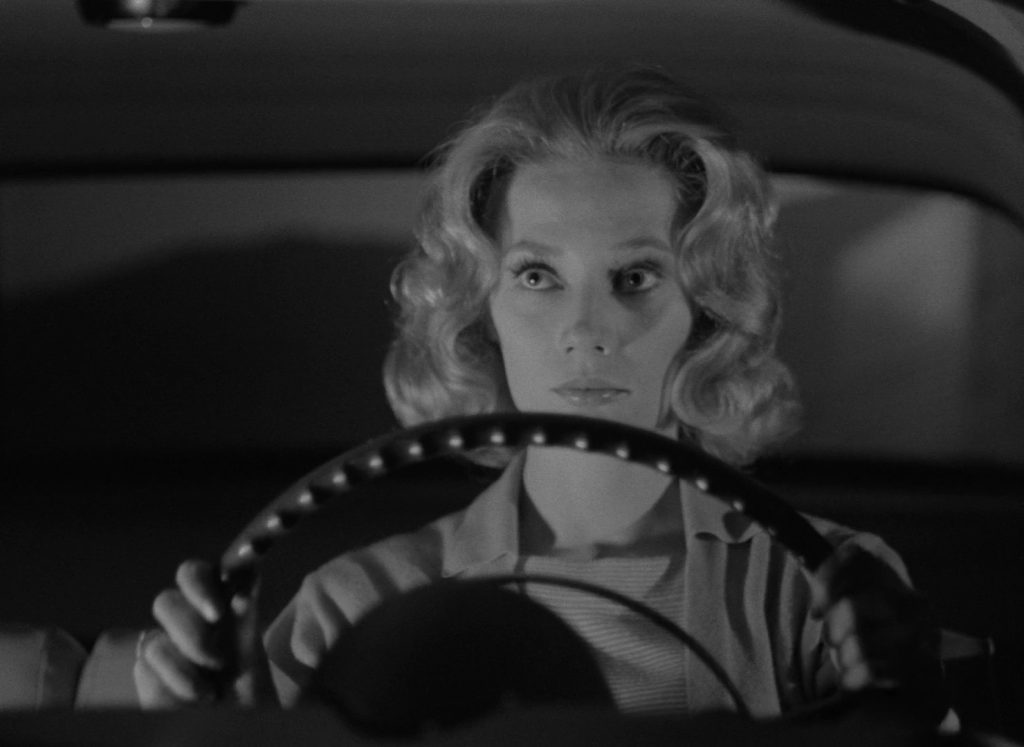
Although Carnival of Souls aims to describe the experiences of women, its director and screenwriter are men. Its chief insight is probably less in the drowning metaphor itself than in the actions and assumptions of men who smother the lives of women, taking every available advantage and feigning innocence like the three boys in the car. As closely as the film mirrors The Wizard of Oz, it also parallels Psycho, another film about how men feel entitled to control women. Both plots get into gear during a woman’s long solo westward drive. In both a man peers in at a woman partly undressed, and the famous shower in one has an equivalent in the baths of the other. Norman Bates and Mrs. Thomas both bring their guests sandwiches, and the spooky salt palace looms in the background like the old Bates mansion. Hitchcock is more analytical about the roots of the man’s crimes, but Carnival of Souls says more about the everyday effects of patriarchy. Compared to the pathological immaturity of Norman Bates, the men in Carnival of Souls exhibit a kind of self-deception, unwilling to see the effects of their actions, and the film means to hold a mirror up to them.
CONNECTIONS:
Nosferatu: A Symphony of Horror – Horror film built around a metaphor with a feminist purpose
The Wizard of Oz – Young woman leaves Kansas for a better life and meets three men who remind her of mind, heart, and courage; journey framed by reality at both ends; confrontation with an older male wizard or phantom
Ordet – Close pairing of a doctor and a minister, almost to the point of an unhealthy alliance
Les bonnes femmes – Film by a male director about the systematic stifling of women in everyday life
Psycho – Woman’s long solo westward drive; man peering into her lodging; proprietor bringing her sandwiches; shower or bath linked to her death; names Marion and Mary; spooky old building looming in the background; jump scare with a figure of death; overbearing doctor
Last Year at Marienbad – Ghostly figures dancing in a ballroom to organ music; palace in silhouette
Mulholland Drive – Inner story flashes through the protagonist’s mind in an instant
Yella – Story of a woman’s new job framed by a car plunging off a bridge; episodes of muffled detachment; drowning as a metaphor
The Counselor – Film modeled after both The Wizard of Oz and Psycho in equal measure
Get Out – Horror film that aims to represent the experience of an oppressed sex or race