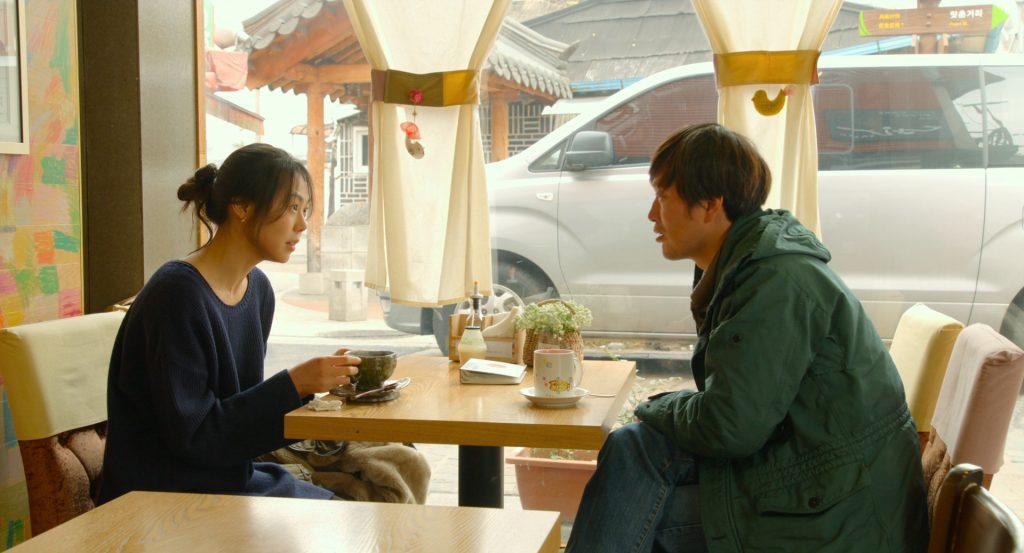
Right Now, Wrong Then
2015, directed by Hong Sang-soo
Seven minutes into Right Now, Wrong Then, the film director Ham Cheon-soo visits the Hall of Blessings in the palace at Suwon. He’ll soon wander back to find the young painter Yoon Hee-jeong drinking banana milk in the same place, but for now he steps out to make way for a visiting couple. The man in the couple photographs his partner on the count of two then shoots her from a slightly different angle, again counting “One, two.” It’s no accident that these anonymous tourists do the same thing the movie does, representing a subject from two different angles.
Halfway through, when the film starts over, the tourist couple is replaced by three young women who take turns photographing themselves in the Hall of Blessings, this time counting to three instead of two. This variation does more than break the symmetry – it points to the solution to the movie’s riddle.
Every great film presents some challenge to its audience, and defining that challenge can put us well on the road to meeting it. The diptych structure of Right Now, Wrong Then makes its challenge explicit, but still the nature of that challenge is elusive. Are we supposed to choose which version of the story is more honest, more believable, more likable, more effective, more illuminating… or what? The title seems to play an unusually decisive part in guiding us, not only because it suggests a “right” and a “wrong”, but also because the first half flips the word order – Right Then, Wrong Now – whereas the official title doesn’t appear until the second half.
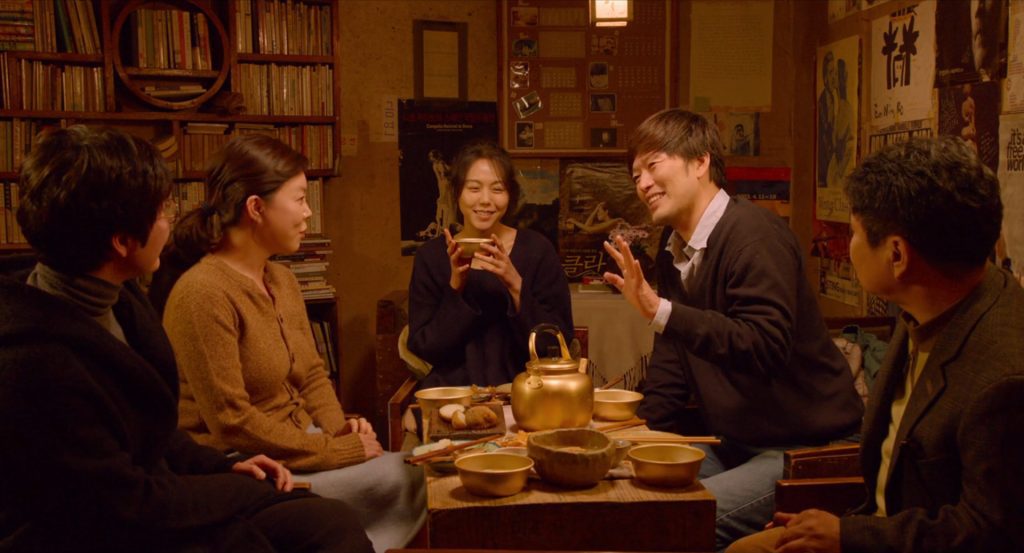
There are plenty of reasons to prefer the second train of events. The central relationship between Cheon-soo and Hee-jeong ends on a much more felicitous note. Things also go more smoothly at the film festival that drew him to Suwon, and even the two big rough spots in this version get more or less ironed out. Hee-jeong moves past her offense at Cheon-soo’s criticism of her paintings, and her friend seems to forgive the director for stripping off his clothes in her café.
All the same, the second half is not an unequivocal improvement on the first half. Cheon-soo has embarrassed himself in front of Hee-jeong’s friends, and even if they’ve forgiven his indecency, his great fan Young-sil loses interest in attending his film screening the next day. More importantly, even if things work out better with Hee-jeong, that relationship is a problem because Cheon-soo is married. The first time in the Hall of Blessings he thinks first of his family, so that the soured relationship with Hee-jeong may be read as the answer to his prayers.
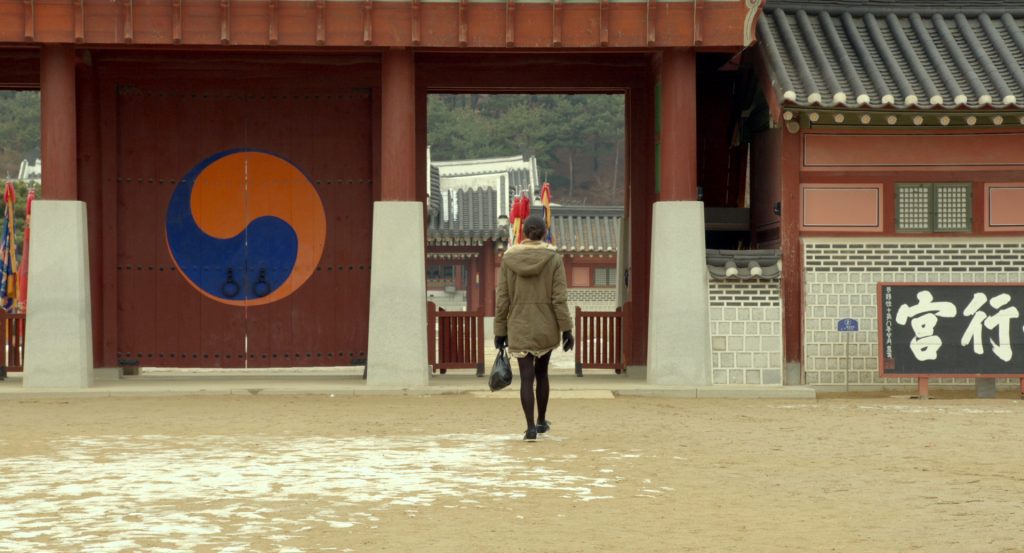
If neither half is clearly preferable, then the three tourists counting to three in the palace suggest the existence of a third alternative which, it turns out, was given to us in the opening frame. As Hee-jeong enters the palace gate, a red and blue Taegeuk (Yin and Yang symbol) covers much of the central doors beside her. The symbol represents the harmonious balance between opposing forces, indicating that the right version of the story is not either episode individually, but rather the combination of the two. The second half earns the label “Right” not because it’s better than the first, but because it completes the needed balance.
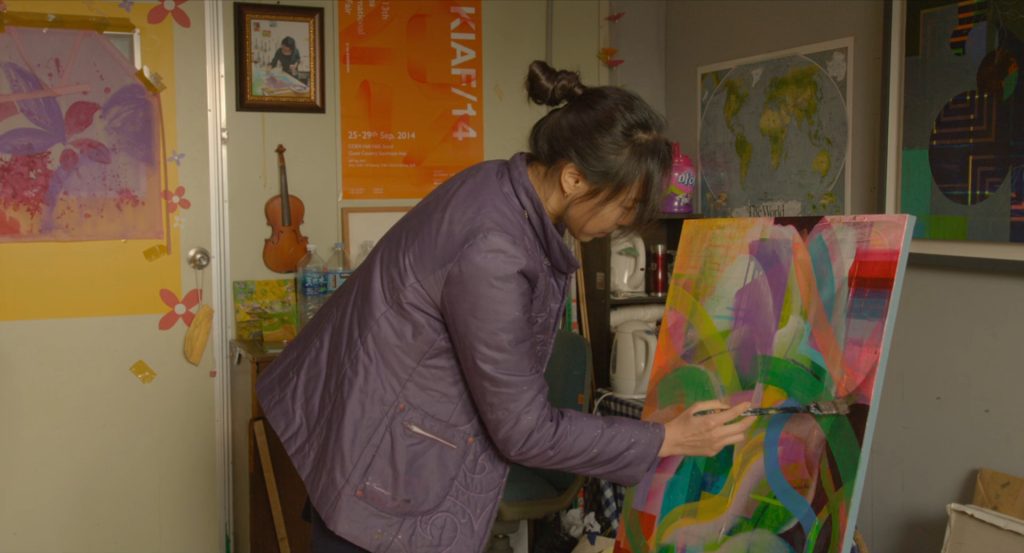
This balance of opposites is reflected, for example, in Cheon-soo’s two reactions to Hee-jeong’s paintings. In the first half he tells her, “You’re setting off on a difficult path… not knowing where you’re headed,” whereas in the second half he says, “It looks like you know what you’re doing,” but “you should have been more daring.” Either he compliments her courage at the expense of her understanding, or the reverse which she takes much less kindly. As we’ll find out in the café, however, his criticisms project his own struggles as a filmmaker, as he thinks of his own work in the same terms.
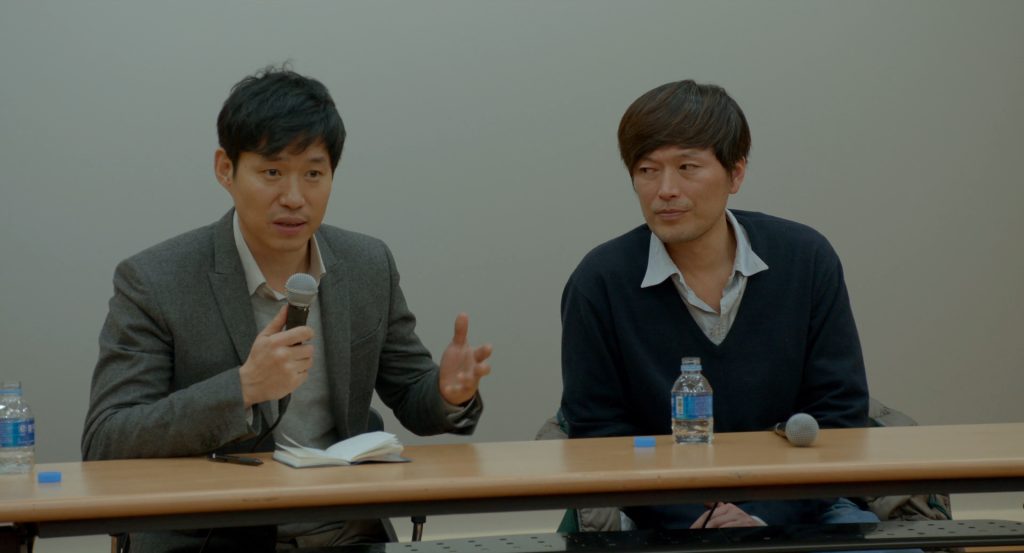
Hong Sang-soo’s films are typically set in the bohemian world of independent filmmaking, often with a director as protagonist, providing occasion to comment on the creative process. At the film festival interview toward the end of the first half, a critic asks Cheon-soo, “How would you define film?” The director finds himself unable to put a definition into words, but in this twice-told tale Hong Sang-soo comes up with a cinematic answer to that same question. The power of cinema lies in its openness, in its ability to represent multiple perspectives at the same time.
The story of Cheon-soo’s visit to Suwon, and of his new relationship with Hee-jeong in particular, is immeasurably deepened in the dual narrative. We can discern, for instance, why it goes better the second time. The first episode starts off too well… she’s flattered by his comments on her painting, and her feelings intensify during the flirtation at the sushi restaurant, but at her friend’s café her mood changes when he reveals that he’s married with two children. She pushes him away, and they don’t see each other again on that timeline. In the second episode his criticism of her paintings hurts her, but he’s not cruel about it, and his honesty creates ground for respect. In the sushi restaurant she’s receptive to him as she was in the earlier version, but now he admits being married before her feelings get too deep: “I think I’m in love with you. I want to marry you.” “Really?” “Yes… but I can’t marry you. I’m already married. I even have two kids.” By admitting the barrier to a sexual relationship, he ironically opens the door to a greater intimacy.
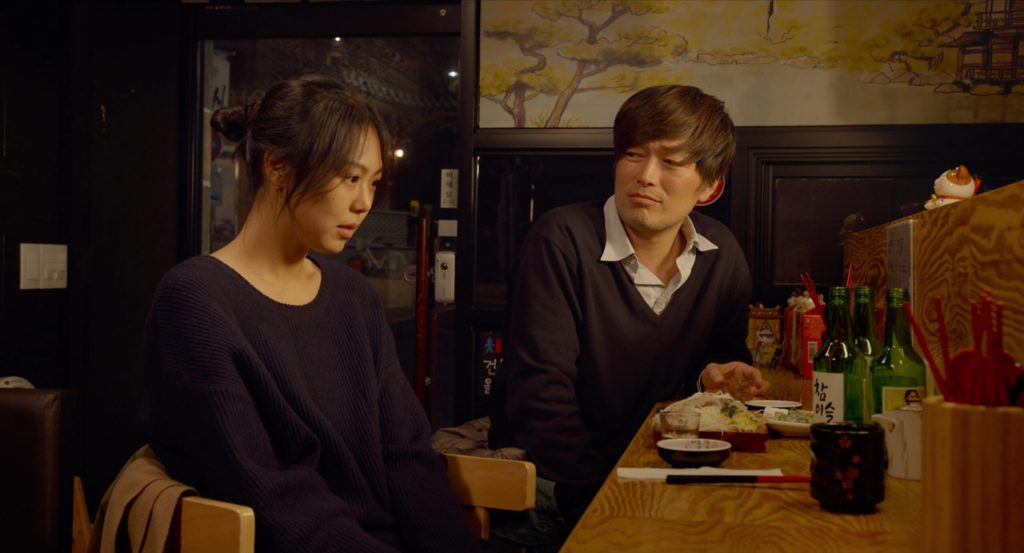
Similarly, it’s only through the dual narrative that we’re able to appreciate the full complexity of Cheon-soo’s character. Much unlike the vain filmmaker Seong-jun in The Day He Arrives, Cheon-soo is uncomfortable receiving excessive praise. We get a hint of this in his shyness with his former assistant Bora who calls him “the most important director to me.” He seems to relax after hearing that Hee-jeong hasn’t watched any of his films and doesn’t even like watching movies. As a celebrated filmmaker he understands the gap that worship puts between two people, and when the two women at the café lavish praise on him he feels compelled to deflate their lofty opinions. Later he tells Hee-jeong he stripped in front of them “because it was hot… I was also drunk,” which sounds comically unconvincing. He goes on to admit that “something must’ve been bothering me,” and we can presume it was the pressure of living up to the women’s high expectations.
In defining cinema the way he does here, Hong does not write some narrow prescription that limits what films can be. Ingmar Bergman had also argued indirectly in Persona that ambiguity is the essence of cinema. The two points of view in Right Now, Wrong Then are literalized for rhetorical effect because the film is directly concerned with the definition of cinema, but the twice-told tale is only one of countless ways to build ambiguity into a film. The essential point is that film becomes more expressive when it creates room for multiple possibilities of understanding.
Numerous small differences between the two halves of Right Now, Wrong Then suggest possible insights. The Taegeuk symbol on the palace gate is more prominent in the opening shot, but it’s centered at the start of the second half as if to say that balance will be achieved. In the first half Cheon-soo is shown inside his hostel, but in the second half he appears at his window as if to suggest a more external view. The different colors of paint that Hee-jeong mixes foreshadow the divergent moods in the two atelier scenes. In the second restaurant scene, Cheon-soo pulls out an actual ring that he had only wished for the first time, suggesting some correlative sort of magic in the intimacy between the pair.
Four minutes into the film, Bora tells Cheon-soo that his films “were very helpful when I was lonely,” helping her to realize “that life’s not all that bad.” Apart from Hong’s theoretical argument for ambiguity in cinema, Right Now, Wrong Then aspires to do something similar for its audience. Putting aside any judgments as to the propriety of the central relationship, the film celebrates the possibilities of unexpected intimacy amid the difficulties and awkwardness of life. Cheon-soo and Hee-jeong reach an almost ideal intimacy at the end of the second half, but then a strangely appropriate sort of transference occurs. When they part, there’s no promise of ever seeing each other again. Instead, Hee-jeong promises him she’ll “watch all your films from now on,” and then she settles in to watch one of them. The intimacy that’s possible between two people can be a model for a congruent intimacy between an audience and a film.
CONNECTIONS:
Casablanca – Establishment of intimacy between two characters, one of whom is married to someone else, without any promise of seeing each other again
Shadow of a Doubt – Quasi-magical effect in the gift of a ring
Persona – Argument for ambiguity as the defining quality of cinema
2 or 3 Things I Know About Her – Signs pointing to both two and three as keys to the film’s structure
Jeanne Dielman, 23 quai du Commerce, 1080 Bruxelles – Second half repeats the first with small but significant variations
Diva – Implied connection between personal intimacy and the intimacy between audience and artwork
The Day He Arrives – Tale of a film director which illuminates the act of filmmaking; significance in the taking of a still photograph near the beginning or end; protagonist’s reaction to praise reveals his character