Journey to Italy
1954, directed by Roberto Rossellini
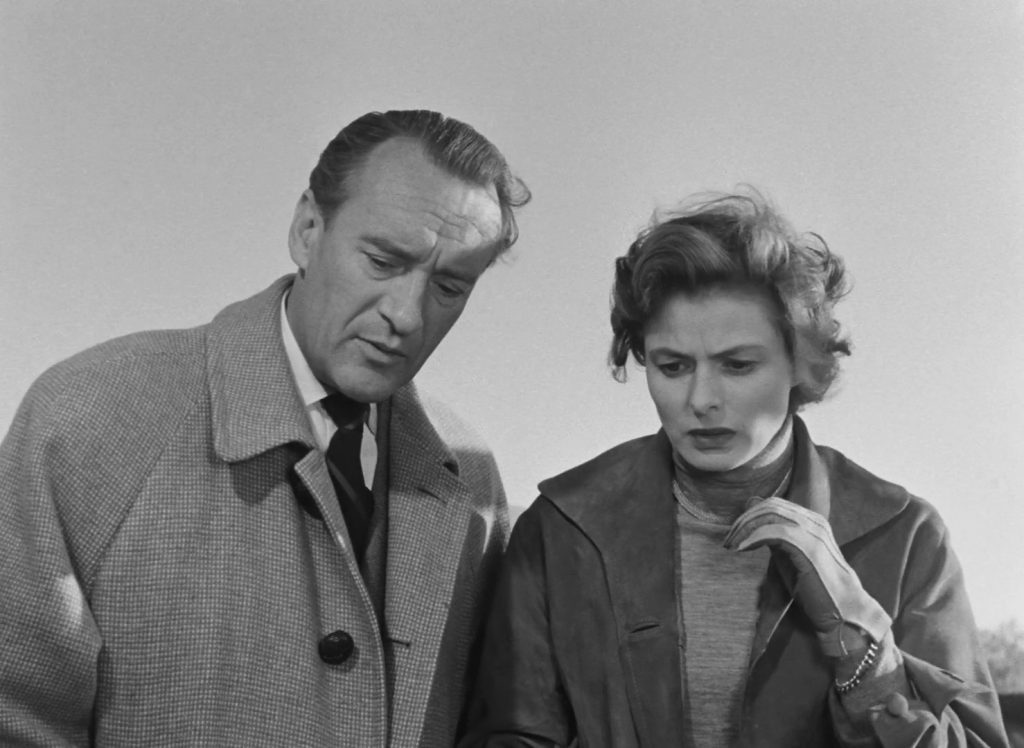
Journey to Italy does not begin auspiciously, and in a sense it never rights itself until its last moments. It starts with a series of missteps. Ingrid Bergman is introduced in an ill-advised leopard coat with a huge collar, looming over George Sanders, who’s not a small man to begin with. Their conversation about Uncle Homer is too obviously expository, and when Katherine and Alex switch seats, he makes an unseemly fuss about a passing driver who’s not doing anything unusual. If he’s so unaccustomed to Italian drivers, he’s already had half the peninsula to vent his distaste.
For all its attractions, the film is a master class in how not to write dialogue. Most of the replies come off as obligatory, whether they’re gushing reactions (“Oh, that… that’s incredible!”), ingratiating fluff (“I’m a little late.” “It doesn’t matter, I am very patient.”), or the bickering couple’s automatic retorts (“Don’t be a hypocrite.”) Katherine’s mumbling monologues in the car (“I hate him! The brute!”) are especially painful, because they tell us in words what any good film should convey between the lines. Clichés abound (“They’re like stars in the night.” / “All men are alike.” / “Life is so short.” “That’s why one should make the most of it.”), and to top it off, the film stereotypes both the aloof, industrious British and the pious, emotional, fecund Italians.
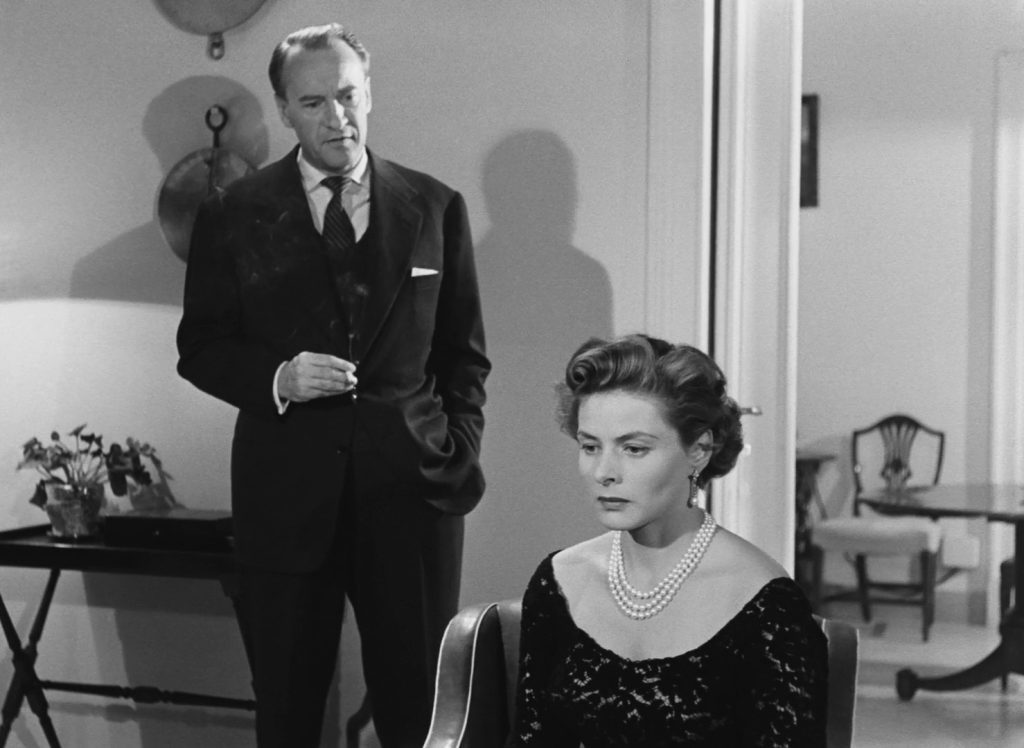
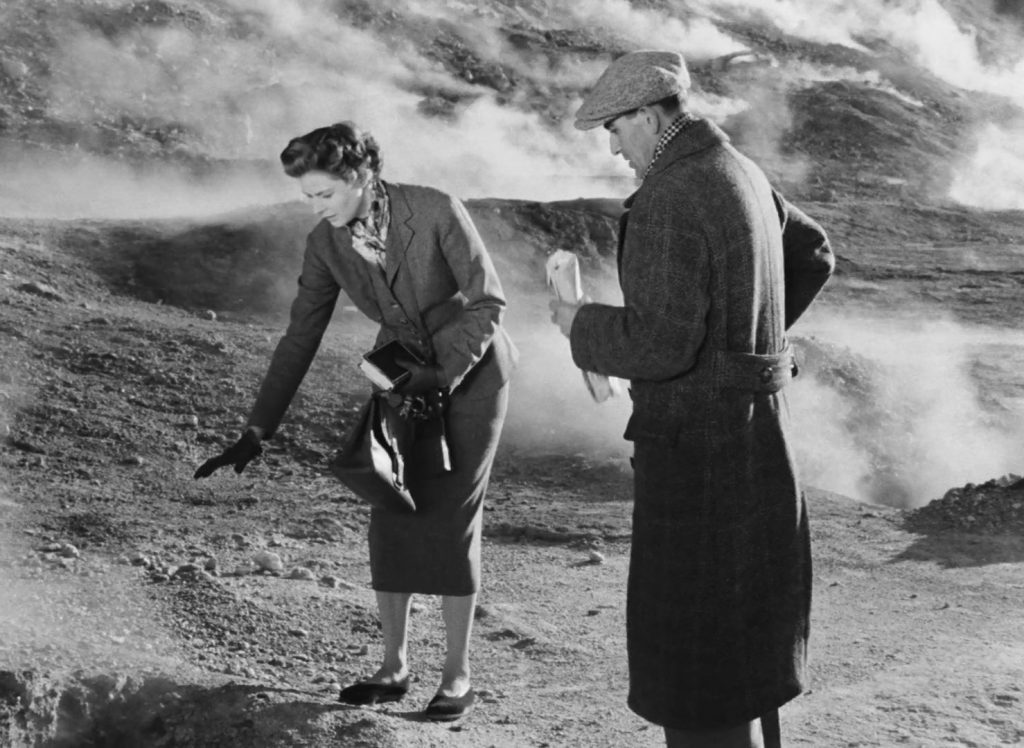
Most of these flaws come under the heading of “telling” where it would be better to “show”. The audience is given no chance to discover the characters, because everything we need to know about them is fed to us, even the ambiguity in their mutual feelings. There’s evidence, however, that this distinction between telling and showing is built into the movie deliberately. As the title indicates, the revelation of Italy is essential to the story, yet Katherine experiences Italy mainly through a series of guided tours (which are analogous to “telling”), starting with the Burtons walking her and Alex through Uncle Homer’s villa. Katherine then follows her guides through the Naples Museum, the cave of the Sibyl, the Phlegraean Fields, the Fontanelle ossuary, and the excavations at Pompeii. Only at the end, at a street procession for San Gennaro, are the two leads properly immersed in Italy without an intermediary, and their immersion is not just a figure of speech – they’re swept into a frenzied crowd.
Journey to Italy was a disappointment at the box office, and its novelty may be obscure to casual viewers today, but it made an extraordinary impact on critics and filmmakers. Rossellini had risen to fame with a trio of Neo-Realist films begun after the liberation of Italy. Neo-Realism was not a self-conscious movement based on cinematic ideals like the French New Wave or Dogme 95; rather it was a practical way to tell stories when resources were scant. At a time when most narrative films were made in the controlled environment of a studio, the new Italian films stood out for their documentary-like immediacy, but as soon as the economy began to improve, filmmakers left the style largely behind. In 1954, though, following a couple of failures made with his new wife Ingrid Bergman, Rossellini was back to a low budget. There was no compelling reason to return to poverty as a subject, so Journey to Italy applies the cinematic habits of Neo-Realism to upper-class life. Much of the film’s genius, or at least its influence, stems from the unusually effective intrusions of reality on a story that may otherwise feel forced.
The prevailing tension in Journey to Italy is not exactly the clash of cultures, but rather the contrast between the oblivious visiting couple and the reality that keeps impinging on their lives. Much of their obliviousness is to each other, and many of their explosions of spite occur after signs of genuine feeling from the other – signs that most viewers will pick up, but which they themselves ignore. When they reconcile at the end, this pattern has already paved the way, but it’s fascinating how much Italy itself prepares them to embrace their relationship in the end.
Alex and Katherine feel the effects of Italy and its culture, even while remaining outwardly obtuse. The camera is frequently drawn to intersecting lives and tangential details: an antique hearse, the base of a column, a middle-aged Neapolitan woman. Italian food, drink, air, men, women, language, architecture, and the pace of life are foreign to the protagonists. Katherine is a passive tourist, while Alex carries his British hauteur almost until the end: “How can they believe in that? They’re like a bunch of children.” Still, it’s not the travelogue that gets under their skin, but something stronger and more subtle. Rossellini has greater cinematic ambitions than to tout the charm of his native land.
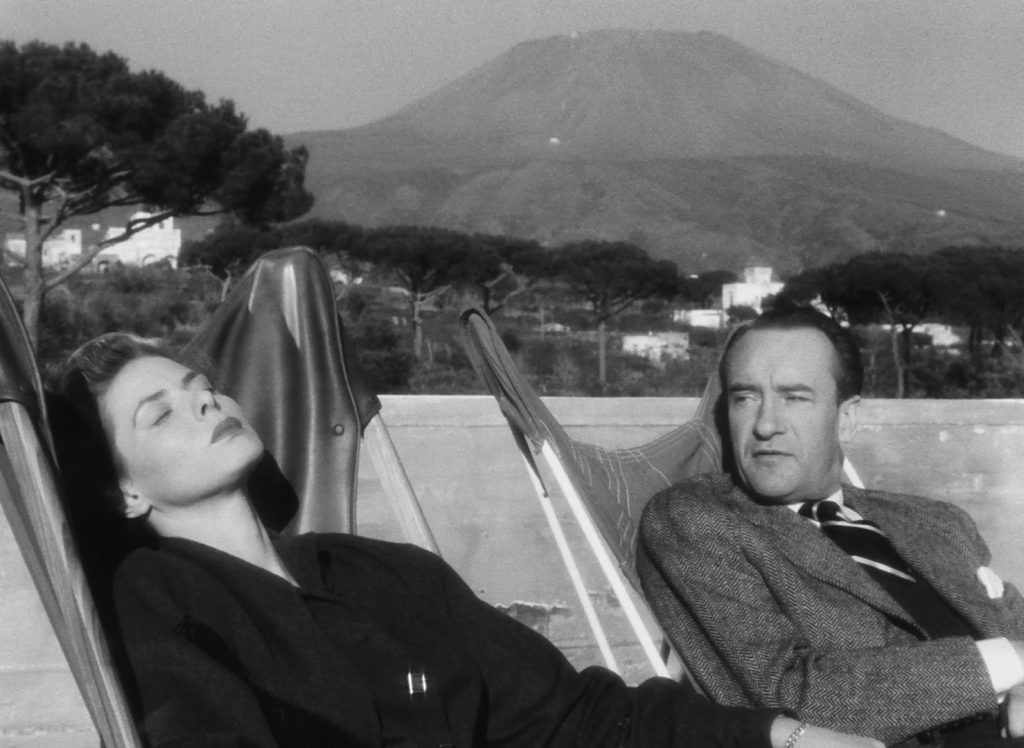
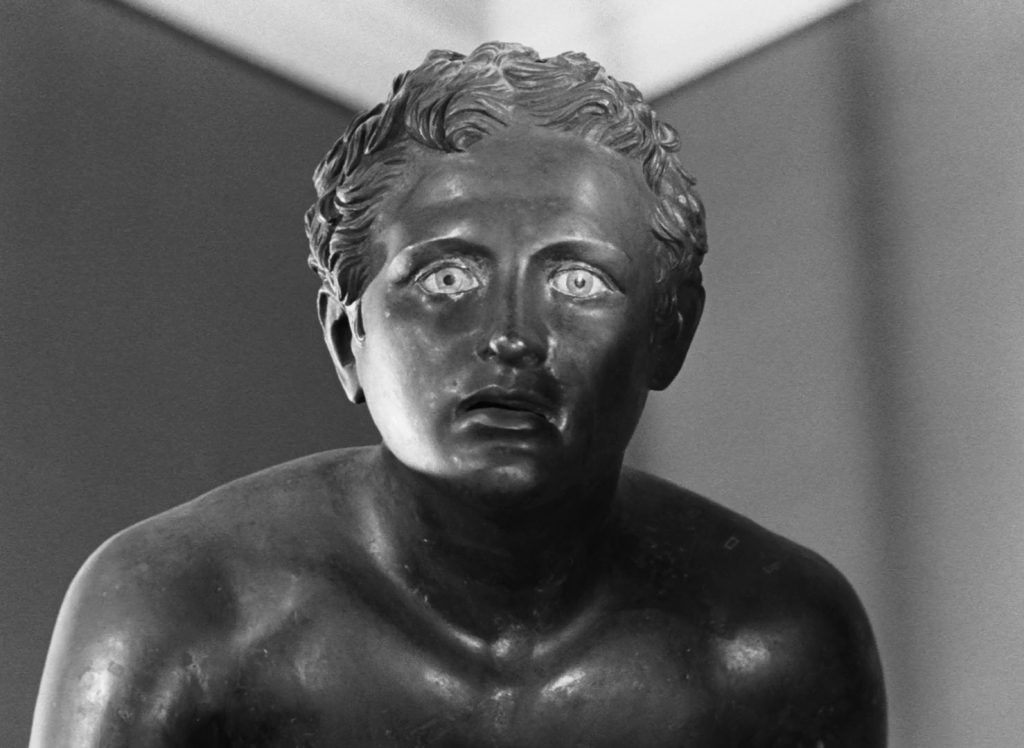
As awkward as the opening may be, it quietly establishes the terms of the couple’s visit. A shaky traveling shot of the highway foretells the disorienting journey ahead, and the mention of an inheritance from Uncle Homer hints at a connection to the ancient Mediterranean world. Alex’s family name is Joyce, like the novelist James Joyce who also accepted an inheritance from Homer when he wrote Ulysses. The name Alexander belongs to ancient Macedonia, and Katherine belongs to medieval Tuscany. Their journey to Italy will confront them not only with an unfamiliar culture but with the living history of remote centuries. The villa looks over the hazy outlines of Vesuvius, Capri, and Sorrento, and Katherine is visibly moved in the presence of ancient and Renaissance statues, the Sibyl’s cave, and the geologic wonders of the volcanic landscape. The museum opens her eyes to a more realistic view of the past, dispelling the romantic notions of her deceased poet friend.
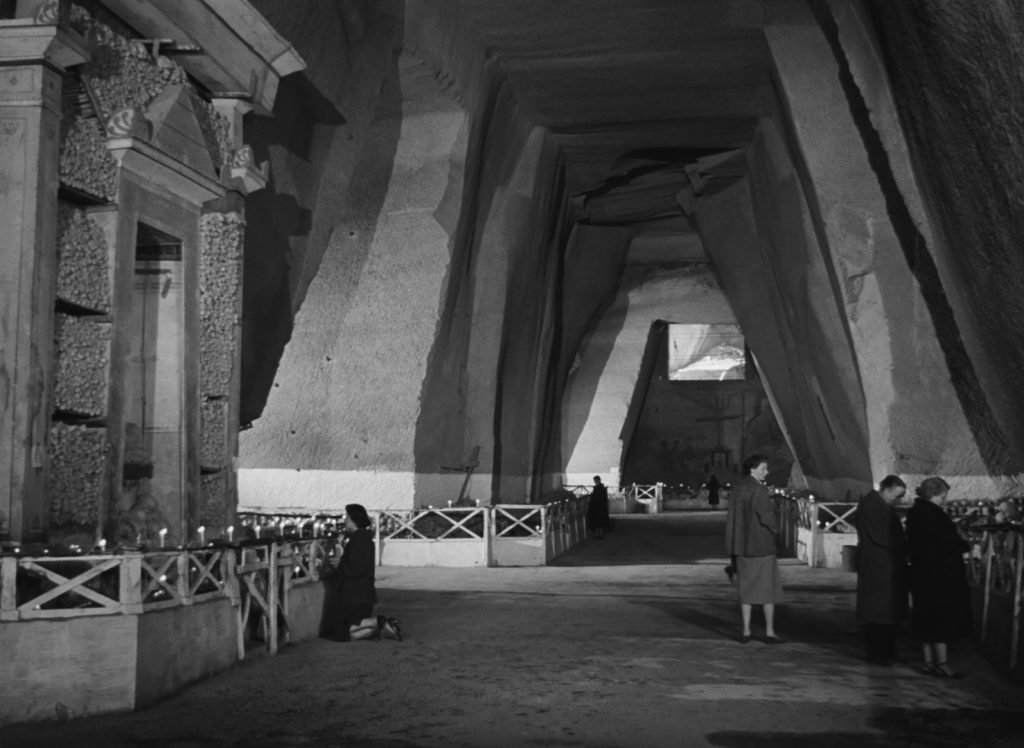
The journey into the past takes a dark turn when Mrs. Burton shows Katherine the Fontanelle catacombs, where the distant past is represented not by artworks, mythology, the old aristocracy, or sulfur springs, but by the bones and skulls of past generations. The scene prepares for the turning point at Pompeii, but only after another dark turn brings on a full crisis.
All the insipid exchanges of dialogue throughout Journey to Italy finally serve a purpose, setting in relief a juxtaposition so incongruous that it’s genuinely lifelike. One second after Alex says, “Let’s get a divorce,” Mr. Burton calls a cheerful “Good morning!” from his car. In a way it’s the most appropriate thing to say in the moment. It throws the couple off balance and saves them from further escalations while they follow Burton to Pompeii. There, together, they experience a connection to ancient life more personal and more terrible than they could have imagined, witnessing the re-emergence of a couple, possibly like themselves, buried in the cinders of Vesuvius. The ancient woman and man had been lost to history for nineteen centuries until this moment. Katherine and Alex are both shaken, and they take their leave.
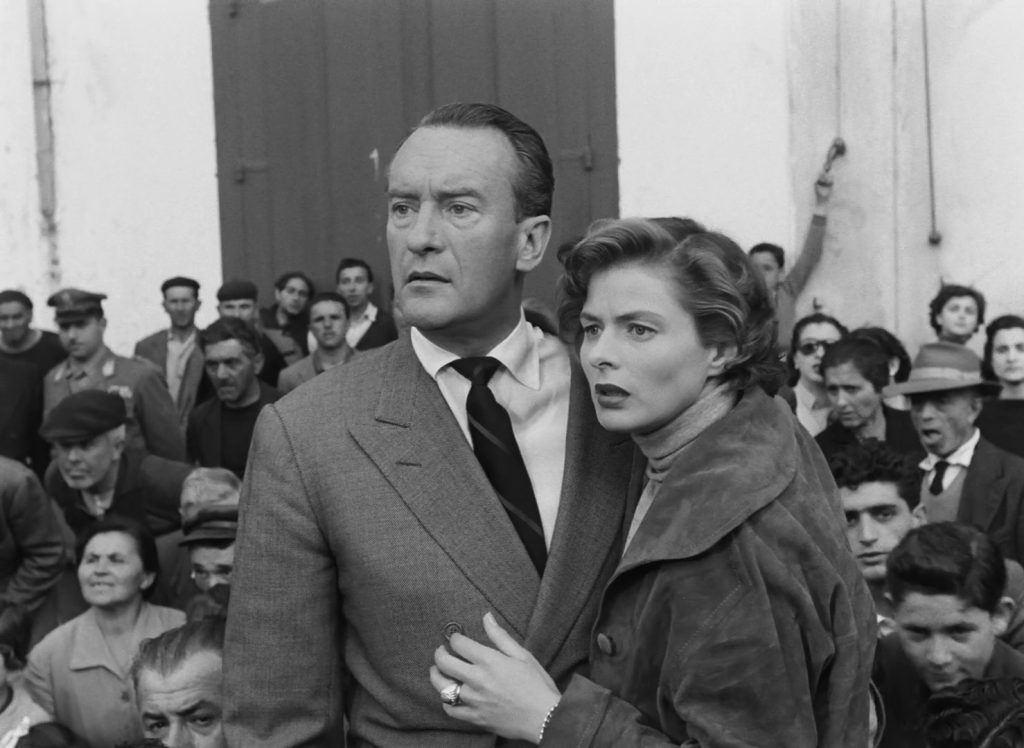
Katherine seems touched that Alex was similarly moved, but soon their reproaches continue. Once again life intervenes, and they get stuck in a religious procession. Suddenly a man on crutches gets up to walk, the crowd surges to witness the perceived miracle, and Katherine is pulled away from Alex. The separation jolts them into reality, and they both realize that they’ve been misunderstanding each other. Instead of ending sentimentally on the embracing couple, though, the film lingers a while on the passing crowd. There’s a joke buried in here – just as Mr. and Mrs. Joyce have been oblivious to the life around them, now the Italian crowd is equally oblivious to the other miracle that’s just happened in their midst.
Journey to Italy, therefore, is a tale of reconnection in the broadest sense – between two people, certainly, but also with surrounding reality and with the span of history. It’s also, importantly, a story about accepting an inheritance. We are all heirs to a vast history, to the reality around us, and in some sense to the company of our fellow travelers. Until the street festival at the end, Katherine and Alex are obtuse to their inheritance, as if it doesn’t matter to them. Finally reality opens their eyes, and they come to embrace all that’s been passed down to them, including their marriage.
The film is almost as famous for its influence as it is on its own terms. It was a touchstone for the French New Wave, partly owing to André Bazin’s fascination with realism, and Jean-Luc Godard paid homage to it in Le mépris. The greater influence, though, was on Michelangelo Antonioni, whose L’avventura transformed the material of this film into something more complete. Like Journey to Italy, L’avventura summons the ancient Mediterranean in its names and settings. The tour of the Aeolian Islands is like the tour of the Neapolitan region from Homer’s terrace, invoking the wonders of physical distance, of nature, and of the past all at once. Antonioni finds a greater variety of ways to bring reality into fiction, and the characters face the same tension between detachment and intimacy. By desentimentalizing the story, L’avventura reaches the wonder that Rossellini aimed for while avoiding the pitfalls that plague Journey to Italy.
Antonioni’s subsequent La notte repeats the exercise, transforming La dolce vita into a more sober film, exchanging drama for wonder – but the two transformations are fundamentally different. Whereas La notte corrects the excesses of Fellini, L’avventura is not essentially a job of correction. Instead it pays respect to Rossellini, building on the earlier film to achieve its original aims.
CONNECTIONS:
Black Narcissus – Foreign landscape credited with the power to erode British supremacism
The Flavor of Green Tea over Rice – Marital reconciliation triggered by unaccustomed circumstances; strange effects of time on life
Wild Strawberries – Idea that the reality of life supersedes the categorical feelings people express in words
L’avventura – Story and emotions swayed by the wonders of the Italian landscape; shots of islands and mountains in the distance; names that evoke the ancient Mediterranean world; social call on an aristocratic family; hotel staff behaving robotically; couple separated, tested, and reunited; echoes or distant rejoinders of sound
Knife in the Water – Husband takes over steering wheel in the opening; marriage tested on a journey; ending in or near a stopped car
Contempt – Marriage strained during a visit to Italy, including Capri; allusions to Homer’s Odyssey
The Passenger – Camera frequently drawn to intersecting stories, stopping to dwell on passing figures, details, or vehicles
Nostalghia – Prayers for fertility in a catacomb or a crypt