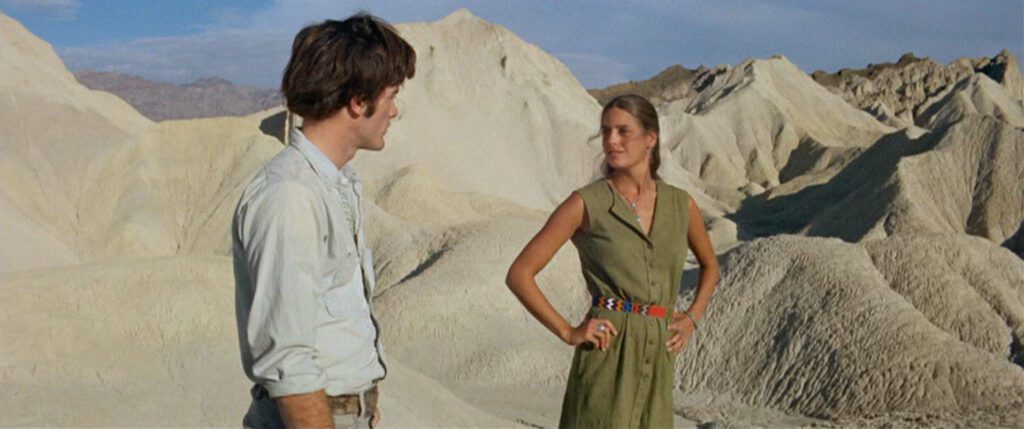
Zabriskie Point
1970, directed by Michelangelo Antonioni
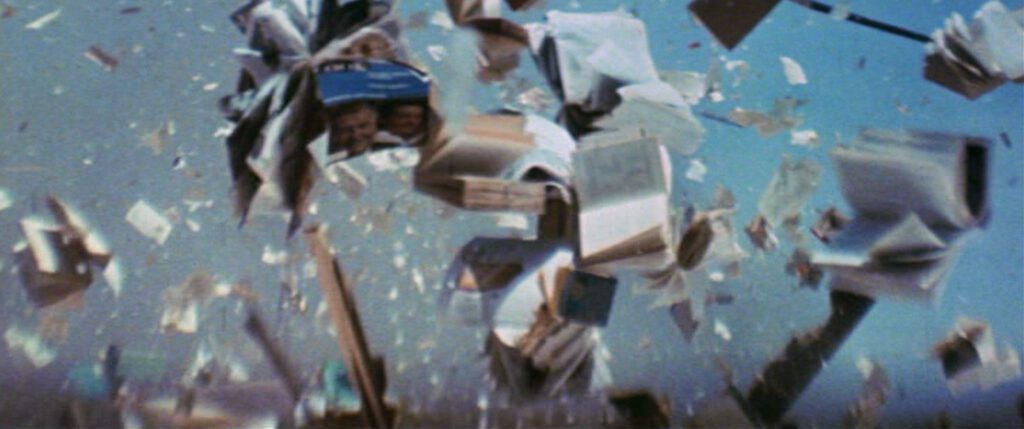
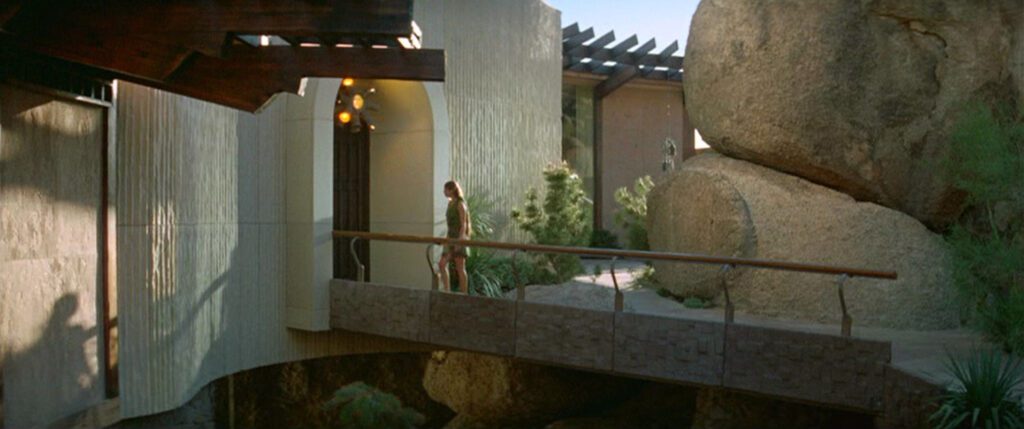
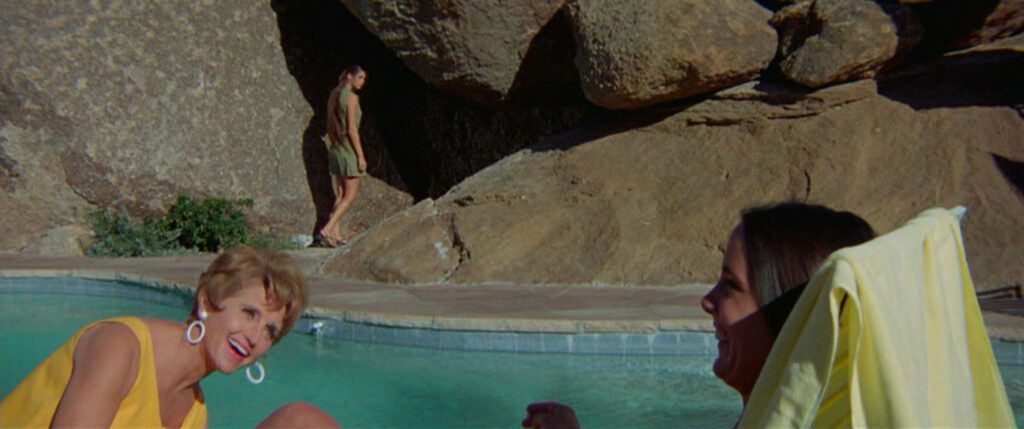
At the end of Zabriskie Point, Daria flees from the desert house near Phoenix, unwilling to continue her job with a real estate developer after hearing of Mark’s death on the radio. Before she drives off into the sunset, she stops to stare back at the house, a deluxe modern dwelling on a rock outcropping. She imagines it exploding in a fireball, first at normal speed then in slow motion, room by room, the contents of civilization blowing up in sequence – food, clothing, furniture, appliances. The last thing she explodes in her mind, accentuated by a drum roll and primal screams, is the one thing that must go before her imaginative destruction is complete – books.
One of Antonioni’s hallmarks, if it can be separated from his overall attention to quality, is the particular care he takes with his endings. Each of his films builds to an ending that’s not calculated for dramatic effect, but rather which is totally appropriate to the rest of the film. These explosions therefore need to be seen in the whole context of Zabriskie Point. The destruction of books does not have a positive record in history, nor for that matter do exploding buildings, but Daria shows no hatred nor wish for tyranny. Her rebellion, rather, is a specific wish to change the direction of a civilization that overvalues abstraction and has forgotten the value of direct experience.
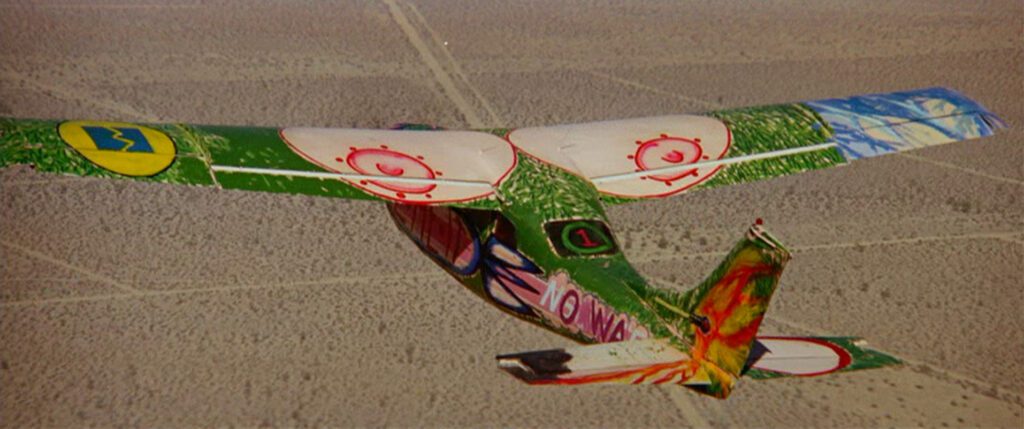
Daria’s symbolic destruction of books is another expression of Mark’s final gesture before returning the airplane and getting shot by police. He had repainted the pink plane with a colorful array of visual and verbal jokes (“she-he-it” doubles as a drawled-out version of “shit”) with the slogans “No War” and “No Words” on the port and starboard sides. The first required no explanation during the Vietnam War, while the second summarizes the spirit of Zabriskie Point. Daria’s fantasy of exploding books is not iconoclastic or anti-intellectual. Like Mark, she’s fed up with a society that bombards us with abstract signs at the expense of real life.
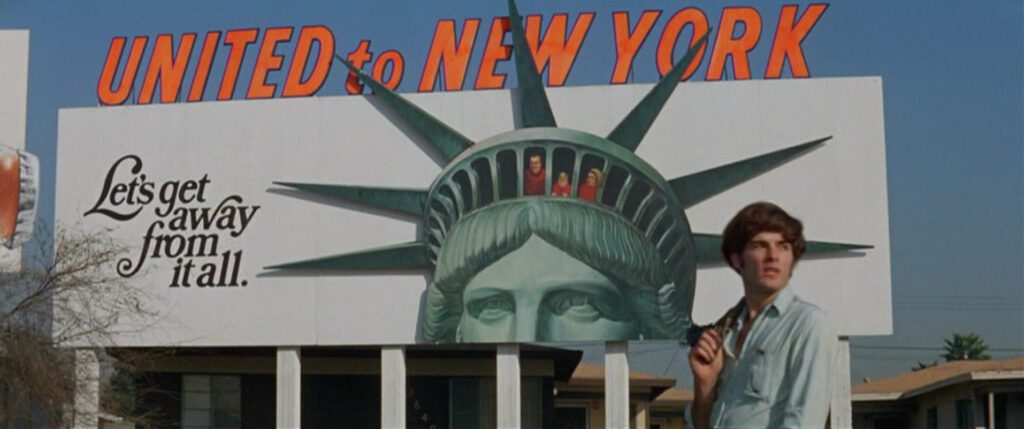
The profusion of signs throughout Zabriskie Point is staggering, yet it’s not an inaccurate portrait of the United States. Mark drives to campus in a montage of billboards, murals, and street signs, and from there on, signs appear at every opportunity – billboards around the airport, logos on buildings and vehicles, wall signs, road signs, product labels and ads in the deli, inscriptions on oil drums and t-shirts, the gag sign in the desert bar (“In case of fire raise this flap.” “Not now stupid! In case of fire.”). Passing a pair of cops, Mark’s peace sign flips to an extended middle finger. Even wordless symbols like the U.S. flag, mannequins in a commercial, or a giant gas station mascot add to the saturation of signs, which isn’t atypical of the American landscape of that era or even now. Most films shot on location in the United States probably take pains to reduce such clutter.
The desert is a respite from the ugliness of signs, but even there humans leave their marks. Daria writes a message in the sand after Mark buzzes her; a National Park Service plaque marks the site of Zabriskie Point; and tourists drive up in a camper plastered all over with souvenir decals.
Zabriskie Point opens with radical college students planning a strike. There are few visible signs or written words at the meeting, but most of the friction stems from a gap between words and action. The scene is a montage of individuals clamoring for recognition – talking over each other, interrupting, and shouting – while the polite ones raise their hands with an almost comic urgency. Mark leaves in frustration, singling out the meeting itself as a mass of words. The flurry of logos and advertisements that follows outside is a seamless continuation of the radical students’ quest for attention.
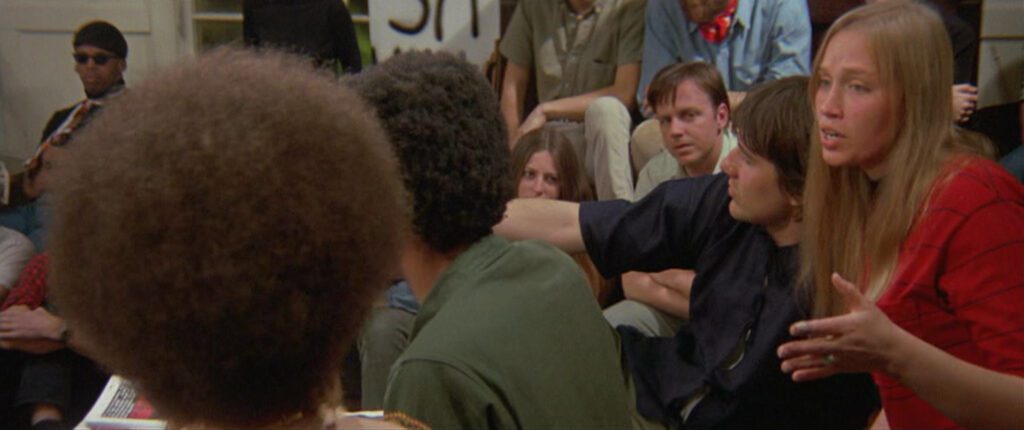
As Antonioni’s portrait of the United States, Zabriskie Point is an outsider’s perspective of a country lost in a sea of competing words. It would be another story if all those words were rich with meaning instead of desperate cries for acknowledgment, like empty bubbles on an effervescent surface. The picture has only become more relevant in the age of social media, and the phenomenon has spread across the globe. The Los Angeles setting points not only to America but also to Hollywood, which has always been a global evangelist for the notion that everyone should want to be a star.
The student meeting and the sign-pocked landscape illustrate a society obsessed with attention. Self-promotion pervades business, politics, and personal life, spanning all generations. The result is an atomized society held back from its potential. We see it in the commercials for Sunny Dunes, in the emotionally disturbed children who surround Daria in the desert village, and in the elderly boxing champion Johnny Wilson who can only talk about himself. We can see its results in two forms of racism: white liberals romanticizing the black experience (We can be revolutionaries too!), and the white gun vendor sharing his customers’ fear of blacks. The business meeting at the end differs only superficially from the student meeting at the beginning – both are people throwing words at each other to get their way, and Daria leaves one meeting with the same disgust that drove Mark from the other.
Only in the open desert and the skies above it do people escape this atomization and come together, connecting with each other and with their surroundings. Mark’s aerial courtship of Daria is not only an exciting act of romance, it’s also a relief from the wordiness and abstraction we’ve been immersed in. At Zabriskie Point they make love, and an imaginary orgy fills the valley echoing their lovemaking. It’s not so much a picture of sex as a picture of social harmony on a grand scale – what the world might feel like if people let go of their dependence on abstractions.
Daria and Mark arrive at Zabriskie Point almost exactly halfway through the film, and they meet at the bottom of the valley less than four minutes later, almost precisely at the hour mark. From these metrics we can guess that the film is carefully structured, and its various symmetries form a kind of loose palindrome – the journey from civilization to Zabriskie Point and back, the parallels between the student meeting and the business meeting, and the two shootings by police (on the college campus and at the airport). Although the badlands of Zabriskie Point are not below sea level, the site belongs to Death Valley which includes the lowest point in America, making the film a symbolic journey deep into the United States.
The argument in Zabriskie Point is more specific than a vague complaint against words. The problem with the words and other abstractions that dominate American civilization is that they’re designed to direct our attention, and in so doing they distract our vision from the people and world around us. Like most of Antonioni’s films it’s about the problem of seeing clearly. The student radicals are so preoccupied with being heard that they fail to listen to each other. Citizens of a consumer society become numb to the advertisements surrounding them and lose the ability to make their own decisions. On a deeper level, the dominant role of words in modern culture makes it difficult to see clearly to the essence of things. Civilization strips people of the ability to look at the world with wonder.
Also typical of Antonioni, and consistent with his disregard for the clamor of words and signs, the film lays a groundwork for emotional experience without trying to direct our emotions the way most movies do through their dramatics. When Daria first hears of Mark’s death on her car radio, instead of breaking down she gets out and simply sways in the wind like the cactuses around her. Not only is her reaction more realistic than an overt display of emotion, it also opens space for the viewer to experience unfamiliar emotions that prepare for the experience of the final scene.
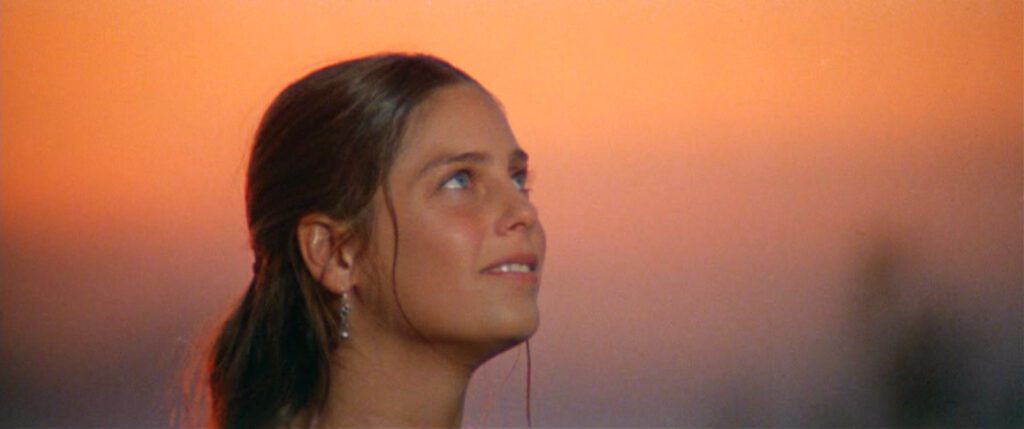
When Daria leaves at the end, it’s not capitalism nor her employer that precipitates her exit… rather she turns to go right after coming face to face with a Native American maidservant. She looks warmly at the woman as if recognizing a kindred soul, someone connected to nature yet trapped in a society that’s out of touch with nature. Daria’s imaginary explosions show a wish not for violence but for a return to the fundamental conditions of life. Her journey to Zabriskie Point has taught her what the film hopes to show, that nature still offers us the conditions for stripping away abstraction, allowing us to connect with each other and to experience the world not through the intermediaries of words and signs, but directly and vividly.
CONNECTIONS:
Day of Wrath – Harmful or corrupting power of words; contrast between words and nature
Mildred Pierce – Set in Los Angeles with an implicit allusion to Hollywood’s social influence
L’eclisse – Distinction between two almost opposite kinds of racism
Alphaville – Argument against abstraction; similarity of vending machine & gag sign jokes; emotion saved for the end
Simón of the Desert – Begins and ends with atomized groups of individuals
The Man Who Left His Will on Film – Critique of radical youths’ preference for abstraction over life in 1970; made with unprofessional actors
The Devil Probably – Male protagonist walks out of a gathering of radical students at the beginning
Blade Runner – Set in Los Angeles with an implicit allusion to Hollywood’s social influence; profusion of billboards and advertisements; argument for experience over abstraction
The Sacrifice – Ends with the fiery destruction of a house; argument for action over words; words are the last item blown up (in Daria’s vision) or given up (in Alexander’s prayer)
Matchstick Men – Set in Los Angeles with an implicit allusion to Hollywood’s social influence