Earth
1930, directed by Alexander Dovzhenko
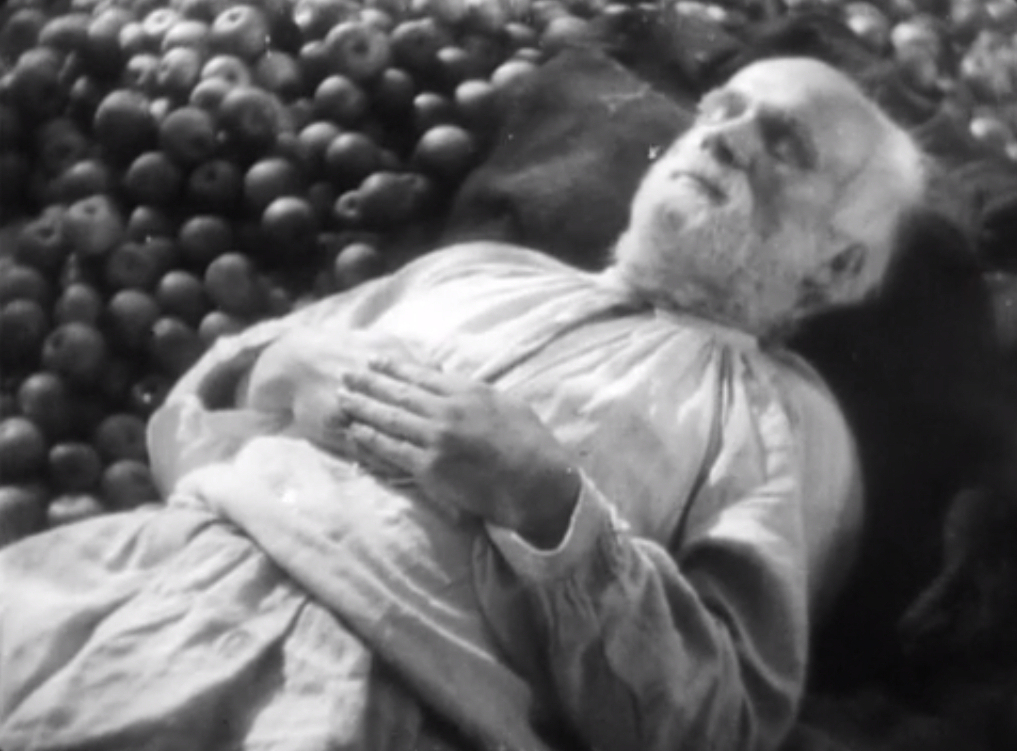
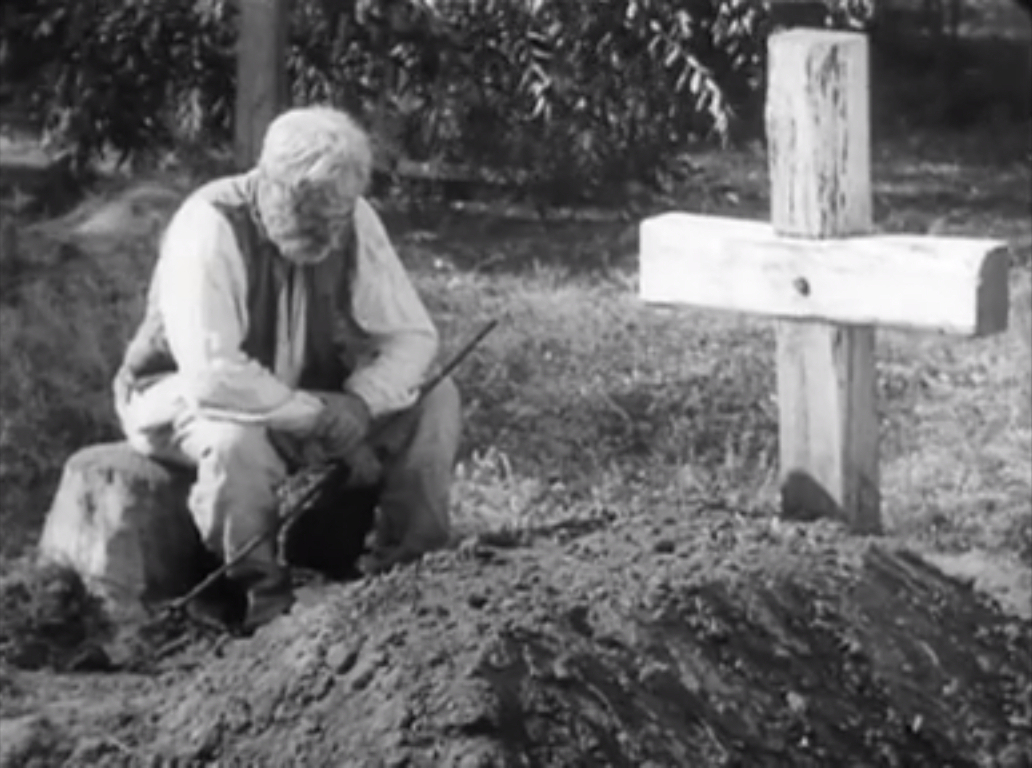
The dialogue in Earth opens with two old men in an apple orchard. “Are you dying, Simon?” “Yes I am, Peter.” “Well go ahead and die.” The exchange is unusually matter-of-fact, without malice, pathos, or any strong emotion. Both men seem to take Simon’s death as a regular part of the flow of life, and Simon will not be seen or mentioned again. Lacking dramatic weight, the scene is ripe with symbolic suggestion.
It cannot be ignored that both men’s names stem from the apostle Simon, whom Christ renamed “Peter” in Matthew 16:18. The replacement of one name with another establishes a broader pattern of replacement or “rechristening” that will govern the remainder of Earth. The small children eating apples just like Simon remind us that new generations must replace the old, and the rest of the film will systematically replace old Christian imagery with new Communist imagery. The idea is nothing less than to overlay a new religion of Communism directly on top of the old religion, and to make it attractive to a modern Soviet population, much as Christianity itself had long ago substituted its own holidays, customs, and symbols on top of pagan religions.
Earth is set in a Ukrainian farming village and the surrounding wheat fields. The peasant farmers, led by a young man named Basil, are collectivizing in order to increase productivity and to raise their economic status, while the wealthier independent farmers oppose their efforts to distribute wealth more evenly among those who create it. Earth was part of a Soviet campaign to collectivize agriculture, and its story appeals to a wish for progress and economic justice. However, by casting Communism as a new kind of religion, the film takes an unconventional approach to propaganda, aiming its argument at the recalcitrance of tradition in the face of official Soviet atheism. By substituting Communist imagery for religious imagery, it intends to show people what they would gain by trading one for the other.
Basil is characterized as a modern Christ who redeems the peasants while standing up to the independent farmers, the modern-day Pharisees. Like Christ, Basil introduces a new form of social thinking and behavior, upending the established order. In one dramatic passage he drives a new tractor into the village, leading a mass of hopeful peasants like Christ riding into Jerusalem on a donkey. Soon afterward Basil is martyred by an angry resister while dancing alone on a winding road. The road is equivalent to Christ’s road to Calvary, his dance a version of the via crucis. Basil’s worldly power, like Christ’s, is magnified after his death. His martyrdom becomes a rallying cry for Communism when another young man, a new St. Paul, addresses a vast crowd at Basil’s funeral. In the last image, Basil and his wife are shown side by side – the film has resurrected him.
The primary antagonist, Choma, is also a religious allusion. His name is a Slavic derivative of Thomas, the apostle who doubted Christ’s resurrection. This modern version of Thomas represents those who still doubt Communism.
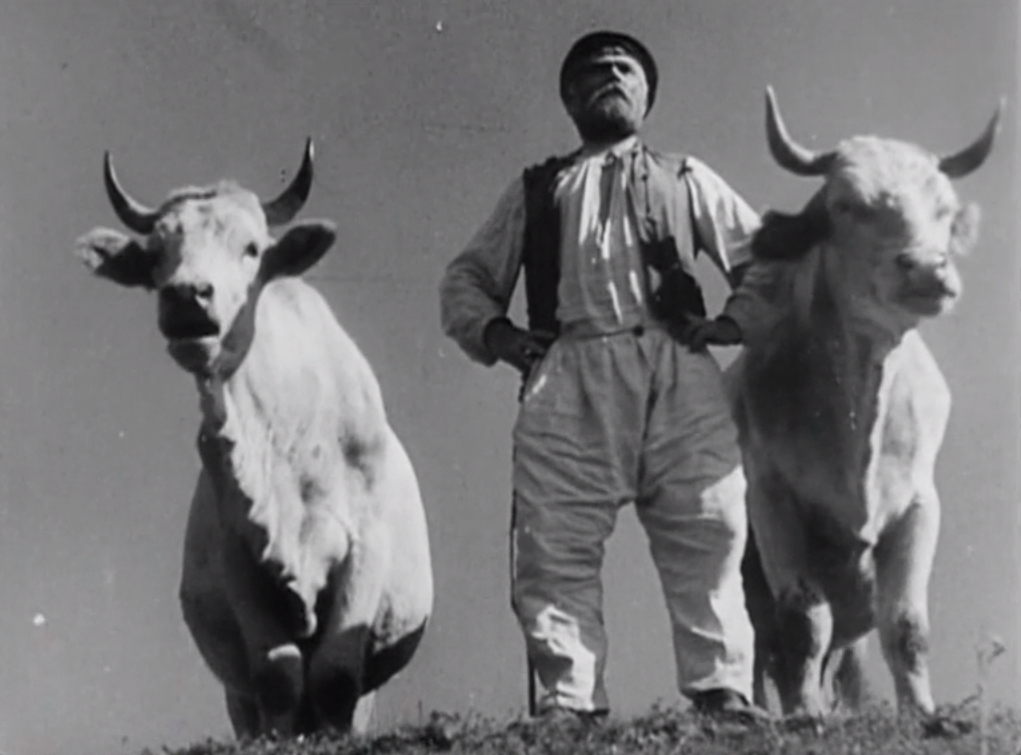
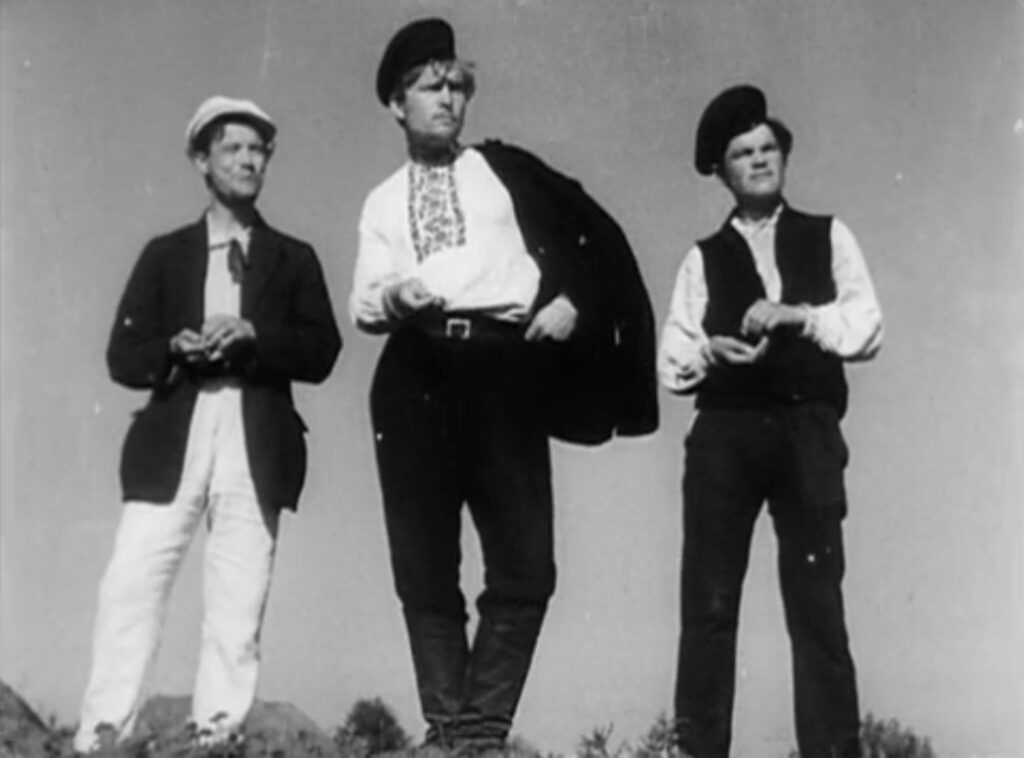
The distinctive cinematographic style of Earth adapts recognizable religious imagery to suit a Communist parable. Before Basil is martyred, sunbeams touch the wheat fields dramatically like so many artistic depictions of divine radiance. Individual characters and anonymous figures are framed like icons, centered on the screen, either looking toward the camera or posing like saints in religious fervor. Humans and cows are often grouped in threes with the central figure slightly higher or farther forward, like Orthodox depictions of the Trinity. It’s no concern of the Soviets if arranging animals like the Holy Trinity looks sacrilegious, but Dovzhenko’s reverence for the natural world appears to be more operative than any irreverence toward religion.
With its slow pacing and large congregations, Earth more than vaguely resembles an Orthodox mass. It would be easy to imagine liturgical music accompanying the slow passages, and Vyacheslav Ovchinnikov’s score for the 1971 Mosfilm restoration recognizes this with its ceremonial pacing and wordless choruses. Halfway through Earth, a montage of industrial breadmaking substitutes for the consecration of bread, the centerpiece of the Christian mass. There are two major processions, one for the tractor and another for Basil’s funeral. When Basil’s father Opanas announces that his son will have “a new kind of funeral” without priests, the film openly reveals its wish to create a religious ceremony out of secular material.
Normally a Soviet propaganda film about agricultural reforms in 1930 would have no need of extraneous religious content like the large crosses at the burial ground or the Orthodox priest who curses the impious peasants. Earth inserts these deliberately, not only to criticize religion, but also to remind viewers that they are looking at religion’s replacement. After thirteen years of official state atheism, it’s useful to see religious signs in their original context as cues for the new signs replacing them.
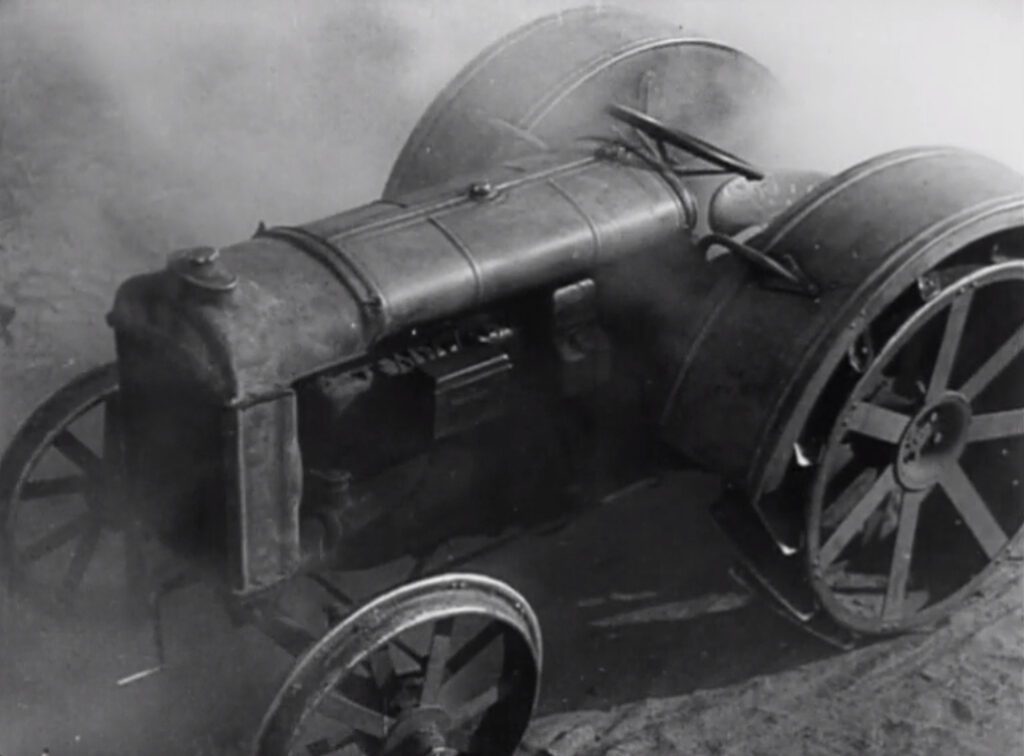
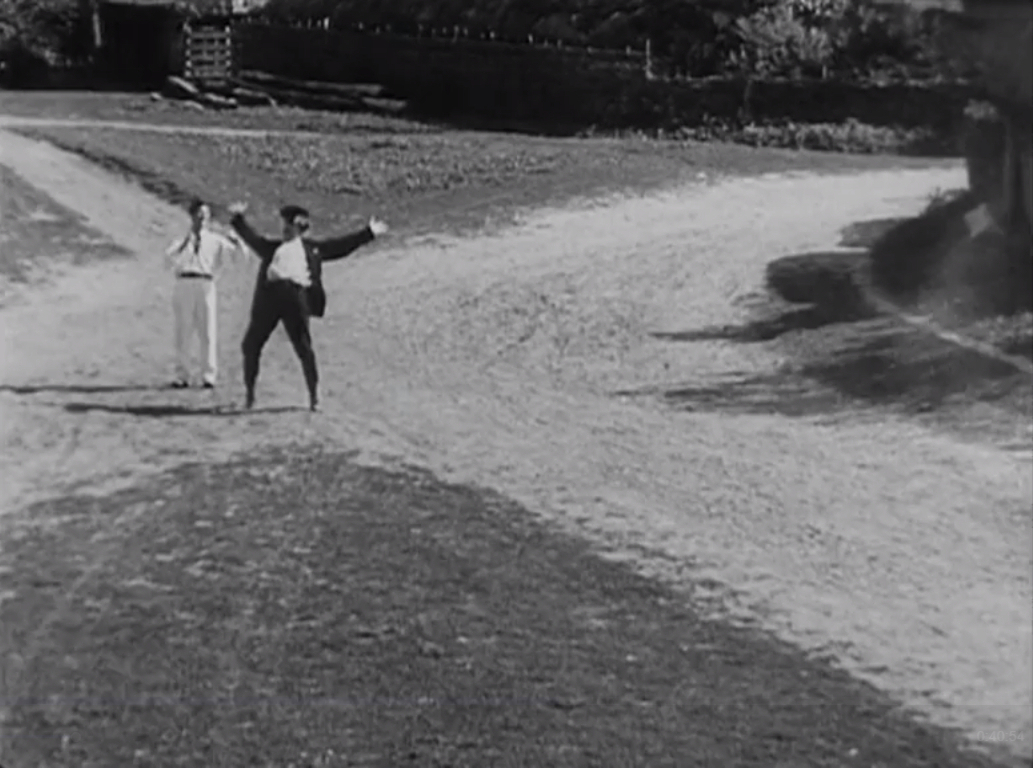
All of this religious imagery builds to a climax whose power is meant to equal the mystical force of a religious ceremony. The groundwork is laid when Basil brings the tractor to the village. When he stops and gets off, the tractor is shot from a high angle, revealing its likeness to a cross, the symbol of Christianity. The tractor is treated as a virtually sacred object, as it would have been to a devoted Communist in 1930. Soon afterward the crossroads too is shot as a bold white cross against the dark ground. Toward the end, many actual crosses are shown in their traditional religious contexts: old women making the sign of the cross, a cross hanging around the priest’s neck, and several grave markers.
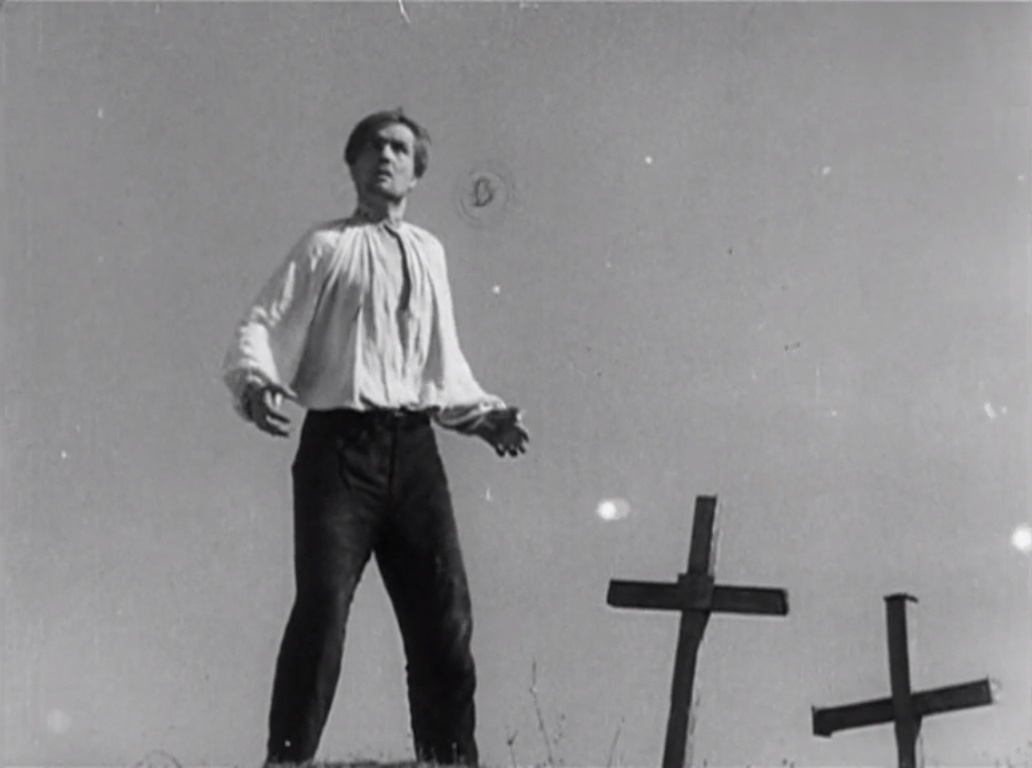
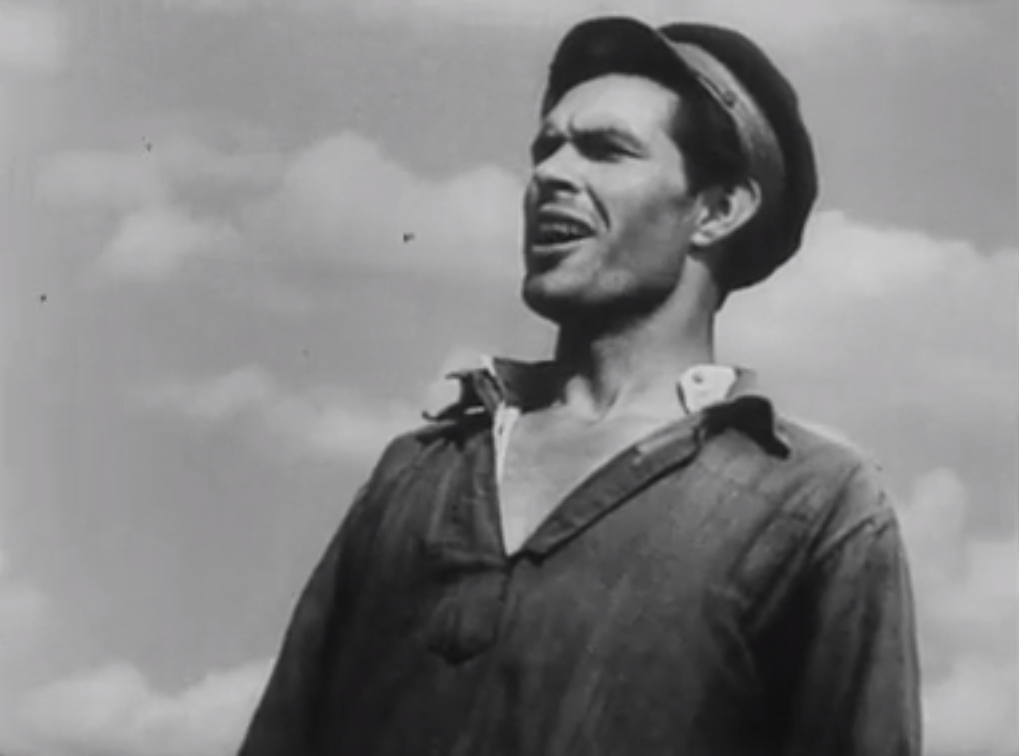
While an energetic young man in the mold of Basil, the new St. Paul, delivers the eulogy at the outdoor funeral, Choma tries to interrupt and confess to Basil’s murder. Transfixed by the eulogy, the crowd ignores Choma. The cross-cutting contrasts Choma’s agitatation with the young man’s self-possession. Beside Choma two large crosses stand out against the sky, but there are no equivalent crosses at the funeral… or are there? The orator addresses Basil’s father: “But you, sir, our ‘Panas, do not despair. The glory of our Basil will fly all around the world” …he pauses and points to the sky… “like that, up there, our Bolshevik airplane!” An aerial shot shows the crowd looking up, turning their heads in unison. The airplane is never shown, but the tractor and all the crosses preceding this should have prepared us to imagine the airplane ourselves, forming a cross in the sky. By leaving the climactic image to the audience’s imagination, the film means to effect a small miracle. The heavenly cross, unseen but all the more vivid, should feel as wondrous as the apparition of a real cross in the firmament.
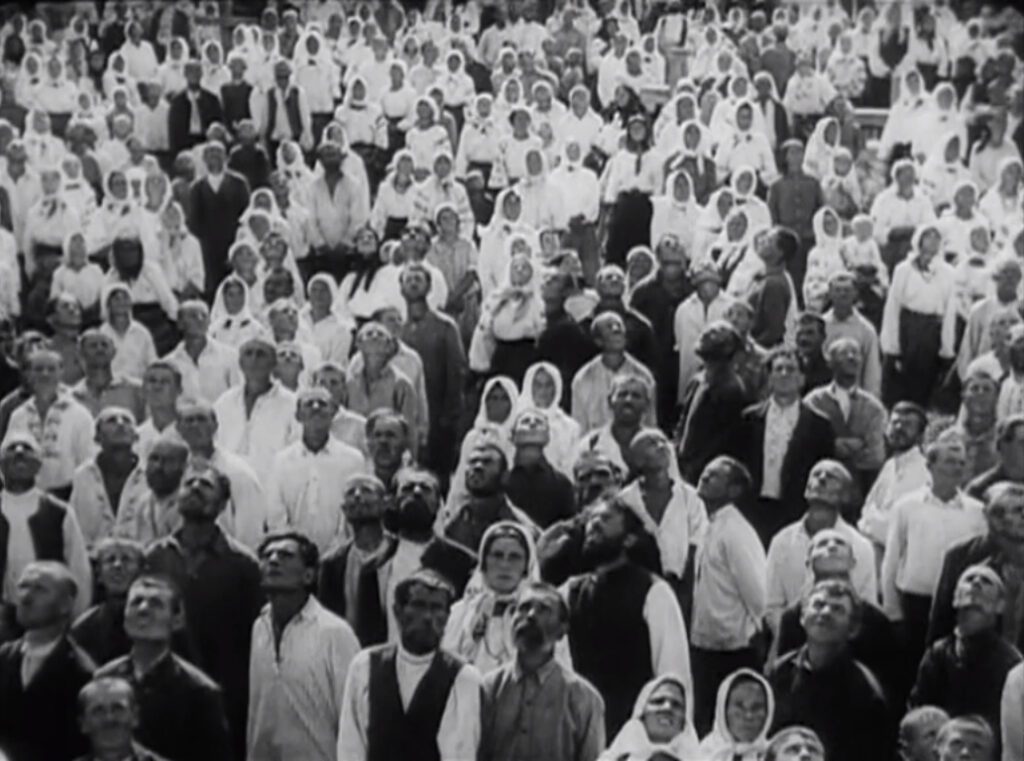
The implied vision of the airplane, a Communist version of the Holy Cross, concludes the story, and the rest is a coda – a nearly three minute montage of wheat fields and apple orchards showing the fertility of the earth as a reward for Communism, followed by Basil’s figurative resurrection in the final shot.
Although Dovzhenko doubtless made Earth with an earnest belief in progress, we know now that forced collectivization was a disaster, neither increasing productivity nor lifting peasants out of poverty. Not only economically disruptive, it was more insidiously an instrument of ethnic oppression, causing incomprehensible misery and death in Ukraine. The film’s value today lies not in its message but as a demonstration of a rarely explored technique. To overlay new imagery on top of familiar images is the cinematic equivalent of writing on a palimpsest, a potentially fertile technique with many other conceivable applications.
CONNECTIONS:
A Man Escaped – Parallels between the film and a Christian mass
Winter Light – Character named after the apostle Thomas; secular metaphor for the eucharist
Simón of the Desert – Airplane near the end resembling a secular version of the Holy Cross
Au hasard Balthazar – Animals depicted with a reverence that may seem sacrilegious but which expresses respect
Blow-Up – Character named after the apostle Thomas
Daisies – Christian imagery used as a template for a non-religious point
The Hypothesis of the Stolen Painting – Cinema as a kind of mystical ceremony
L’argent – Replacement of religious ideas with corresponding secular ideas
When the Tenth Month Comes – Pattern of replacements; symbolic object in the sky at the end that replaces a prior image