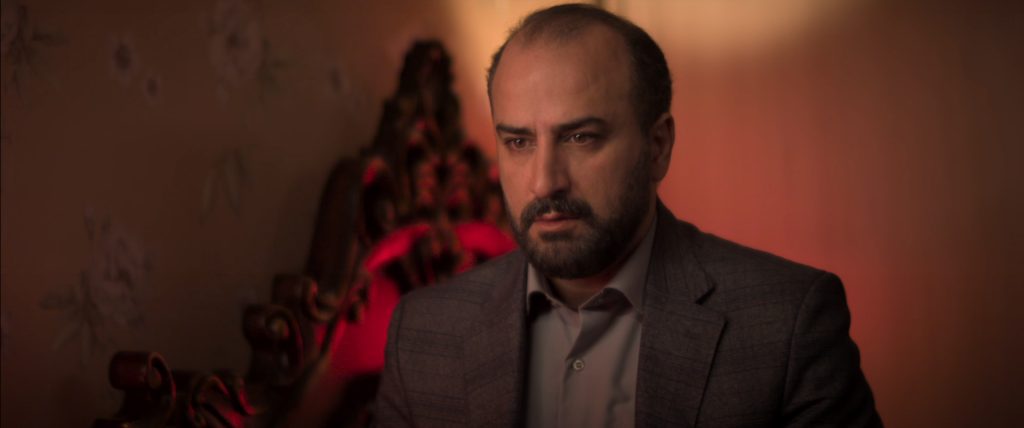
The Seed of the Sacred Fig
2024, directed by Mohammad Rasoulof
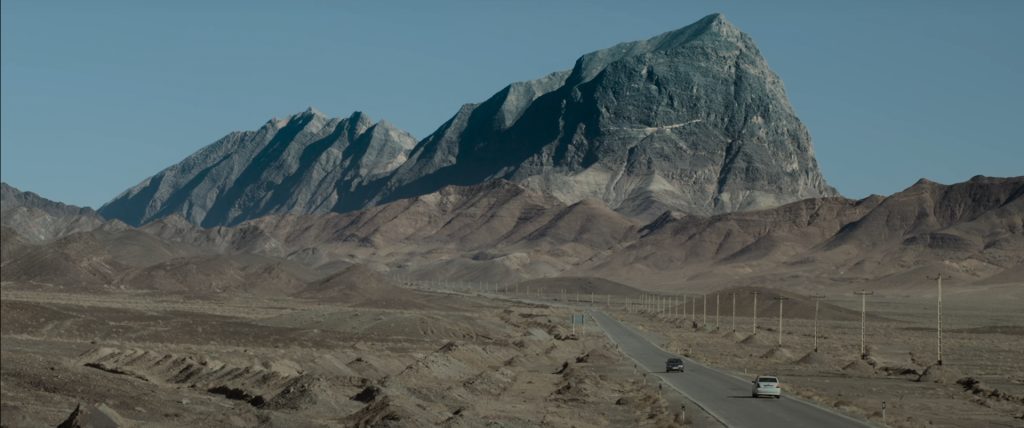
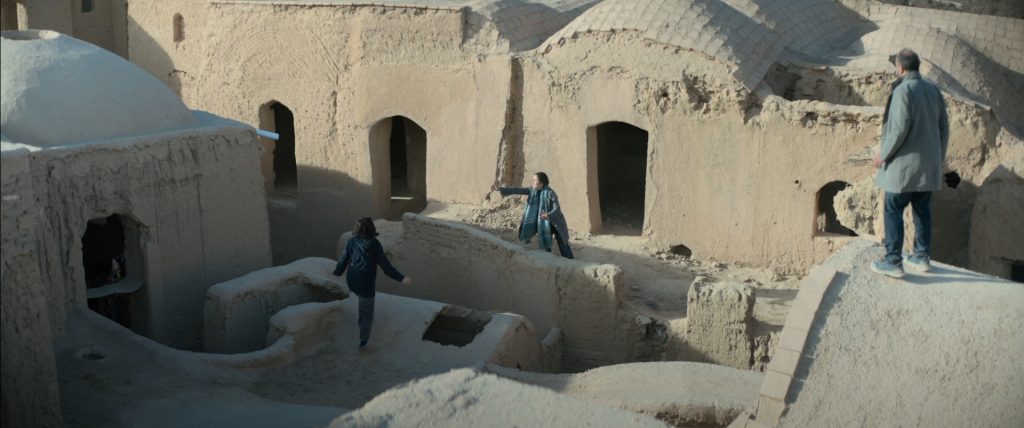
There’s evidence that each of the four segments in Mohammad Rasoulof’s There Is No Evil (2020) is modeled on some classic film, although the resemblance isn’t usually apparent until near the end of each episode. The same goes for The Seed of the Sacred Fig, which starts to echo Stanley Kubrick’s film The Shining when Iman takes his family to an isolated location and turns decisively against them. Both films begin with the father accepting an attractive new job, and both stories end on the father’s dead body in a labyrinth. In one, the son tricks his father into a hedge maze; in the other, the father’s pursuit of his youngest daughter ends in a sort of casbah. Both those children wear Mickey Mouse clothing at one point. In both films the father escapes from a locked room, and Sana breaks down a door with an axe just as Jack Torrance did in The Shining.
Any interpretation of The Shining needs to account for the final image of Jack in a 1921 black and white photograph in the hotel lobby. Iman also appears in an old black and white photograph, a family portrait in the safe house near the end. Sana asks about his hand placed over his heart, which ties back to the opening sequence with five cardboard cutouts of bearded men making that same gesture. Najmeh explains that it represents total submission to God – a concept that recurs throughout The Seed of the Sacred Fig and which drives the plot. Iman first excuses his signing of death warrants during a bedtime prayer: “I submit to the one who submits to You.” The family photograph therefore goes straight to the point of Sacred Fig as much as the ballroom photo goes to the point of The Shining.
Another important parallel may help us to make sense of Rasoulof’s homage to Kubrick. The Shining is notable for its tension between the psychological and the supernatural. The audience is kept guessing which force is primarily responsible for the horrors that unfold in the Overlook Hotel. An analogous tension drives Rasoulof’s plot, but it’s obscured because the competing forces are rooted in everyday life. Iman’s madness is simply the gradual erosion of his conscience as he accedes to the regime’s expectations… but it’s madness all the same. Likewise there’s no supernatural force driving the Iranian film, except that the dictates of religion lie behind everything. It may not be a ghost story, but everything that happens is predicated on spiritual beliefs.
The title points to the troublesome influence of religion, with an epigraph about the Ficus religiosa tree to clarify its meaning. Unlike normal trees which grow from the ground up, the Ficus religiosa is an epiphyte, germinating in the branches of other trees. The metaphor is subversive… we’re told that its seeds are deposited in bird droppings, and that the fig eventually strangles its host. The implication is that religion can also strangle what it grows on, whether that’s an individual, a family, or a whole nation. It turns Iman against his conscience; it divides his family; and it sows tyranny and chaos in Iran.
The bird excrement is also important to the metaphor. We often think of religion as the domain of the sacred, but instead of being born in the shared ground of the Earth, the fig tree is spread and born in unclean matter. Likewise, in Rasoulof’s film, religion exerts its power through the vulgar channels of violence and sex, i.e. through political and misogynist oppression. The action opens with eight bullets dropping onto a desk, each landing with a plunk like a falling seed, and later when Najmeh removes buckshot from Sadaf’s face, she drops the pellets into a sink where they bounce around in slow motion, again like seeds falling from a tree. Bullets are thus equated with seeds, one standing for violence, the other for the oppressive influence of religion. All the violence in this story, whether staged or inserted as cell phone footage, stems from the theocratic regime’s obsession with controlling women. The riots, arrests, and death sentences come in the wake of the religious police’s real-life killing of Mahsa Amini in September 2022 for not wearing her hijab.
A dogmatic believer might take offense at linking religion to a parasitic tree or to excrement, but the film turns that objection on its face. The real perversity is when religion enlists people in playing God or speaking for God. When Iman initially resists the command to sign the death warrant, his instinct tells him that doing so would be playing God with the life of the accused. Ironically, it’s the act of submission that implicates him more fully in the injustice. The practice of submission is seemingly opposite to playing God; it acknowledges the individual’s limits and the authority of a higher power, but when religion asserts divine authority in any human being, it corrupts the entire chain of authority. Iman may rationalize submitting to “the one who submits”, but that “one” above him is not in fact submitting. The theocrat is usurping divine power, so that theocracy is a form of idolatry.
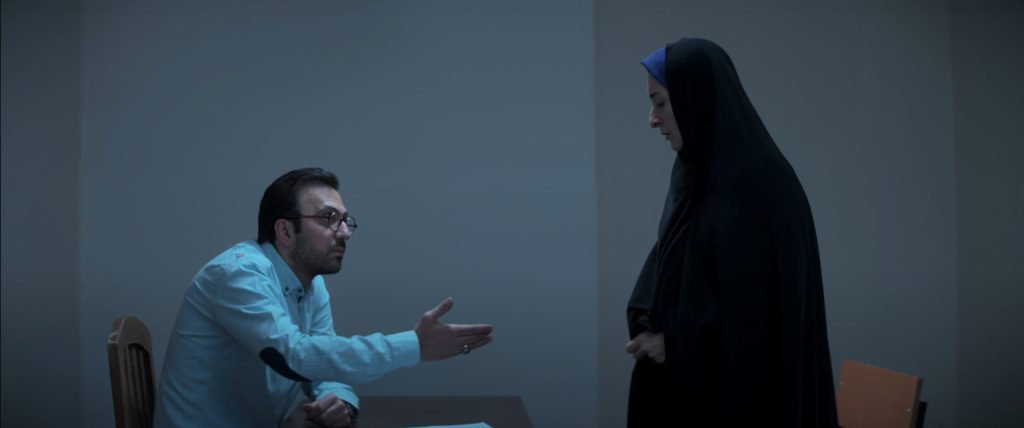
The interrogation scene in particular pokes a hole in the presumption of religion’s infallibility. When the gun goes missing, Iman’s colleague and confidant Ghaderi urges him to send the three women of his family to their mutual friend Alireza, whose skills Ghaderi builds up: “He’s the best interrogator there is. He has psychological tricks, he’ll figure it out quickly.” Though it’s never stated directly, when the family returns home it’s clear that Alireza has pointed the finger at the elder daughter Rezvan. Iman accepts the accusation religiously, but it turns out that Sana took the gun without her sister’s knowledge. The greatest interrogator in a government blessed with divine authority couldn’t even see through the wiles of a teenager.
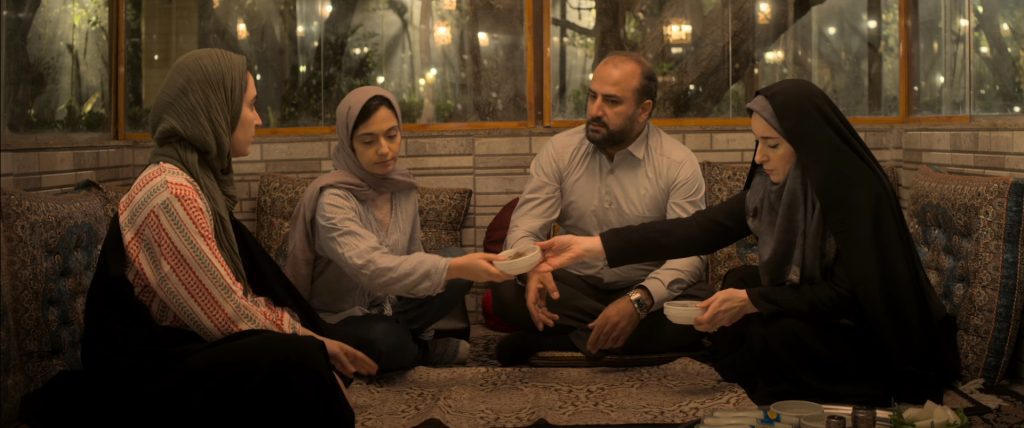
At every turn in the family drama, the act of submission is a major issue. The daughters must give up plans with their friends to celebrate Iman’s new job at a restaurant. Now that their father is an investigator, they must be scrupulous about their dress, their behavior, and their friends. Sadaf cannot stay over anymore or show herself to Iman. Najmeh and the girls must submit to a humiliating interrogation. Sana wants to dye her hair and paint her nails, but it’s against God’s eternal law. When Iman suspects a liar in the family, the women turn into prisoners. Despite having an innate sense of justice, Najmeh is complicit in the web of oppression, calling the student protestors “thugs”, denying their humanity, driving Sadaf away, and taking Iman’s side against her daughters. She represents the situational conservative found in every society, her liberal conscience unable to compete with her wish for a three-bedroom apartment, a dishwasher, and general avoidance of trouble.
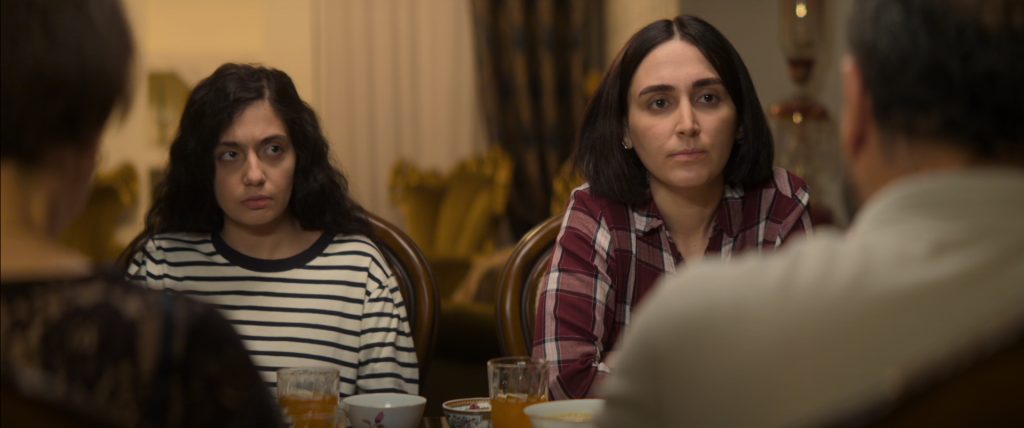
As Iman becomes interpellated deeper and deeper as an agent of a supposedly divine government (his name itself means “believer” or “submitter”), his family’s resistance grows. The daughters resist instinctively, but Najmeh’s turning point comes when she takes the blame for the missing gun. Initially her lie is meant to shame the guilty daughter, whose identity she does not yet know, but once she crosses that line she’ll remain on the girls’ side. Throughout the film the symbolic command to “sit down” appears several times, often meeting delay or resistance until the showdown in the casbah when Najmeh finally refuses the order from Iman. The family drama has important social implications – religious and political authority creates its own resistance.
Just as The Shining is a metaphor for the United States (it’s filled with Americana, and Jack’s predecessor was British the same way that Britain preceded the U.S. on the world stage), The Seed of the Sacred Fig is a metaphor for Iran – yet it’s also a universal story of tyranny, and any American watching it at the time of release must find the story familiar, with religion intruding into government, the undermining of truth in televised propaganda, and especially the cruel way that politics can split families.
The great turning point in The Seed of the Sacred Fig is the missing gun, and it happens almost exactly halfway through. The gun is a particularly strong MacGuffin, serving a symbolic role but never getting dropped from the plot. The bullets in the opening shot take their cue from the title, standing for the germ of violence that will strangle the family and the country just as the fig tree strangles its host – but when the plot turns in the middle, so too does the metaphor. The bullet that Sana fires into the ground is one of the eight bullets from the opening, only now it’s being planted almost literally in the earth like the seed of a normal tree. The effect is the family’s liberation, essentially opposite to the strangulation of the parasitic tree. The bullet cracks the floor of the casbah, sending Iman down to the next level where he too is planted like a seed.
Iman’s old family portrait may be the equivalent to the ballroom photo in the Overlook Hotel, but it differs in that it’s inserted within the action. Like The Shining, there’s also a brief epilogue after the father dies – a final montage of video clips from the student protests – which ends with a twist comparable to the date on the ballroom photo. After all the images of conflict, a young woman rides off on a motorcycle flashing a peace sign. The tale of strangulation and violence has turned into a tale of liberation and peace. Not only does the reversal portend hope for Iran, it also recasts the metaphor in the title, offering an idea of the sacred that does not strangle the place where it grows.
CONNECTIONS:
Fever Mounts at El Pao – Story of a government official’s gradual process of corruption
The Shining – A father turns against his family after starting a new job, escapes from a locked room, and dies in a labyrinth where he is revealed in a frozen position; father seen near the end in a black and white group photo; door broken down with an axe; child in Mickey Mouse clothing; metaphor for a nation’s corruption