The Man Who Sleeps
1974, directed by Bernard Queysanne
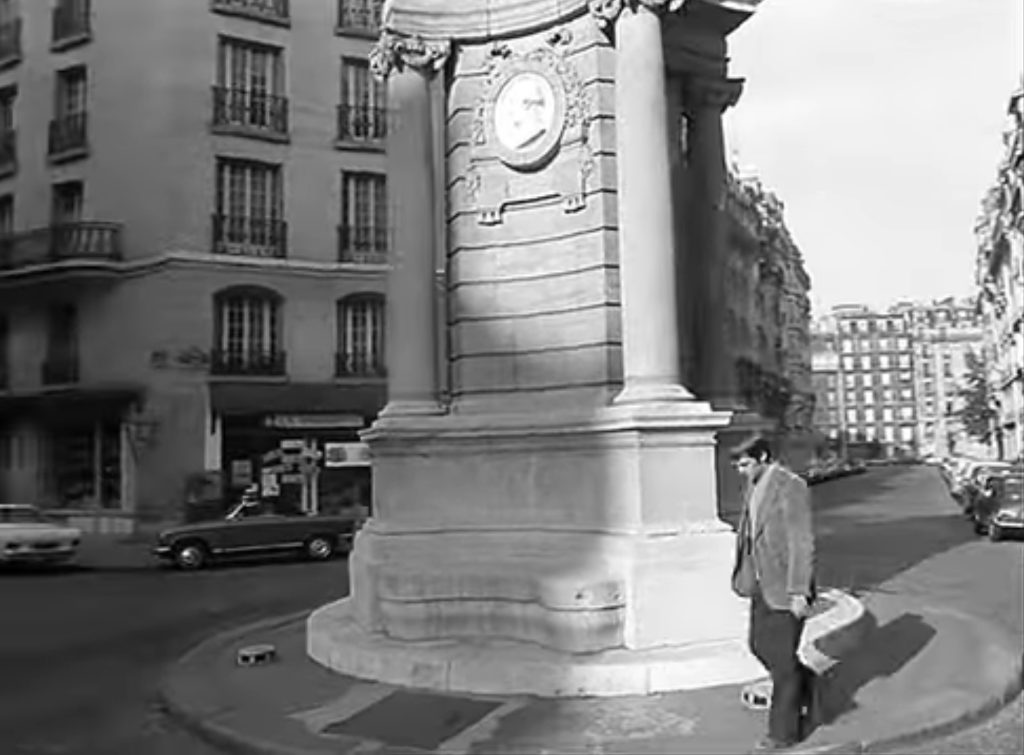
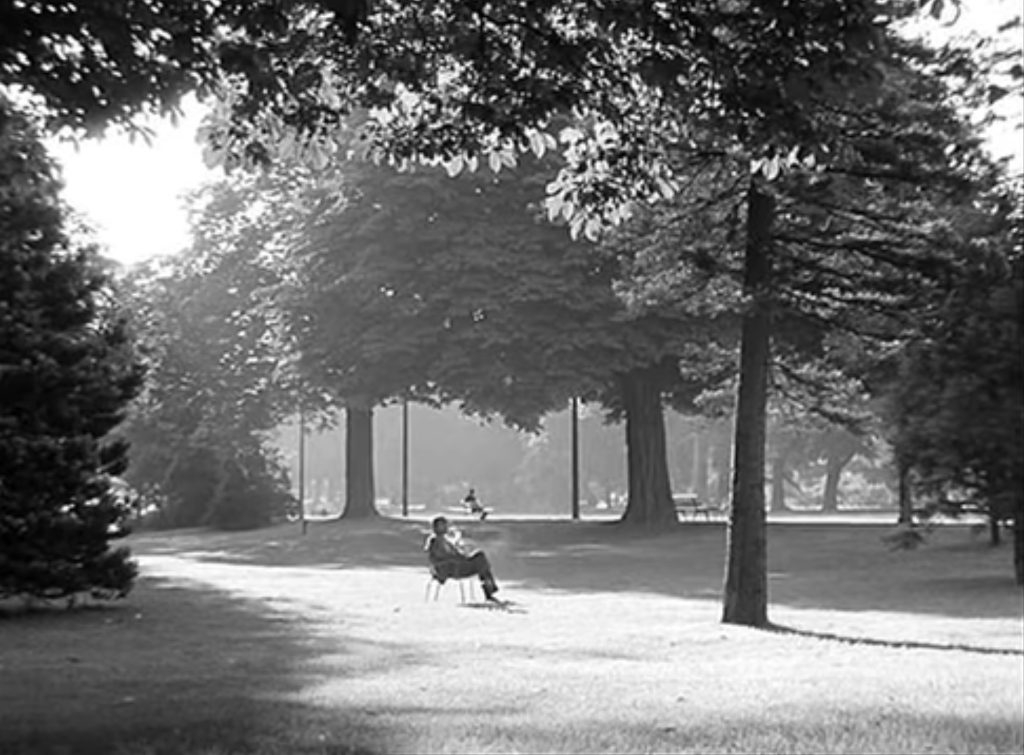
About forty-seven minutes into The Man Who Sleeps, the unnamed protagonist walks around a small monument in the middle of Place Georges Mulot in the 15th arrondissement of Paris. Instead of following him, the camera loops in the opposite direction, and after half a revolution, the subject vanishes behind the monument. The camera, presumably mounted on a driven vehicle, speeds up for another one-and-a-quarter turns, as if to verify that the young student isn’t there anymore. We can easily imagine how this trick was performed, but the point is that this vanishing corresponds to an important change in the man. In the next shot he reappears only to fade momentarily into the glare of the sun. These and a couple other disappearances indicate that something of his personality is beginning to dissolve.
Five minutes earlier, a shot of the Eiffel Tower disappearing into fog foreshadowed his own disappearance: “You are invisible, limpid, transparent. You no longer exist.” Later, twenty minutes after vanishing behind the monument, he will fade completely to white. Although the ending seems to deny that he’s learned anything (“…and you are no wiser”), it’s as if his ego has receded.
The Man Who Sleeps tells of a university student’s gradual reemergence after withdrawing from his routine, from his classes, from social relations, even from the flow of time. It was not quite accurate to say, above, that the young man is unnamed, because the film is narrated in the second person. He is called “you” throughout. Given also that the film is bracketed by high overviews of Paris, from which the student is picked out of an almost random window, and into which he makes one final disappearance as he shrinks to a speck among other anonymous specks on a distant street, the insinuation is that there’s something universal in his story.
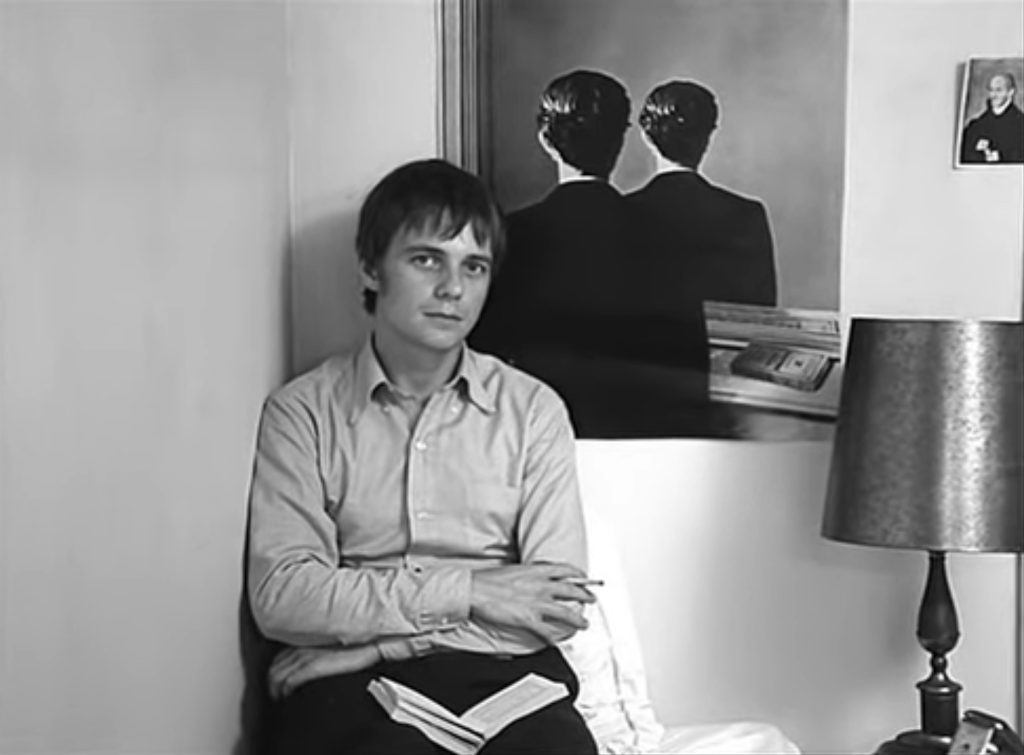
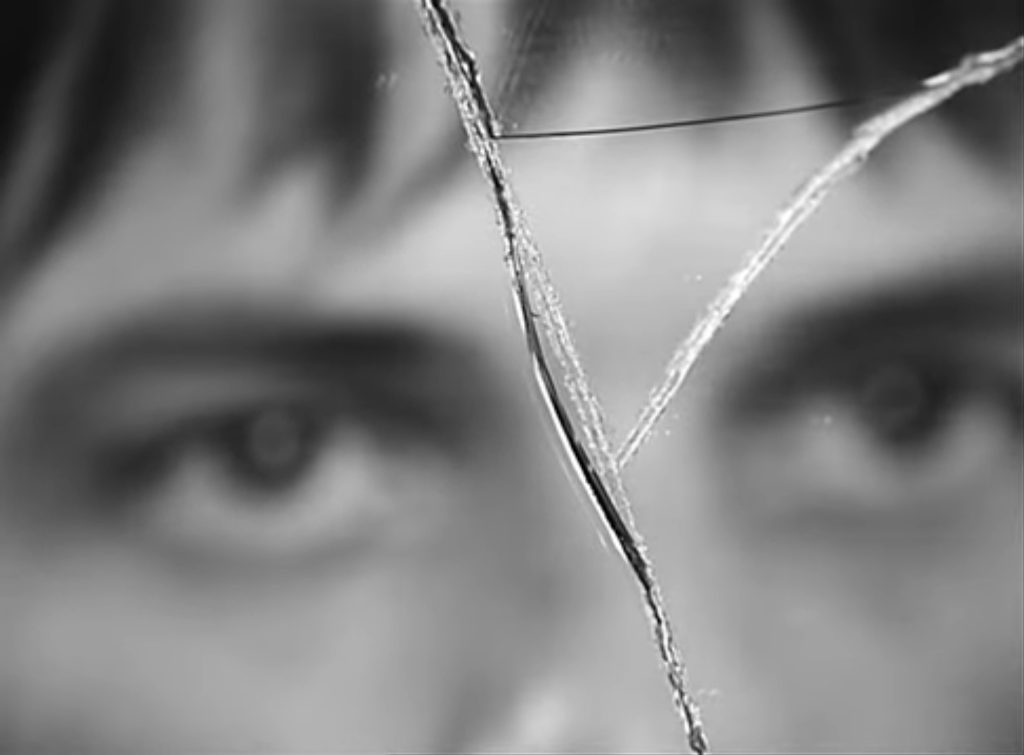
Everything begins one hot morning in May. The student’s alarm goes off at 7, he rushes to class amid throngs of commuters, then during an exam, as he stares vacantly toward the board where “12h 45” is written, a woman’s hypnotic voice-over takes him back to the ringing of his alarm clock, describing the months-long chain of events that unfolds if he chooses to ignore it. This long adventure, however, is not told in the conditional mood. The voice tells us, rather, that it was the student’s more conscientious doppelgänger who went to class in his stead. A real part of him actually does withdraw from the life expected of him. The film offers recurring visual confirmations of a split character: the broken mirror that divides his face, another mirror that reduplicates him ad infinitum, and a prominent poster of René Magritte’s La reproduction interdite over his bed, in which a mirror reflects the back side of a man facing it, replicating his image with eerie literalness.
Instead of making the story more fantastic, these signs of a split personality make it more believable. Most of us won’t drop out of school and spend a year as urban hermits, yet there’s probably something in us that recoils, at least sometimes, from the regimentation of a purpose-driven life.
Certainly there are signs that the student is withdrawing from responsibility or from an imposed sense of purpose, yet that doesn’t adequately describe what’s going on. The film does not frame his withdrawal as a rebellion. “You reject nothing, you refuse nothing.” Instead of a social or psychological response, it’s as if he’s seeking a different placement within time itself. We’re told that all it took to set him off was a vaguely followed line of text, the bitterness of his coffee, and the sight of his socks soaking in a basin, but our visual and auditory evidence disputes this simple explanation. Depending which timeline you follow, normal life ceases for him either at the sight of the inscription on the classroom whiteboard, or at the sound of the alarm clock. Either way it’s a token of measured time, and the early stages of his new phase are dominated by the aggressively magnified and syncopated sounds of clock gears. Other ambient sounds, like the bells of Saint-Roch or the dripping of the tap, are also linked to measured time, and several clocks appear throughout.
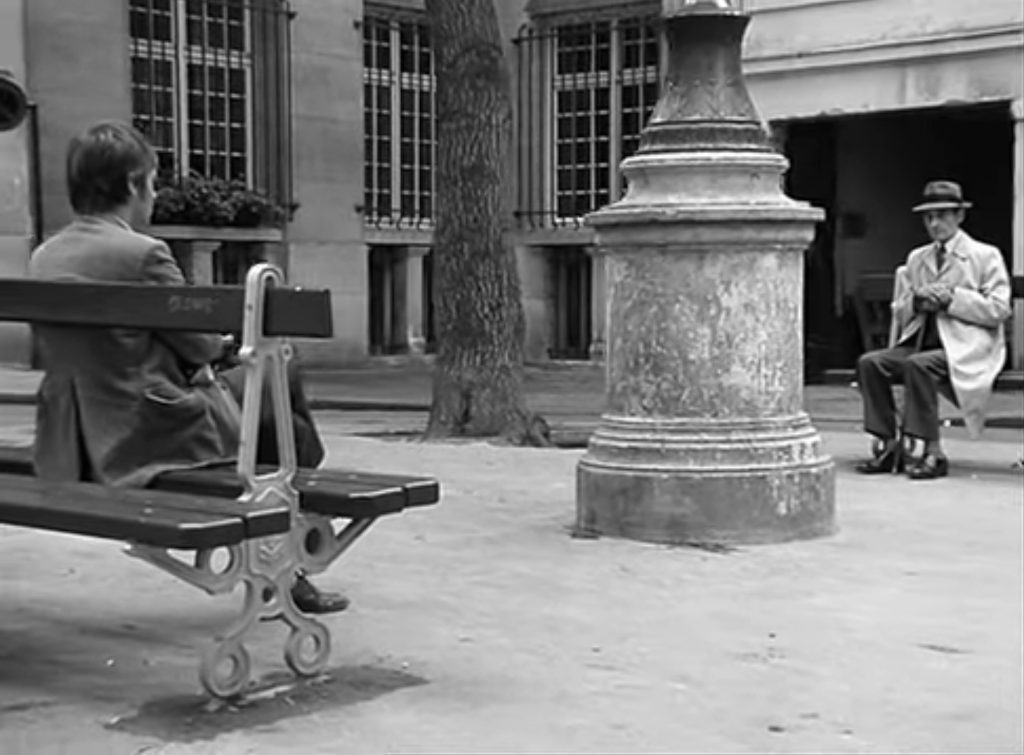
There is no sign of the oedipal rebellion so stereotypical of college students in the early 1970s. On the contrary, his one role model is an old pensioner on a street bench, a ready father figure whom he attempts to mirror from across a round pedestal. “His madness, if he is mad, consists in believing that he is a sundial.” Unable to match the old man’s fixity, he moves on, but when he later disappears behind the monument at Place Georges Mulot, which echoes the pedestal between him and the old man, it’s as if he’s trying again to stand above the flow of time, as if becoming a sundial. To vanish behind another round stone structure would complete his emulation of the sitting pensioner.
The film’s midpoint comes while its subject shuffles cards for a game of Solitaire, referred to here by its old-fashioned name of “Patience”. Again he’s setting himself apart from the flow of time. The symbolic inflection point, however, occurs about three minutes later when a forward tracking shot of Avenue Kléber reverses itself, right after the voice-over reaches a moment of particular stillness: “Time passes. You are drowsy. You put the book down beside you on the bed. Everything is vague, throbbing. Your breathing is astonishingly regular.” It’s right after this that the Eiffel Tower vanishes, the student is described as “invisible”, and his existence is first likened to that of a rat. Everything after the reversal of that tracking shot can be classified as the return journey, culminating in the student’s re-entry into normal life.
Before normality resumes, the student will pass through a sort of crisis: “But rats don’t spend hours trying to get to sleep. Rats don’t wake up with a start, gripped by panic, bathed in sweat….” This crescendo of doubts concludes with the poetically apt likening of the student to “a messenger delivering a letter with no address.” The flurry of insecurities leads to an apocalyptic passage of ruined buildings, the student’s own room wrecked almost beyond recognition. Finally, on the other side of this long adventure, the film brings its protagonist back to reality with an almost cruel banality: “The game is over. The world has stirred, and you have not changed. Indifference has not made you any different.” If there’s anything positive to be gained, it’s a new humility. “You are not the nameless master of the world,” unlike the spider he had pretended to be, spinning its web over Paris.
To put this film in its best light, we can make a couple of critical observations – not to find fault, but using the film’s limitations as guideposts to define more clearly what it actually achieves.
First is the problem of the voice-over, a device which tends to steer a film toward telling instead of showing. As wonderfully suggestive as Perec’s writing may be, if the viewer trusts in it too completely then it wraps up its case with too much clinical finality. The long final passage tells us, in no uncertain terms, that the young man’s illusions are over, that he is now once again an ordinary person, simply “waiting on Place Clichy for the rain to stop falling.” It’s a fine lesson, but it’s still a moral lesson delivered in words, and the second-person voice may come off, in retrospect, like preaching.
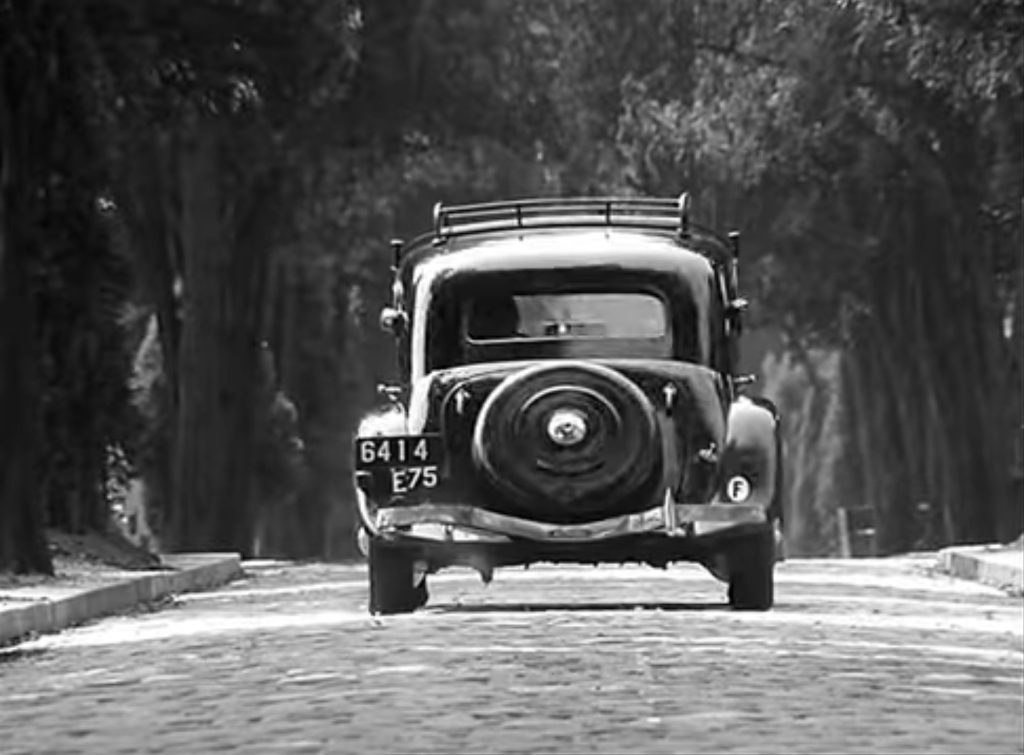
We’ve already noted, however, that various signs cast doubt on the voice-over, like when it blames the young man’s detachment on a mere line of text, his coffee, and his socks. The voice-over sometimes falls out of sync with the visuals, and this asynchronicity opens room for a logic that’s independent of Georges Perec’s text. When a black Citroën drives through Père Lachaise Cemetery, for instance, we may read it as an allusion to Cocteau’s Orphée and infer that the student is following a dead end. When he reads Le Monde and fancies himself a powerful man with a cigar and fancy automobile, we can sense some of the arrogance that will later be stripped from him. When two little boys in striped shirts flank him at a railing and clang a ruler across the bars, we can see that the student, while seeking freedom, has stepped into a sort of prison. In the final reckoning, the sounds and images are expressive enough that we needn’t take the voice-over at face value. There’s a sense of liberation in the ending that overrides the narrator’s insistence that nothing has been gained, allowing us to read some irony into her words.
The second critical observation stems from the narrator’s summary of the student’s experience, right after the camera reverses direction on Avenue Kléber: “You live in a parenthesis, in a vacuum of promise, and you expect nothing.” By trying to escape the oppressive grip of time in his academic routine, the student attempts to place himself in the kind of parenthetical bubble of time that Yasujiro Ozu describes so elegantly, and with so much less fuss, toward the end of The Flavor of Green Tea over Rice. Like the student, Ozu takes a positive view of stepping outside the incessant flow of time, showing how a brief passage of perceived timelessness can reset lives and relationships. Ozu had likewise defined this timelessness in terms of asynchronicity, with separate clocks chiming midnight a minute apart, making the placement in time ambiguous. If we take a constructive view of The Man Who Sleeps, the student, too, manages to reset his life for the better after stepping outside of time, despite all the implied self-deception.
It’s the difference, though, that gives The Man Who Sleeps its reason. Whereas Ozu’s characters had made the best of one of those pockets of seeming timelessness that life occasionally gives us, the Parisian student tries to force and to prolong a parenthetical sense of time. As much as The Man Who Sleeps is about a journey outside of regular time, it’s also about the delusion of trying to master time.
CONNECTIONS:
La nuit fantastique – Man who fancies himself a clock or who fancies another a sundial
Meshes of the Afternoon – Unnamed protagonist who behaves like a somnambulist and is reduplicated; brief passage of time repeated at the film’s end or beginning
The Third Man – Character who vanishes by a kiosk or a small monument in a European capital
Orphée – Elegant black car driving into the territory of the dead
Juliette, or the Key of Dreams – Protagonist’s adventure equated with sleep or somnambulism; man eternally rearranging calendar pages or playing cards; hard object clanging against prison cell doors or vertical bars; loss or rejection of memory
The Flavor of Green Tea over Rice – Opportunity to reset the direction of life during a temporary escape from the regular flow of time
The Eighth Day of the Week – Dripping faucet linked to the counting of seconds; striving for a time outside the sequence of clocks and calendars
Hiroshima mon amour – Paris associated with the willful obliteration of memory, which leads to hatred; dreamlike journey from detachment to engagement
Pickpocket – Young Parisian man’s withdrawal from and eventual re-entry into society; attention called to small ordinary sounds beyond the protagonist’s room; newspaper as a shorthand for the external world
A Story of Water – Eiffel Tower partly obscured by rising floodwater or by fog
Last Year at Marienbad – Long hypnotic voice-over describing a subjective experience; nameless characters; recurring card game; retreat into solitude
Cléo from 5 to 7 – Wanderings through Paris that capture much of the city’s variety; transformation of the protagonist’s sense of time; sound effects that mimic the ticking of a clock
Time Walks Through the City – Narrative tour of a city without synchronized dialogue; descent into & reemergence from a state of distorted time
2 or 3 Things I Know About Her – Paris as a character; walk through Paris brings existential healing
Weekend – Turning point marked by a reversal of camera direction; implied dialectic within the narrative; apocalyptic tone at or near the end
2001: A Space Odyssey – Man’s ego dissolves in solitude; protagonist replicated; abstract and fantastical journey
The Man Who Left His Will on Film – Young man’s withdrawal from reality; protagonist split into two persons near the beginning; labyrinthine journey through a major city; cinematic puzzle
Heart of Glass – Voice-over that seems intent on hypnotizing the viewer; vision of apocalypse toward the end
The Devil Probably – College-age man’s withdrawal from and possible reengagement with life; scenes on the banks of the Seine and in Père Lachaise Cemetery
The Hypothesis of the Stolen Painting – Shot of the Cité Vaneau cul-de-sac either behind the titles or near the midpoint; film presented as a philosophical puzzle
The Baby of Mâcon – Turning point near the middle when a forward tracking shot goes into reverse
In the City of Sylvia – Young man’s extensive wanderings through a French city; past, present, and future considered jointly; hints of dialectical progression