The Kid
1921, directed by Charles Chaplin
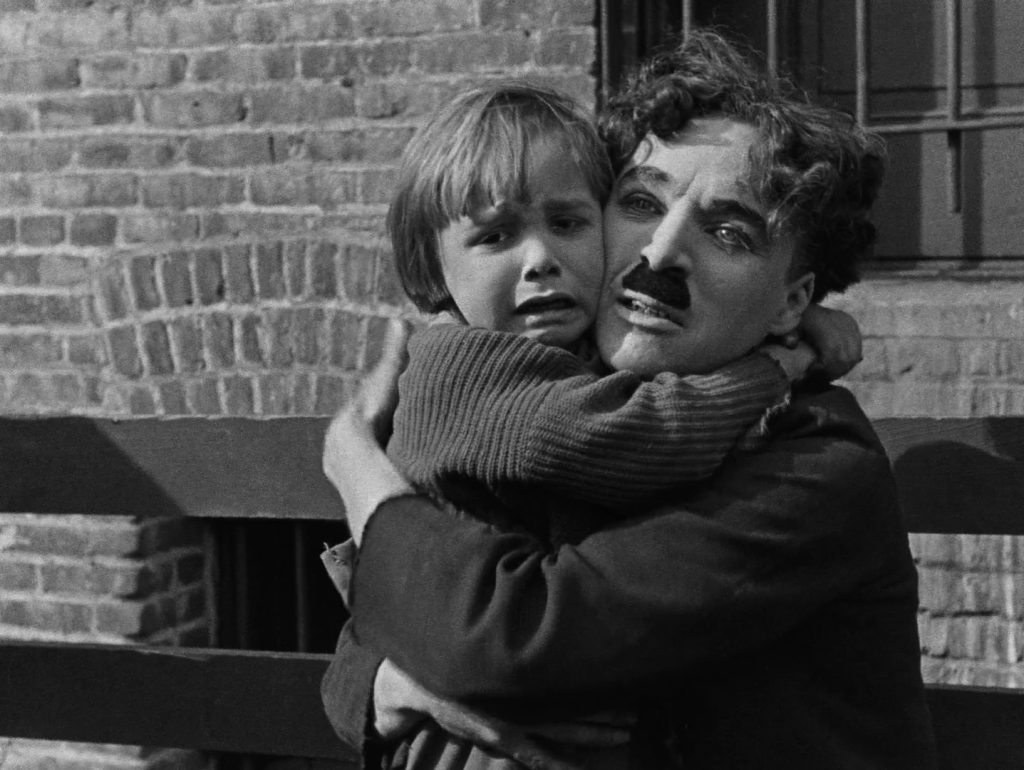
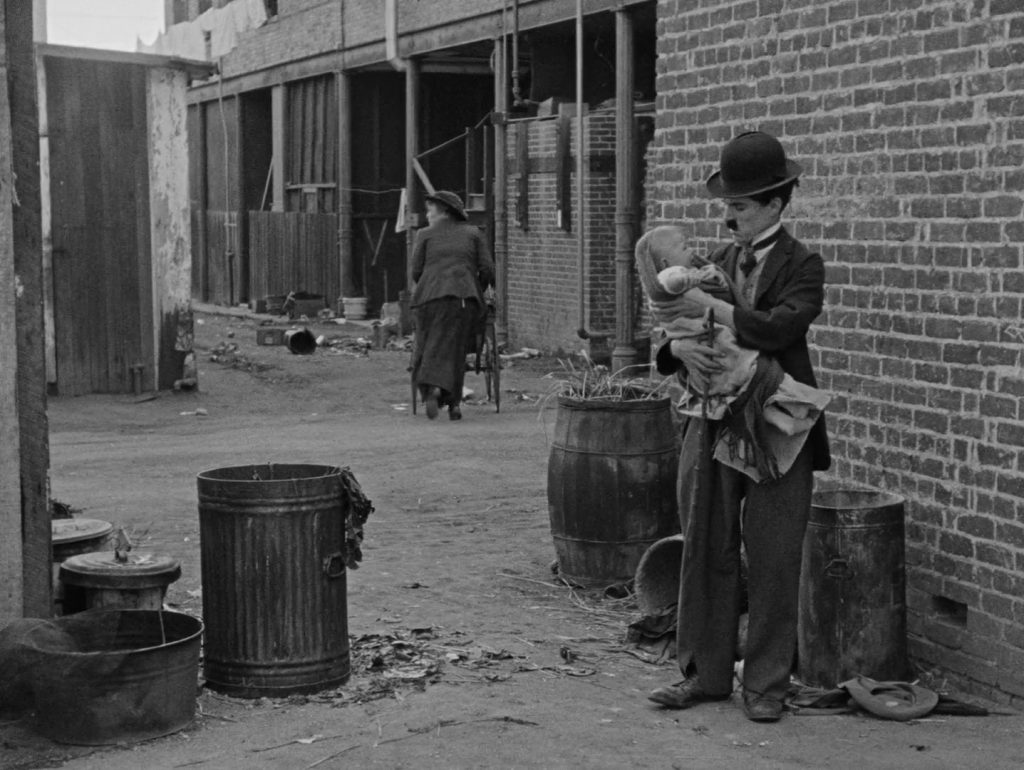
Six minutes into The Kid, Charlie Chaplin’s Tramp character finds a baby abandoned by car thieves in an alley. He picks it up, setting in motion an elaborate chain of gags as he tries to put it back or give it away. Most viewers will take the sequence for granted as a bravura display of Chaplin’s comedy, but it also does something sneaky. In an unlikely story where so much seems to be manipulated for comic or emotional effect, the passage quietly lets us know that the film cares about reality. In real life, even the kindest soul would go to great lengths to avoid an unexpected responsibility like this infant, especially a man like the Tramp who can barely take care of himself. If the Tramp had adopted the baby at first sight, the audience might have made allowance for a fictional shortcut, but when all his efforts to get rid of the baby fail, the sequence cements the relationship more convincingly. Now we can believe the Tramp is a father.
A different sort of logic bridges the plot’s other great leap of faith, with the same effect. Out of nowhere, a title card announces that the kid’s mother, who began the story in a charity hospital, has become a star of the theater stage. This time the film goes to no great lengths to justify the unlikely good fortune, but when the impresario walks in wiping tears from his eyes with affected gestures, we can infer that the woman has just performed in a tragedy, and that she’s drawn on her own unhappy experience to become a powerful actress. Suddenly her arc becomes believable too.
These subtleties are not just demonstrations of how a movie achieves plausibility. They’re important in this case, because underneath its heartwarming story, The Kid means to shift the way we perceive reality itself. Because of its short length, its emotional appeal, and its use of time-tested narrative tropes like virtuous underdogs and unsuspected identity (the woman encounters her lost child before either one knows it), the film probably comes across as a simple classically constructed comedy, a story type familiar from theater and opera, distinguished only by Chaplin’s brand of storytelling. The key to the movie appears late, in the only scene free from the demands of plausibility.
One may ask why the dream sequence right before the end is even necessary. It inserts a needed cushion of time between the Tramp’s loss of his child and their reunion, keeping the ending from feeling too abrupt. It also offsets the happy ending with its own tragic conclusion, heightening the emotional effect, but these reasons don’t account for the particular content of the Tramp’s dream.
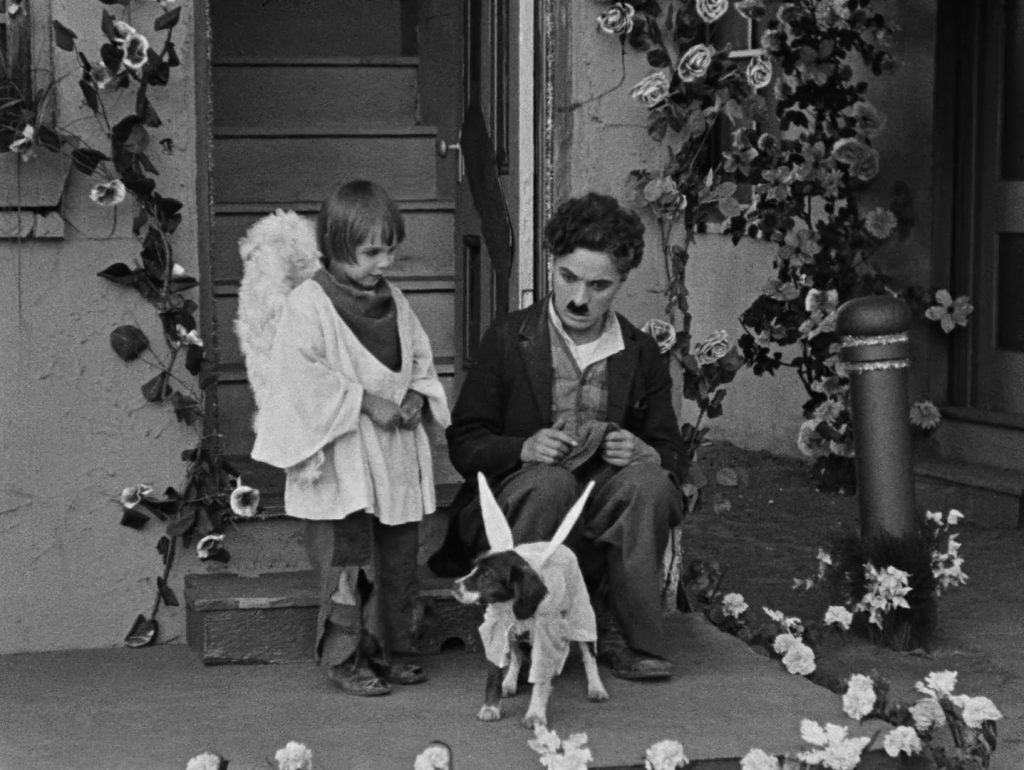
At a low point when all his joy seems lost, the Tramp dreams he’s died and gone to heaven. Before falling asleep he was mistreated at length, his boy was taken in the night, and he’s locked out of his own shabby apartment. The dream is a plausible response to all of that, a therapeutic wish fulfillment that replays recent events and frames them more palatably, but what’s most striking is how closely his vision of paradise resembles his actual life. It’s not just that characters and events recur – it’s that the transformation itself is so pitiably small. Heaven is nothing more to him than his derelict alley festooned with a few strings of white flowers. Things are better, to be sure, but not by much. Everyone wears feathered wings, and they can fly short distances. His son returns, and the stolen toy dog returns as a real dog with wings. People are friendlier, including the cop and the bully, but only up to a point. Within three minutes everything goes wrong, and the policeman ends up shooting the Tramp dead.
As soon as the dream begins, and the drab tenement walls sprout festive garlands in a slow dissolve, we’re confronted with a recognizable truth that’s borne out in the rest of the dream. People’s fantasies, however much power of creativity we might attribute to them, are generally limited by their experience. The Tramp cannot conceive of a paradise more than a degree better than what he’s already lived through. One may always imagine something worse, but any imagined improvement must be cobbled together from what one has already experienced. Dante faced the same problem in his Divine Comedy… the Inferno is filled with fantastic tortures, but the heavenly choirs of the Paradiso have little appeal to anyone hoping for a taste of unearthly joys. When the Tramp’s dream goes sour, we can believe that he’s not surprised, because that’s all he’s known his whole life.
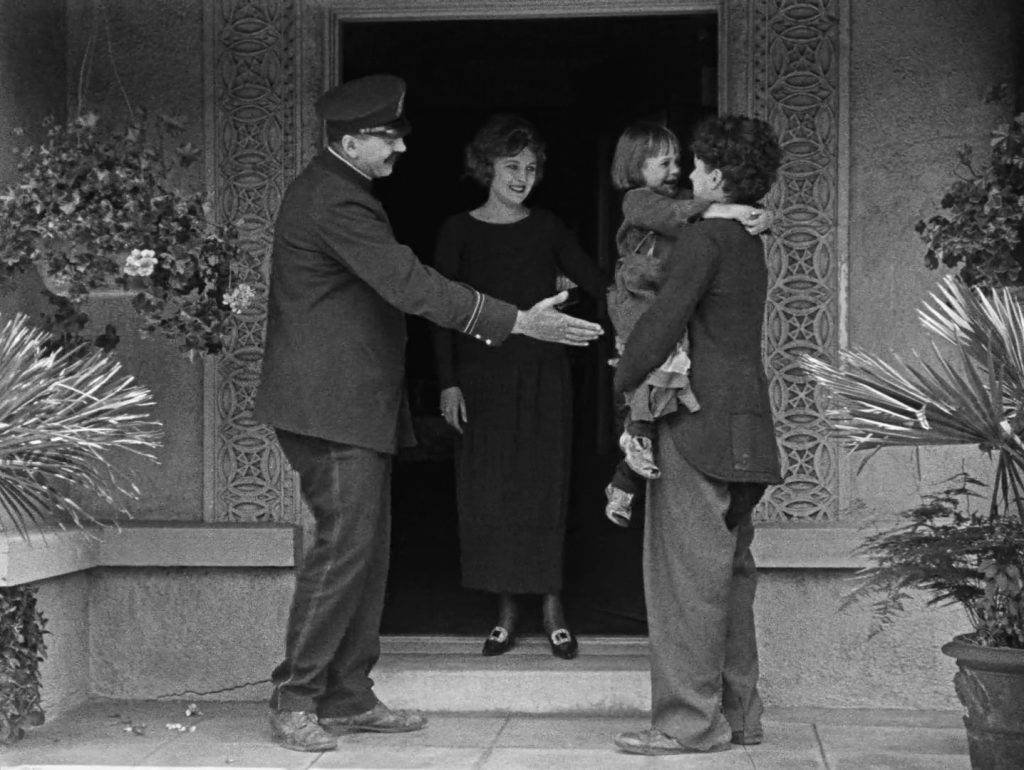
The great insight of The Kid depends not on the story’s plausibility, but on its homage to reality. When the policeman wakes the Tramp from his sad dream and takes him not to the police station but to a handsome doorway to be united with the woman and the kid, we should understand that while fantasy is limited by experience, reality is not. People generally believe it’s the other way around, but when the Tramp is welcomed into something resembling a family at the end, his reality exceeds his fantasy.
It’s important that the film does not make any promises. The point is not that reality will exceed fantasy, but that it can and often does. When the Tramp walks in the door at the end, there is no hint that he’ll marry the woman, nor is there any promise that he’ll be with his beloved little boy for any great length of time. The ending is vague, but it implies a faith in life that should be enough to satisfy the viewer. The contrast between the dream and the ending should help us to recognize how reality may surpass our imagination. In retrospect, the same idea has been in The Kid all along.
When the mother sits on a park bench despairing for herself and her baby, she can hardly imagine how well things will turn out. When she puts her son in the rich folks’ car, hoping for his material provision, she has no idea of the loving upbringing he’ll actually receive. When an older kid robs and attacks the boy, the Tramp can hardly expect his kid to defend himself so well, nor would he likely imagine himself getting the better of the muscle-bound big brother or the officials who take the kid away. The film handles these conflicts without stooping to cheap triumphs. Reality is messy, but on the whole it’s more generous than habitual observation would lead one to expect.
The woman’s dressing room scene foreshadows the dream, her environs suddenly decked on all sides with flowers that fail to cover her sadness, but it ends on a happier note that encapsulates the emotion in the film’s insight. A black delivery boy emerges from behind a gigantic bouquet, and when she gives him an unexpected tip, his face brightens up in a way that expresses all the joy that the film builds up to half an hour later.
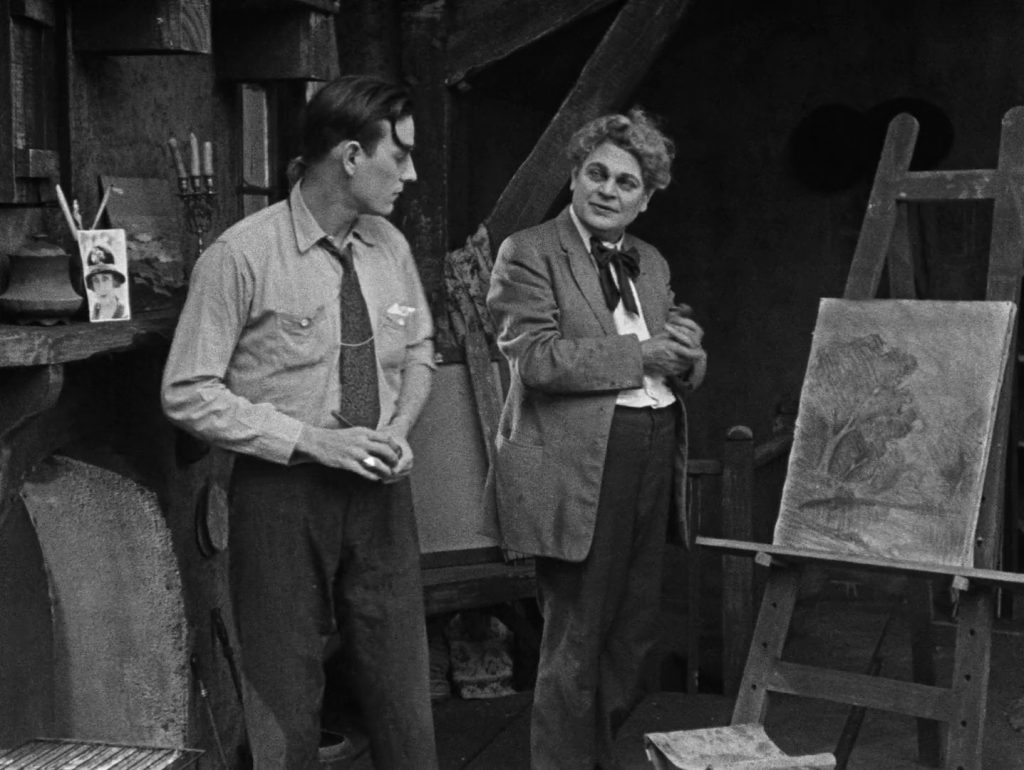
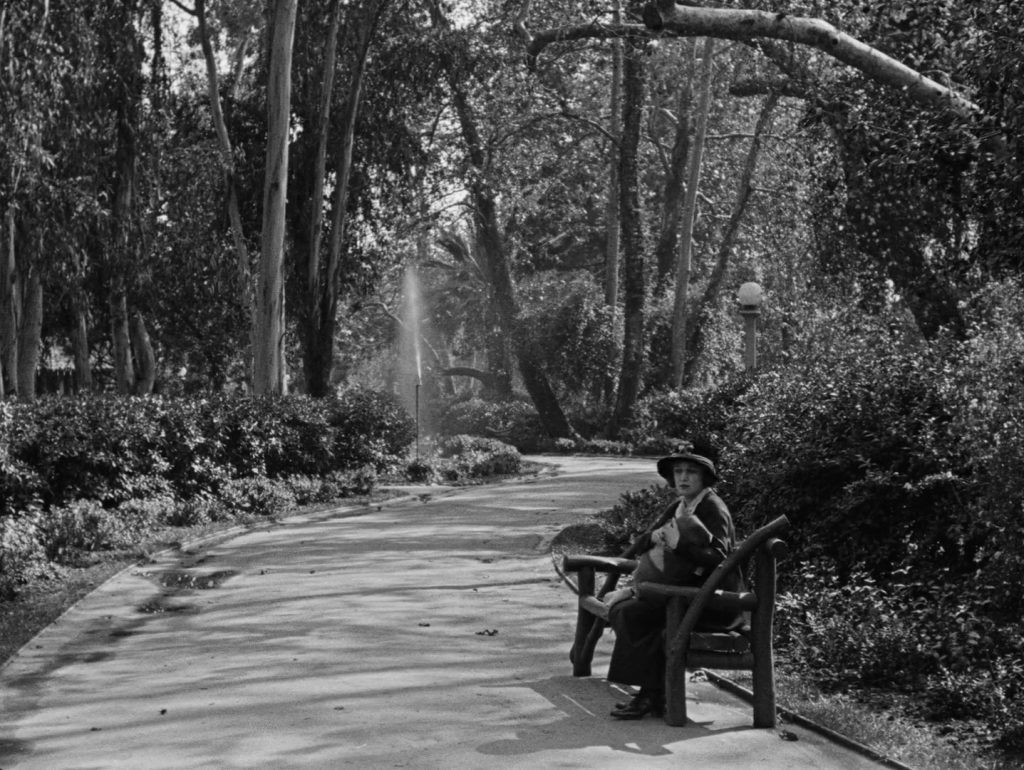
The same contrast between fantasy and reality that gives the ending its power is hinted at two minutes in, when the film cuts between the woman and her ex-lover, presumably the kid’s biological father. The woman is sitting in a gorgeous park, on a winding path through thick foliage with a fountain at the next bend. Under the circumstances she’s probably obtuse to the beauty around her, just as we all tend to be obtuse to the potential of our reality, but her faithless lover stands in a bohemian loft where his artist friend paints a tree-filled landscape with evident pride. He’s working indoors, so the painted scene appears to be imagined, yet it comes nowhere near the richness of the real greenery around the woman. Again the usual connotations of reality and fantasy are reversed, the fantasy falling flat like the Tramp’s dream, and reality exceeding the bounds of imagination.
Just as the film acknowledges the complexity of real life in its messy fights and in the vague ending, it also avoids making saints out of its characters. For all his basic decency, the Tramp enlists the kid in vandalism, breaking windows in a repair scam. It’s the sort of crime that poverty breeds, less a flaw in his or the kid’s character than a flaw in society – the same society that finds a “sin” in motherhood and that puts its poor under constant police surveillance. The Tramp is not above hitting the bully with a brick or throwing a bowl of flour in the faces of intrusive social workers, but he’s always thinking of his kid’s welfare and protection. In Chaplin’s world, virtue is not some impossible perfection; rather it’s about assisting in the boundless outpouring of a reality that’s worth putting faith in. The Tramp gives the kid the love and attention that a baby left by a garbage can would have little reason to expect, and he does it with enthusiasm, not in order to think of himself as a “good person” but because he appreciates the wondrousness of making the world unexpectedly better.
CONNECTIONS:
A Matter of Life and Death – Vision of heaven that mirrors the shortcomings of life on earth