Mr. Thank You
1936, directed by Hiroshi Shimizu
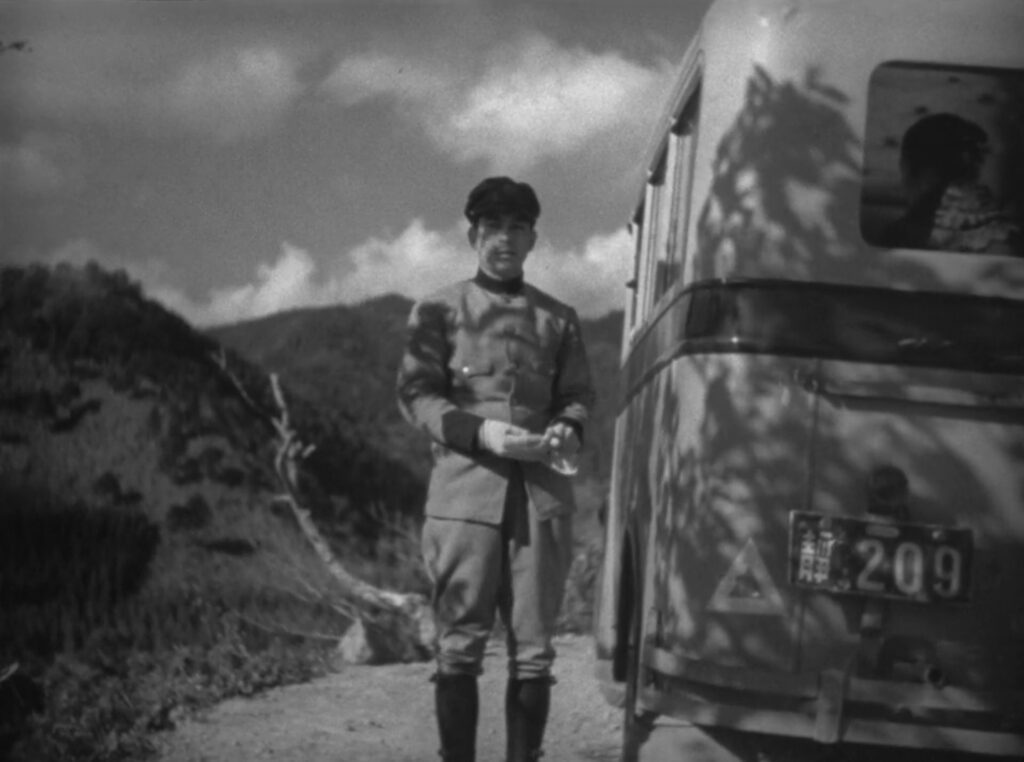
In the opening shot of Mr. Thank You a bus comes down a mountain road in the far distance. It enters a hidden bend, and then – as if miraculously – a quick dissolve brings it forward, re-emerging in the foreground about twenty seconds sooner than expected. Most viewers are so used to tricks of cinema like this dissolve that they forget to appreciate the magic in its effect. It’s a convenient way to advance the story, and why hold the shot anyway while the bus is off-screen for so long? But if we stop to appreciate the supernatural quality of the bus leaping forward like that, we can start to see what this movie is about – the miraculous nature of kindness.
The quick progress of the bus around that bend is only the first of many small miracles. The following sequence shows the bus driver, nicknamed “Mr. Thank You”, waving joyfully and thanking various pedestrians, highway workers, cart-pullers, and even chickens who move out of the bus’s path. The first pedestrians spread out or veer off to make way for the bus, but gradually the editing makes the bus seem to pass right through them, as if the driver’s words of gratitude worked magic.
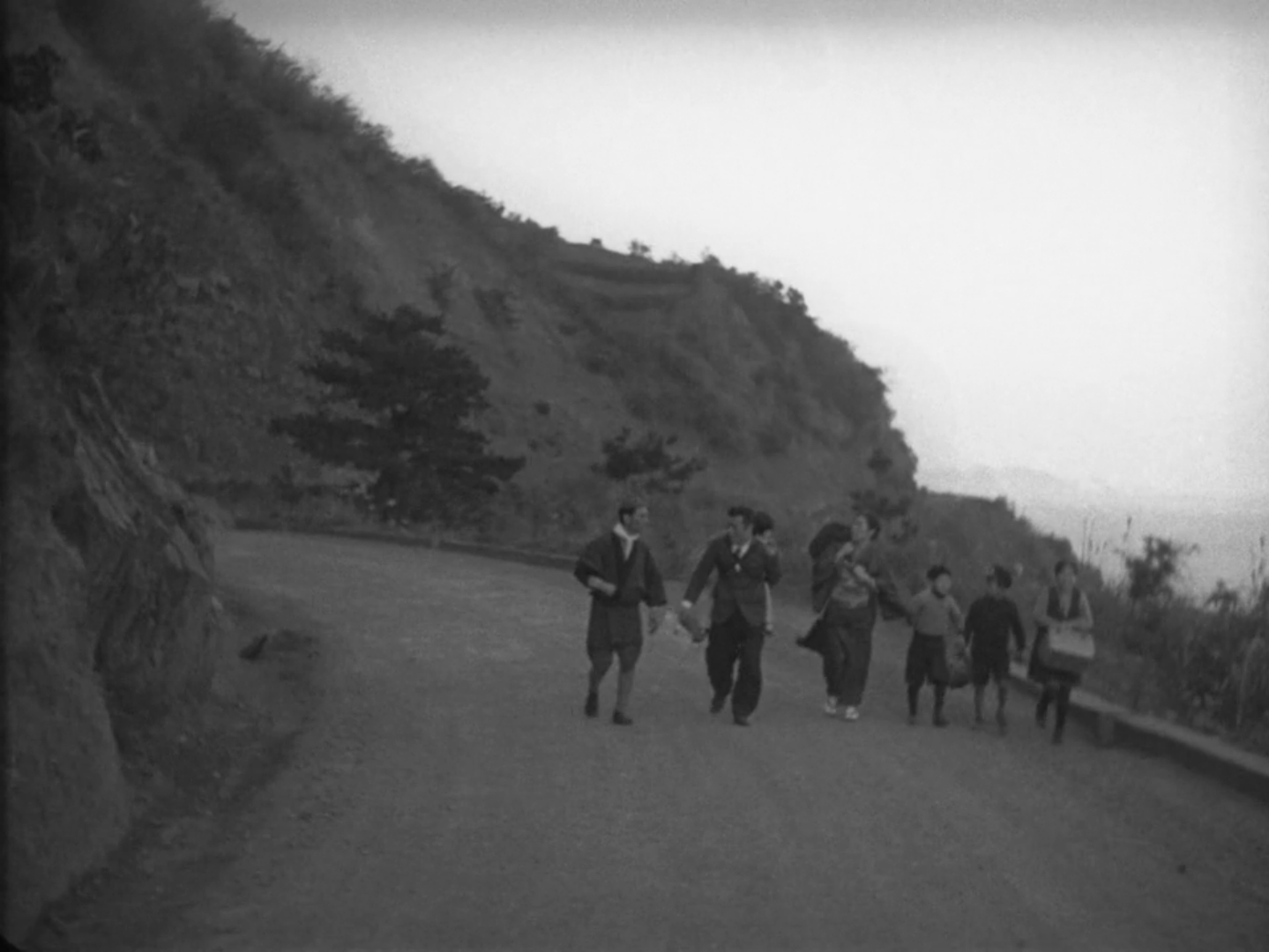
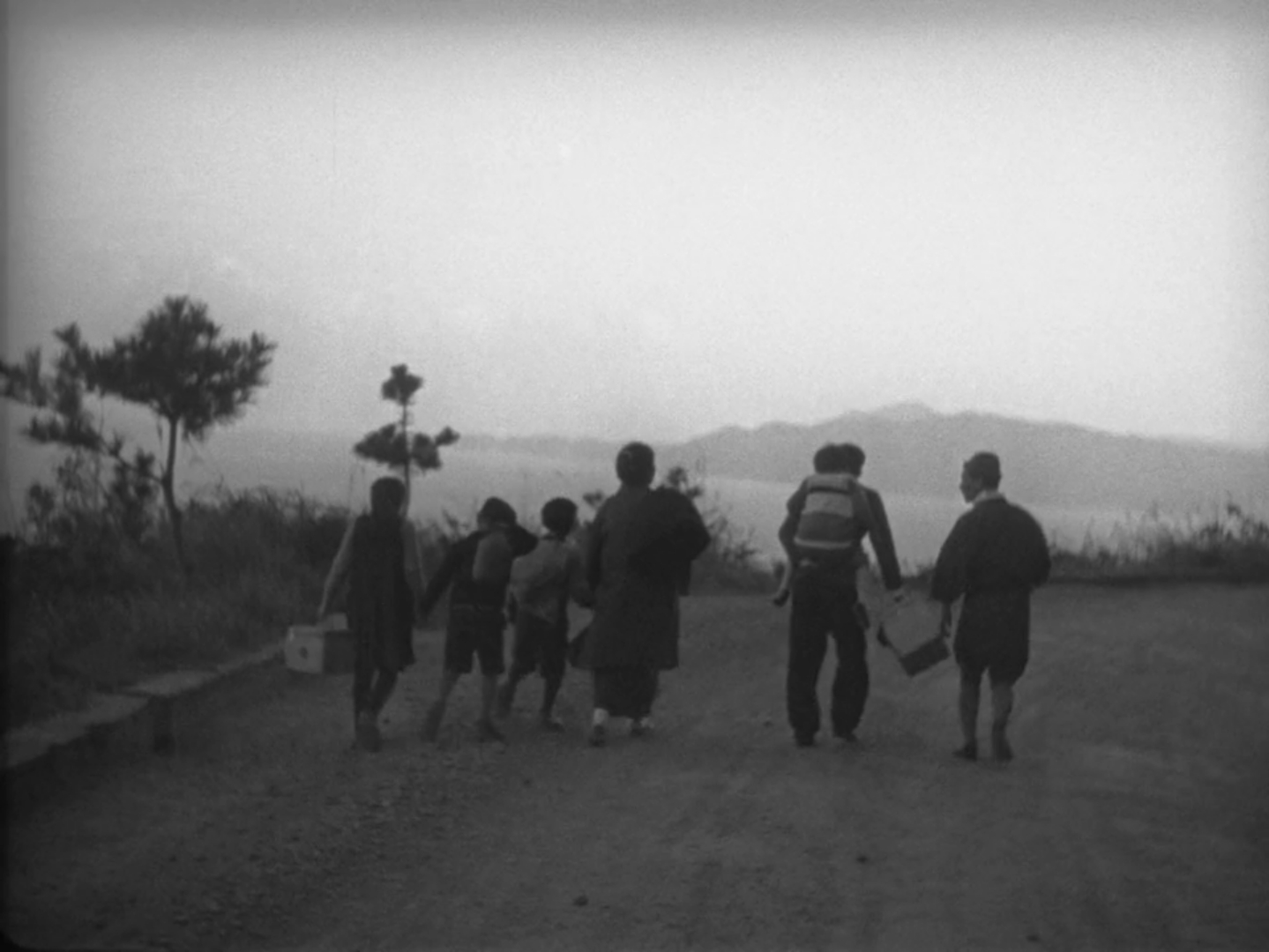
The bus driver is unfailingly kind and polite. He and his bus are an angelic presence amid the hardships of rural life in 1930s Japan. He smiles, listens to people, and never reproaches anyone. He looks warmly on the schoolboys who hitch rides on the back bumper, and he gratefully offers a free ride to a Korean woman who helped build the highway and can’t afford to ride his bus. He does favors along the way for people who aren’t even his customers. He relays a message from a father to his daughters, he agrees to buy a phonograph record for some village girls, and he promises to leave flowers and water on the Korean laborer’s father’s grave. The only thing that distracts from his driving is his sympathy for a crying 17-year-old girl who’s about to be sold into prostitution in Tokyo. In his greatest act of kindness he rescues her by sacrificing the money he’s saved up to buy his own bus.
It’s not just that Mr. Thank You is so kind; rather his kindness feels miraculous – both because of the visual and editing tricks that accompany it, and because its benefits are so much greater than the cost. At the first station, a woman wakes up an old man who missed the bus. He races after the bus, but it looks hopeless. Later we find that he’s made it aboard, and although we can imagine the ordinary circumstances that achieved this – maybe the driver stopped for him, or someone gave him a lift to catch up – its cinematic expression, the elliptical cutting that puts him safely on the back seat without any ado, suggests a kind of magic.
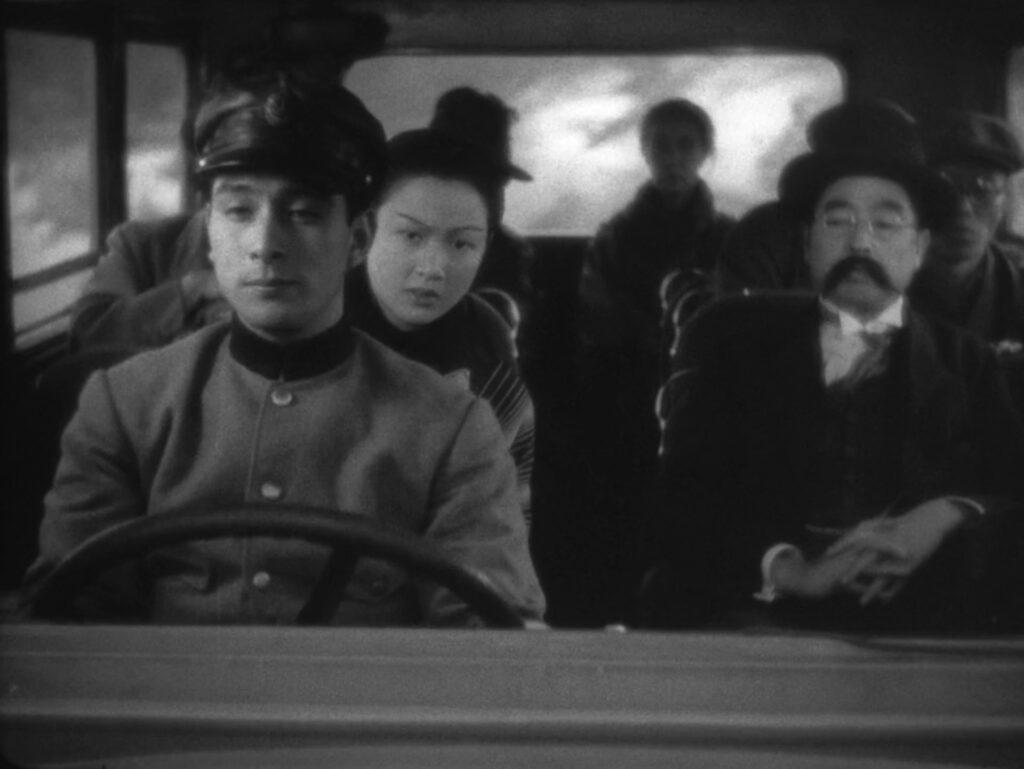
The film makes no literal claim to any supernatural powers. It’s enough to show that acts of kindness have a real power whose effects exceed rational expectations. Small efforts produce great results. The bus driver seems to understand this when he justifies his trouble in buying a hit record for the village girls. “With just one record, all the village girls can have a good time. There’s no other entertainment up here in the mountains.” He knows his small act will be magnified, providing hours of enjoyment for people to whom such pleasures mean a lot. In a similar way, a shopkeeper gives the mother and daughter a box of sweets before the bus takes off. It’s a small gesture, but down the road the mother shares the sweets with other passengers, inspiring the woman behind the driver to pass out shots of liquor, which in turn leads to singing and merriment.
The midpoint of Mr. Thank You is bracketed by two cinematic miracles, both marked by dissolves like in the opening shot. The first almost reprises the opening: at the same bend in the road, the bus leaps forward around the same curve. The angle is slightly different, and the direction is reversed, but this echo of the first shot so close to the halfway point reiterates that the bus’s strange leap forward is a clue to the movie’s logic. After a traveling shot of white trees in a mountain valley, the second miracle happens. While most of the passengers sleep, a sudden unexplained dissolve brings the poor girl all the way from the back to the front, and she looks around surprised, as though an uncanny force had pulled her toward Mr. Thank You – whose kindness will later save her from a terrible fate.
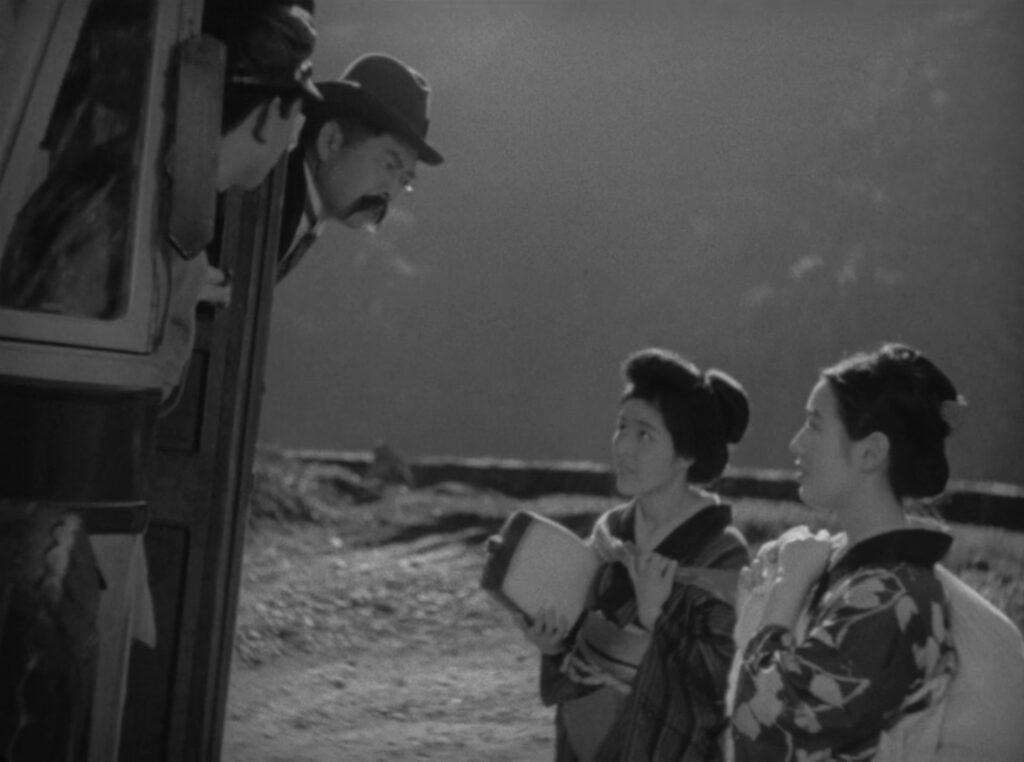
Even the climactic act of kindness, when the driver saves the girl from prostitution, is framed as a sort of miracle. Mr. Thank You tells the woman behind him that girls who cross these mountain passes to find work rarely make it back to their hometown. Later the woman repeats this, stressing the point. When we find the girl and her mother riding with Mr. Thank You the next day, we know that by the power of kindness she has defied frightful odds to return home.
In Mr. Thank You the miraculous power of kindness is reflected in its converse principle – the lack of kindness works a negative magic. When a convertible overtakes the bus, honking loudly to get ahead, the woman behind Mr. Thank You remarks that the car’s driver couldn’t be bothered to give thanks. Immediately the car gets a flat tire, and the woman shouts a sarcastic “Thank you!” as the bus passes it. Much later the car reclaims the lead, again failing to thank the bus, but later it breaks down, never to be seen again.
Besides Mr. Thank You, the unfortunate girl, and her mother, the two other lead characters are both foils to the driver’s kindness. The modern young woman behind him resembles him in many ways. She spends her life traveling from place to place, she’s sympathetic to the girl in back, and she’s kind enough to propose the sacrifice that will save the girl from prostitution. But she also has a sharp tongue, and she humiliates the salesman – mocking his moustache, shaming him for his attentions to the young girl, and refusing him a shot of liquor. She represents an average human being, admiring and encouraging kindness but not living up to the driver’s supreme charitability. The salesman, on the other hand, is a more total contrast. Totally self-absorbed, he ignores elderly passengers who would be more comfortable in his front seat; he leers at the young girl and acts like a cad; he gets impatient when the driver stops to help people; and we hear that he sells fraudulent financial products. His outsized moustache is a sign of pride, and when the modern woman points out that it’s fake he’s so sensitive that he gets off the bus and walks.
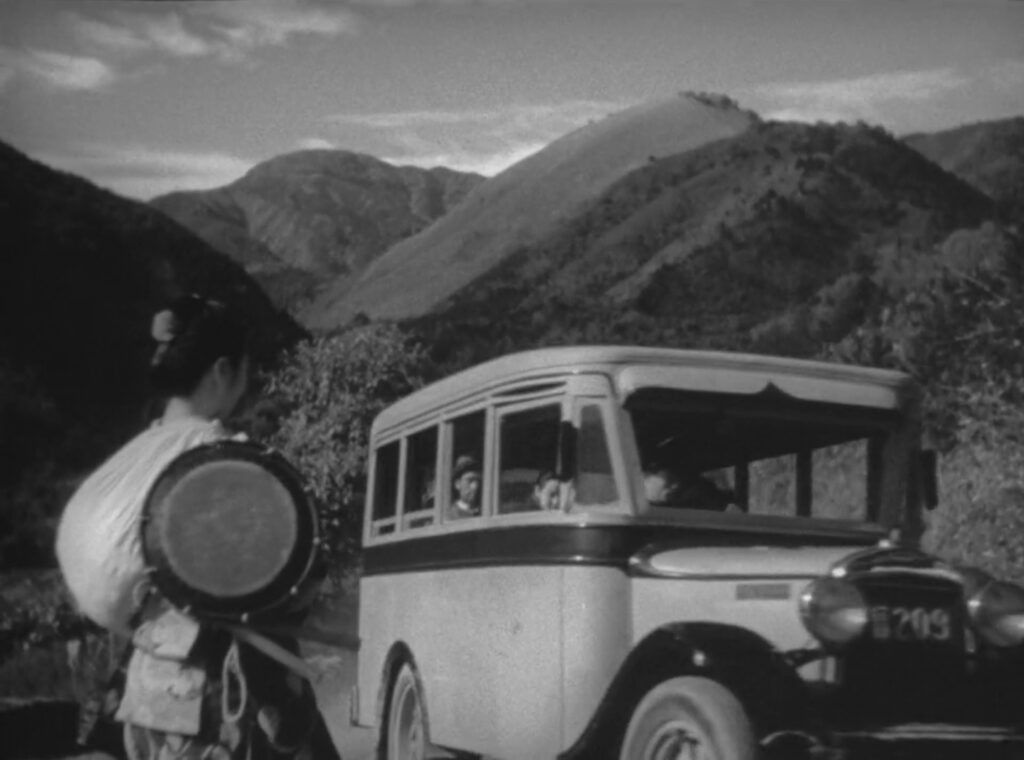
While the movie never insists that kindness will always be rewarded, or that selfishness will be punished, its presentation is modest enough that even a skeptical viewer can believe its pattern. Without necessarily understanding its method, most viewers will appreciate how kindness multiplies its benefits, because the film allows us to discover the causes and effects ourselves in a series of incidents that ring true to life.
The film is not without artifice, but it doesn’t stretch credibility. It uses doubling, not to be arty but to reinforce essential details – the vanishing and reappearing twice at the same bend, the rude motorists whose car breaks down twice, or the passenger whose giant moustache competes with the salesman’s. There are two tunnels, each marking a mountain pass, and two scenes where the young girl cries – both of these doublings set up the line (also doubled) that makes the mountain passes sound like points of no return. The two passes also impute a special power to the bus itself. The driver remarks that they “made it” over the pass, as if the journey were uncertain and made possible through the force of Mr. Thank You’s kindness.
A story about the unexpected power of kindness is always instructive, but Mr. Thank You should have been especially welcome in 1936 as the economic depression and growing militarism created a vacuum of kindness in Japan. On the return trip at the end, people on the road cheer as Mr. Thank You passes. If the movie has had any effect, its viewers should feel the same way, ready to praise and spread kindness wherever they can.
CONNECTIONS:
Ajantrik – Benevolent personification of a motor vehicle