Katzelmacher
1969, directed by Rainer Werner Fassbinder
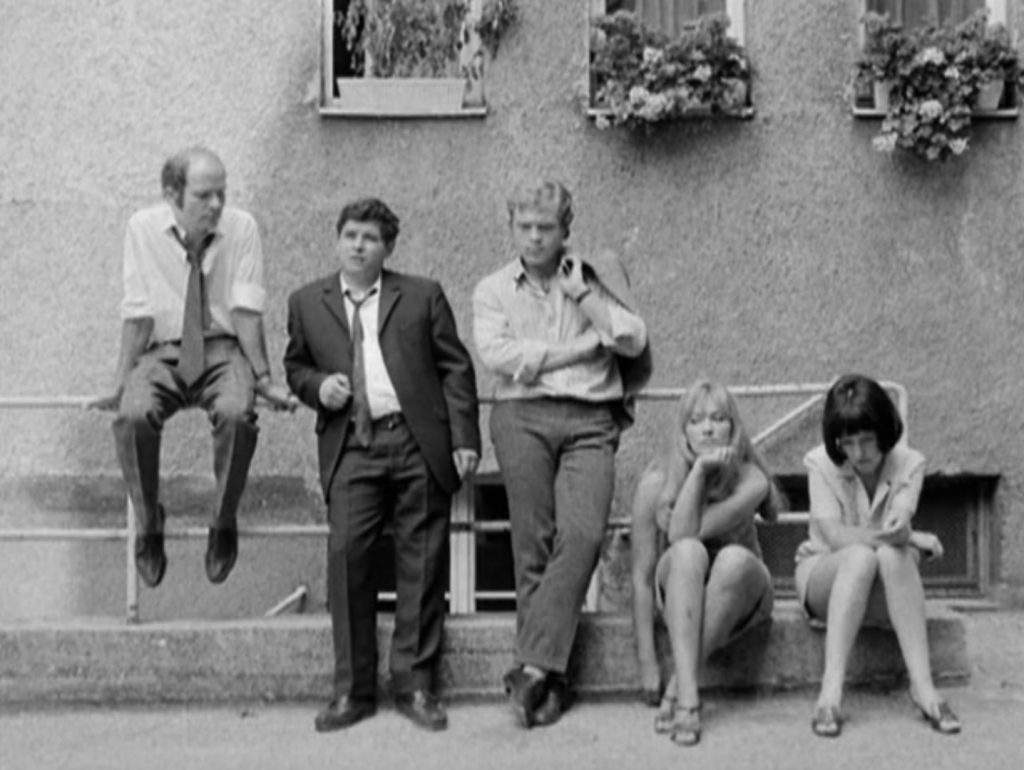
Thirty-six minutes into Katzelmacher, in one of the many loitering scenes, Paul introduces his patron Klaus to three of his friends. Klaus shakes their hands, stands by the rail for a while, then excuses himself, shaking their hands again. In the full minute that Klaus is present, nothing else of note happens, just a long dead silence. Even measured against the boredom and futility that dominate Katzelmacher, the scene looks remarkably pointless, but its point will soon become clear to viewers who are curious enough to look for it. After a wordless half-minute cutaway to Elisabeth and Peter, the film returns to the earlier set-up by the railing. Now Paul and his friends will meet another stranger, a Greek guest worker played by Rainer Werner Fassbinder, and the contrast between the two meetings will reveal the particular magic of the film’s style.
As an older, financially stable gay man taking sexual advantage of Paul, there’s every reason to imagine that Klaus would be unwelcome among the hoodlums on that Munich street, yet he stands with them for a while and leaves without much ado. The gang’s ringleader Erich asks who he is, and Paul just says “a guy”. The second meeting goes very differently – the gang is immediately hostile to Yorgos. One might conclude that xenophobia exceeds homophobia among this bunch, but that wouldn’t tell the whole story.
If Katzelmacher had been shot in a conventionally realistic style, it probably would have been as dull as the petty incidents it portrays. Many viewers will find it dull regardless, but a receptive viewer may find a latent energy in its minimalism. The more spare the settings, and the more affectless the acting, the more suggestive everything appears. At any rate, no one can fail to notice the stark frontality of the compositions. The key to Katzelmacher is to realize that the drama resides in its symmetries.
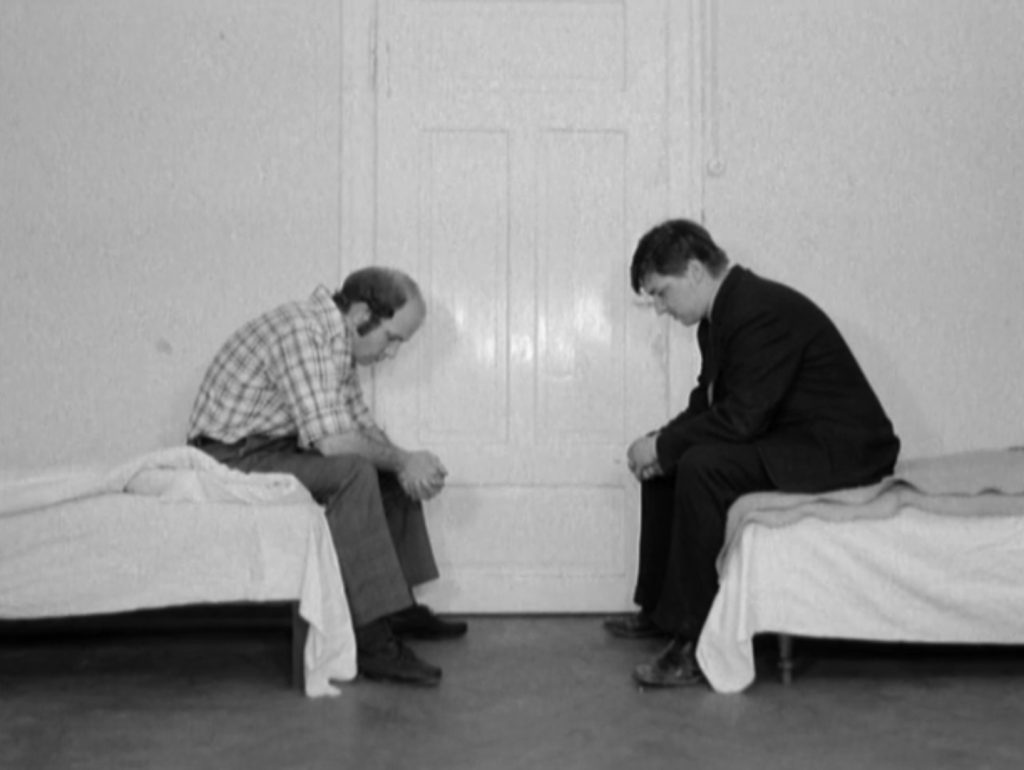
When Klaus joins the group momentarily, he completes the composition, filling a space on the right side of the screen, his dark jacket balancing Erich’s on the left. He blends in visually… but when Yorgos comes in, his back turned and his body leaning diagonally under the weight of his suitcase, blocking half of Erich’s body, he disrupts the composition. Later when Peter and Yorgos sit in opposite beds, Peter will reject the symmetry, bleating like a goat at his unwanted roommate. On the other hand, Yorgos and Marie will be paired in some of the film’s most attractive shots, reflecting the harmony between those two.
Instead of looking fussy, the scene arrangements in Katzelmacher create visual tension as the characters seek their places in a contentious social order. All the symmetry has a subliminal effect, reminding us how basic it is to fit in. In the film’s first line Marie confesses her fear of isolation: “And if it goes wrong? How lonely everything will be.” In scene after scene it’s striking how much abuse and disappointment the characters tolerate just to have some place in the order, no matter how low. We’re constantly reminded of their inequalities – discrepancies in attractiveness, financial means, intelligence, social standing, physical strength, even penis size – but instead of separating the characters, these inequalities usually bind them together.
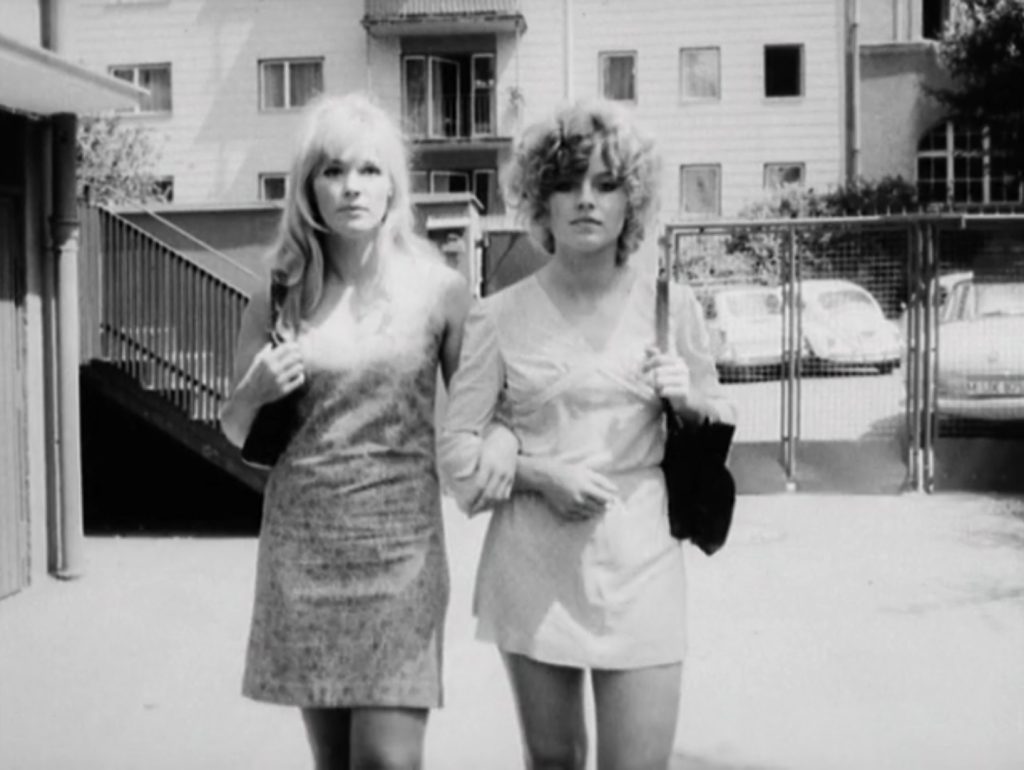
Seven times, a reverse tracking shot interrupts the action to follow two characters promenading arm-in-arm up a wide alley. These are the only camera movements and the only occasions for music, each overlaid with Franz Schubert’s German Dance for piano (Opus 33 No.7). In each tracking shot one person is noticeably subordinate, always either agreeing, remaining silent, or striving too hard to match the other. These seven shots highlight the paradox of Katzelmacher – despite all the appearances of equality and togetherness, despite the symmetry and the interlocking arms and the movement in the same direction, human relationships fall by default into hierarchies. As much as we might idealize equality, people find comfort in hierarchy because at least it gives everyone a place in society.
The resulting social order, however, is far from appealing. Katzelmacher is a portrait of desperation, loneliness, and violence. Fassbinder would go on to make a career of bringing German history into the present, but we don’t need that much context to see the Germany of the late 1920s and early ’30s persisting on the streets of modern Munich. Helga reminds Paul that Erich has been in jail, and no further parallels to Hitler are needed because it’s clear enough that the breeding ground for Nazism still exists. When the characters gather at a tavern, a panorama of old Munich hangs behind them linking past and present, but the woodcut engraving is almost incongruous amid the relentless modernity. The link to the past is plain enough that the film would rather spend its energy reminding us that the old currents of hierarchy and violence are very much in the present. An Elvis Presley poster hangs behind Helga and Paul, and the film is set almost exclusively amid the nondescript sort of architecture that was thrown up all over Germany shortly after the war.
Katzelmacher opens with an epigraph:
“It is better to make new mistakes than to perpetuate the old ones to the point of universal unconsciousness.”
The idea of history repeating itself is familiar almost to the point of cliché, but the particular point of Katzelmacher lies as much in this reference to a general unconsciousness (“…bis zur allgemeinen Bewußtlosigkeit”). It’s precisely because the characters live unthinkingly that they take comfort in hierarchy. When Paul and Erich sit in the tavern with Yorgos, cheerfully clinking beer glasses with him while plotting violence in German that he can’t understand, they mock his intellect: “He just sits there without a thought in his head.” When they first meet Yorgos, Paul speaks of his “stupid expression”, but these comments are clearly projections of their own lack of thought.
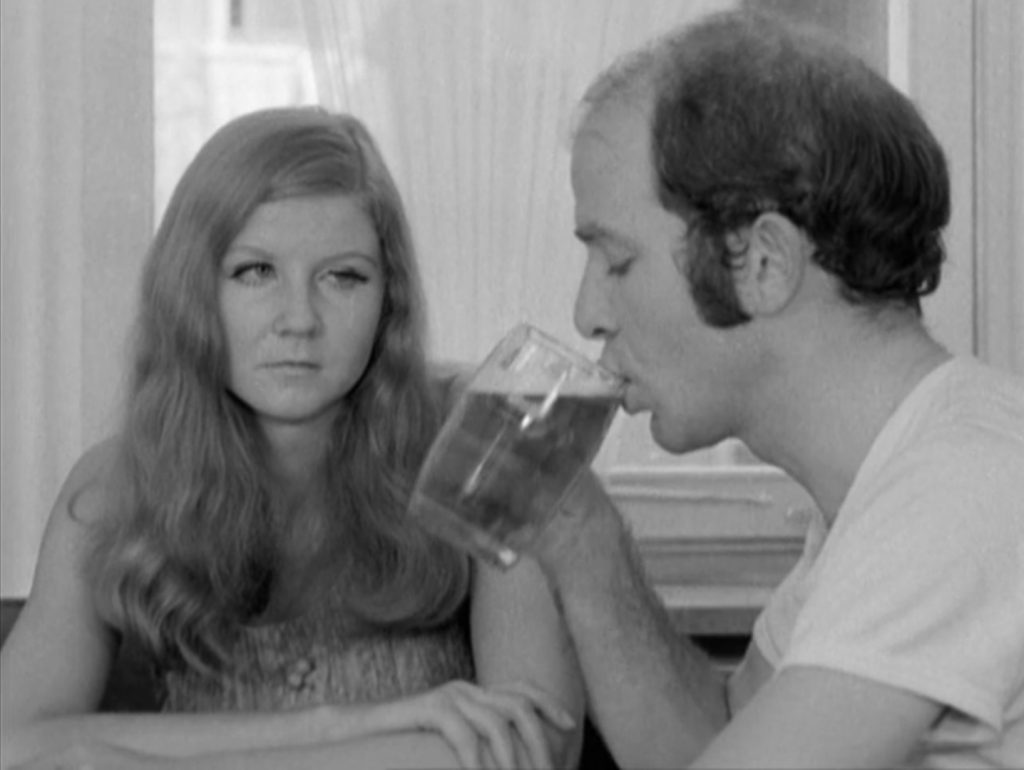
The “general unconsciousness” of Katzelmacher manifests itself largely in gossip and fantasy. Lacking any satisfactory inner life of their own, everyone takes an inordinate interest in their neighbors’ lives, and lacking any great love of life they reach for the unattainable. At the beginning they speak of some nebulous heist they’ve planned, but nothing comes of it, and they eventually talk of robbing vending machines instead. Paul and Erich talk of castrating Yorgos but end up simply beating him down on the street. The girls inflate Gunda’s awkward encounter with Yorgos into a tale of rape. Rosy aspires to be an actress, but in the absence of demand for her talent she pays an agent to promote her. Peter has an affair with a woman who claims to like balding men and dirty thoughts, evidently flattering his masculinity to lead him on. Marie is attracted to an idealized image of Yorgos, finding honesty in his expression despite his denials of his wife and children back home, and fantasizing in the film’s last line that “everything’s different in Greece.”
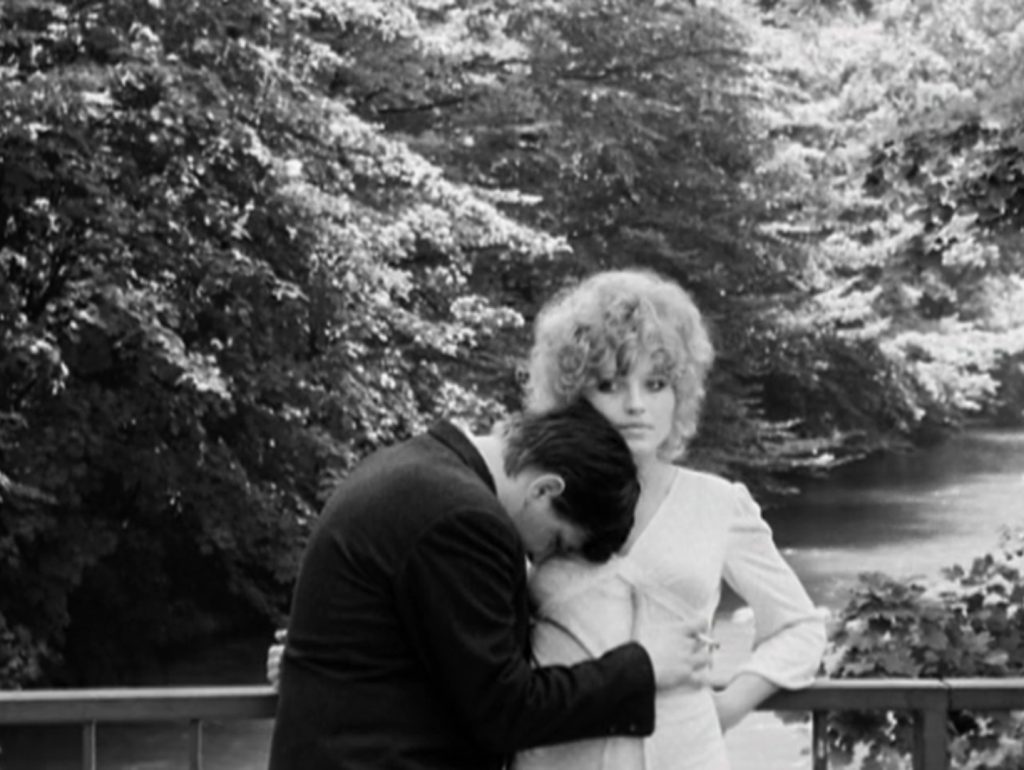
This last comment may sound hollow because it’s hard to imagine Marie finding a better life with Yorgos, but in a political sense there’s a truth to it. Greece is famously the birthplace of democracy, the antithesis to the social hierarchy that dominates Katzelmacher. Likewise, the street thugs imagine Greece as a hotbed of communism, which is also – in its ideal form – antithetical to their hierarchies. The four vignettes preceding the last shot (where Marie envisions going to Greece) are in summary a critique of the capitalist order that prevails both in the lead-up to fascism and in modern Germany. First the gang admires Elisabeth for exploiting Yorgos, and Peter admits that immigrants “increase production” while “the money stays in the country.” Next Rosy and Gunda discuss the inevitability of marriage. Elisabeth then plans to divide her apartment further to squeeze in another Gastarbeiter. Finally Erich and Paul talk about enlisting in the military as the only way out of their bleak circumstances. After Marie’s final line about Greece, Schubert’s German Dance recurs while the credits roll, bringing us back to those seven tracking shots, and reminding us of the unfortunate hierarchy that underlies even apparently harmonious relationships.
CONNECTIONS:
Vivre sa vie – Low-end restaurant with a large, elegant city panorama on its wall; brief vignettes of struggling young urban characters; unsentimental portrayal of crime and prostitution
Band of Outsiders – Characters bump each other to rotate seating positions at a restaurant table
The Bitter Tears of Petra von Kant – Relationships default to a hierarchical order
The Discreet Charm of the Bourgeoisie – Action periodically interrupted by disconnected promenades
Veronika Voss – Sins of the Third Reich persisting in modern capitalist Germany