Contempt
1963, directed by Jean-Luc Godard
The arc of Contempt can be summarized in the difference between its opening and closing shots. Both show the filming of a movie, but one ends with the camera turned on the audience, while the other looks out over the Mediterranean. One is an inward gaze and the other outward, a point reinforced by the fact that Godard’s cinematographer Raoul Coutard is present in the first but not the second. Contempt revolves around the filming of Homer’s Odyssey, but the first camera follows the producer’s assistant Francesca, who would be unlikely to appear in The Odyssey walking through the alleys of Cinecittà in modern dress. The opening is therefore self-reflexive, having no part in the fictional production, and it ends with an important quotation:
“’Cinema’, André Bazin said, ‘substitutes to our gaze a world that aligns with our desires.’ Contempt is the story of that world.”
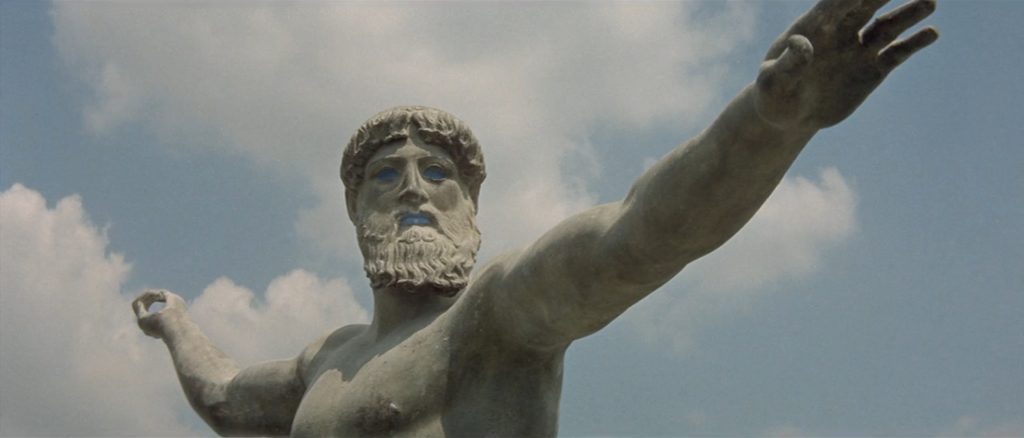
When Coutard’s camera turns directly into our eyes, it’s an aggressive gesture comparable to the awakening of Talos in Jason and the Argonauts (released in June 1963 just as Contempt began filming), when the enormous statue comes to life and turns its bronze head to glare at Hercules. The gesture here is meant to awaken our attention to our own gaze and its accompanying desire. Most people, when they come to a movie, bring a conscious or unconscious wish list. They may want spectacle, or adventure, or whichever emotion comes with the particular genre, and they’ll measure the film according to its fulfilment of those desires.
There’s an often noted irony in the genesis of Contempt. After rising to fame as a leading force in the French New Wave, Godard was approached by Italian producer Carlo Ponti to make a million dollar Technicolor film in CinemaScope, capitalizing on the rising popularity of arthouse movies. For at least two years Godard had been preoccupied with the question of how to make an honest film, and the prospect of catering to a mass audience’s desires must have been anathema to the philosophically minded filmmaker. The resulting film is anything but an indulgence. The premise might suggest epic adventure, with the bonus attractions of French idol Brigitte Bardot and Hollywood action star Jack Palance, but the plot all but ignores the Odyssey, focusing instead on the unpleasant back-and-forth of a marital spat with a tragic ending. It might be tempting to describe Contempt as a betrayal of the producers, and its title as a reflection of Godard’s feeling toward his assignment, but that would not be fair to the positive achievement that Godard makes of his unusual opportunity.
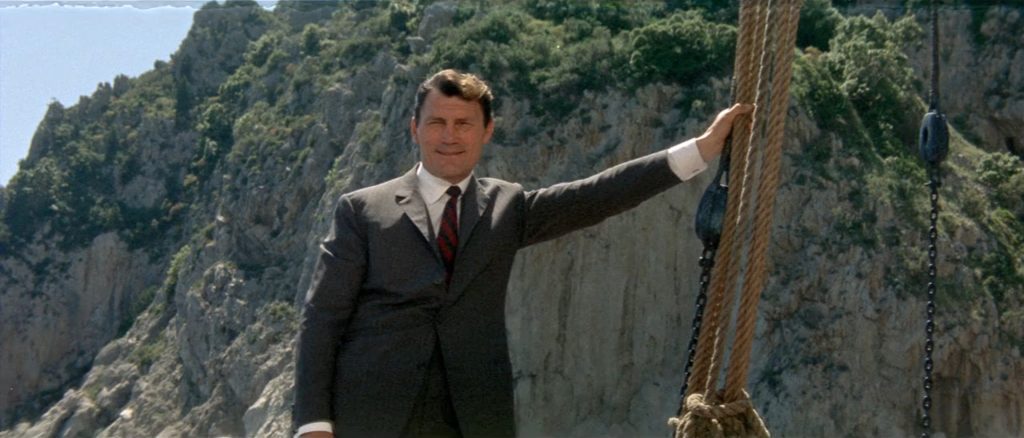
As critics at Cahiers du cinéma in the fifties, Godard and his colleagues had championed many low-end Hollywood movies that other critics didn’t take seriously, including some referenced in Contempt… so the idea of Godard as an artist with contempt for popular entertainment is off base. Jerry Prokosch may be a caricature of vulgar Hollywood producers, but the satire in Contempt is not aimed downward at the supposedly low aspirations of mass culture. The insight here is that the worst excesses of modern filmmaking happen precisely because of a wish to make art. Prokosch wants to adapt Homer’s epic poem not only for its drama and spectacle but also for its pedigree.
In Jerry’s villa, Paul tells Francesca a joke about an errant disciple of the Hindu sage Ramakrishna, who tries to impress his former master by walking across the surface of a river. “You fool,” the sage answers, “I did that ten years ago with a rupee and a rowboat!” The disciple’s magical aspirations are analogous to the mystical reverence paid to Art in our age. A movie or any creative work should be able to take its audience across the figurative river without recourse to some nebulous magic, but rather with the ordinary skill of a boatman.
A year before Contempt, Godard had criticized modern culture’s idolatry of art, quoting in Vivre sa vie Poe’s tale of a painter whose wife wasted away in proportion to the life he infused into her portrait. After Contempt, Godard returned to the modest register of a ‘B’ movie in Band of Outsiders, in which an anonymous student asks his English teacher, “How do you say ‘A big one million dollar film’?” The line pokes fun at the commercial impulse behind so much filmmaking, and it also points back to Godard’s experience making Contempt, but the bigger joke is in the assignment the teacher has just given her students, asking them to translate Shakespeare from French into English. She’s essentially asking them to rewrite high art, and the same joke is embedded in the premise of Contempt when Paul Javal is hired to rewrite The Odyssey.
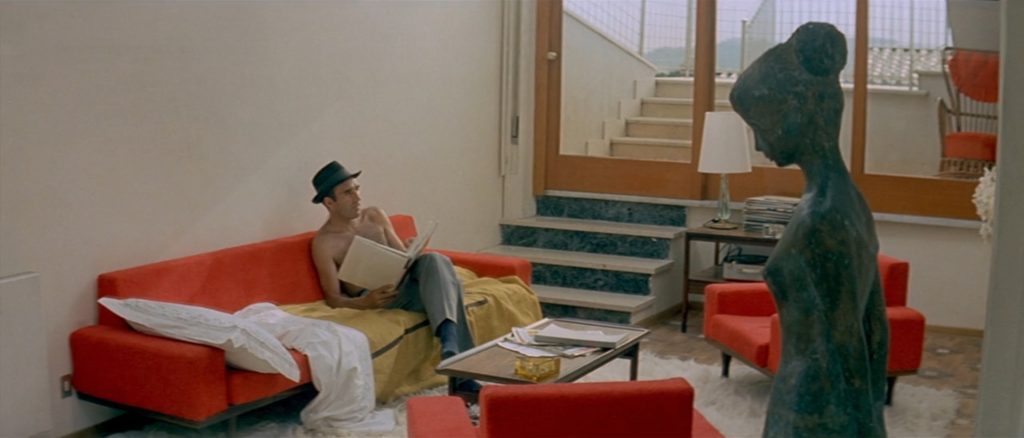
None of this however seems to account for the bulk of the drama, which centers on the decaying marriage of Camille and Paul. Twice Paul thrusts his unwilling wife into the arms of his patron Jerry Prokosch. She retaliates by kissing and ultimately riding off to Rome with the womanizing producer. She tells her husband she no longer loves him, but she won’t put her reasons into words, and he spends much of the film trying to win her back while also asserting dominance over her. Neither Paul nor Jerry is a sympathetic character, and the viewer is given few of the pleasures that typically sustain a plot. The purpose of this storyline must be puzzling, even without the mystery of what it has to do with the film’s critique of art. Luckily, the couple’s first scene goes a long way toward piecing everything together.
Right after Raoul Coutard turns and points his camera at the viewer, the film cuts to Paul and Camille in bed. She’s lying naked, face down, asking him how he likes her various body parts: her feet, ankles, knees, thighs, buttocks, breasts, shoulders, arms, and face. The scene and its nudity are more vulgar than typical for Godard, who was certainly no prude. It was added for commercial reasons at a producer’s insistence, but the director makes a virtue of the scene, which helps to define the link between the melodramatic plot and the film’s chief argument.
Camille’s chain of questions, and her husband’s admiration of each piece of her body, comes off as absurd, especially when she asks, “Which do you like better, my breasts or my nipples?” as if there could possibly be a good answer to such a question. After they’re done, she concludes, “Then you love me totally.” “Yes,” he replies, “I love you totally, tenderly, tragically.” The idea that he loves her as the sum of her parts tells us why their relationship will fail. It’s not love at all, but fetishism. He’ll spend the rest of the movie acting possessively toward her. Godard, ever appreciative of paradox, must have understood that a man can offer his wife in exchange to another man yet still desire to possess her. Camille’s receptiveness toward Paul waxes and wanes across the long confrontation in their apartment as he tries to win back her good feelings, but as they walk out she tells him “I despise you” (“Je te méprise”). The line is apparently the source of the title (Le mépris in French), but given the nature of his professed love, we could just as well say that the original contempt is in his feeling toward her.
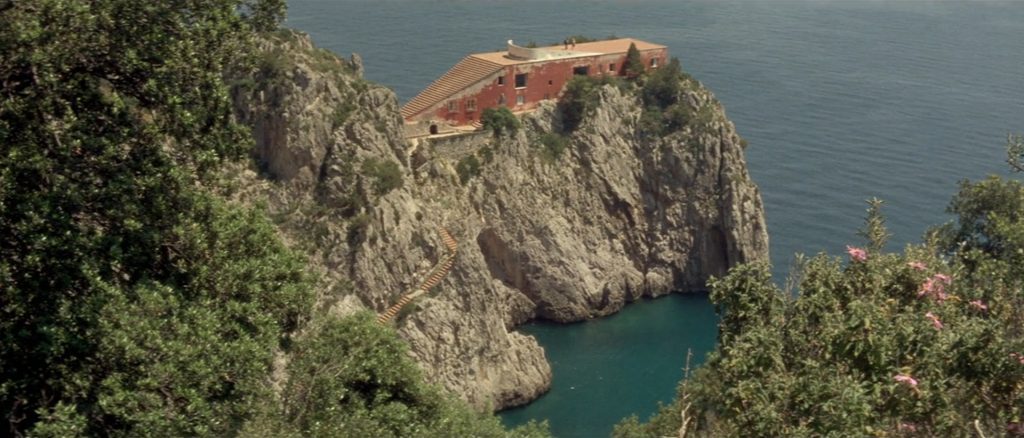
Much of the little exposure we’re given to the creative process behind the Odyssey film is the running disagreement between Fritz Lang and Prokosch about Ulysses’ motive. Jerry theorizes that the seafaring hero’s wife Penelope did not love him, and that despite his love for her he took ten years to return from the Trojan War because he was fed up with her. Lang disagrees, preferring the simplicity of the classical interpretation. This ambiguity mirrors the ambivalence in the Javals’ relationship, and Paul takes Jerry’s side in the debate, presumably because of a shared misogyny. These symmetries hint at the link that unites the film’s two great threads, but the early scene in the marital bed clarifies the link. The impulse to elevate art above life is synonymous with the fetishism that convinces Paul that Camille belongs to him like some object.
When Godard’s voice quotes Bazin, and Coutard looks down at us through his camera, the film thrusts us into “the story of that world” that “aligns with our desires.” In other words, instead of serving up what the viewer wishes for, Contempt will present the story of those wishes. In both Paul Javal’s fetishism and Jerry Prokosch’s hubristic grasping for Art, the film holds a mirror up to anyone who approaches with a pre-written wish list. The alternative approach is put into the mouth of Fritz Lang: “The world of Homer is a real world. And the poet belonged to a civilization that developed in accord, not in opposition, with nature. The beauty of The Odyssey lies precisely in this belief in reality as it is.”
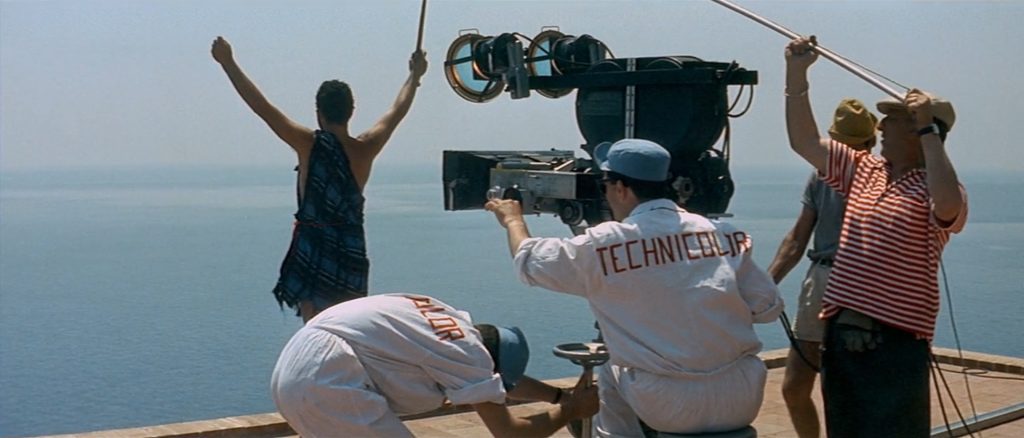
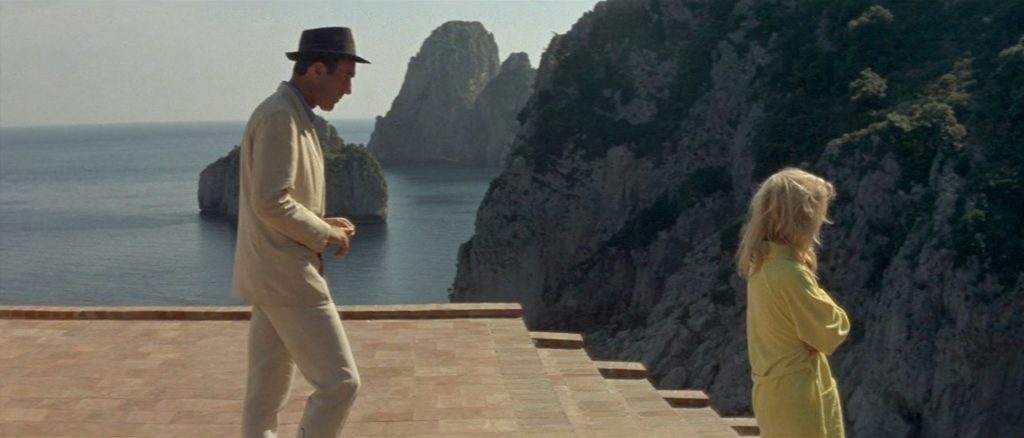
To look at reality as it presents itself, not as one wishes it to be, is the definition of wonder that underlies the cinema, for example, of Michelangelo Antonioni, which shares much in common with Contempt (Godard had wanted Monica Vitti in Bardot’s role). After the drama between Paul, Camille, and Jerry ends in tragedy, Godard’s film returns squarely to the initial subject of cinema. On the roof of the villa in Capri, Paul walks into a busy film set. Until now, Paul has played the part in the intimate tale that corresponds to Ulysses in the grander tale about making art, and the costumed actor playing Ulysses stops short at the sight of Paul – one fictional Ulysses meeting another. Fritz Lang then tells Paul he’s shooting “the first gaze of Ulysses when he sees his homeland again,” and the two incarnations of Ulysses share the same view over the sea. We too are given the same view, only now, instead of the almost terrifying shock of the giant camera turning to face us, we’re led into the view gently, at a safe distance, and it’s no longer a figurative mirror. If we’re willing to accept the film’s argument, if we leave our wishes aside and take in the full reality presented to us, then the final image of the sea – featureless as it is – should fill us with wonder.
CONNECTIONS:
Journey to Italy – Marriage strained during a visit to Italy, including Capri; allusions to Homer’s Odyssey
L’avventura – Mediterranean setting and ancient allusions inspired by Journey to Italy; argument for wonder over dramatics as the proper subject of cinema
L’eclisse – Argument that wonder consists in looking at reality as it presents itself, not as we wish it to be
Band of Outsiders – Dual satire of big-budget filmmaking and the production of art; hint of absurdity in the act of rewriting Homer or Shakespeare
Pierrot le fou – Ends on a view of the Mediterranean from an island, with an insinuation of wonder; critique of the pretension of making art
Persona – Bracketed by scenes alluding to the exhibition or production of cinema
The Baby of Mâcon – A person’s body parts are praised individually in succession shortly after the opening
Mulholland Drive – Dialogue ends with an emphatic pronunciation of “Silence”