Coach to Vienna
1966, directed by Karel Kachyňa
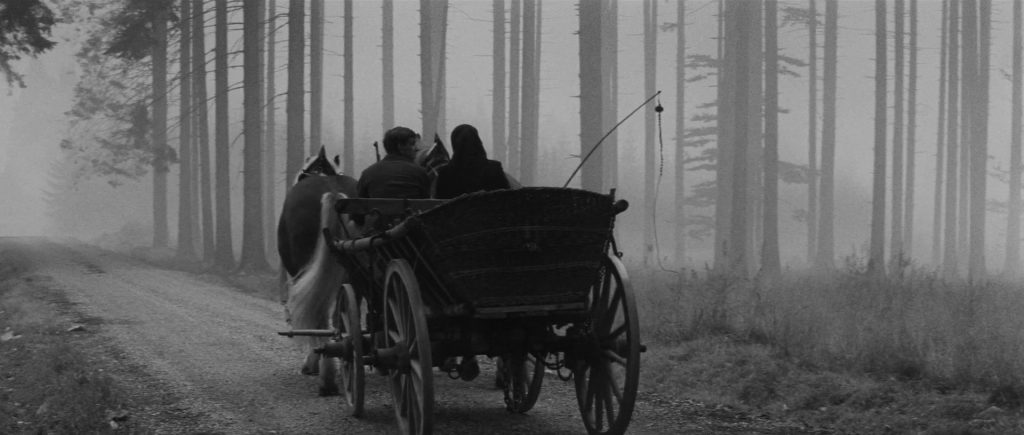
Seven and a half minutes into Coach to Vienna, an overhead shot connects the four corners of the cart behind the driver’s seat. The young Wehrmacht soldier Hans sits front portside, examining a compass in his hand. To starboard, next to his wounded comrade Günther, is a pistol. Moving back, the camera completes the square with a knife in one corner and a rifle in the other. We’ve already found the coachwoman’s axe hidden under the carriage. There would be no special reason to link these five objects apart from the importance the story places on them, plus the intentional geometry of the camera’s quadrilateral tour of the cart and the pattern in the vengeful young widow’s furtive disposal of the knife, pistol, and compass. A compass indicates four main directions, so that one may imagine the four weapons arrayed around it on perpendicular axes: two for cutting and two for shooting.
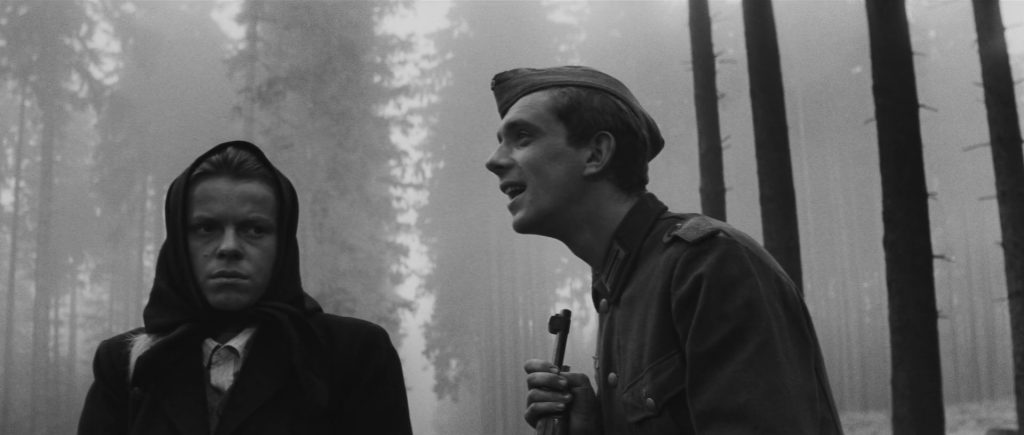
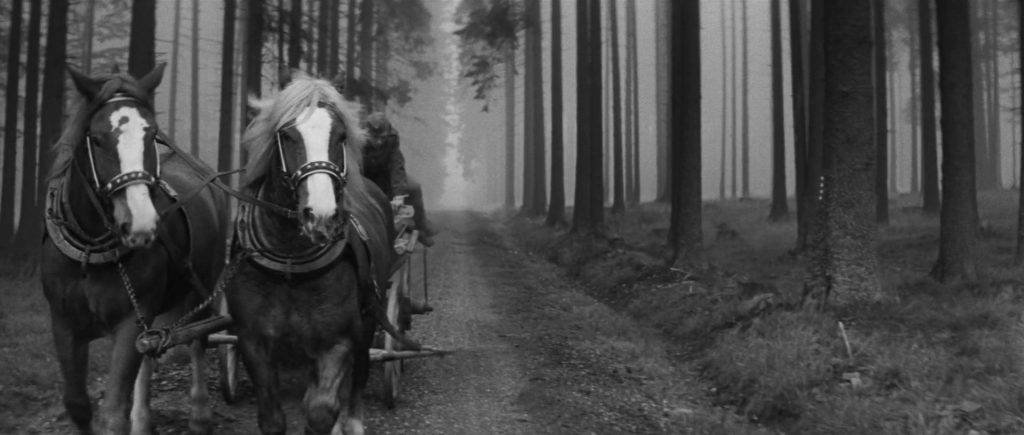
A comparable symmetry links the five travelers: the unnamed widow (called Krista in the script) at the center, with two horses, one blond and one dark-haired, reflecting the two soldiers, also blond and brunet. The Czech partisans near the end are likewise a group of five, with a sergeant at their center. It might seem fanciful to point out that a group of five with one member placed centrally forms a cross, if not for the prominent place given to other crosses in Coach to Vienna. Hans and the widow are finally joined with a cross necklace. She makes a sign of the cross when Günther orders Hans to shoot her, and there’s a roadside cross at the inflection point halfway through when she turns left to begin heading back north, away from the Austrian border.
All the outward signs of religion in Coach to Vienna are matter-of-fact enough to have passed as ordinary relics of the nation’s cultural past in communist Czechoslovakia. Only when we join overt and covert references, including all the figurative crosses, does it become evident how thoroughly religious the form of the tale is. The cinematographer Josef Illík must have taken immense care to give the forest the consistent impression of a gothic cathedral, complete with nave, columns, multiple transepts, gothic lighting effects, doors at one end, and a cross at the other. The slow journey of the horse-drawn coach is like a religious procession. Jan Novák’s score confirms the intention in all of this, with its Bach influence and especially the pipe organ which creates an ecclesiastical atmosphere from the opening shot onward.
After a few written words of backstory, the narrative begins with the widow’s prayer “for strength to carry out the act of just vengeance without hesitation.” Ironically the widow will get the outcome she prayed for in a wholly unexpected way, as if God were asserting his exclusive right to take revenge. Before the widow returns home, both Nazi soldiers will be dead, though not by her hand, and her hatred will be gone. Instead of the triumph she hoped for, she’ll be gang raped by the Czech partisans until their sergeant interrupts them to execute Hans, declaring that they’re “not Nazis” and putting the young soldier out of his misery. He plays God, but she is spared from committing that sin.
Though the widow’s initial prayer seeks retribution, her two subsequent prayers entrust matters to the deity. Twice she begins the Lord’s Prayer, each time placed roughly symmetrically thirteen or fourteen minutes from her first or final appearances on screen. Each is whispered during a moment of tension, first when she takes the pistol away and then when she approaches Hans with intent to use the axe. It’s important that she doesn’t finish the prayer on either occasion, because the point of interruption bears doubly on what happens next.
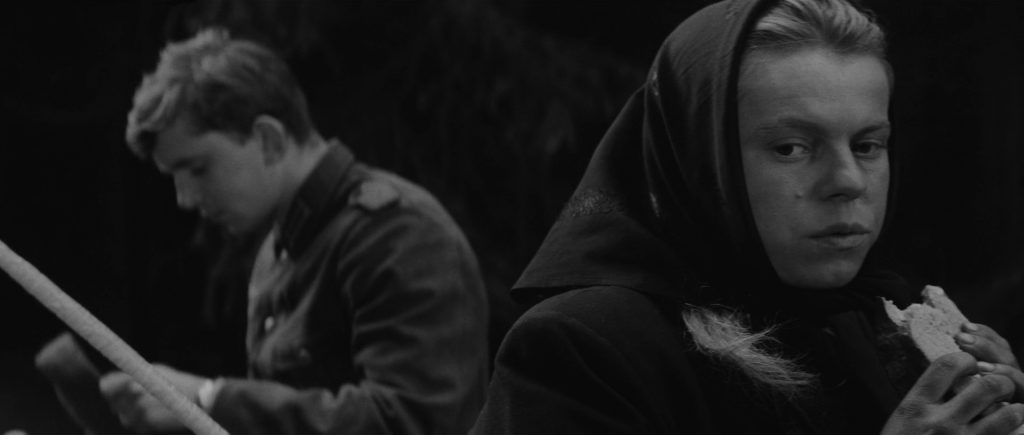
The first Lord’s Prayer is cut off after “Thy will be done, on Earth as it is in Heaven.” The widow finishes her delicate task and leaves the rest unsaid as she begins eating a sandwich. Two things are going on here. First, as if to show the unexpected extent of divine charity, her next unspoken words are answered right away. She gets her daily bread, and so does Hans. Second, and more crucially, her last spoken words are answered as divine will begins to take effect. When she offers bread to Hans, it’s the first time her heart softens, opening a long process of reconciliation that forms the heart of the story.
The reconciliation will be complete after the second Lord’s Prayer, which gets interrupted after “Forgive us our trespasses….” Again, the unspoken next clause is answered without delay after Hans wakes up and begs for his life. She takes pity on him and gives up her avenging mission. Although she proceeds to beat him, her violence is fundamentally an act of love, discharging her murderous energy in a nonlethal direction. Soon, when he puts the cross around her neck, her forgiveness will be complete. At the same time, it would seem that her own trespasses are also forgiven as she’s saved from the act that would ruin her.
With five minutes remaining, however, just when the story seems headed for a clear moral lesson, five Czech resistance fighters stumble on the newly reconciled pair sleeping together in the hay-lined cart. They assume that their female compatriot has had sexual relations with the enemy, and they proceed to rape her while forcing him to goose-step behind the coach with a leash tied to his neck. This violence spoils not only the moral clarity and any chance of a happy ending, it also spoiled the film’s chances in communist Czechoslovakia. It was bad enough to portray a Nazi soldier sympathetically, but to portray Czech partisans as anything less than heroic was heresy. The episode demands a reason, if only because of the risk it entailed for the filmmakers.
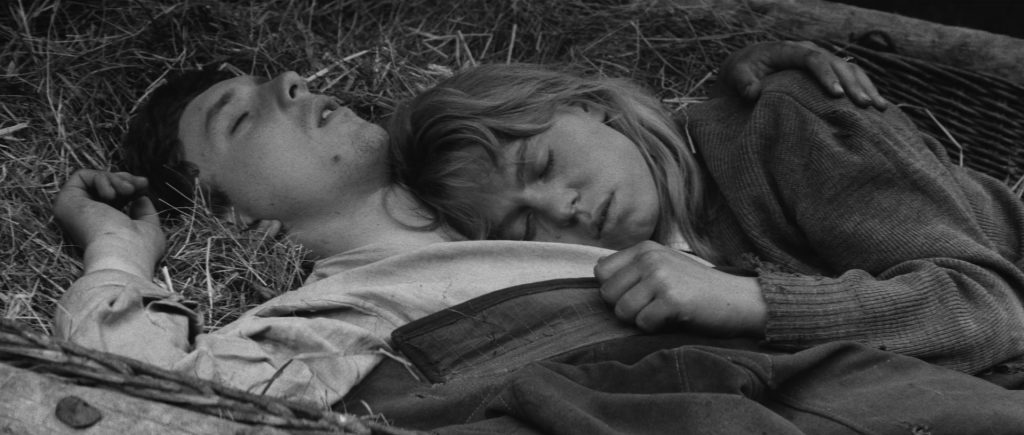
Coach to Vienna was banned a couple years after its premiere, but despite its controversial depictions it’s certainly not pro-Nazi. Hans rejoices at the bells which he takes as signals of Hitler’s death, and he had already tried to distance himself from the Reichsdeutsche in the widow’s eyes (as if being Austrian instead of German made him any less threatening). His character, in any case, is believable, and so are the crimes of the resistance fighters. The unhappy turn at the end may come across as a gesture of honesty – not only is it possible to find goodness among the enemy, but the side fighting for justice is not immune to disgraceful behavior. One could read a subversive political comment into this, a suggested parallel between the shameful partisans and the Czechs who would inflict a second wave of tyranny on their people under Soviet auspices, but Karel Kachyňa was on friendly terms with Czechoslovak president Antonín Novotný, so the political offense may not have been intended.
It would be strange, though, for a film with so much careful artifice to take such a sharp turn toward realism at the end. We must still account for the religious form of the picture, which is not merely symbolic but extends to the whole feeling of Coach to Vienna. When the widow comes full circle and passes back through the gate at the end, it’s as if she’s been inside a church through the whole film. Her rape and Hans’ torture, though, have spoiled any possibility of reading the film as a sacramental experience, or even as a mass. It’s too hard to twist the ending into anything uplifting. Still, one possibility remains open. Taking cues from the introductory text and the two Our Fathers, we can read the film as a prayer.
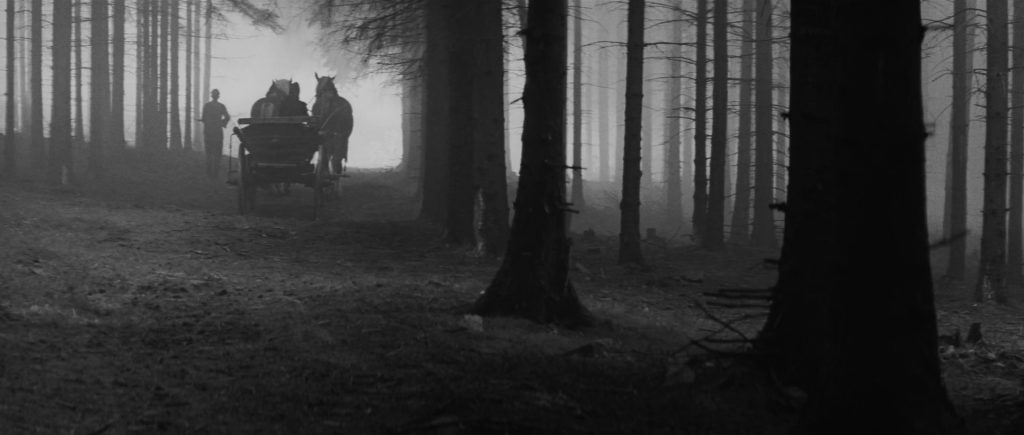
Since the unfinished portions of the Lord’s Prayer have weighed so heavily thus far, it would make sense to connect the last unspoken line to the film’s summation: “And lead us not into temptation, but deliver us from evil.” The first clause here is the answer to the widow’s initial prayer for strength to carry out her vengeance. In the end she’s saved from the temptation to take justice into her own hands, which would have meant unnecessarily killing a dying man and also killing a young conscript with much of his innocence intact. The role of the second clause is not as obvious. She’s made it back alive with her horse and carriage, and she’s surely learned enough of human affairs to shed any naivety or simplistic moral outlook that would divide her surroundings into easy categories of good and evil. Nevertheless she likely carries a heavy trauma from her experience, and to speak of her delivery from evil at the end must sound perfunctory at best. The prayer, rather, is for the viewer, who has been immersed in the semblance of a sacred space for over an hour, and who should have absorbed something from the widow’s journey – both an appreciation of forgiveness and a readiness to confront the world as it actually is and make the best of it.
CONNECTIONS:
Diamonds of the Night – Czechoslovak New Wave film focused on two characters in a forest during World War II
Persona – Two main characters, one talkative and one mostly silent, who veer between extremes of animosity and affection
Stalker – Camera strays from the characters to reveal a handgun abandoned in the wild