
Alien
1979, directed by Ridley Scott
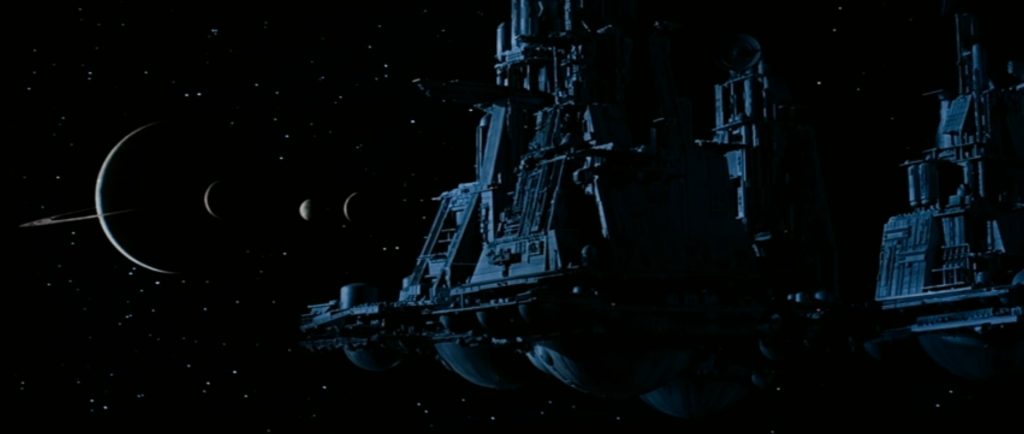
In the third shot of Alien, the underbelly of the cargo ship Nostromo slices through deep space. Coming right after a text on a starry background, the angle is likely to trigger recollections of Star Wars, whose action also began with the transit of a giant spaceship overhead. The likeness here makes the contrast in the following shots all the greater. Instead of the bustling corridors of the Imperial Star Destroyer, the Nostromo feels palpably lifeless as the camera explores inside. Eventually a cabinet-like robot jerks forward; some pages rustle in the airflow; a couple of drinking bird toys rock in perpetual motion; and a computer monitor turns on unassisted. Finally a rotunda lights up, and the lids of seven beds rise like a blossoming flower. The astronauts have awakened from a long hibernation.
All this quiet drama creates a picture of coming-to-life. Alien is built around three iconic pictures of life: the awakening at the beginning, a birth in the middle, and Ripley’s arm at the end cradling a cat in a maternal embrace. The film’s argument is summed up in those three images, each offering a progressively more complete definition of life.
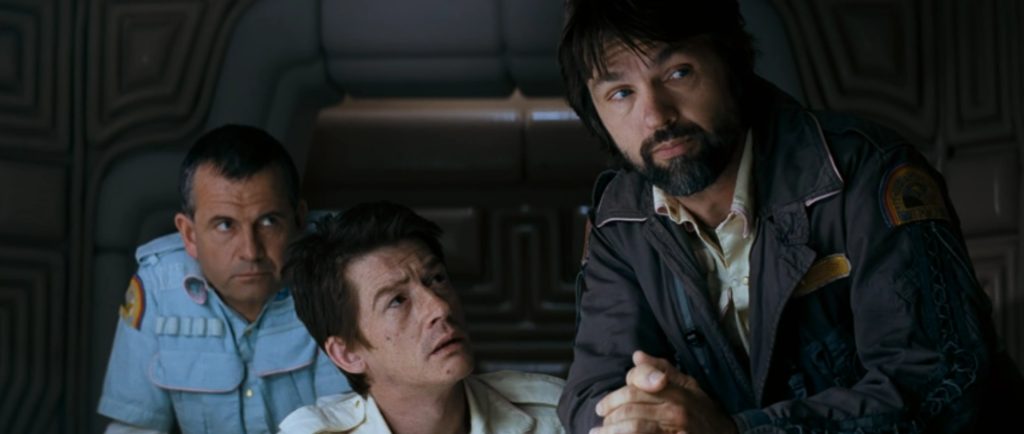
The opening sequence defines life in the most basic terms, as a kind of animation in contrast to the surrounding inertness, but we can already sense that this definition isn’t enough. The robot, toy birds, and computer are not alive, and even the astronauts are stuck in a sort of living death. At breakfast Brett says “I feel dead,” and Parker ribs him: “Anybody ever tell you you look dead?” The crew are expendable pieces in a capitalist enterprise, and their motives are strictly mercenary. One of them isn’t alive at all, as we’ll find out. There’s a modest cinematic glory in the crew’s awakening, but it’s echoed more darkly later on when the alien larva stirs and its egg opens up like a flower. The alien moves energetically, but whatever life it possesses is hardly the life that most people would think of treasuring.
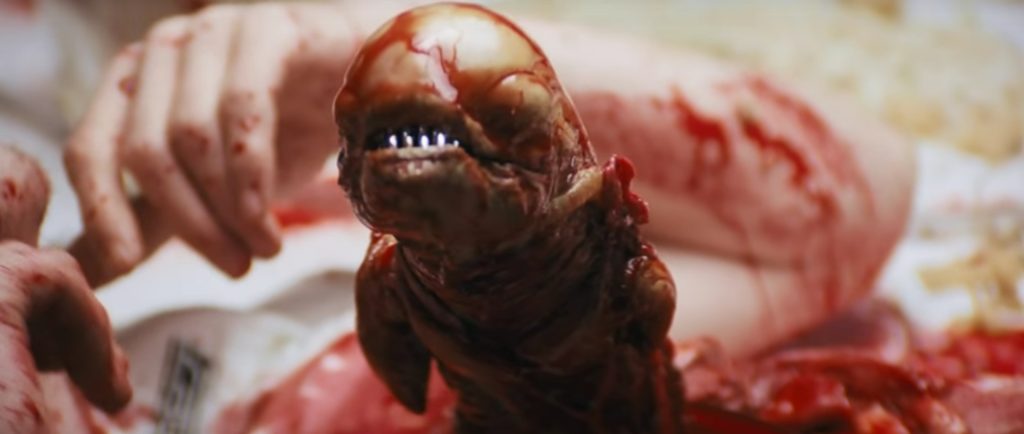
The birth of the alien from Kane’s chest occurs close to the film’s midpoint (within 30 seconds, in the director’s cut), and it’s often cited as the most memorable scene. It defines life more precisely, not merely as autonomous movement but as part of an organic continuum. The newly hatched creature emerges from its host, presumably descended from the now-fossilized organism that had attacked the ancient pilot… but again this definition of life feels inadequate. It’s too literal, and the birth process makes a mockery of sexual reproduction. What happens to Kane is about as close to a forced pregnancy as a man could conceivably experience.
Only at the end, when Ripley embraces the cat in her bosom for the last stretch of the voyage, is the picture of life satisfactory. She and Jones may share no traceable relation, but the bond between them gives life its essence. Real life, in other words, requires sympathetic connection with other living beings. An “alien” is something that doesn’t belong, something that isn’t related, and the alien here shows no ability to form a loving bond with another creature. It lives as a monad, using other creatures solely as props to its own existence. From that point of view, Ash is scarcely different, a psychopathic robot who admires the alien’s purity “unclouded by conscience, remorse, or delusions of morality.” His sarcastic smile reveals the real intent in his final expression of sympathy for the crew.
Just as the alien makes a mockery of sexual reproduction, the ship’s computer makes a mockery of parenthood. It’s disconcerting to hear the human crew call their electronic guidance system “Mother”, and when Ripley takes command she discovers that the computer has zero interest in the crew’s welfare. There’s nothing genuinely motherly about it. By the same token, Ripley’s line after blowing up the Nostromo, “I got you, you son of a bitch,” is not a casual choice of words. “Son of a bitch” is said five times, directed once at Ash and three times at the alien, and Ripley calls Mother a “bitch” when she’s unable to cancel the detonation. “Bitch” implies a perversion of life’s functions, a performance of motherhood or womanhood devoid of the nurturing qualities commonly associated with those roles.
The ship’s name Nostromo is derived from the Italian nostr’uomo (literally “our man” but colloquially “shipmate”), making it a masculine counterpart to the feminine Mother that runs it, each name an equally inadequate instance of the bond it expresses. The computer is no real mother to the crew, and the ship is no real mate. The shuttle is named Narcissus, from a Joseph Conrad title like the Nostromo, its mythological origin fitting the story about an autosexual creature with no external love objects.
The imagery of Alien points in various ways to life and to sexuality, almost always with a whiff of perversion or a sense that it doesn’t measure up to the potential of lives connected by vital social bonds. The interior of the crescent-shaped alien ship was inspired by an ossuary or abbatoir, and the various phases of alien life are full of vaginal and phallic forms. The alien’s inner mouth emerges from a larger one like a simulated act of birth. Ash attempts to kill Ripley by penetrating her mouth with a rolled-up magazine in a room lined with pornography. The film is not body horror, but it has its share of revolting imagery, and the disgust it arouses is directed not at life itself but at the denigration of life.
The alien has no discernible sex, but it mimics the behavior of a rapist when it “impregnates” Kane, when it wraps its tail around Lambert’s legs, and when it comes after Ripley while she’s undressing. For this reason, and because its women prove more resilient (and in Ripley’s case, tougher) than its men, Alien is sometimes credited as a feminist film. It is also economically progressive, implicitly critiquing the exploitations of a powerful company that devalues its workers, especially the blue-collar ship mechanics Parker and Brett. In any case, both of these progressive subtexts fit under the more fundamental argument for empathy as an essential component of life. Rape and exploitation are anathema to life because they betray and undermine the communal bonds that life demands. The same goes for racism and for the devaluation of animal life, each of which Alien acknowledges. It’s not happenstance that the first four crew members killed or captured are white men (the android Ash being the fourth).
Although Alien is only Ridley Scott’s second feature, it’s remarkable how consistent its values are with his subsequent films spanning four decades, particularly on three points: the preciousness of life, the humane isolation of antisocial threats, and the necessity of communal effort.
Despite all its gore and violence, Alien is foremost a celebration of life, and its tension is driven by the crew’s will to live, a will also expressed strongly by the replicants in Blade Runner who are so desperate to extend their brief lifespans. The closest mirror to Alien in Scott’s filmography is probably The Martian, another story of astronauts coming home that strongly emphasizes the values of life and togetherness. In keeping with these values, Scott’s films typically address the problem of antisocial behavior in the most humane possible way, the clearest example being the story told in The Martian of the unruly Caltech students who were given their own lab in the desert instead of being expelled. Although there are acts of violent self-defense in Alien, the eponymous creature is not visibly destroyed but isolated in empty space, just as Ridley Scott films like Hannibal or The Counselor recommend the isolation of psychopaths. The alien may appear to be anathema to life, but no one is called on to play God and decide what it deserves. Its destiny simply matches its nature, which is to be alone.
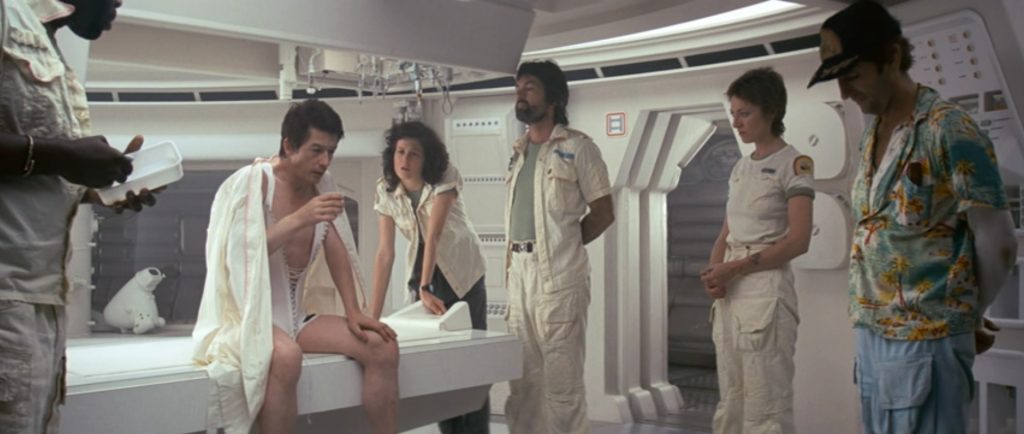
If the ideal mode of life is to be connected harmoniously with other creatures, then the activities of life are also optimized when shared. Like The Martian, which begins with the important line “All right, team, stay in sight of each other,” Alien also exhorts communal action from its characters. They wake up together, eat together, explore the alien moon as a team, and care for Kane after he’s attacked. When they split up to search for the alien, Dallas admonishes them, “I want you to communicate. Keep in touch at all times,” and when the search resumes without him, Ripley echoes the thought: “We have to stick together.”
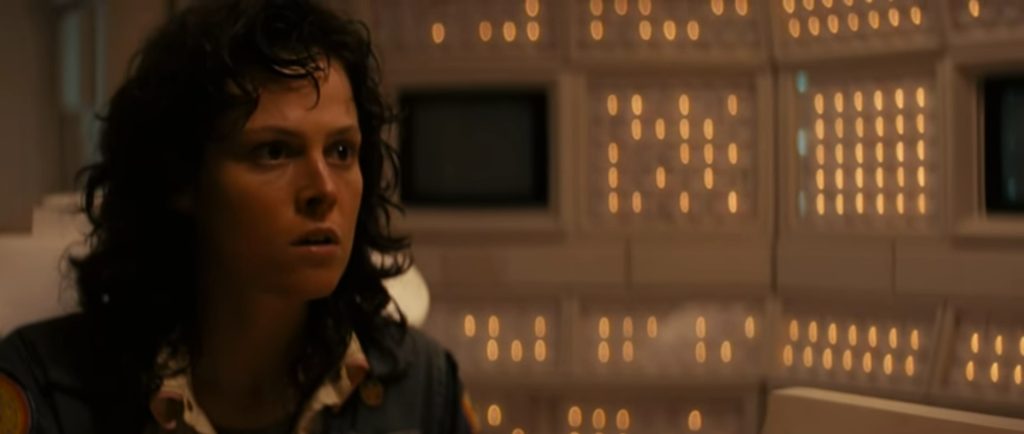
The Nostromo is no utopia, but its six human members get along well together, and their society is egalitarian enough to model some of the social connectedness that defines life in this film. There is a clear hierarchy, but it’s imposed by the company, and its order is somewhat fluid. Apparently when Captain Dallas is off the ship, Ripley outranks him. At one point Dallas says, “I just run the ship,” deprecating the importance of his authority. No human or animal character is made too endearing or dislikable, and no one plays the hero, although Dallas warns Parker against doing so. Ripley only emerges as the protagonist toward the end. The greatest sign of connectedness however is the invisible link between the crew and the people back home. Ripley speculates, presumably with good reason, that the company they work for wants the alien for its weapons division – a critique of unchecked capitalism that resonates in today’s world. With only one human and one feline survivor, the failures in Alien may seem to outweigh the success, but the fight has been for more than the survival of the crew. By ejecting the alien, they have at least delayed the introduction of a terrible weapon to Earth.
CONNECTIONS:
Nosferatu: A Symphony of Horror – A man picks up a monster while travelling on business, and a woman defeats it; important role for cat(s) at the beginning or end
The Martian – Story of astronauts returning home, with a greater subtext about the value of life and connectedness