Diamonds of the Night
1964, directed by Jan Němec
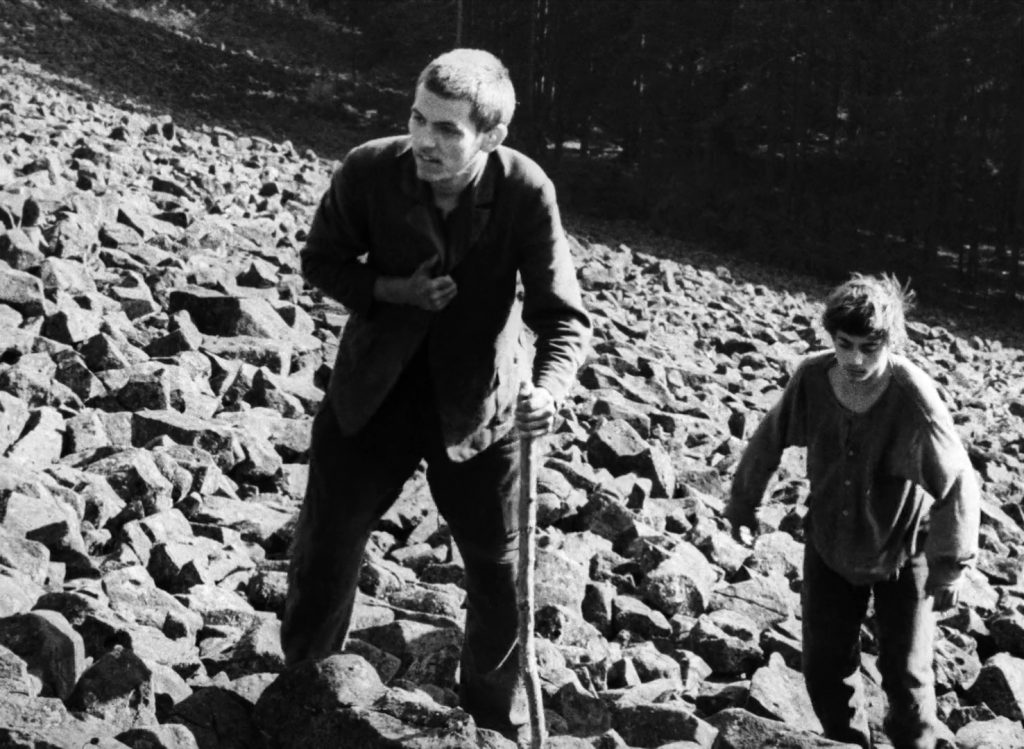
In a film as ambiguous as Diamonds of the Night, the chief question is what, at the very least, one may hold onto. Most viewers will seek satisfaction in the plot and will come up short. Neither a tragic nor a hopeful reading fits the ending comfortably. First, after two offscreen gunshots, the two boys lie dead on the ground; then they’re alive again, walking through a firing squad and continuing into the woods. Previous montages, like the boys thinking of camouflaging themselves with branches or contemplating the assault of a woman in a farmhouse, have taught us to trust the last shot in a contradictory sequence, so the pattern supports the hopeful ending… but the boys’ release back into the forest still feels unconvincing. Would the militia really just let them go, especially after the commander’s order to “fire” and after having hunted them mercilessly?
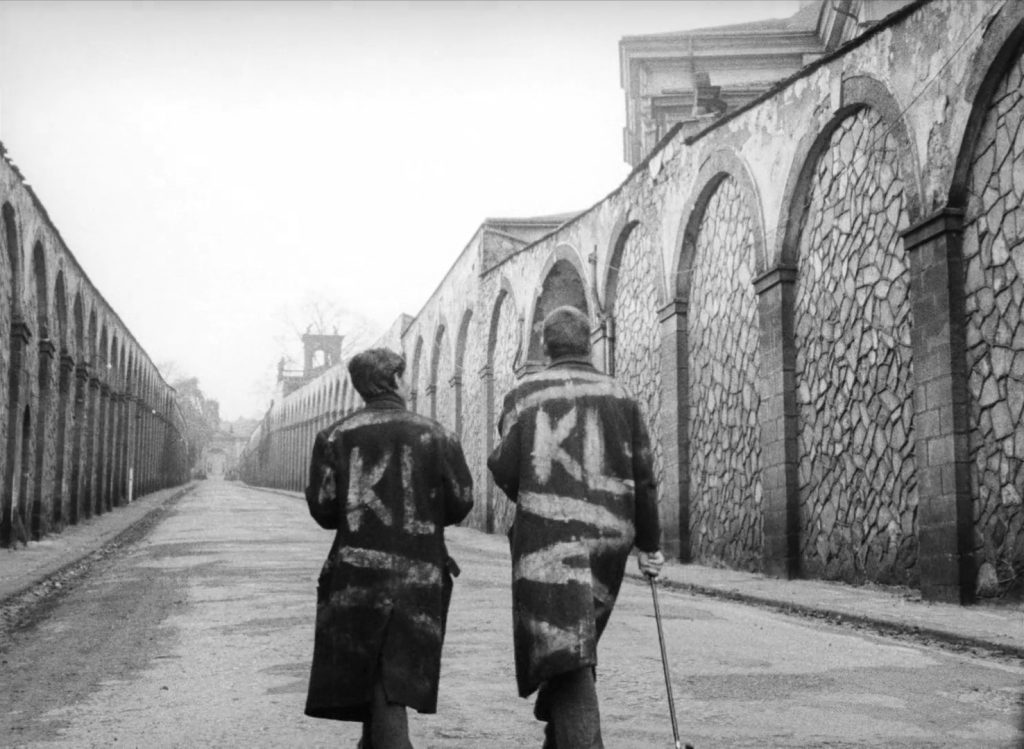
If nothing else, we can believe the premise of two boys escaping from a train carrying them to a concentration camp. The film is based on a short story by Arnošt Lustig, adapted from his own escape during a transfer to Dachau. The unbroken two-minute opening shot gives the escape some of the integrity of reality, but almost as soon as editing enters the film, it destabilizes the story. The boys’ journey is interrupted by cutaways to Prague, to a cemetery, and to a camp transport, but it’s hard to say whether we’re seeing memories, fantasies, fears, or hallucinations. Certainly no one would wear a KL (Konzentrationslager) uniform on an urban tram, so it’s safe to say that the imagined or remembered flashes should not necessarily be taken literally.
All the stability that’s missing from the story can be found, however, in the film’s structure, which at least allows us to say a few things with confidence. In its basic form Diamonds of the Night consists of two flights through the woods, broken in the middle by a nine-minute interlude at a farm. The two long stretches differ from each other, the first focusing on the ordeal of hiding in the forest, the second showing the boys taken into custody, but the two halves are linked by symmetries too uncanny to be accidental.
In each half, the boys flee uphill from men targeting them with rifles – either guards on a train or an elderly militia – the echoing cracks of gunfire mixed with cries of “Halt!” Each escape is punctuated by a similar series of “thought balloons” representing the inner life of the second (darker-haired) boy: catching a tram by the Powder Gate in Prague; clambering through tram cars in a field; women and cats looking down from windows; a deserted street; a mattress and pillow stuck in a window; a woman adjusting her clothes in a doorway… all these are repeated in the second half, almost in the same order. A fantasy of the two boys walking in shiny black shoes is echoed in the second half by a close-up of two old men’s legs dancing in black shoes. The initial escape from the train is reprised twice in the second half, once in flashback and once, evocatively, when the second boy hops off a tram down a grassy embankment then runs to a cemetery.
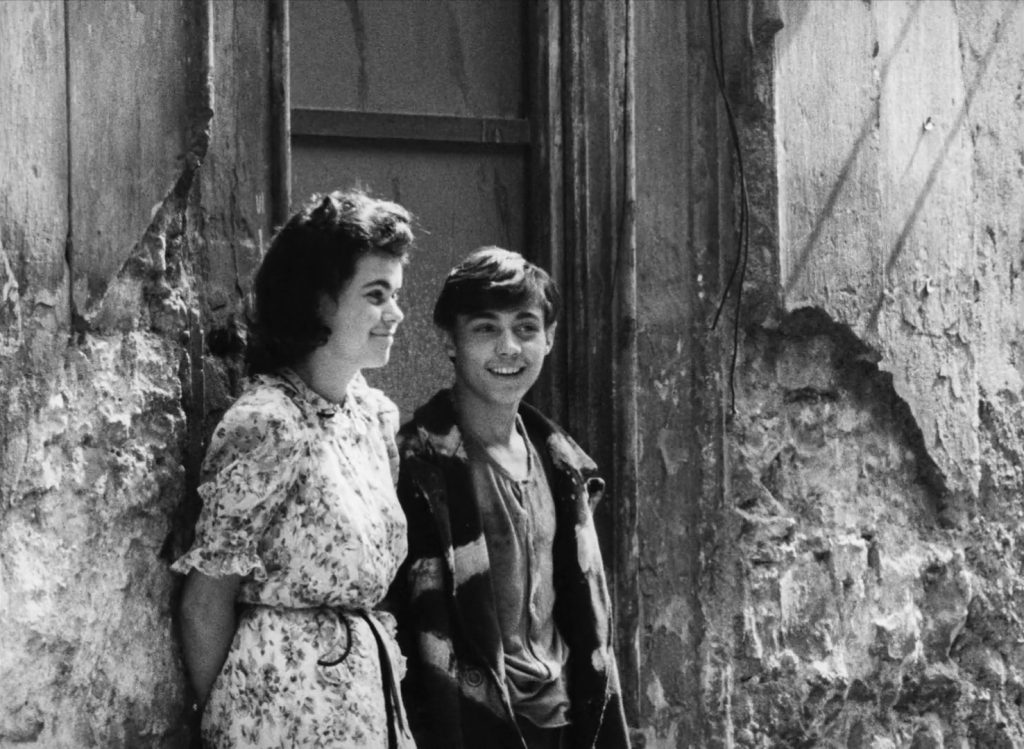
As different as the two halves may be, all these parallels give the second half a familiar feeling, so that the film resembles a twice-told tale. In the context of the Holocaust, Diamonds of the Night evokes the mix of feelings that must have accompanied the terror and uncertainty its victims went through. By focusing on an escape, without bringing it to a conclusion, it captures the two boys’ experience in media res without the retrospective sentiment that the finality of a concentration camp would impose. The inserted mental flashes represent glimmers of hope – normal life with a pretty girl, a return home – that would have been felt even in a camp, but whose possibility was more vivid during an escape. The twice-told tale balances those moments of hope with a general sense of cyclical time. In a hostile world, the same troubles repeat themselves in new forms.
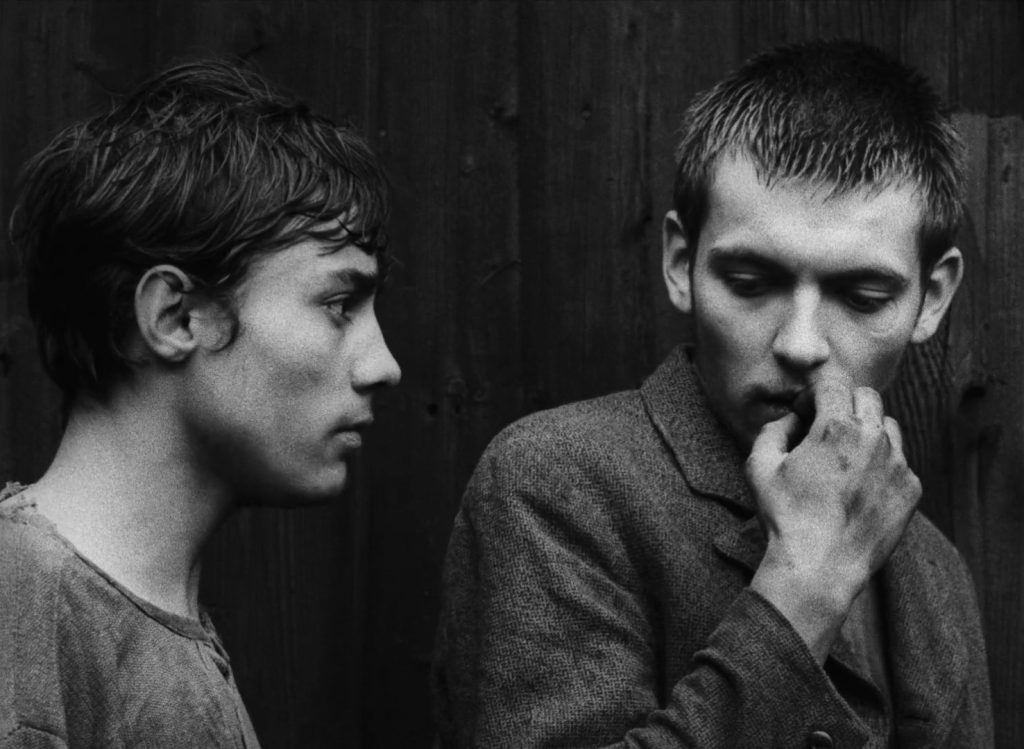
Not only is the film like a twice-told tale – the experience is also split between two persons, and there’s an element of artifice in that decision as well. The first boy, the blond, bears the physical pain, his bloodied ankles suffering at every step, while the second boy bears the pain of deprivation – hunger, cold, and emotional longing. The point of view favors the second boy asymmetrically, only because cinema is better at expressing his experience. As a rule, films that try to depict physical pain end up producing a false sense that it’s more bearable than it actually is. It’s just as well, then, that the first boy’s ailment is no more dramatic than the agony of chafed feet, which most viewers will be able to relate to.
The twice-told tale, however, opens other possibilities if we look at Diamonds of the Night in the context of the Czechoslovak New Wave and Czechoslovak history. Only nineteen years after its end, World War II was still recent enough to remain a frequent subject of eastern European cinema (much more than in western Europe), but the idea of cyclical trauma adds a subversive relevance at a time when the nation was effectively under a second foreign occupation. The story of two boys, friends but not brothers, going through two cycles of persecution, may be likened to the recent history of a nation in two parts, Czechia and Slovakia, similar in language but different in heritage. In the brief gap between Nazi and Soviet domination, Czechoslovakia had asserted its right to well being as the boys do in the short interlude at the farm, demanding bread and milk but refraining from conflict.
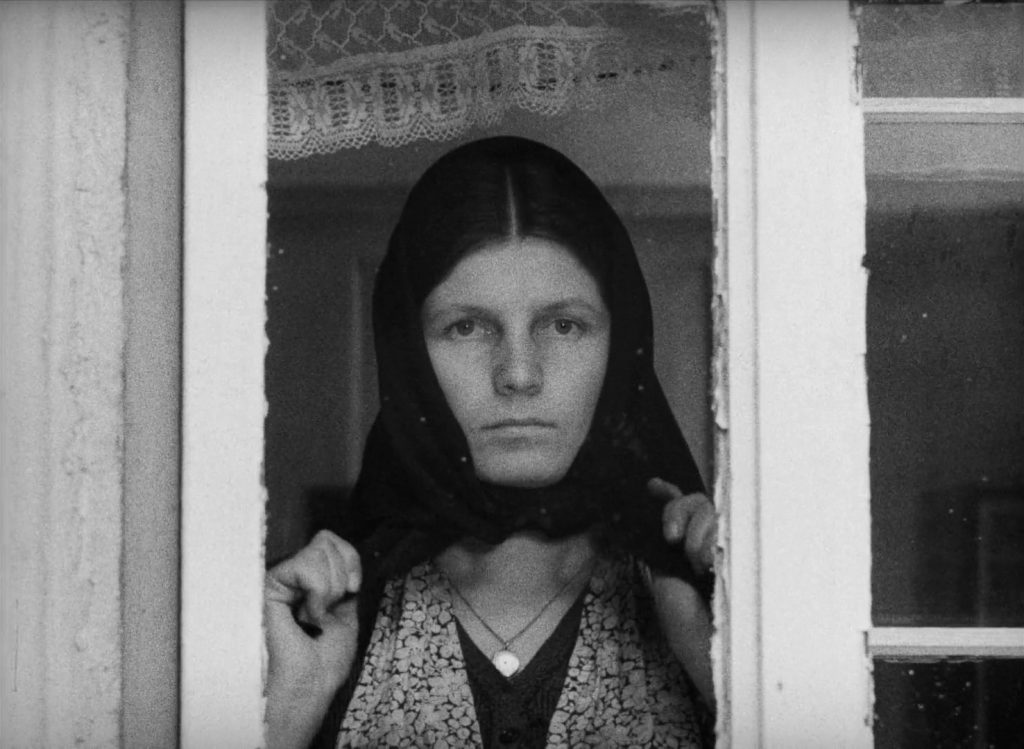
At the end of the farmhouse scene, the woman puts on her headscarf as if preparing to call the militia on the vagrant boys. The people of Czechoslovakia may have felt similarly betrayed after their peaceful emergence from Nazi tyranny. The moment we last see the woman in the window, the film cuts to one of the riflemen who will hunt the boys in the woods. The fact that the militia speaks German disguises any intended likeness to Soviet tyranny, but a couple of key signs depart from Lustig’s autobiographical source story. The location of the boys’ escape is never specified, but the rugged landscape and the militia commander’s threat of a court-martial in Carlsbad (Karlovy Vary) suggests that the riflemen are not Bavarians (a train from Buchenwald or Auschwitz to Dachau would cross flat or rolling ground in Bavaria) but Sudeten Germans loyal to the Nazi Party… homegrown traitors, in other words, like the Czechs and Slovaks who were loyal to the U.S.S.R.
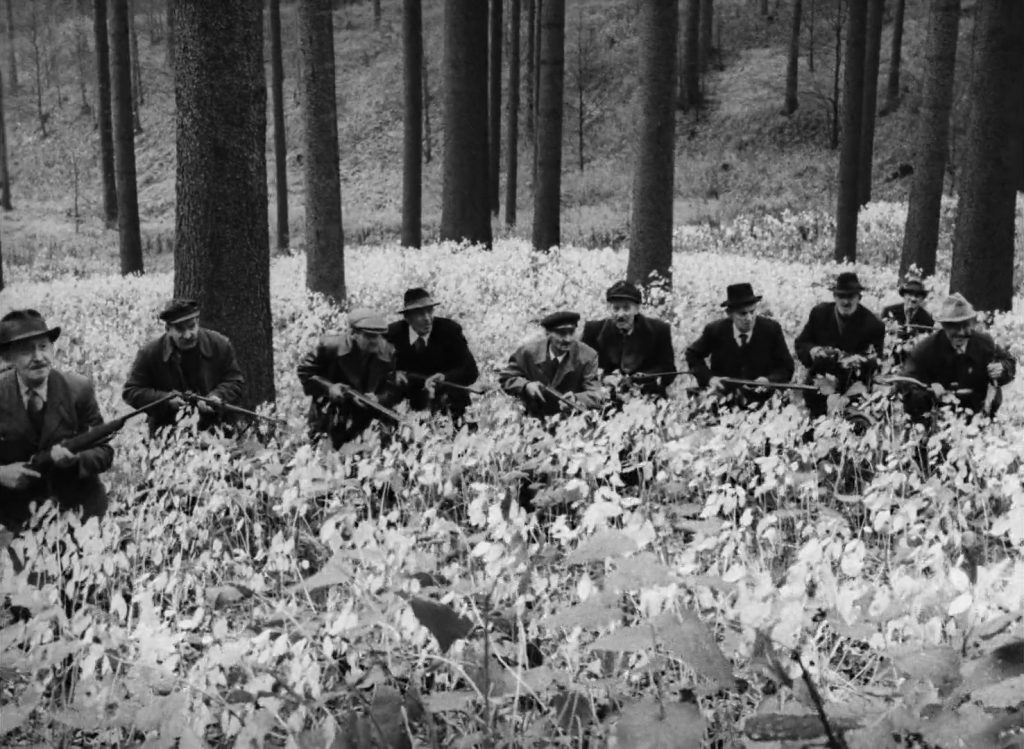
Any subversive reading along these lines must probably remain vague. The more closely the film tried to analogize the terrors of Soviet domination, the riskier it would have been, especially before the brief loosening of censorship in the 1968 Prague Spring. One advantage of an allegorical reading, though, is that it resolves the ambiguity at the end. If the boys stand for the freedom-loving Czechoslovak people, then both endings can be simultaneously valid. The Communist Party had cut innocent lives short, but others survived, and the final venture into the darkening woods points to an uncertain future.
Diamonds of the Night may be open to legitimate criticism for its grotesque portrayal of the elderly hunting party. Coming from 28-year-old director Jan Němec, the extended scene smacks of intergenerational disgust, yet any point made in the age difference appears to be secondary. The Communist Party of Czechoslovakia was not exactly a gerontocracy, as the current president and secretary, Antonín Novotný, was only 60 at the time. Nevertheless, the advanced age of the militia adds an unexpected perversity to the hunt, as most audiences wouldn’t expect such a degree of heartlessness from a group that old, and it may have had a historical basis if the assumption were that younger soldiers were spread elsewhere.
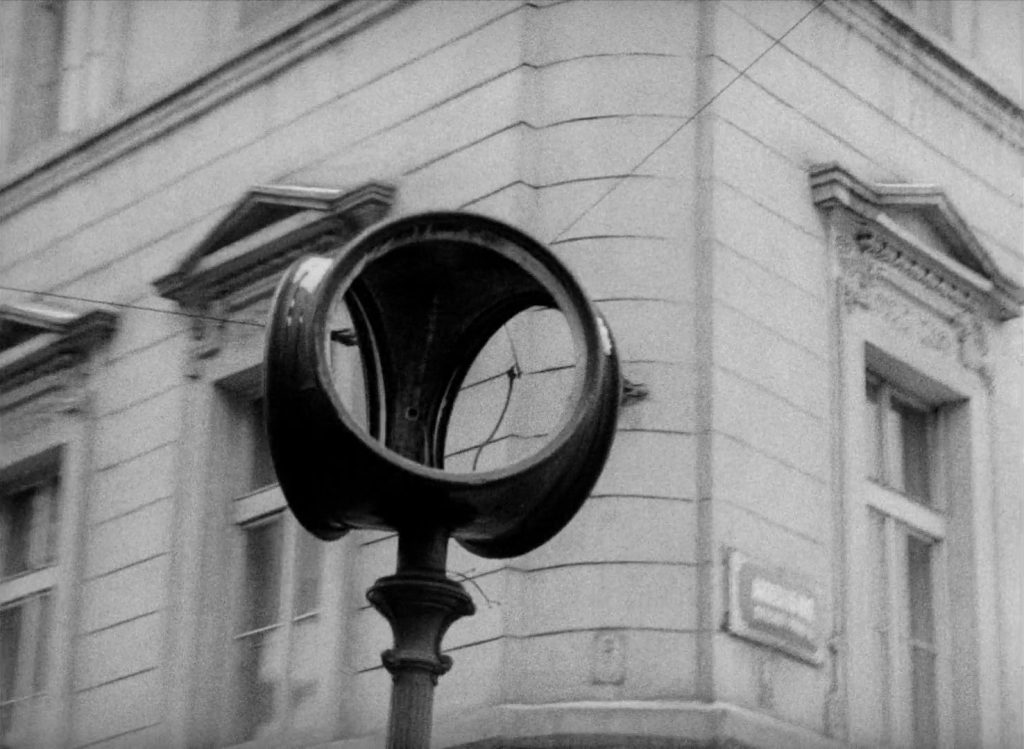
As a picture of oppression, Diamonds of the Night is not so simplistic as to rub viewers’ noses in the boys’ suffering for the sake of pity. One clue to its method is the intermittent tolling of distant church bells. The chimes – four or five then a quick fade to long silence – start during the titles, resume when the boys take shelter, then return late in the beer hall scene, matching the intercutting to remembered or imagined freedom in the woods. The arhythmic fading in and out of the bells is unrealistic. Rather, like all the intermittent editing, it captures the sense of life itself coming and going, as it must for persons living through fear, pain, and deprivation. All the markers of time in Diamonds of the Night are likewise intermittent – church bells, trains and trams, running or walking, even clocks themselves – appearing off and on, sometimes stopped. An empty tram sits in a field; a three-faced clock in Prague stands empty. Only in the lead-up to the boys’ execution does time feel continuous, underscored by the loud ticking of the commander’s clock.
Like the fading and returning church bells and all the intermittent movement and cutting, the twice-told tale also creates an impression of time destabilized. In the last half hour, the terror of being caught by the militia is compounded by a feeling of reliving past trauma. The first boy finds himself laughing during two moments of relaxation, only for a jolt of pain to end his laughter abruptly. In its variety of incidents, Diamonds of the Night shows how inhumanity tears the fabric of life into shreds, disrupting the flow of time and destroying the peace that living creatures require.
CONNECTIONS:
Wild Strawberries – Clock with no hands portending a stoppage of time
The War Is Over – Frequent interruptions of the narrative to insert a character’s mental images
Heart of Glass – Two halves that correspond obliquely to fascism and the post-war period, with an interlude between them
The Devil Probably – Montage of falling timber; coins overflowing someone’s hands and spilling onto the floor