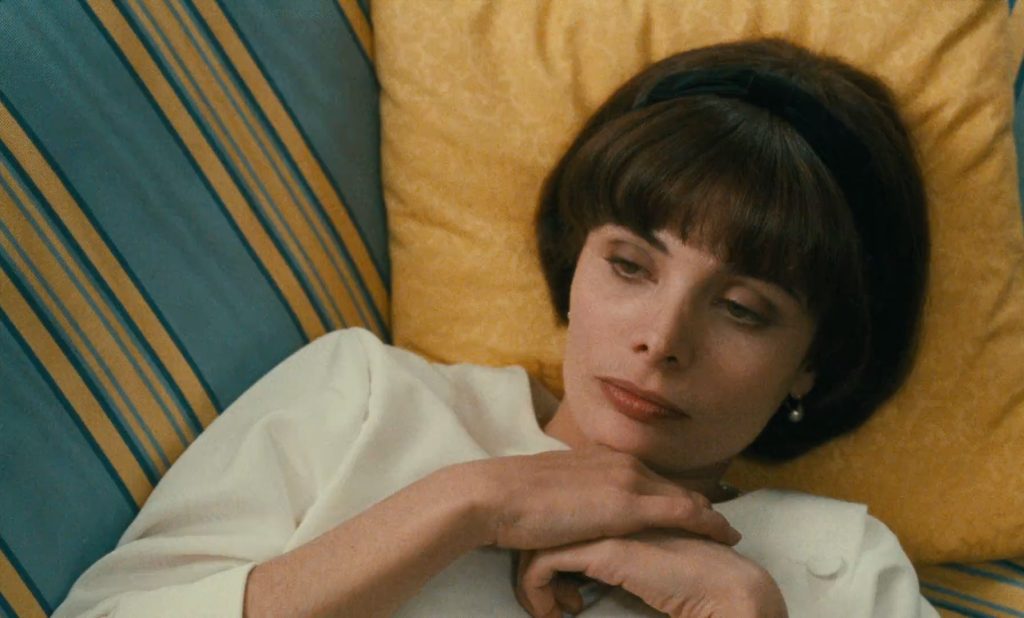
Betty
1992, directed by Claude Chabrol
Seventeen minutes into Betty, after welcoming the stranded protagonist into her luxury hotel suite and giving her a bubble bath, Laure Levaucher (Stéphane Audran) puts a pair of slippers on Betty’s feet. “They’re slightly too big,” Laure realizes, but her guest doesn’t mind. “It’s okay.” The moment alludes to Cinderella, except that the slipper is not a perfect fit. Unlike the fairy tale princess, Betty doesn’t fit the world of wealth and privilege she’s just left behind, but there are enough parallels to suggest a conscious transformation of the Cinderella tale. Laure plays a fairy godmother to Betty, and the film begins around the corresponding midnight, shortly after Betty steps back into the real world she was born into. A drug-addicted doctor picks her up in a bar and tells her “I love gray,” as if to admit he’s attracted to the cinders in which this self-professed “dirty girl” was raised.
Claude Chabrol’s interest in the Cinderella legend is a natural extension of his running critique of the French bourgeoisie. Betty’s husband Guy is almost impossibly handsome, like a Prince Charming come to life, and his family looks like the supporting cast of a regal ballroom scene, most of all his sister-in-law Odile in her flamboyant evening costume. Still there’s something off about the whole bunch. Hearing about a reception for a Burkinabé minister, Guy casually slurs the Africans: “Oh, les nègres.” When Guy’s mother catches Betty having sex with the saxophonist in the living room, she frets about her precious couch: “No, no, not on that….” There’s a recurring insinuation that Guy is attracted to Betty, not in spite of her sordid past, but because of her past.
Nevertheless, the film is far from being a cheap shot at the upper class. By the end, after Betty has betrayed Laure and rejected a gracious offer of reconciliation with Guy and his family, the weight of appearances is so much against Betty that the film can be described as a test of the viewer. Can we still sympathize with Betty after all that she’s done?
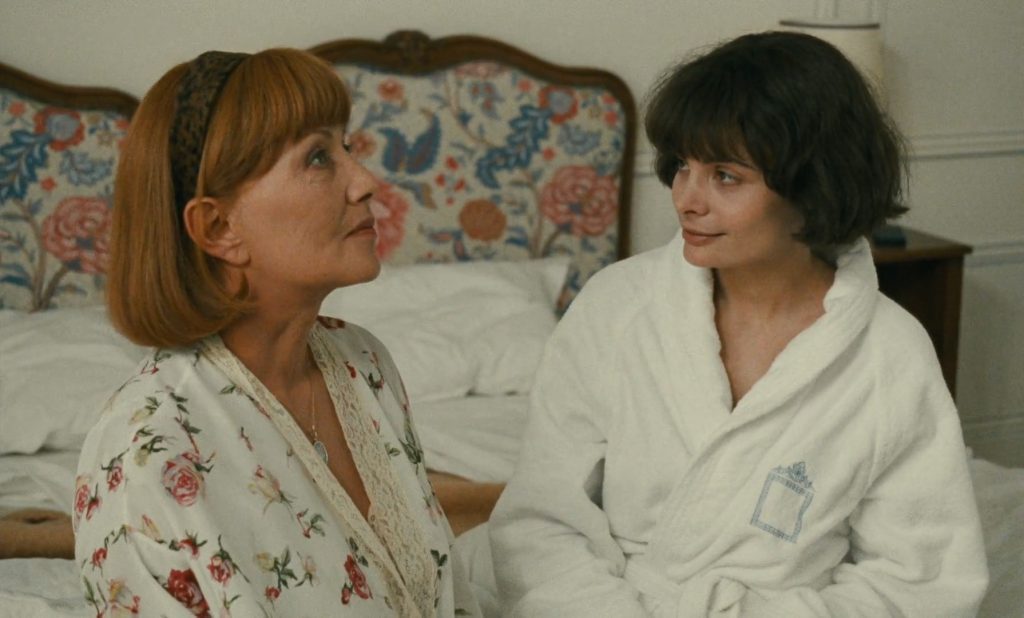
More than anything, it’s the betrayal that tends to set viewers against Betty. Laure is unfailingly kind to her, yet without any sign of scruples, Betty seduces Mario, leaving her benefactress with nothing to live for. Laure is a widow with the caring instincts of her long tenure as a nurse, and the casting of Audran makes it virtually impossible to fault her, both because of the actress’s extraordinary graciousness and because of her status as Chabrol’s ex-wife and longtime star. When Laure finds her lover in bed with Betty, she quietly returns to Lyon without a word or gesture of complaint. We hear from Madame Étamble that Laure dies shortly thereafter, and the ending cuts to Betty with a peaceful smile in Mario’s restaurant Le Trou, scooping a pair of dead fish out of the tank.
Not every viewer will be prepared to forgive Betty. The flashbacks explore her motivations through the analytical eyes of her lover Schwartz, a medical student, but there’s nothing obviously redeeming about her desire to emulate Therèse, her aunt and uncle’s sexually abused chambermaid. Still, when she cries for the two children she never had a chance to mother properly, or when a brute from the jazz bar pushes her around and leads her by the neck, we cannot doubt that she’s been at a disadvantage for much of her life. Given the class difference between her and Guy’s family, or even between her and Laure (who comes from the same upper circle of Lyonnais society), the film would have to punch downward if it took sides against Betty.
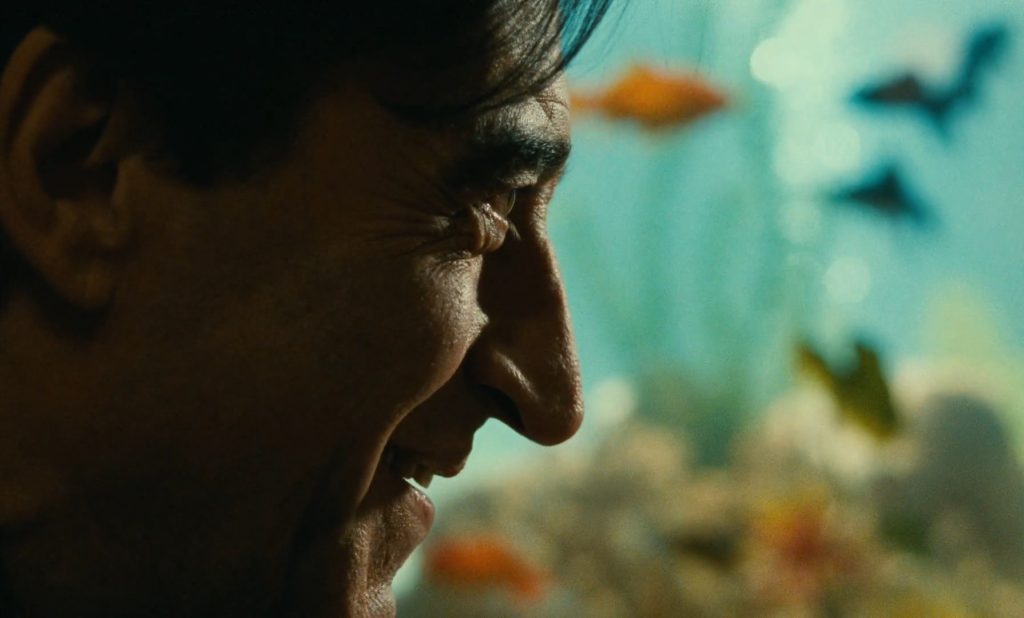
In the first line of dialogue Betty asks Bernard, “Is it true you’re a real doctor?” She doesn’t trust the man to be what he claims to be, and by the same token we may not trust Betty to be the innocent woman she presents herself as. Despite his degraded state, though, Bernard is a real doctor after all, and if we watch fairly we must recognize a genuine core of innocence in Betty, whatever her failings may be. We’re told repeatedly that the clients at Le Trou are all somehow “twisted”, and the restaurant is a sort of microcosm, its melancholy collection of heavy drinkers reflected in the fish at the heart of the dining room. Bernard is a broken doctor, and Betty is a broken innocent.
Betty’s story is told largely in flashbacks, many of them triggered by external cues that remind her of past events. The pattern makes her look self-centered in a rather ordinary way, easily drawn back into private memories while listening to others. Other flashbacks correspond to her narration as she tells her story to Laure. The last flashback is of the first kind, a memory that intrudes into her last meeting with Guy. She reminds her husband that she had warned him not to marry her, but she suddenly softens: “But I’m glad you came. It’s better to part this way.” Suddenly the film flashes back to Schwartz for two seconds: “Hey kid, you getting romantic?”
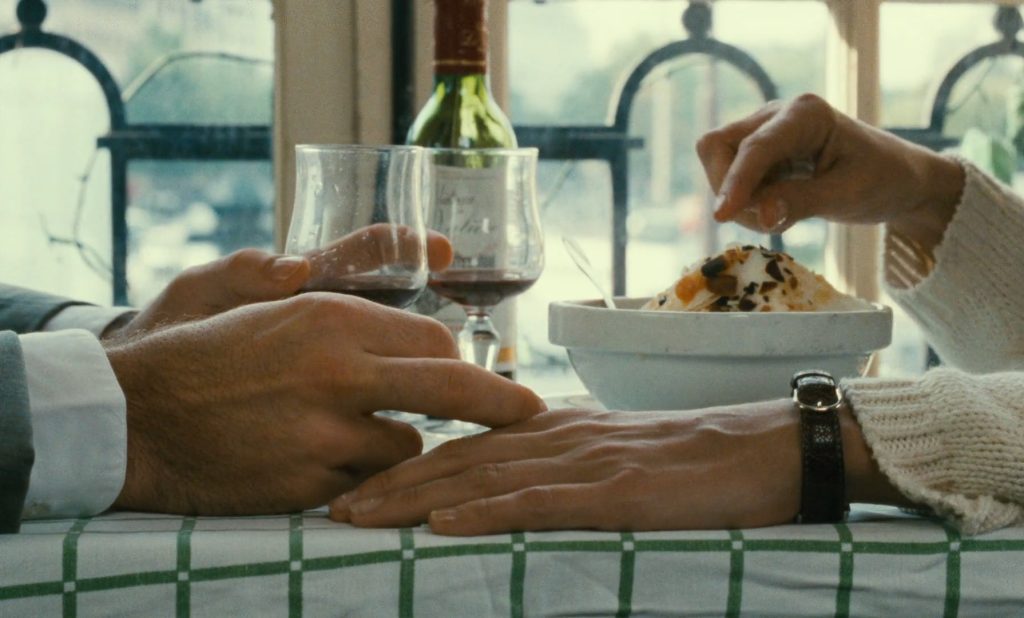
She’s not getting especially romantic – she’s just turned Guy down – but it could be that Schwartz’s words pull her back from an invisible precipice, from some impulse she never acts on thanks to this remembered warning. The point, though, is that insofar as Betty’s story resembles Cinderella’s, it’s not a romance. Schwartz’s two-second flashback may pass almost unnoticed, but its odd placement, and the fact that the director’s son Thomas Chabrol plays Schwartz, gives it the weight of truth. The insert is like a deus ex machina, as if the director were stepping in to point Betty – or the viewer – in the right direction.
Betty gives up her princely husband for a commoner, a former taxi driver who owns a small restaurant and who compares his home to “an old farm.” Mario may have exhibited chivalry when he carried the passed-out Betty through heavy rain, and he may look a bit like Alain Cuny’s minstrel in the medieval fairy tale Les visiteurs du soir, but he’s more down-to-earth than the aristocratic Guy, and a better match for Betty. As they drive off together, Betty tells Mario, “We’ll have champagne tonight. Okay? And I won’t drink too much. I promise.” In other words, she’ll still drink, but a little less than before. The film doesn’t offer a perfect ending, but things may get better for her.
To say that Betty is an anti-romantic transformation of Cinderella is not just to point out that it descends into real-world vulgarity like prostitution, infidelity, and alcoholism. What’s important, rather, is that the story itself is not idealized like a fairy tale. The events unfold as they might in real life, and Betty should not have to be a saint to merit our sympathy. In any case there’s no evidence that she betrays Laure out of meanness… her impulsive sexuality is more akin to an addiction.
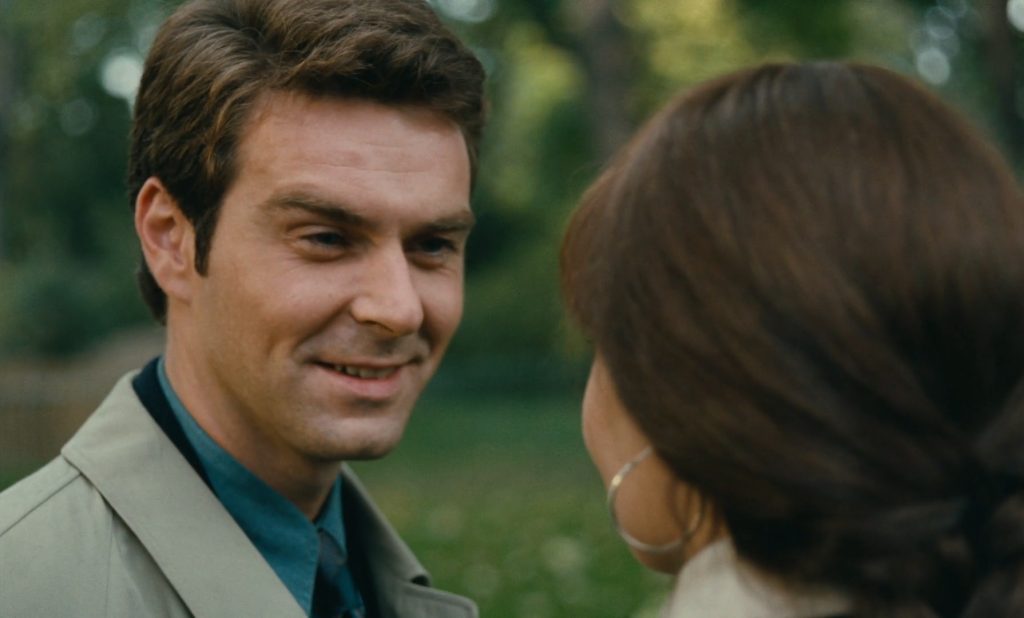
Although Betty genuinely cares for Guy and for her daughters, she doesn’t subscribe to the romantic worldview that defines the middle and upper classes. She always knew it wasn’t wise to marry Guy, and when Laure asks whether she believes in motherly love, she confesses to a more nuanced view: “Ah, I forgot. You don’t have kids. You couldn’t know. Maternal love, like in books or songs, like we’re taught at school… I believed in it when I got married,” going on to describe how Guy’s family treated her like livestock for breeding.
The point of Betty is that the bourgeois conception of moral justice is founded on a romantic worldview. It makes sense only in a world where things work out like in a fairy tale, where the bonds between lovers or between parents and children are unaffected by the hardships of ordinary life. When Betty asks her mother-in-law which movie she saw, the woman answers, “Something about an abortionist. I didn’t like it in the least.” It’s a likely allusion to Chabrol’s own Une affaire de femmes (1988), but it also summarizes the moralistic outlook of a privileged class that won’t bring itself to appreciate what a struggling woman without good options goes through.
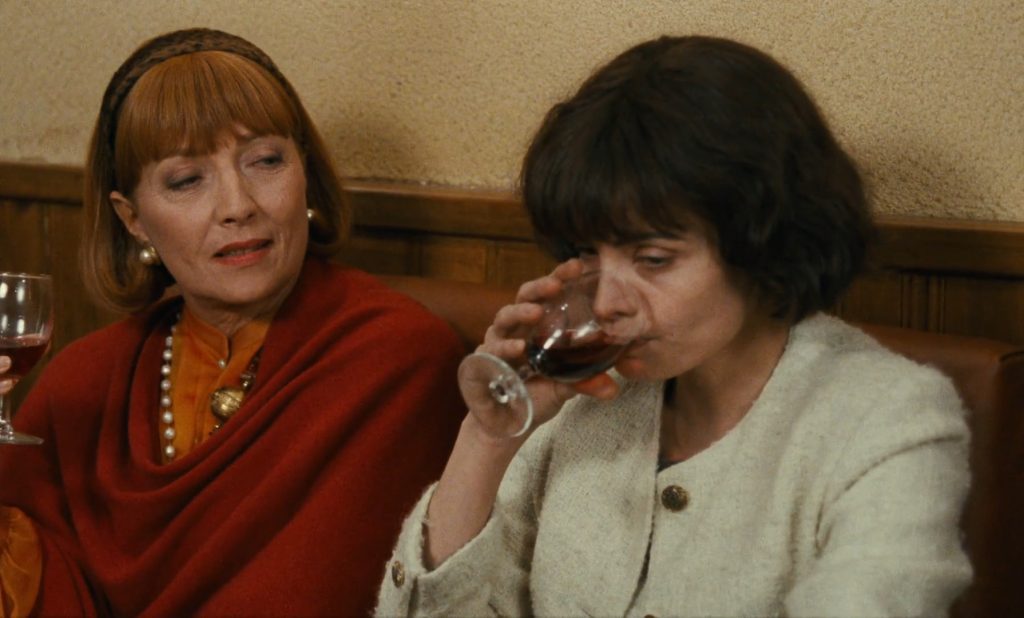
Like Chabrol’s first feature Le beau Serge, Betty is full of pairings and doubles, some obvious and some hidden. The pattern here tends to connect things or characters asymmetrically, to draw equivalences between persons, for example, of vastly different class or circumstances. Betty and Laure are both alcoholics, and their fathers are both chemists of different sorts; Guy and Betty’s father are both described as “always joking”; the employees at the Hôtel Trianon share the names of workers at Le Trou and in the seedy hotel where a man pays Betty for sex. Betty dismisses her family’s maid before inviting Philippe over, and her john dismisses the chambermaid before taking advantage of her. By linking people of high and low station (and even people to fish), these connections point to commonalities that erode moral and social hierarchies that depend on a romantic worldview.
Besides all these imbalanced symmetries, Betty herself is frequently paired on the screen with other characters, and in most cases by far, she’s placed on the right side of the screen. This could be interpreted different ways – one might be tempted to say that it puts her “in the right” (an idiom that doesn’t quite work in French) – but Betty’s first side-by-side pairing, in the opening scene, makes the greatest sense of the pattern. Seen through the windshield of Bernard’s car, she’s on the right because Bernard is driving, taking her where he wants to go, and in this sense she’s almost always being led around by someone else, whether for her benefit or not. Once we perceive that Betty is always in the passenger seat, not because she’s passive but because society confines her there, it makes little sense to condemn her.
CONNECTIONS:
Midnight – Cinderella story with a pivot analogous to midnight, a lavish setting in Versailles, and eventual love with a taxi driver or former taxi driver
Antareen – Fish tank as an implicit metaphor for the characters’ situation
La cérémonie – Story that’s sympathetic to a lower-class woman despite the seemingly unforgivable wrongs she commits near the end
LIST OF DOUBLES:
- Laure and Betty are both alcoholics
- Laure and Mario’s former lover are both widows
- Guy and Betty’s father are both described as “always joking”
- Guy looks like a prince and is wealthy; Mario resembles a fairy tale minstrel and is chivalrous
- Laure watches Betty from her window in the same spot in the garden with both Guy and Mario
- Laure and Betty both have fathers who were chemists of a sort
- Betty and Mario both put their finger to their lips to signal quiet
- Betty watches Laure and Mario in bed (twice) as she had watched Therèse’s rape
- Odile/Frédéric and Betty/Guy hire possessive nannies
- Charles at the seedy hotel & another Charles at the Hôtel Trianon
- Joseph working at Le Trou & another Joseph at the Trianon
- Guy’s father was a general, and there’s an American officer at Le Trou
- Laure was married to a doctor, and Bernard is a doctor
- Two double whiskeys
- Betty shown signing contract twice & leaving the signing twice
- Pair of picture frames behind Laure in her room
- Mario and Betty scoop dead fish from the tank
- Laure and the second pair of fish die around the same point in the film
- The fish and the customers at Le Trou both drink constantly
- Betty sleeps with two men right after leaving her family (one well off & takes upper hand; other not well off & she takes upper hand)
- Betty dismisses maid before sex with Philippe and subsequent eviction; man who picks her up dismisses maid before sex and subsequent eviction