Loveless
2017, directed by Andrey Zvyagintsev
Of all the basic plotlines in cinema or literature, stories of missing children are among the most prone to sentimentality, surpassed maybe only by stories of missing pets. Loveless avoids this trap, not because it’s exceedingly careful, but because it knows its purpose. To say that it’s not sentimental does not mean it’s not emotional; rather the emotional effect is put to a greater end, with pathos kept to the exact minimum required.
There are only two scenes of real pathos in Loveless. Zvyagintsev told an audience in Lausanne that if he had been unable to get Alexey crying in his room, he would not have made the film. The other scene is the unveiling at the morgue, where the two actors were unexpectedly confronted with a graphically mutilated mannequin. The latter scene is featured in the “making-of” featurette, and the filming came off triumphantly. Both scenes were evidently essential to Zvyagintsev’s vision, and they’re placed symmetrically, each a little over ten minutes from the beginning or the end. The film is thus built around them like a magnet around its two poles.

Despite the emotional force of those two moments, the film does what it can to avoid forcing the viewer’s reaction. Alexey cries in the dark, as if the film were reticent to show him, and the morgue scene is saved by the fact that it’s not Alexey’s body. The effects are no less strong either for the viewer or for the characters. Alexey’s parents may be relieved, but they also know that what they’ve seen is still likely close to the truth. Each scene humanizes the characters, one eliciting sympathy for the boy and the other revealing a suppressed flame of love in the outwardly “loveless” parents.
In a 2018 conversation with the British Film Institute, Zvyagintsev said that Michelangelo Antonioni’s L’avventura sparked his career as a filmmaker, and the influence shows in Loveless. Both films are stories of disappearances, but the likeness goes beyond that. An unsolved disappearance tends to come across as real because it’s not just a plot device in the service of a dramatic revelation. Finding out Alexey’s fate would inevitably sentimentalize the story, just as finding out Anna’s fate would have diminished the sense of wonder that L’avventura aims for. It’s essential to L’avventura that Anna disappears a second time, in the second half, from the hearts and minds of her lover and her closest friend, and that this second vanishing evokes as much wonder as the first. Loveless flips the order of the disappearances – Alexey has already vanished from the lives of his parents before he vanishes physically.
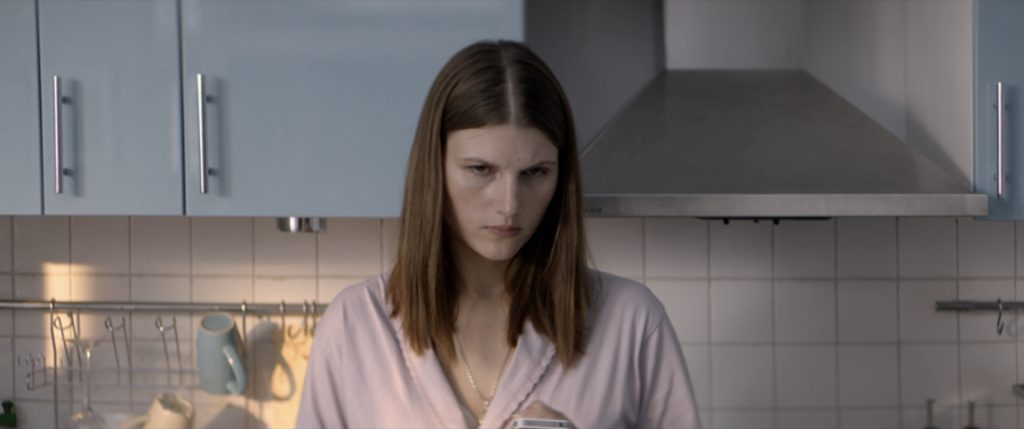
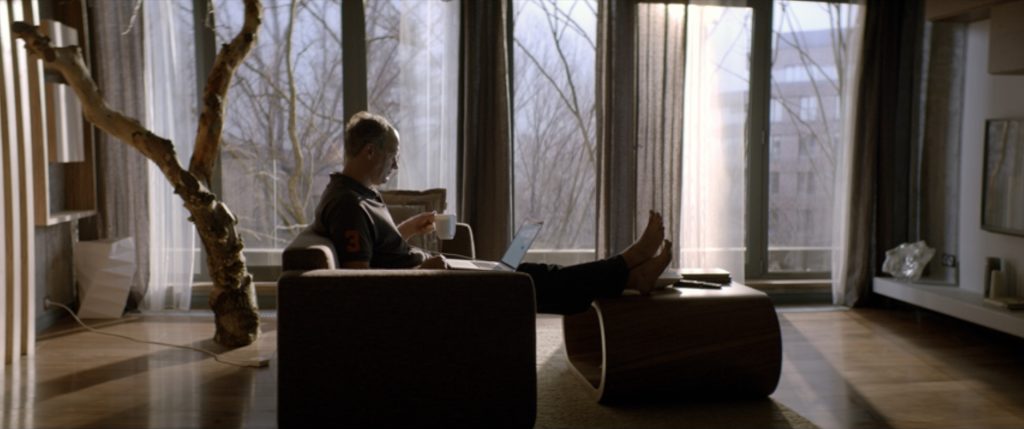
We’re told as much again and again, especially when Zhenya confesses to Boris or to her lover Anton that having Alexey was a “mistake” and that she regrets not aborting him. As we’ll find out, she and Boris do care for their son on some level, but their indifference is also real, and it’s best expressed in the half-hour gap in runtime between Alexey’s exit and their discovery that he’s missing. This gap corresponds to two days of narrative time as the story follows each parent to work and to bed with a new lover. More than anything, the half-hour gap portrays the selfishness of upper-class Russian society. The time is filled with shopping, eating, complaining, a massage session, and sex. Each parent’s life parallels the other, and we also find parallel selfies – a table of blondes at Anton’s favorite restaurant, and Masha with her mother at the store – seemingly innocent moments that emblematize the self-centeredness around them.
The emotional effect of Loveless, with its twin moments of pathos and its portrait of self-absorption, should be to impress on the viewer the preciousness of life. About half the film is devoted to the search for Alexey, and the laborious process is a continual reminder of the value of a single life. The search and rescue team embodies this awareness in counterpoint to the parents’ indifference and the police’s economizing of resources. The team’s volunteers, and the coordinator Ivan in particular, represent a faith in society’s potential to do better. Nevertheless, Loveless is a story of social failure.
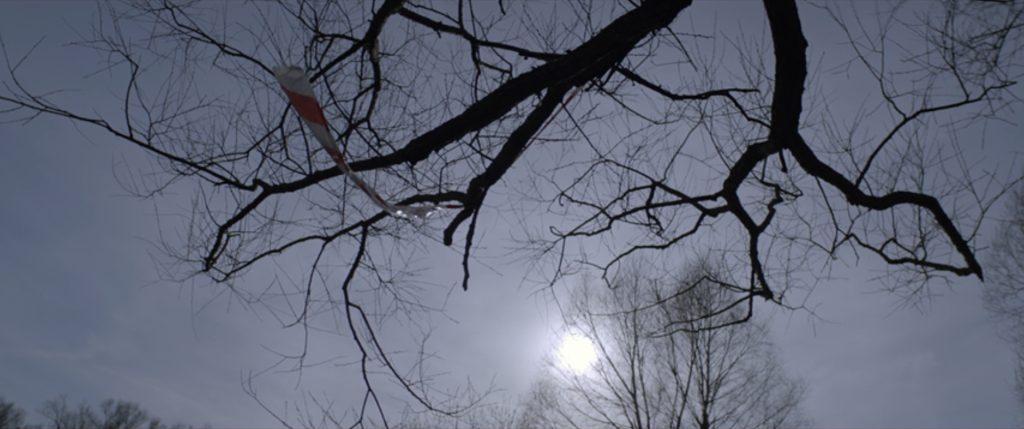
Another similarity to L’avventura is the pattern of doublings, including the aforementioned two scenes of pathos, two selfies, and two sex scenes. Twice the search party calls for Alexey in the woods (reminiscent of the search on Lisca Bianca); twice Ivan says “On with the song”; and there are two zooms through a window into snow. A mural of the sun behind the forest echoes an earlier shot of the sun through tree branches. Masha shops for groceries with Boris and for clothes with her mom. There are false identifications in the hospital and in the morgue. Some repetitions emphasize particular points, while others hint at recurring cycles of behavior. In the epilogue Boris neglects his new son as he had neglected Alexey before. Zhenya predicts that in another twelve years Boris will “play the same trick” on Masha that he played on her after twelve years of marriage, and Zhenya’s mother calls her a mistake as Zhenya had called Alexey a mistake.
There’s special emphasis throughout Loveless on the cycle of generations. The action begins with children bursting out of a school, and the woman who comes in to view the condo is pregnant, as is Masha. Alexey was born in the highly symbolic year 2000, and Boris calls his mother-in-law “Stalin-in-a-skirt” alluding to Russia’s Soviet past. These signs don’t form an allegory so much as they suggest that the problem of “lovelessness” (nyelyubov, maybe better translated as “anti-love”) is rooted in a long, somewhat cyclical social history.
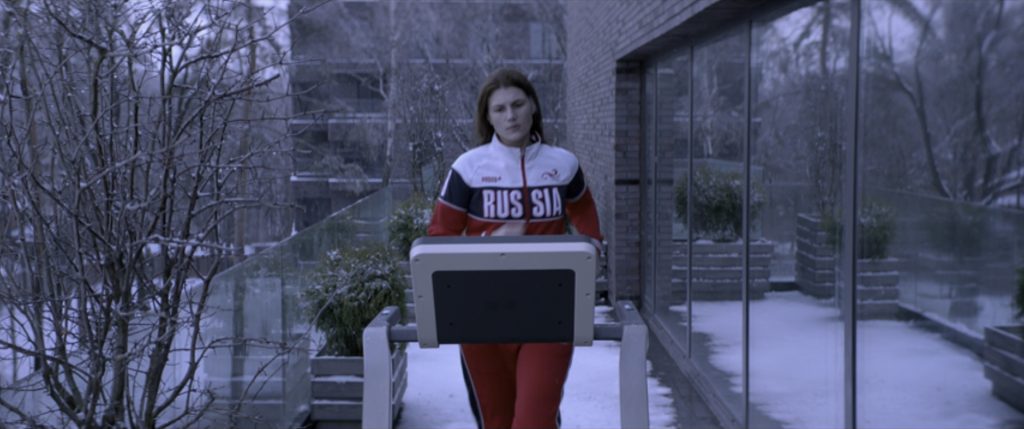
An especially suggestive repetition brackets the story. A Russian flag flies above the school doors, and Zhenya ends her part in a flag-colored tracksuit with “Russia” written across her chest. Commenting on the tracksuit in 2018 (before he went into exile), Zvyagintsev cautioned against reading too much politics into Loveless, excusing Zhenya’s garment as a ubiquitous artifact of the Sochi Olympics. The excuse rings hollow, but the director had compelling reasons to be mute about any political message. In any case, as always, we should not expect the author to help us with interpretation. Whatever was intended, the ending of Loveless comes down strongly on the side of a political reading that’s consistent with Zvyagintsev’s later open opposition to Russia’s invasion of Ukraine.
In the epilogue, leaping forward from 2012 to about 2015, news broadcasts about the invasion of the Ukrainian Donbas dominate parallel scenes at Boris’s and Zhenya’s new homes. If the search for Alexey has heightened our appreciation of his life’s incalculable worth, then any Russian viewer should connect his story to the thousands of young men whose lives will be wasted in a war of aggression… especially if one recalls that Zhenya had expected Alexey to wind up in the army. If mothers and fathers as uncaring as Zhenya and Boris would feel the loss of their sons so acutely, then all parents should recoil just as strongly from sending their children to a discretionary war.
However casual the choice of Zhenya’s final costume may have been, its image cannot be ignored. It’s not necessary to link Zhenya to the grandiose figure of Mother Russia; it’s enough, rather, to view her as a representative of the Russian people growing suddenly tired while treading aimlessly without progress. As Anton said to her earlier about lovelessness, “You cannot live in that state.” In her last moment Zhenya looks straight into the camera, and the effect is like looking into a mirror. Whatever she might be thinking, the hope must be that the viewer finds some self-recognition in that shot and helps to turn Russia onto a better course.
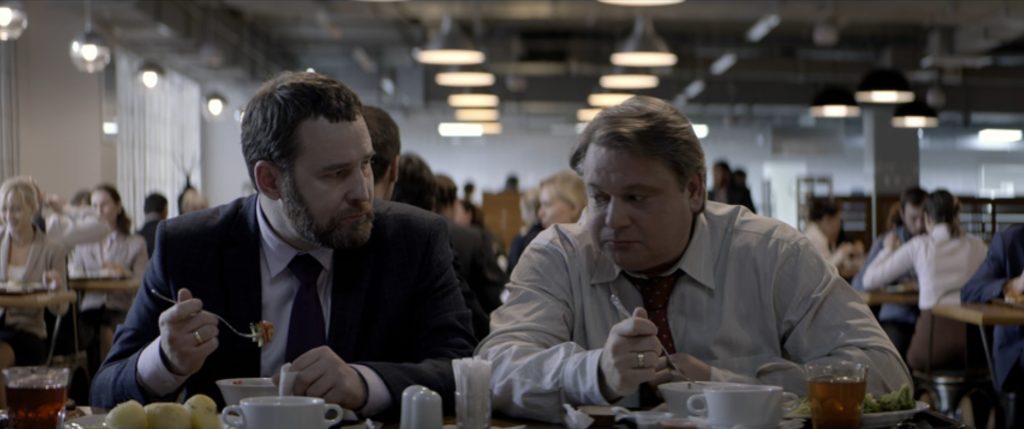
Despite the bleak story, the film justifies the optimism of this reading. On his way to work in October 2012, Boris hears a radio commentary on the apocalyptic mania around the end of the Mayan calendar that December. At lunch he asks Sergey whether he believes the world is about to end, to which his friend answers “Definitely” before asking for help with work. Sergey’s rapid change of subject represents a kind of courage, as if saying that “things look dire, but we have work to do.” Furthermore, when the film leaps forward in the epilogue, well past the Mayan doomsday, it reassures us that the world does go on. At the end, without giving any false reassurance about Alexey’s fate, the final shot of the ribbon waving from the tree is a sign that something of the boy’s presence remains in the world.
CONNECTIONS:
L’avventura – Disappearance of a person in two senses, literal and emotional; pattern of doublings
When the Tenth Month Comes – National flag centered in a symmetrical shot of a school building; that shot paired with another image that comments on national identity
The Return – Prediction of a recurring disappointment after a second 12-year interval
The Martian – Story about the preciousness of a single life and the concerted attempt to rescue it
REFERENCES:
Internet Movie Database (https://www.imdb.com/title/tt6304162/trivia/) (on the importance of Alexey crying in the bedroom)
The Making of Loveless – featurette on the Sony Pictures Classics dvd (behind the scenes at the morgue scene)
“In conversation with Loveless director Andrey Zvyagintsev” on the British Film Institute’s YouTube channel (https://www.youtube.com/watch?v=uBTIb2xx8ek), 15 February 2018 (on the influence of L’avventura)
“Andrey Zvyagintsev: ‘With Russia’s re-Stalinsation, there are negative tendencies’” The Irish Times, 7 February 2018 (Zvyagintsev’s remarks on political meaning)
LIST OF DOUBLINGS:
Forest and river in snow at the beginning and end
Red and white ribbon in the tree
Sun by the ribbon & painted on a wall
Russian flag at the school and on Zhenya’s tracksuit
Pregnant woman looking at the apartment, Masha pregnant
Boris neglects Alexey & his new son
Alexey crying in his room & parents crying in the morgue
Radio forecasting the end of the world & the arrival of an Arctic front
Masha shopping with Boris and with her mother
Selfie at restaurant and in clothing store
Dark sex scenes between Zhenya & Anton, Boris & Masha
Ivan says “On with the song”
Search team calling for Alexey
Zooms into a snowy window in the classroom & in Alexey’s room
Two false identifications, in a hospital & in a morgue