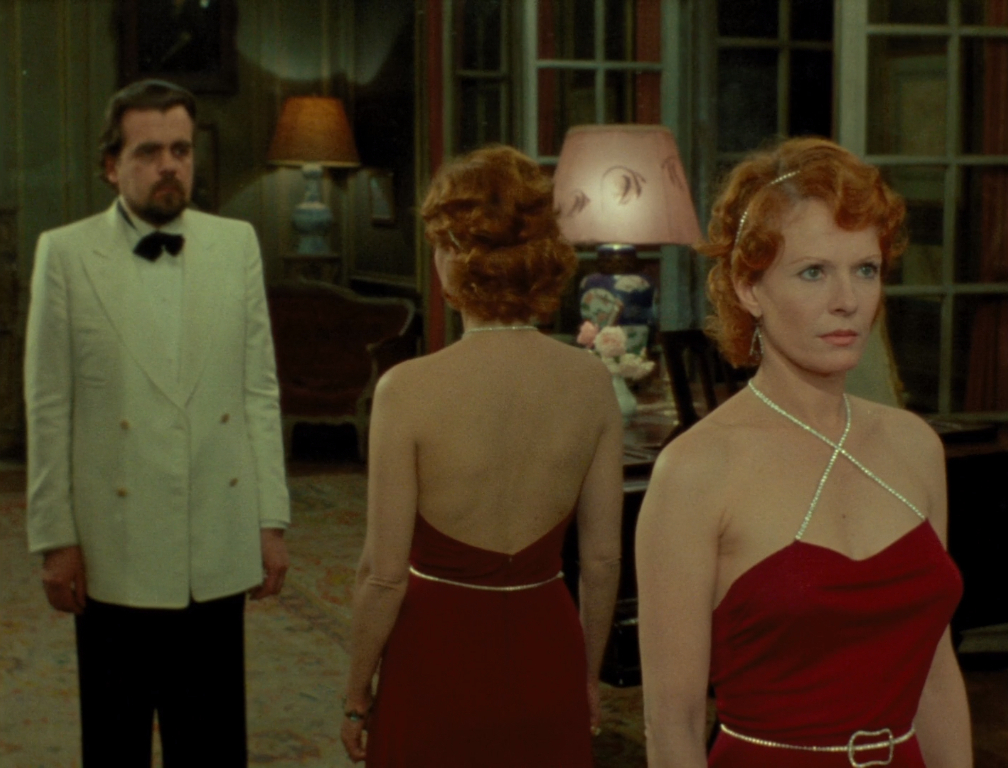
India Song
1975, directed by Marguerite Duras
Nine minutes into India Song, a mysterious question is heard in the drawing room at the French Embassy in Calcutta:
“What are you afraid of?”
Twenty-eight seconds later, during the same languorous pan, another voice answers:
“Anne-Marie Stretter.”
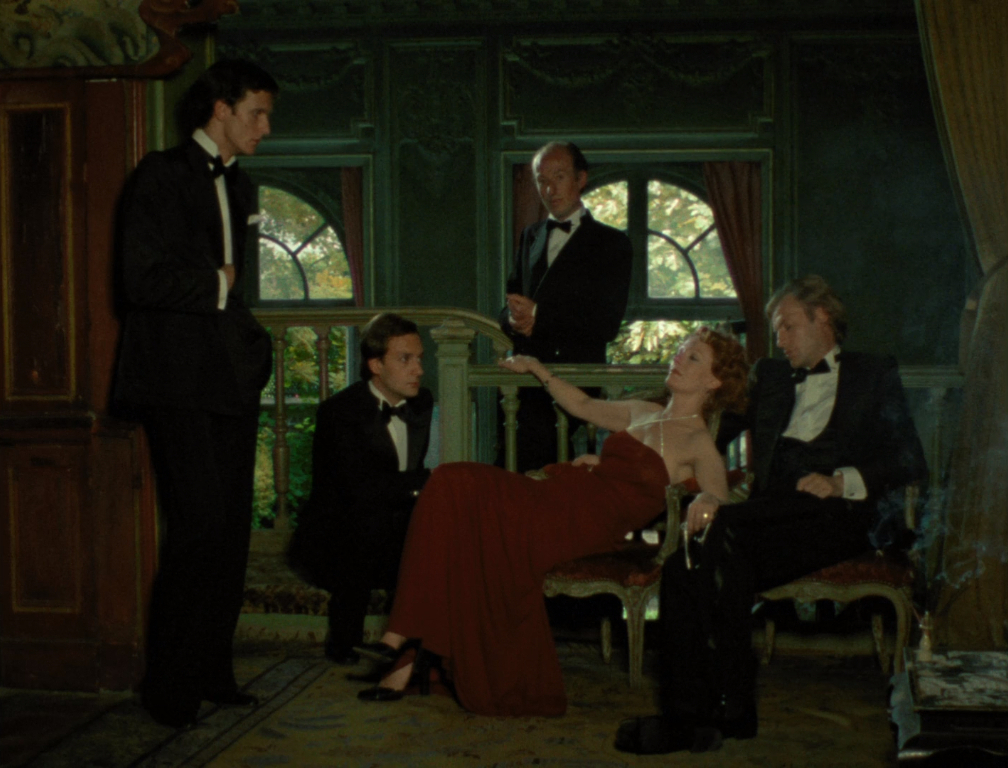
It’s ambiguous whether Madame Stretter’s name bears any connection to the original question. It’s pronounced with a hint of surprise as the camera passes a framed photograph which might be Stretter in her youth. These off-screen voices (“voix intemporelles”) are safely removed from the ambassador’s wife. They’ll note the worn-out inscription on her tombstone, placing them well beyond her time frame as they comment on the last few days of Stretter’s life, which ended in 1937.
Still, there’s reason to believe that Anne-Marie Stretter remains an object of fear long after she’s dead. There’s a similar ambiguity when a narrator asks about a “smell of death” just as the vice-consul enters the scene. The question asks not “who” but “what” you are afraid of. What’s terrifying is how easy it is to succumb to her fate, her “leprosy of the heart”. Leprosy numbs the nerves, and Stretter, a bored wife living in a world she cannot get used to, is numb toward life. Months earlier she and her lover Michael Richardson had attempted suicide in Chandernagore, reportedly her first attempt. Her next attempt is presumably at the end of the story when she drowns herself at the beach near the embassy villa.
When the narrators describe her first suicide attempt, their exchange hits on a word that illuminates the guiding structure:
“Indifference to life.”
“Or the opposite. People confuse things.”
“No. There’s a definite equivalence.”
Here they seem to be questioning whether Stretter sought death because of boredom or an excess of passion. The key word is “equivalence”. Boredom may seem opposite to passion, but people are often bored precisely because of passions either thwarted or overindulged.
India Song is built on a web of dichotomies: the West and the Orient, characters and narrators, past and present, image and sound, Calcutta and Venice, the Ganges and the Mekong, the actual French filming locations and the purported setting in Bengal, the house and the garden, Anne-Marie Stretter and the Laotian beggar woman. In each case there’s a real difference, but also an important equivalence. Stretter and the beggar enjoy opposite extremes of wealth and comfort; one is usually visible and the other never seen; but each has her own madness, and both have taken circuitous paths from Savannakhet to Calcutta.
A profound equivalence also binds Anne-Marie Stretter to the disgraced vice-consul of Lahore, who’s been demoted after losing his nerves one night and shooting lepers and dogs in the Shalimar Gardens from his balcony. On one hand she and he are hardly equal; Stretter still enjoys the dignity of her position, held “irreproachable” despite her extramarital affairs, and the vice-consul is wholly at her mercy, begging for her affections, rejected, kicked out of the embassy, and reduced to shouting in the streets. They differ even symbolically: he has no name while she has two. Nevertheless both of them are defined by their pain. Stretter will take her own life, and the vice-consul’s mortifying behavior shows every sign of suicidal desperation. In Lahore he had also shot at the mirrors – a gesture of self-hatred, and a reinforcement of the mirror motif so central to India Song – a mirror’s reflection being a poetic image of equivalence.
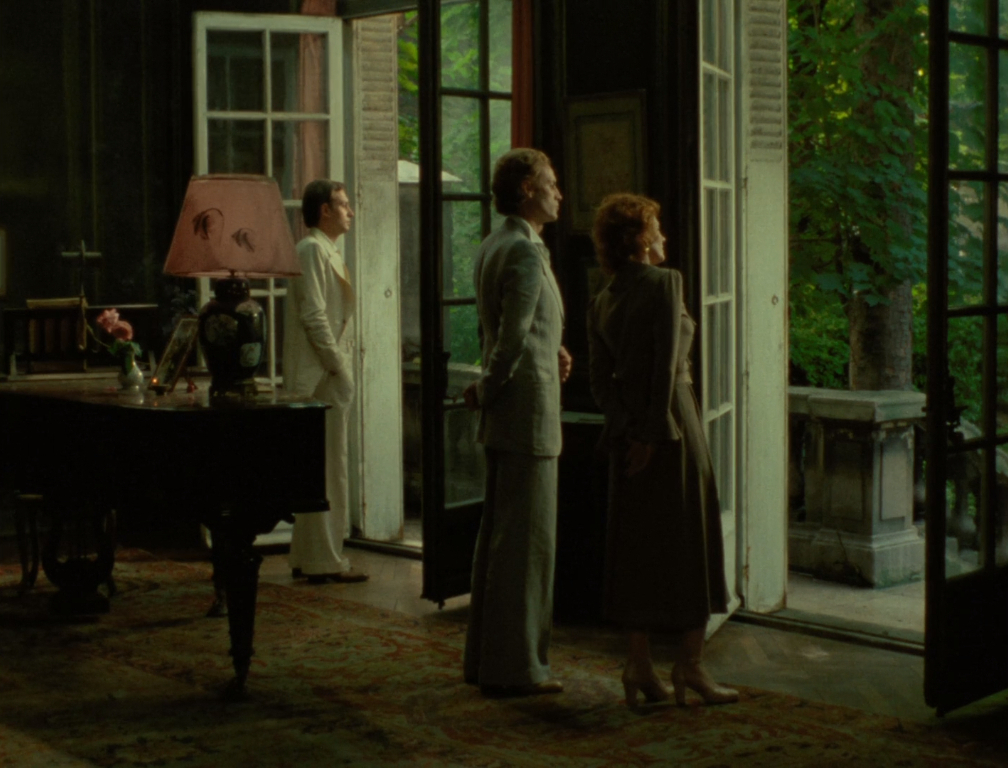
Completing a sort of triangle, there’s also an equivalence between the vice-consul and the beggar woman. Both are tortured outsiders haunting the French Embassy and shouting in the streets. He comes from the west (Neuilly by way of Lahore), she from the east (Laos). When Anne-Marie Stretter and two of her lovers first venture onto the terrace, seemingly lured by the beggar’s voice, the vice-consul comes into view instead – but only after an ambiguous shadow, which could belong to either of them, crosses the foot of the steps. Toward the end another unidentified shadow, likely the vice-consul’s, crosses the park on the delta island.
In a few respects India Song resembles Marguerite Duras’ 1972 feature Nathalie Granger. Both films are told in fragments, even if India Song eventually coalesces into a complete story. Both are set mainly in a house and its gardens, where the residents are opaque, largely mute, unintelligible, a challenge to the viewer. In each film a strange man enters the house, full of trepidation, giving the story its first emotional foothold and allowing the viewer to enter the story at the same time and in the same manner he does – apprehensively, longingly, totally conscious of his position as an outsider. In Nathalie Granger he’s a comically inept washing machine salesman played by Gérard Depardieu; in India Song it’s the vice-consul of Lahore. Both men can be viewed as proxies for the viewer as we approach a film that doesn’t readily invite us inside.
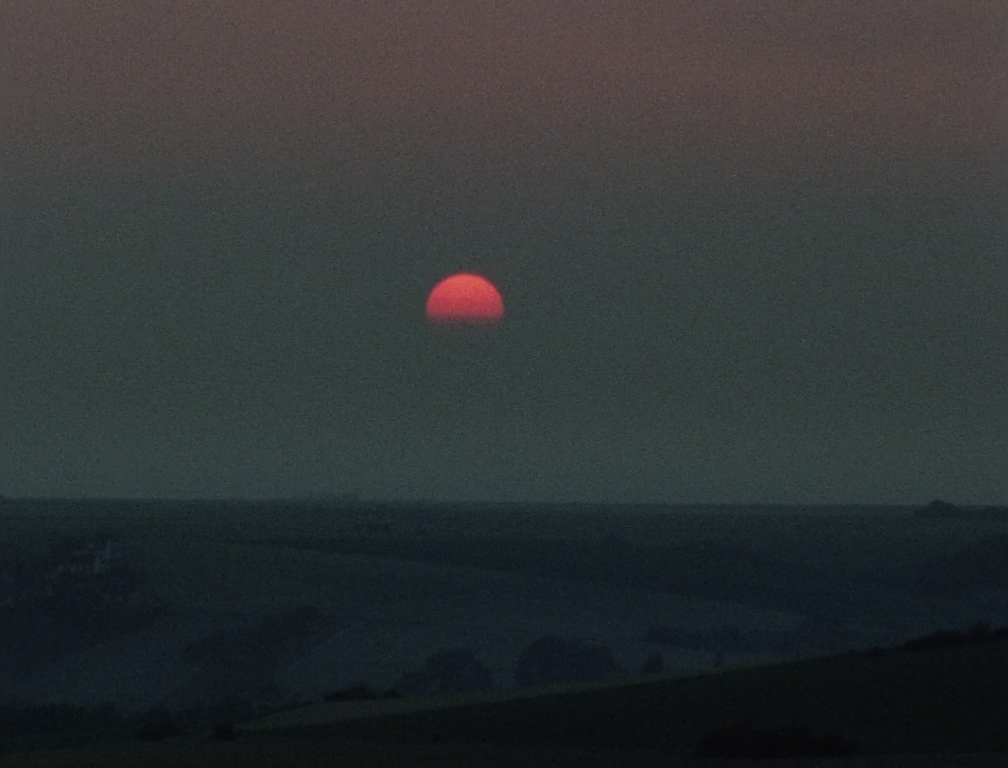
Duras followed India Song with a kind of sequel whose title quotes the voix intemporelle voiced by Duras herself during the gathering at the top of the stairs, the last shot in the embassy. Asked what the vice-consul is bellowing outside, she answers: “Son nom de Venise dans Calcutta désert” – i.e. Madame Stretter’s Venetian maiden name, Ana Maria Guardi. Her Venetian name is thus equivalent to the vice-consul’s agony, and by extension to the man himself insofar as he’s defined by his pain; but it’s also equivalent to her French name, to Madame Stretter herself, and to the generalized fear of that off-screen voice right before Stretter is introduced. Like a sun, her name radiates equivalence in all directions. Isn’t she also equivalent to the fading sun in the opening shot – a dying breed of colonial aristocrat, tired of her life?
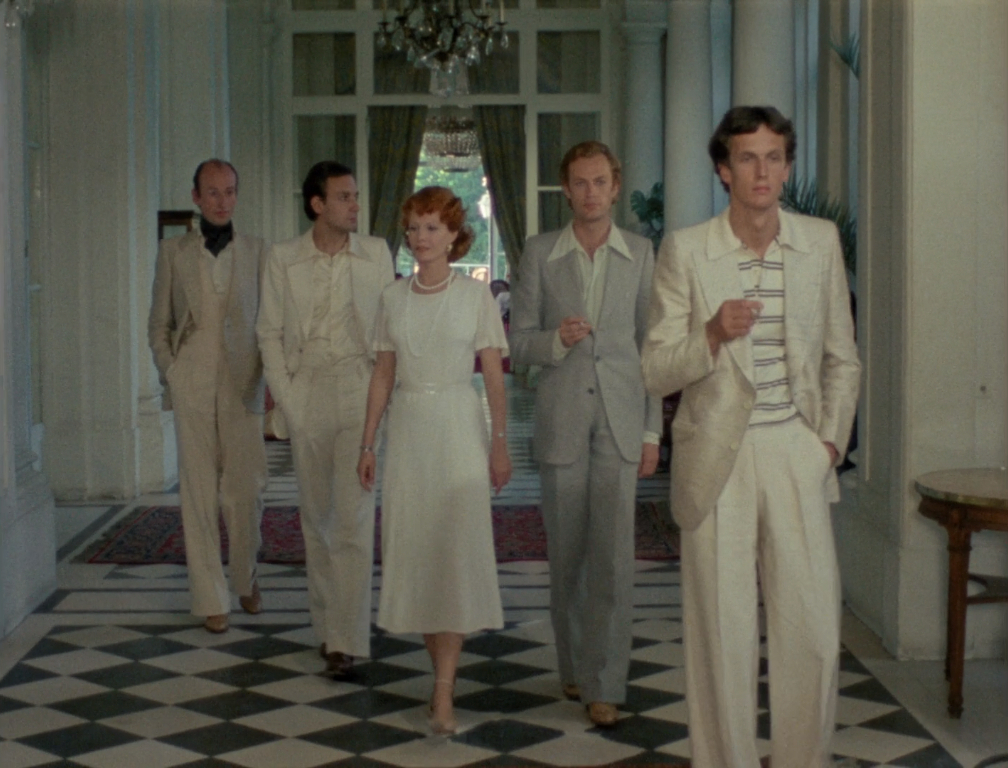
If Anne-Marie Stretter is frightening, it’s because she stands for the spiritual epidemic of our age. Her dissolute life amid the hunger and disease of the Third World makes her, on one level, representative of the greater West. Her death is one of “those European suicides that increase with the hunger that they never suffer” (one of the narrators’ fragmentary lines). Her “leprosy of the heart” contrasts with the real leprosy outside. She suffers from so-called “First World problems”, but the film doesn’t make light of her anguish. Her numbness to life is a symptom of our times, less and less confined by geography, and India Song presents it as a recognizable object of fear. The film does not explain this numbness, but it points the way out.
On top of all the other equivalences, India Song aims for an equivalence between viewer and characters. Movies often do this in cheap ways that numb the viewer, like encouraging identification with a character. India Song doesn’t play that game; if anything the opaque characters shun viewer identification. Duras does this in Nathalie Granger too, but here the separation of voice from image – there is no synchronized dialogue, and most of the voices do not even belong to the image at all – puts us at a further remove. This distancing is a challenge, but it’s also an invitation to look more closely.

Duras takes up Antonioni’s project of teaching us to see, and like Antonioni she understands that extraneous dramatics distract from genuine vision. Both directors are commonly associated with “ennui” because their characters are often numb to life, but this numbness is precisely what they want to challenge in the viewer. When the narrator says she’s afraid of Anne-Marie Stretter, it’s because this numbness, this internalized leprosy, has become the hallmark of modern life. Most people won’t commit suicide like she does, but they eagerly commit the smaller suicide of killing time. The alternative is not to make ourselves busier, but to make our time count – which we do by looking directly at life with renewed wonder. From this point of view, the voix intemporelles, rather than standing as obstacles, become intermediaries between the viewer and the mysterious world onscreen.
The object of watching India Song is not, like in most movies, to coast along passively on the story, treating its characters as extensions of our own nervous systems through which we experience new things. Rather, although they remain forever “other” to us, the challenge is to see them as recognizable human beings. Anne-Marie Stretter, on the verge of suicide and unable to find wonder in life, should inspire a certain fear for her life as well as for ours, but this abstract fear requires a concrete equivalent which is found in the vice-consul. Again, the off-screen voices are there to guide us: “Isn’t there in each of us a chance, just one, of being like him in Lahore?” As much as we might recoil from his behavior, the point is not to judge him but to ask ourselves what will save us from his fate.
CONNECTIONS:
Black Narcissus – European vision of India filmed entirely in Europe
Nathalie Granger – Nameless character who enters the house uninvited and adds narrative weight to the fragmentary story
The Discreet Charm of the Bourgeoisie – Diplomat shooting dogs from a balcony
Baxter, Vera Baxter – Nameless character who enters the house uninvited and adds narrative weight to the fragmentary story; contrast and equivalence between a modern suicidal housewife and another woman from far away or long ago
In the Mood for Love – Languorous period piece with recurring musical themes; significant use of mirrors & shadows
Enemy – Ambiguous hinge between two equivalent characters: shadow on steps between Laotian beggar and vice-consul, spider-head between Anthony and Adam